Mississippi Order of Continuance
About this form
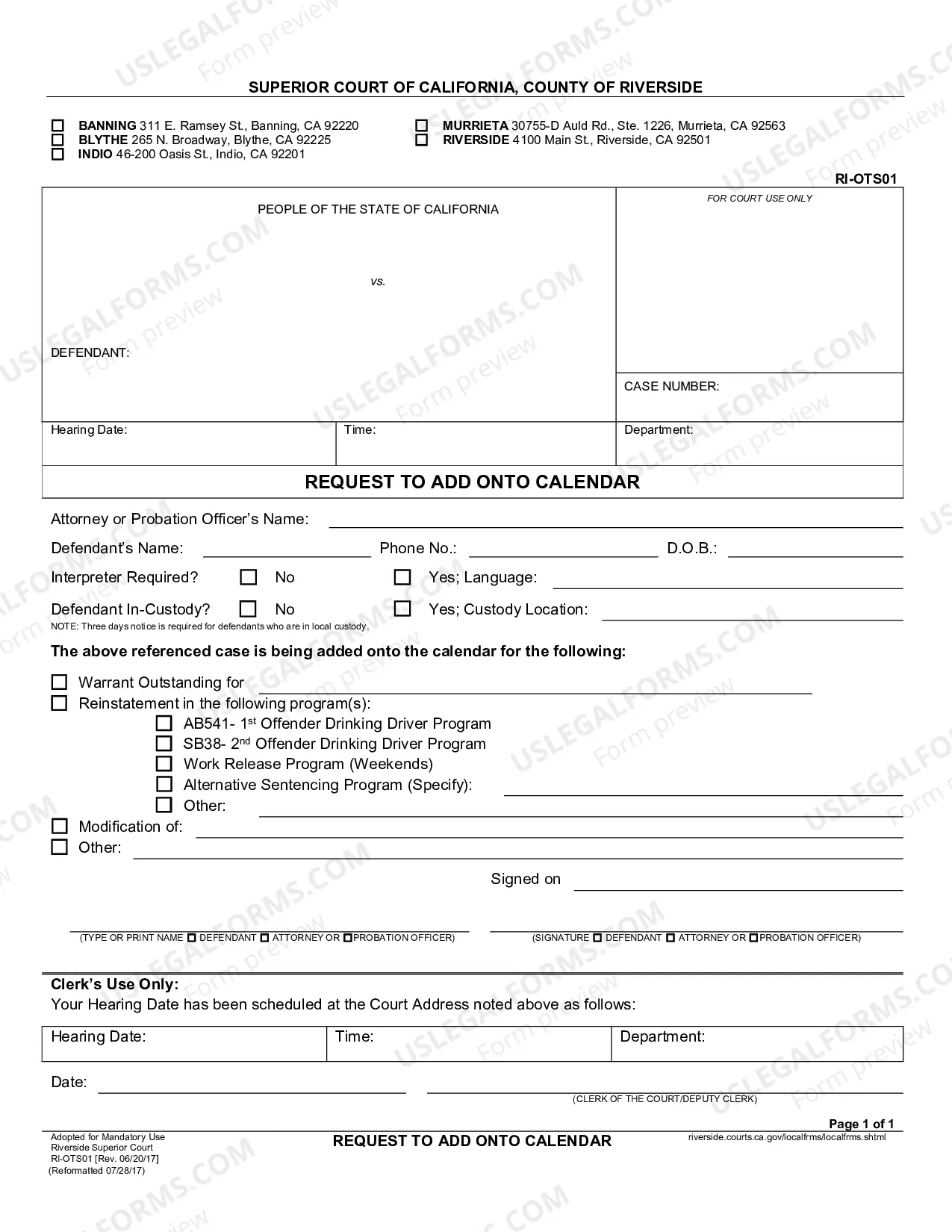
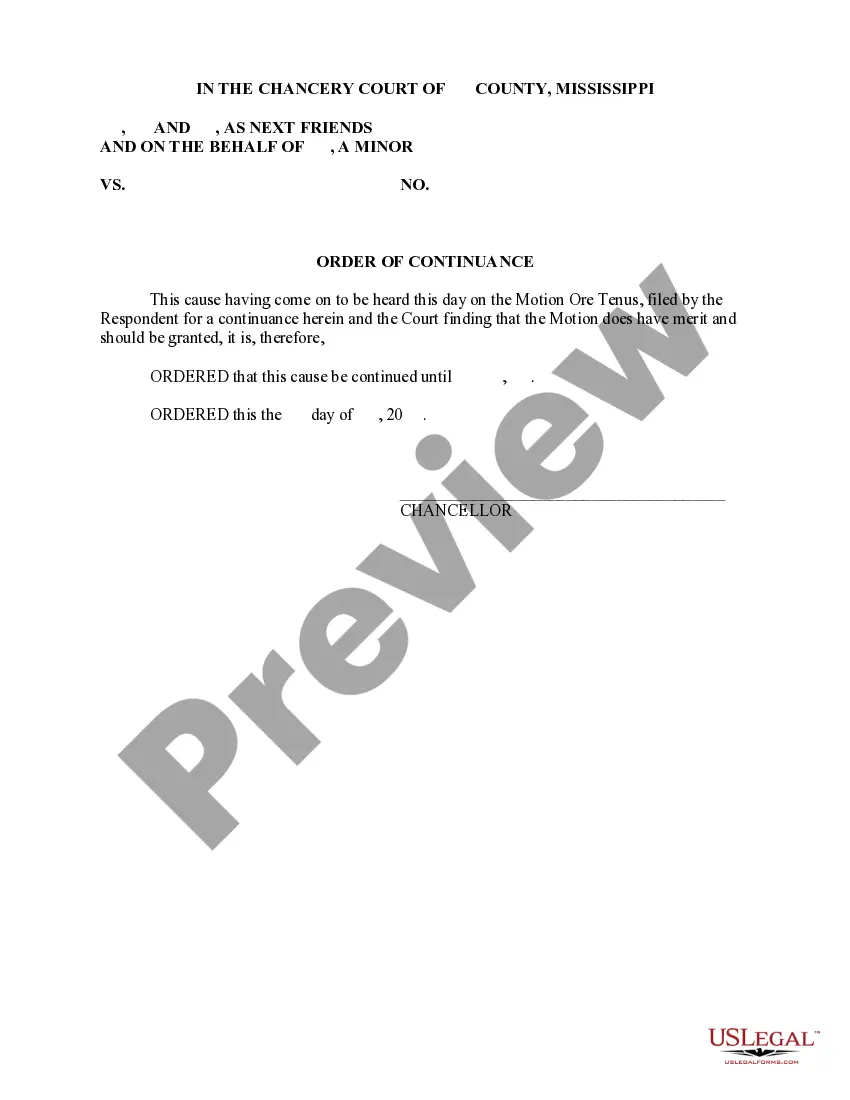
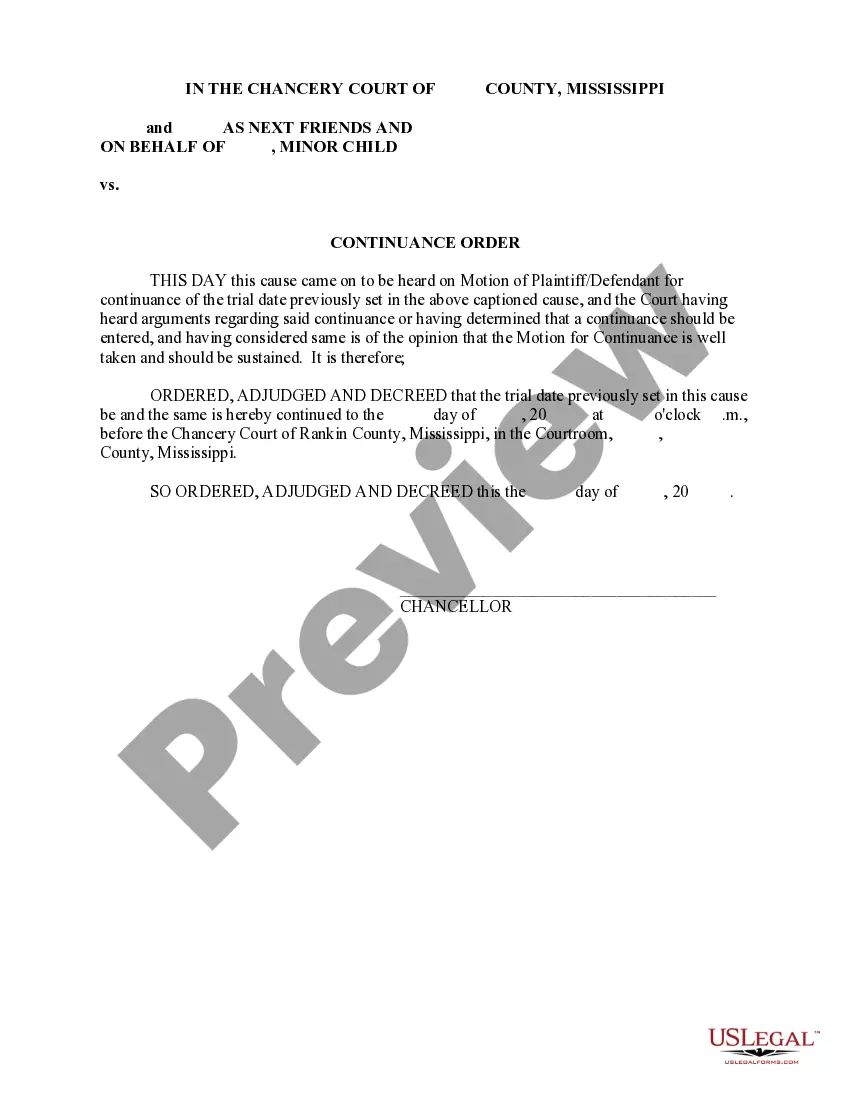
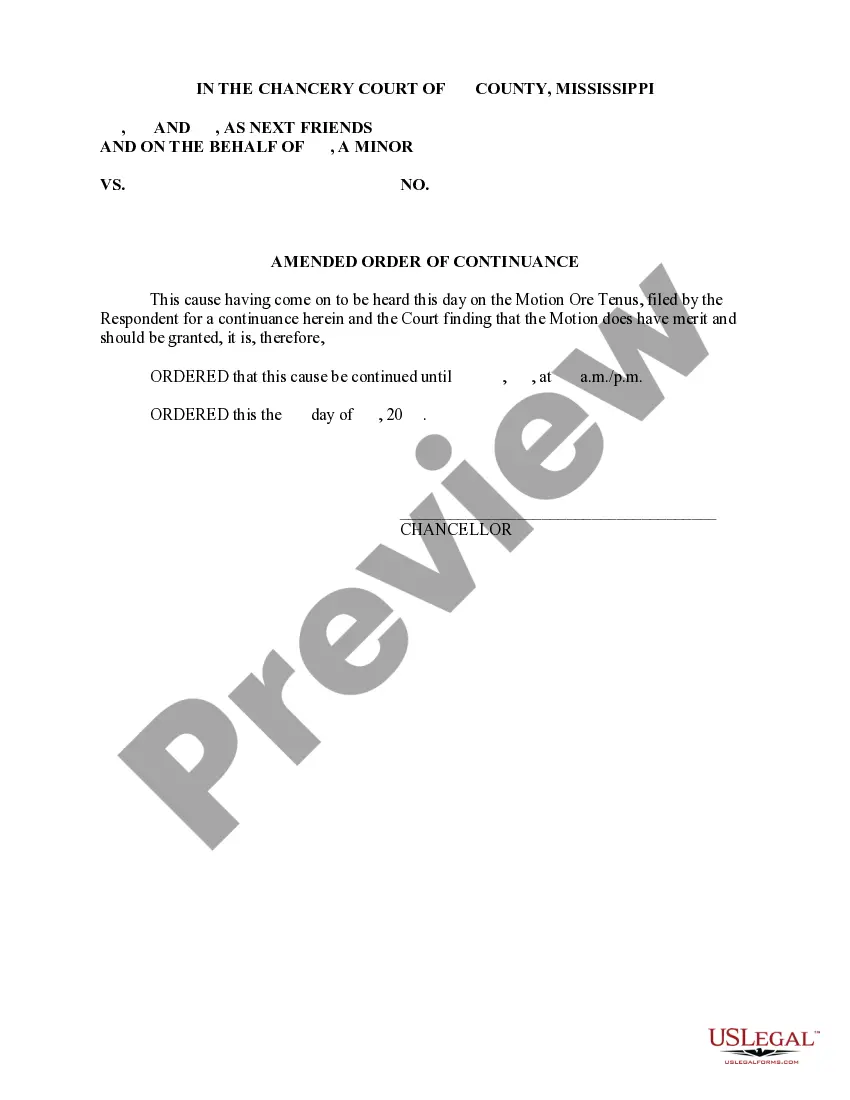
The Order of Continuance is a legal document issued by a court that grants a postponement for a scheduled hearing or trial. It is an official command signed by a judge, allowing the involved parties additional time to prepare their case. Unlike other court orders, this specific order is focused on delaying court proceedings.
Main sections of this form
- Case title identifying the parties involved.
- Order statement including the judge's decision to grant the continuance.
- New date for the hearing or trial.
- Signature of the judge to validate the order.
- Date of the issuance of the order.
When to use this form
This form should be used when a party in a legal case files a motion requesting to postpone a scheduled court date. Common situations include the need for more time to gather evidence, prepare legal arguments, or when one party cannot attend due to unforeseen circumstances. It is essential to ensure the court acknowledges and formally permits the delay.
Who should use this form
- Individuals or entities involved in a legal proceeding who require a postponement.
- Representatives filing on behalf of a minor or incapacitated person.
- Attorneys or legal representatives managing the case.
How to complete this form
- Identify the parties involved and enter their names in the case title.
- Include the case number assigned by the court.
- Specify the new date for the scheduled court hearing or trial.
- Ensure the judge signs the document to validate the continuance.
- Enter the date when the order is issued to ensure accurate records.
Does this form need to be notarized?
This form does not typically require notarization to be legally valid. However, some jurisdictions or document types may still require it. US Legal Forms provides secure online notarization powered by Notarize, available 24/7 for added convenience.
Get your form ready online
Our built-in tools help you complete, sign, share, and store your documents in one place.
Make edits, fill in missing information, and update formatting in US Legal Forms—just like you would in MS Word.
Download a copy, print it, send it by email, or mail it via USPS—whatever works best for your next step.
Sign and collect signatures with our SignNow integration. Send to multiple recipients, set reminders, and more. Go Premium to unlock E-Sign.
If this form requires notarization, complete it online through a secure video call—no need to meet a notary in person or wait for an appointment.
We protect your documents and personal data by following strict security and privacy standards.

Make edits, fill in missing information, and update formatting in US Legal Forms—just like you would in MS Word.

Download a copy, print it, send it by email, or mail it via USPS—whatever works best for your next step.

Sign and collect signatures with our SignNow integration. Send to multiple recipients, set reminders, and more. Go Premium to unlock E-Sign.

If this form requires notarization, complete it online through a secure video call—no need to meet a notary in person or wait for an appointment.

We protect your documents and personal data by following strict security and privacy standards.
Common mistakes to avoid
- Failing to file the motion for continuance before the original court date.
- Not including a valid reason for the request to postpone.
- Leaving out the new proposed date for the hearing.
- Neglecting to have the judge sign the document before submitting it to the court.
Why use this form online
- Immediate access to a professionally drafted template tailored for legal use.
- Easy to download and customize based on individual case needs.
- Time-saving by avoiding lengthy in-person visits to legal offices.
Looking for another form?




Form popularity
FAQ
A continuance can be asked for as many times as someone might wish. Whether the judge grants is going to be based on the type of case, the rationale for the request, and the particular judge's general stance on continuances.
Continuances Based on Inadequate Time. Perhaps the most common reason for a continuance is when one side did not have enough time to investigate the case and analyze the evidence. Continuances Based on Changing the Indictment or Attorney. Continuances Based on Surprises.
Take your completed Form SC-150 or letter to the clerk's office. Ask the clerk to attach it to your file. Or go to your trial and ask the judge for a postponement (or continuance). In your Form SC-150 or letter, give the judge a good reason why you are filing your request late.
A continuance is a grant of additional preparation time before or during a trial. Either the prosecution or the defense can request a continuance, and sometimes even the court can order a continuance of its own accord.
The rule of reason applies to postponing a court date. If the justification is reasonable, related to trial preparation, your health or that of a family member, or a matter of some importance scheduled before the court date was set, the judge will likely have no problem with a request for postponement.
A valid emergency can serve as an excuse for missing a court date. Some examples of legitimate emergencies include: An emergency room visit for a sudden, debilitating medical condition. A sick child.
A continuance is a grant of additional preparation time before or during a trial. Either the prosecution or the defense can request a continuance, and sometimes even the court can order a continuance of its own accord.
A continuance in a criminal trial is a formal delay of the trial that can be requested by either side, before or during the trial.Requesting a continuance and receiving one are two very different things; it is important to have a good reason behind the request because it is a good reason the judge will expect.