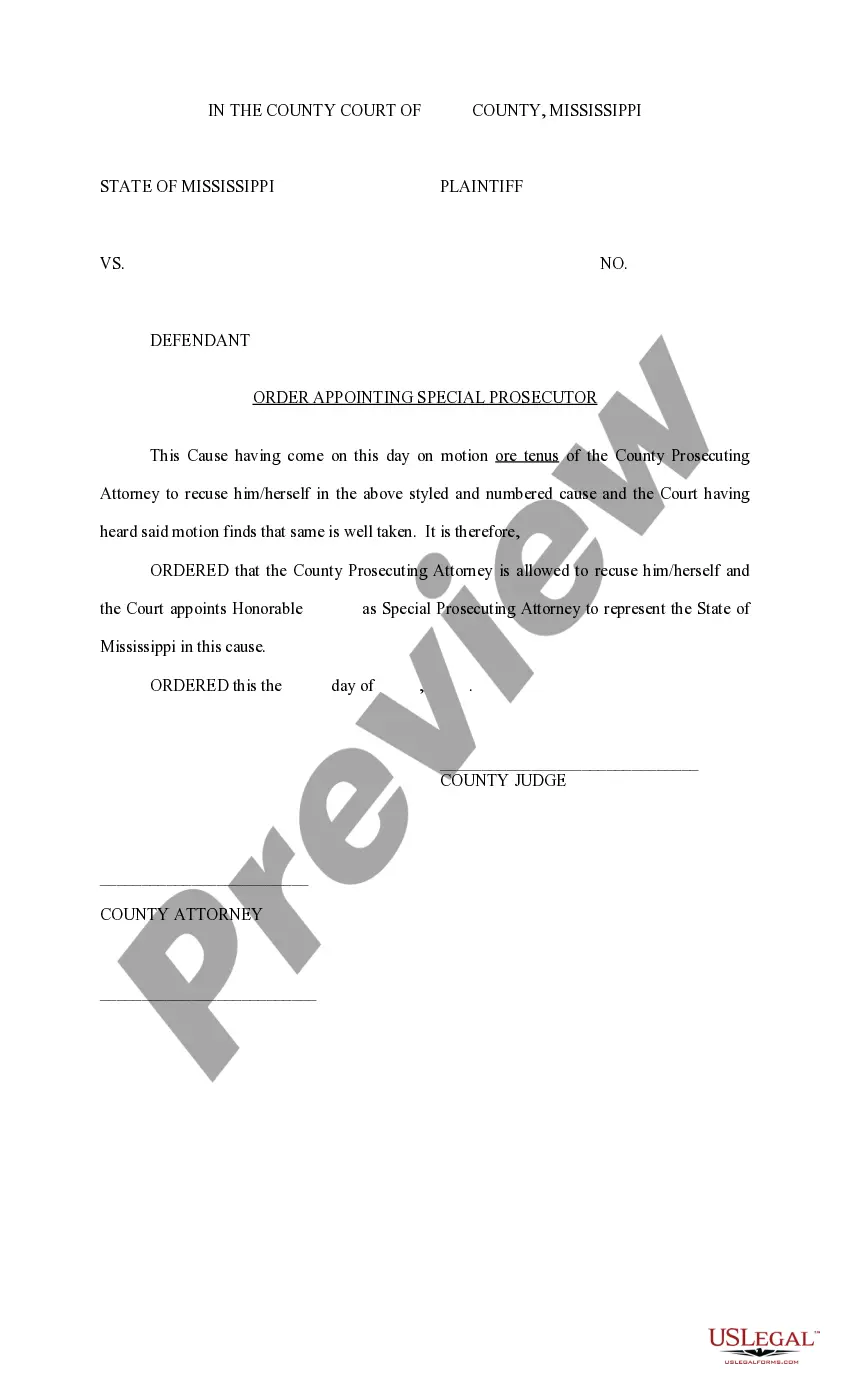
Mississippi Order Appointing Special Prosecutor
What is this form?
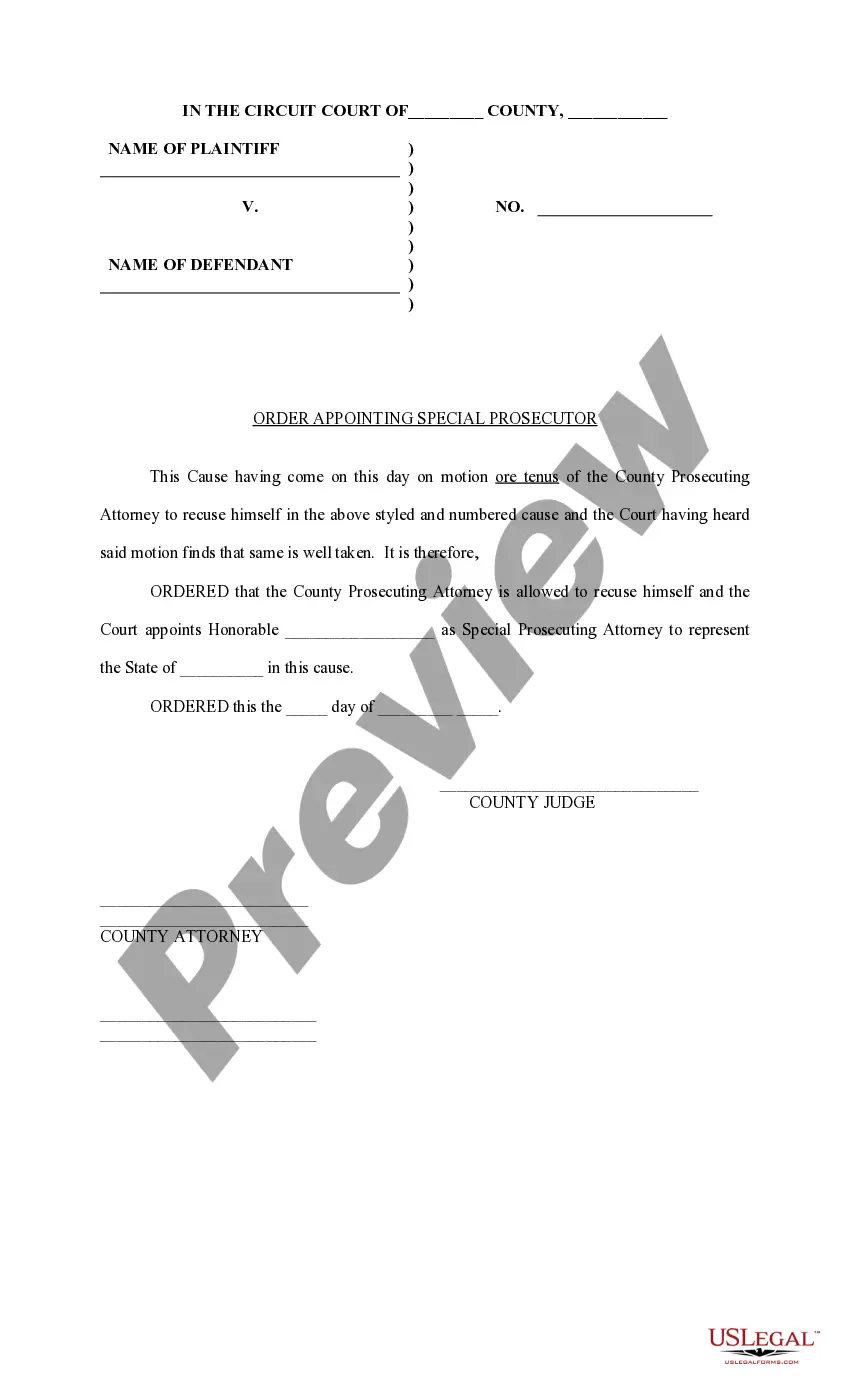
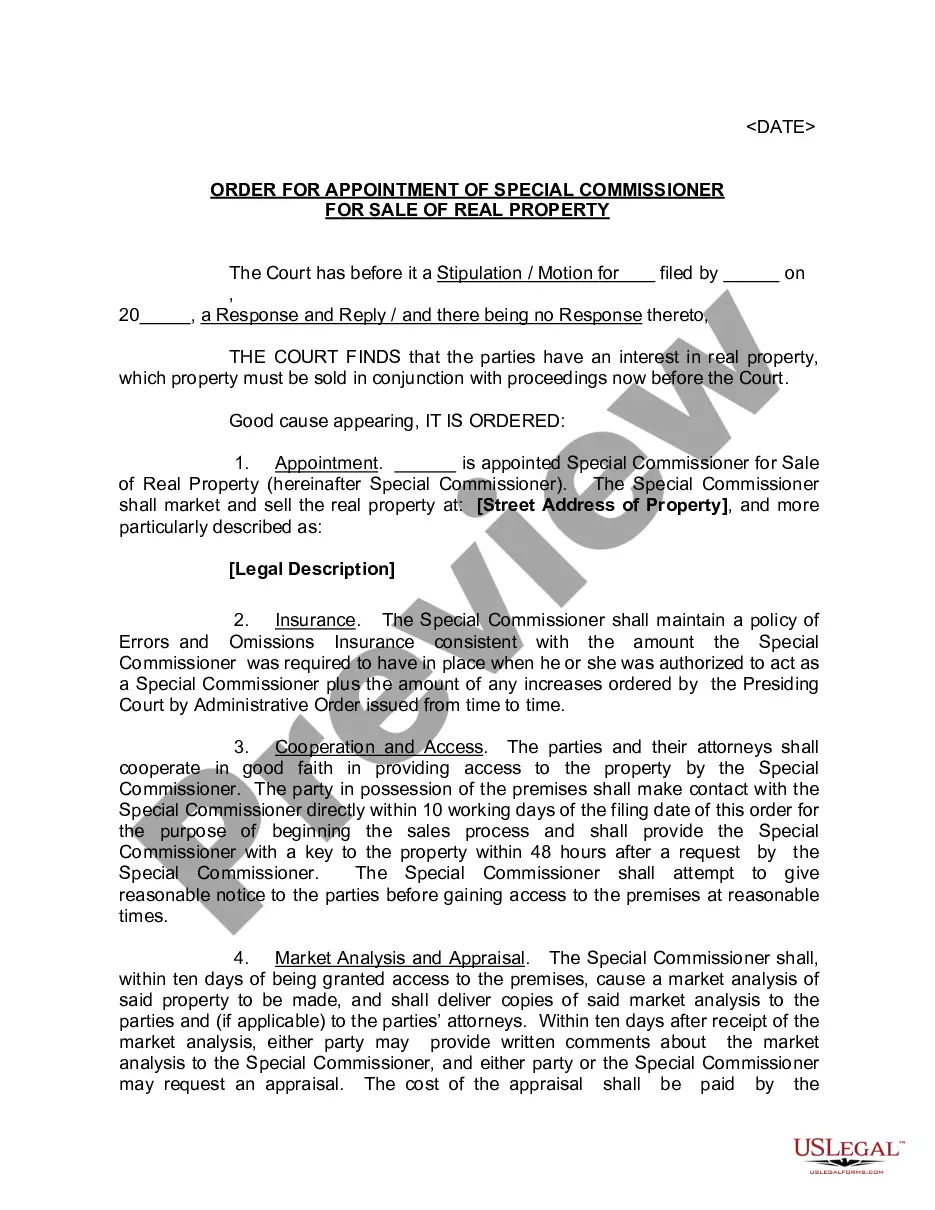
The Order Appointing Special Prosecutor is an official court document that designates a special prosecutor to handle a particular case or matter. This form differs from other legal documents as it specifically addresses the need for appointing a prosecutor distinct from the regular prosecutorial office, often in situations involving a conflict of interest. It serves as a crucial tool in ensuring fair representation and the impartial administration of justice.
Form components explained
- Title of the order specifying the appointment of the special prosecutor.
- Details of the case for which the special prosecutor is being appointed.
- The name and qualifications of the appointed special prosecutor.
- Authority under which the order is issued, typically including relevant statutes.
- Signature of the presiding judge and date of the order.
Common use cases
This form is necessary when a conflict of interest arises for the regular prosecuting attorney, necessitating an independent prosecutor to ensure a fair trial. Scenarios may include high-profile cases, cases involving misconduct, or any situation where public trust in the prosecution may be compromised.
Who this form is for
- Judges seeking to appoint a special prosecutor in cases of conflict.
- Legal representatives tasked with drafting the order on behalf of the court.
- Government officials responsible for oversight in prosecutorial matters.
How to prepare this document
- Identify the specific case requiring the appointment of a special prosecutor.
- Fill in the name and qualifications of the individual being appointed.
- Reference the pertinent legal authority that allows for the appointment.
- Ensure the order is signed and dated by the presiding judge.
- Adapt the language as necessary to fit the facts surrounding the case.
Does this form need to be notarized?
This form does not typically require notarization unless specified by local law. However, it is essential to check jurisdiction-specific requirements to ensure compliance.
Get your form ready online
Our built-in tools help you complete, sign, share, and store your documents in one place.
Make edits, fill in missing information, and update formatting in US Legal Forms—just like you would in MS Word.
Download a copy, print it, send it by email, or mail it via USPS—whatever works best for your next step.
Sign and collect signatures with our SignNow integration. Send to multiple recipients, set reminders, and more. Go Premium to unlock E-Sign.
If this form requires notarization, complete it online through a secure video call—no need to meet a notary in person or wait for an appointment.
We protect your documents and personal data by following strict security and privacy standards.

Make edits, fill in missing information, and update formatting in US Legal Forms—just like you would in MS Word.

Download a copy, print it, send it by email, or mail it via USPS—whatever works best for your next step.

Sign and collect signatures with our SignNow integration. Send to multiple recipients, set reminders, and more. Go Premium to unlock E-Sign.

If this form requires notarization, complete it online through a secure video call—no need to meet a notary in person or wait for an appointment.

We protect your documents and personal data by following strict security and privacy standards.
Avoid these common issues
- Failing to include the case details accurately.
- Using generic language that does not reflect the specific circumstances of the case.
- Not obtaining the judge's signature prior to submitting the order.
Why use this form online
- Convenience of immediate access and download from anywhere.
- Editability to tailor the document specifically to the case at hand.
- Reliability of having a form developed and reviewed by licensed attorneys.
What to keep in mind
- The Order Appointing Special Prosecutor formalizes the appointment of an individual to prosecute a case.
- It is crucial for situations involving conflicts of interest or specific prosecutorial needs.
- Properly completing this form helps ensure that legal proceedings are conducted fairly and effectively.
Looking for another form?


Form popularity
FAQ
A lawyer who represents the state in local criminal cases is usually referred to as the "District Attorney," although, depending on your state, these attorneys can go by other titles such as "Prosecuting Attorney" or "County Attorney." The Attorney General of a state typically represents the state in civil cases, but
A lawyer is simply one who is trained in the law.In comparison to lawyers who can be hired by anyone (including the government), the District attorney has only one client the government and responsible for one job to prosecute criminal defendants on behalf of the government.
IPAC: Clay County Prosecutor - Emily Bookwalter Clarke.
District attorneys have the power to choose which charges are filed against an individual accused of a crime. When the police arrest someone, the district attorney's office has the power to prosecute those cases, divert the accused to a program or drug treatment, or dismiss the case altogether.
Evans is still the chief prosecutor in seven central Mississippi counties. He was reelected in November 2019 to another four-year term, running unopposed.According to the Mississippi Bar Association, Evans has received no public sanction and is still a lawyer in good standing.
The prosecutor, Fifth Circuit District Attorney Doug Evans, tried Flowers multiple times as he failed to convince the juries of Flowers' guilt and failed to make convictions stick.
The state of Mississippi will pay Curtis Flowers $500,000 for his wrongful imprisonment. Mississippi Circuit Judge George Mitchell ordered the compensation on March 2, 2021. Under the judgment, the state will pay Flowers $50,000 a year for the next 10 years.
Angel Myers McIlrath was appointed by Governor Phil Bryant to serve as District Attorney for the 19thCircuit Court District of Mississippi, where she has served the citizens of Jackson, George, and Greene counties as an Assistant District Attorney for over 12 years.
The Crown Prosecution Service (CPS, or in Welsh: Gwasanaeth Erlyn y Goron), is the principal public agency for conducting criminal prosecutions in England and Wales. It is headed by the Director of Public Prosecutions (DPP).
Flowers had been accused of the July 1996 shooting deaths of Tardy Furniture owner Bertha Tardy as well as employees Carmen Rigby, Robert Golden and Derrick Stewart. Flowers, who had briefly worked at the store, had no prior criminal record and has maintained his innocence.