Mississippi Mineral Right and Royalty Transfer
Understanding this form
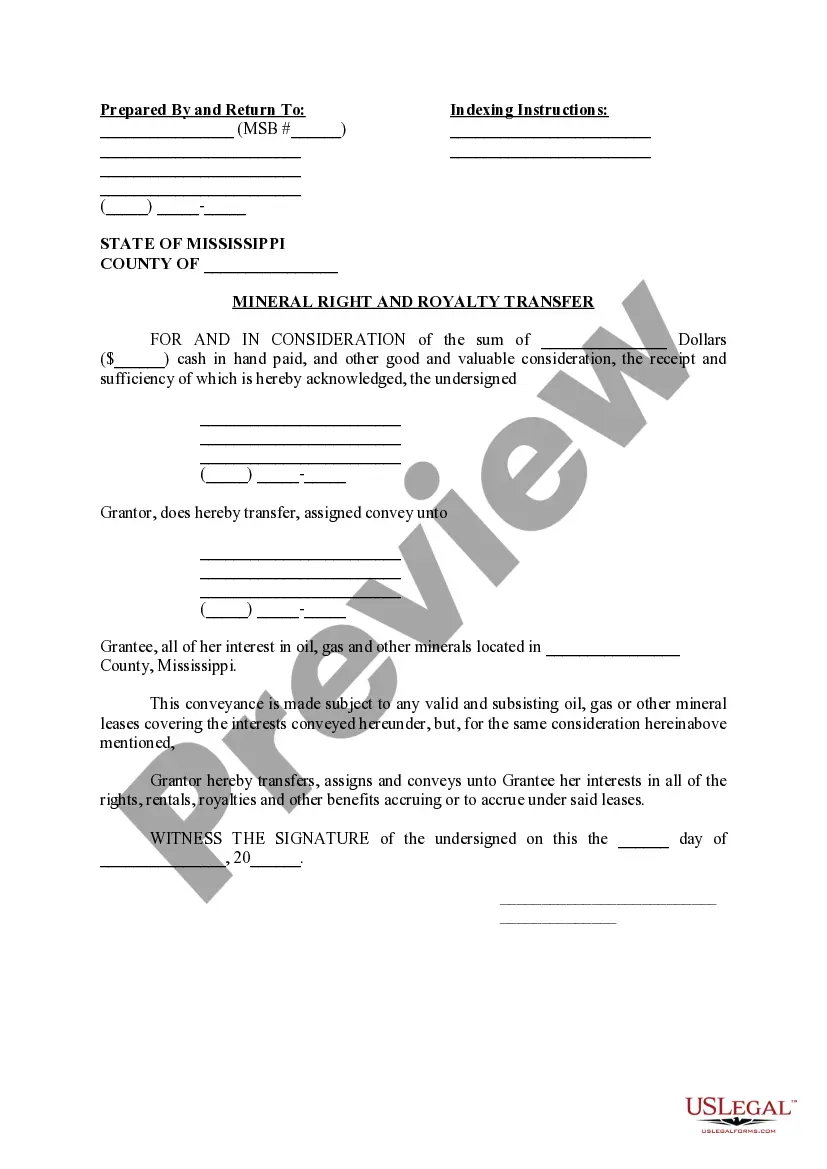
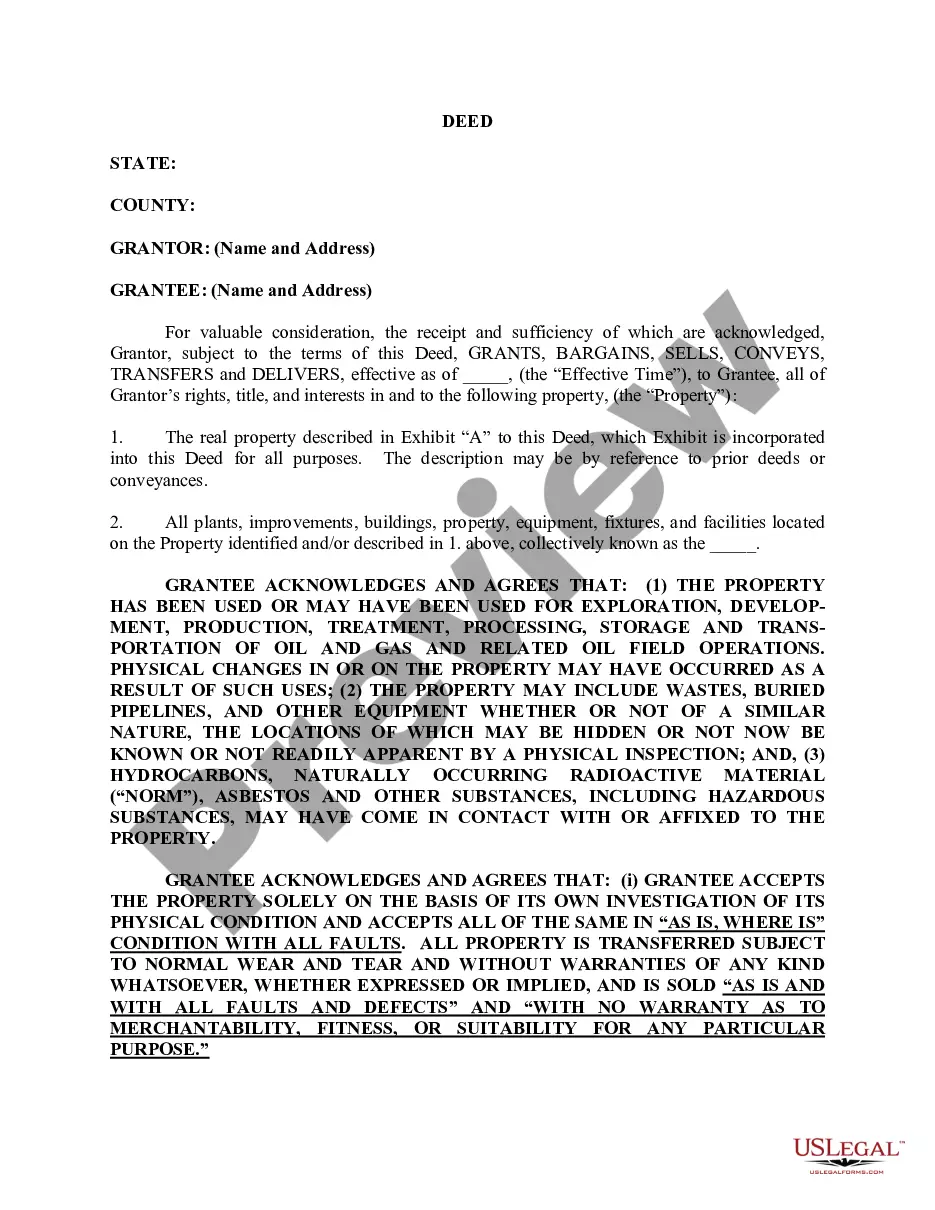
The Mineral Right and Royalty Transfer form is a legal document used to transfer all rights and interests in oil, gas, or other minerals from one party (the grantor) to another (the grantee) in the state of Mississippi. This form is specifically designed for the transfer of mineral rights, distinguishing it from other real estate forms that may pertain to surface rights or other types of property. It includes essential clauses to ensure that the transfer is recorded correctly and complies with state regulations.
Main sections of this form
- Prepared by and return to section for legal documentation purposes.
- Grantor and grantee information, including names and contact details.
- The consideration amount to acknowledge payment for the transfer.
- Details about the mineral interests being transferred within a specific county.
- Signature lines for the grantor and notary public to validate the transaction.

When to use this form
You should use the Mineral Right and Royalty Transfer form when you intend to sell or transfer your rights to oil, gas, or other minerals located in Mississippi. This often arises in situations where property owners wish to monetize their mineral interests, such as in cases of resource exploration or in facilitating royalty payments from mineral extraction activities.
Who this form is for
- Property owners who wish to sell their mineral rights.
- Landowners receiving offers for mineral rights from energy companies.
- Estate administrators handling the transfer of mineral rights from a deceased estate.
- Investors or purchasers planning to acquire mineral rights.
Instructions for completing this form
- Identify the parties involved: Clearly list the names and addresses of the grantor and grantee.
- Specify the property: Indicate the county in Mississippi where the mineral rights are located.
- Enter the consideration amount: Fill in the total dollar amount for the rights being transferred.
- Sign the form: Have the grantor sign and date the document in the presence of a notary public.
- Complete the notary section: Ensure the notary public completes their verification and provides their signature and stamp.
Does this document require notarization?
Yes, this form must be notarized to be legally valid. The presence of a notary public verifies the identity of the grantor and confirms that they willingly signed the document. US Legal Forms offers integrated online notarization, available 24/7 through secure video calls, making the process fast and efficient.
Get your form ready online
Our built-in tools help you complete, sign, share, and store your documents in one place.
Make edits, fill in missing information, and update formatting in US Legal Forms—just like you would in MS Word.
Download a copy, print it, send it by email, or mail it via USPS—whatever works best for your next step.
Sign and collect signatures with our SignNow integration. Send to multiple recipients, set reminders, and more. Go Premium to unlock E-Sign.
If this form requires notarization, complete it online through a secure video call—no need to meet a notary in person or wait for an appointment.
We protect your documents and personal data by following strict security and privacy standards.

Make edits, fill in missing information, and update formatting in US Legal Forms—just like you would in MS Word.

Download a copy, print it, send it by email, or mail it via USPS—whatever works best for your next step.

Sign and collect signatures with our SignNow integration. Send to multiple recipients, set reminders, and more. Go Premium to unlock E-Sign.

If this form requires notarization, complete it online through a secure video call—no need to meet a notary in person or wait for an appointment.

We protect your documents and personal data by following strict security and privacy standards.
Avoid these common issues
- Failing to accurately identify the property by not specifying the correct county.
- Missing signatures from either the grantor or the notary.
- Omitting the consideration amount or miswriting it.
- Not completing the form in compliance with Mississippi specific requirements.
Why complete this form online
- Convenience of downloading and completing the form at your own pace.
- Editability allows for corrections before finalizing the document.
- Access to attorney-drafted content ensures legal compliance and clarity.
Looking for another form?


Form popularity
FAQ
The owner of mineral rights can sell, lease, gift or bequest them to others individually or entirely. For example, it is possible to sell or lease rights to all mineral commodities beneath a property and retain rights to the surface.
You can retain your mineral rights simply by putting an exception in your sales contract, provided that the buyer agrees to it, of course. If you sell your house with no such legal clarification, then those mineral rights automatically transfer to the buyer.
Mineral interests and royalty interests both involve ownership of the minerals under the ground. The main difference between the two is that the owner of a mineral interest has the right to execute leases and collect bonus payments and the owner of royalty interests does not execute leases or collect bonus payments.
Like land, mineral rights are conveyed through a deed transferring ownership to the buyer. While the property deed will reference the mineral rights transfer at the time of the separation of land and mineral rights, subsequent sales of the land will not.
Nationally, mineral rights owners can expect anywhere from $100 to $5,000 per acre for their mineral rights lease. The most valuable mineral rights leases are on producing parcels of land that are still expected to hold many more precious minerals.
Call the county where the minerals are located and ask how to transfer mineral ownership after death. They will probably advise you to submit a copy of the death certificate, probate documents (if any), and a copy of the will (or affidavit of heirship if there is no will).
Mineral rights are automatically included as a part of the land in a property conveyance, unless and until the ownership gets separated at some point by an owner/seller.Conveying (selling or otherwise transferring) the land but retaining the mineral rights.
After a divorce, mineral rights can be transferred by submitting the divorce decree and conveyances to the county (where the minerals are located) for recording. They usually go to the same agency that records titles and property deeds. The county will return the recorded original documents to the new owner.