Mississippi Preliminary Injunction
About this form
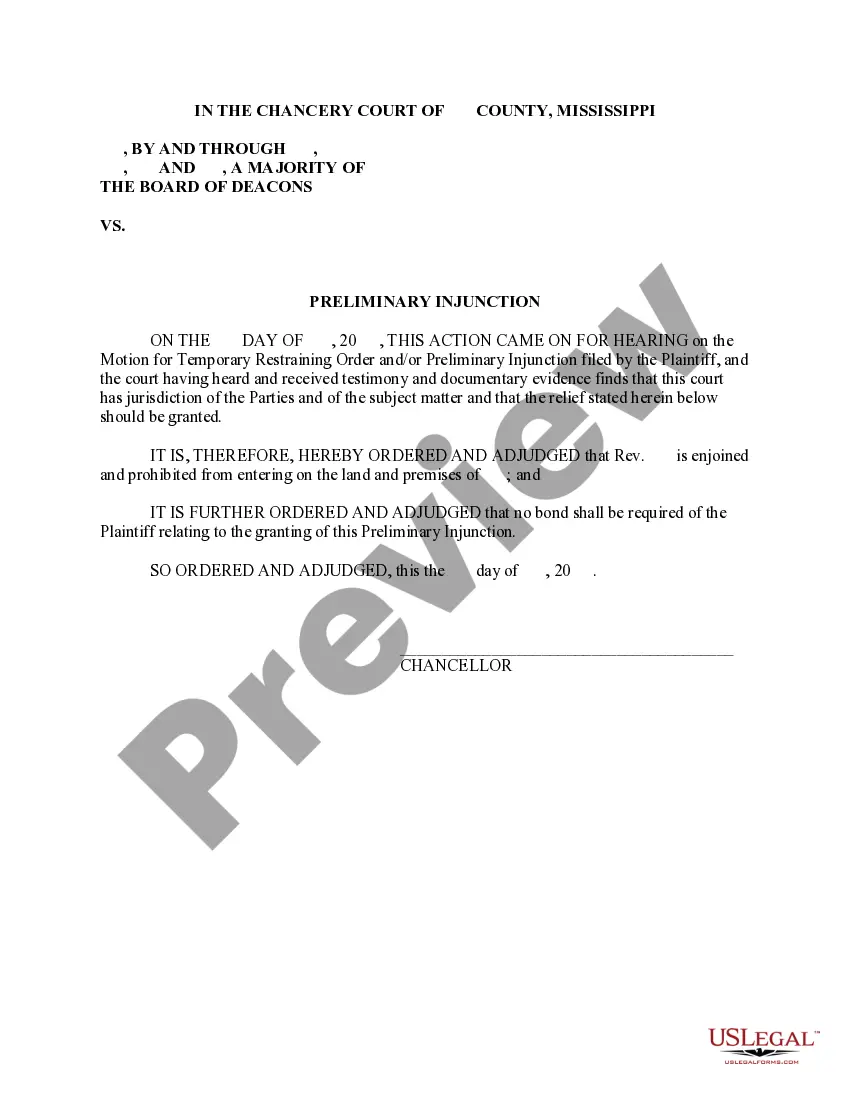
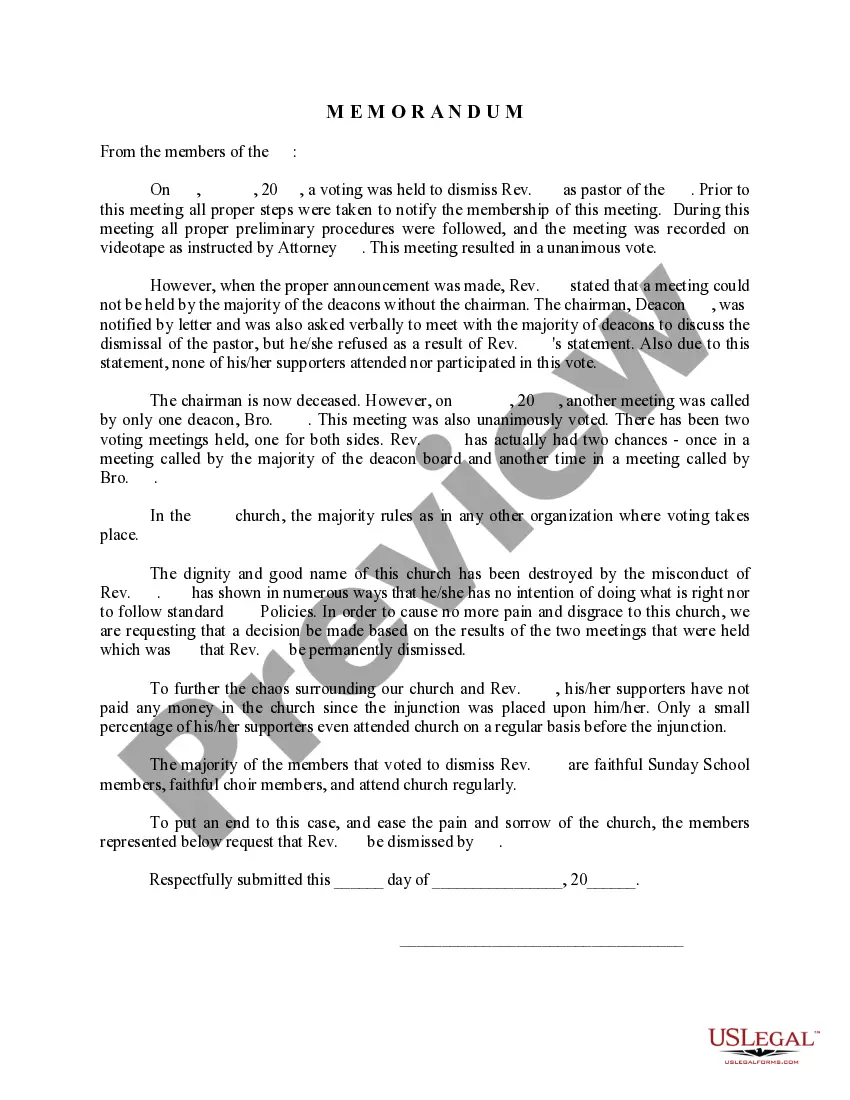
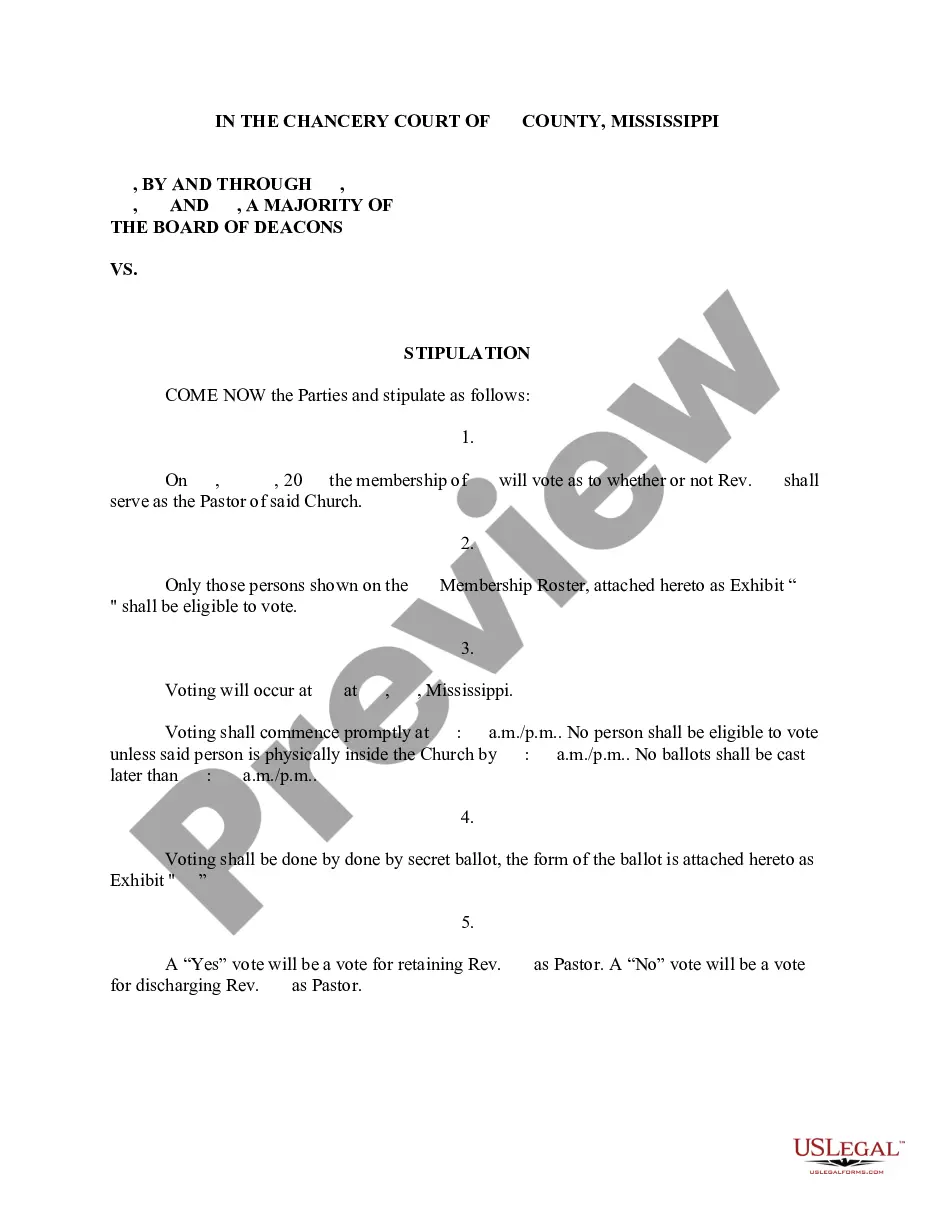
A Preliminary Injunction is a legal document used to request a court order that temporarily restricts an individual or entity from taking certain actions, in this case, preventing a former Pastor from entering church property. This form differs from a Temporary Restraining Order as it typically involves a hearing where evidence is presented, and a longer-lasting injunction is sought pending the outcome of a fuller court process. This form is relevant in situations where immediate action is necessary to prevent harm or disruption while a legal dispute is resolved.
Form components explained
- Identification of the parties involved, including the church Board of Deacons and the Pastor.
- A declaration of jurisdiction by the court handling the case.
- Order prohibiting the Pastor from entering the church property.
- Information regarding the absence of a bond requirement for the Plaintiff.
- Signature line for the Chancellor or presiding judge.
Situations where this form applies
You should use a Preliminary Injunction when you need to quickly obtain a court order to prevent an individual from engaging in actions that could cause harm or further complications while a case is pending. This form may be necessary in cases involving disputes within organizations, such as churches, where the presence of a former member may disrupt operations or pose risks to members.
Who this form is for
This form is intended for:
- Church Boards of Deacons or similar governing bodies.
- Legal representatives of organizations seeking to protect their property and members.
- Individuals needing to enforce a court-ordered restriction against another party.
How to complete this form
- Identify the Plaintiffs and Defendants, clearly naming the church Board of Deacons and the Pastor.
- Fill in the date of the hearing and any relevant details about the court.
- Specify the actions that the Defendant is being prohibited from taking.
- Indicate whether a bond is required and include the court's decision on this point.
- Sign and date the form in the designated space provided for the Chancellor.
Does this document require notarization?
This form does not typically require notarization to be legally valid. However, some jurisdictions or document types may still require it. US Legal Forms provides secure online notarization powered by Notarize, available 24/7 for added convenience.
Get your form ready online
Our built-in tools help you complete, sign, share, and store your documents in one place.
Make edits, fill in missing information, and update formatting in US Legal Forms—just like you would in MS Word.
Download a copy, print it, send it by email, or mail it via USPS—whatever works best for your next step.
Sign and collect signatures with our SignNow integration. Send to multiple recipients, set reminders, and more. Go Premium to unlock E-Sign.
If this form requires notarization, complete it online through a secure video call—no need to meet a notary in person or wait for an appointment.
We protect your documents and personal data by following strict security and privacy standards.

Make edits, fill in missing information, and update formatting in US Legal Forms—just like you would in MS Word.

Download a copy, print it, send it by email, or mail it via USPS—whatever works best for your next step.

Sign and collect signatures with our SignNow integration. Send to multiple recipients, set reminders, and more. Go Premium to unlock E-Sign.

If this form requires notarization, complete it online through a secure video call—no need to meet a notary in person or wait for an appointment.

We protect your documents and personal data by following strict security and privacy standards.
Typical mistakes to avoid
- Failing to accurately identify parties involved, which can lead to complications.
- Not including necessary court details, such as dates or case numbers.
- Omitting the justification for the injunction, making it harder for the court to grant it.
Advantages of online completion
- Convenience of immediate access to legal forms without the need for in-person visits.
- Editability allows users to tailor the document to their specific situation easily.
- Reliability of professionally drafted forms that comply with legal standards.
Looking for another form?




Form popularity
FAQ
"When a court employs the extraordinary remedy of injunction, it directs the conduct of a party, and does so with the backing of its full coercive powers." A party that fails to comply with an injunction faces criminal or civil penalties, including possible monetary sanctions and even imprisonment.
Temporary and Permanent Injunctions ( Sections 36 & 37) Perpetual Injunctions ( Section 38) Mandatory Injunctions ( section 39) Damages in lieu of or in addition to Injection( Section 40) Injunction to perform a negative covenant( section 42)
Preliminary Injunctions: A preliminary injunction is an order prohibiting an action, to preserve the status quo while the underlying court case is decided.
A preliminary injunction is an injunction that may be granted before or during trial, with the goal of preserving the status quo before final judgment.
Temporary injunction. n. a court order prohibiting an action by a party to a lawsuit until there has been a trial or other court action.
Definition. A preliminary injunction is an injunction that may be granted before or during trial, with the goal of preserving the status quo before final judgment.
A temporary restraining order (TRO) is a legal document issued by a judge before trial that forces or prevents an action for a specified time frame. During court cases that involve trademark infringement or the use of a trade secret, a TRO can halt patent, copyright, or trademark infringement in the short term.
Temporary Restraining Orders: A temporary restraining order (TRO) is an order by the court immediately prohibiting a threatened action.Preliminary Injunctions: A preliminary injunction is an order prohibiting an action, to preserve the status quo while the underlying court case is decided.
(a) A preliminary injunction is an order granted at any stage of an action or proceeding prior to the judgment or final order, requiring a party to an administrative case or any third person to refrain from a particular act or acts.