Mississippi Agreed Temporary Restraining Order
What this document covers
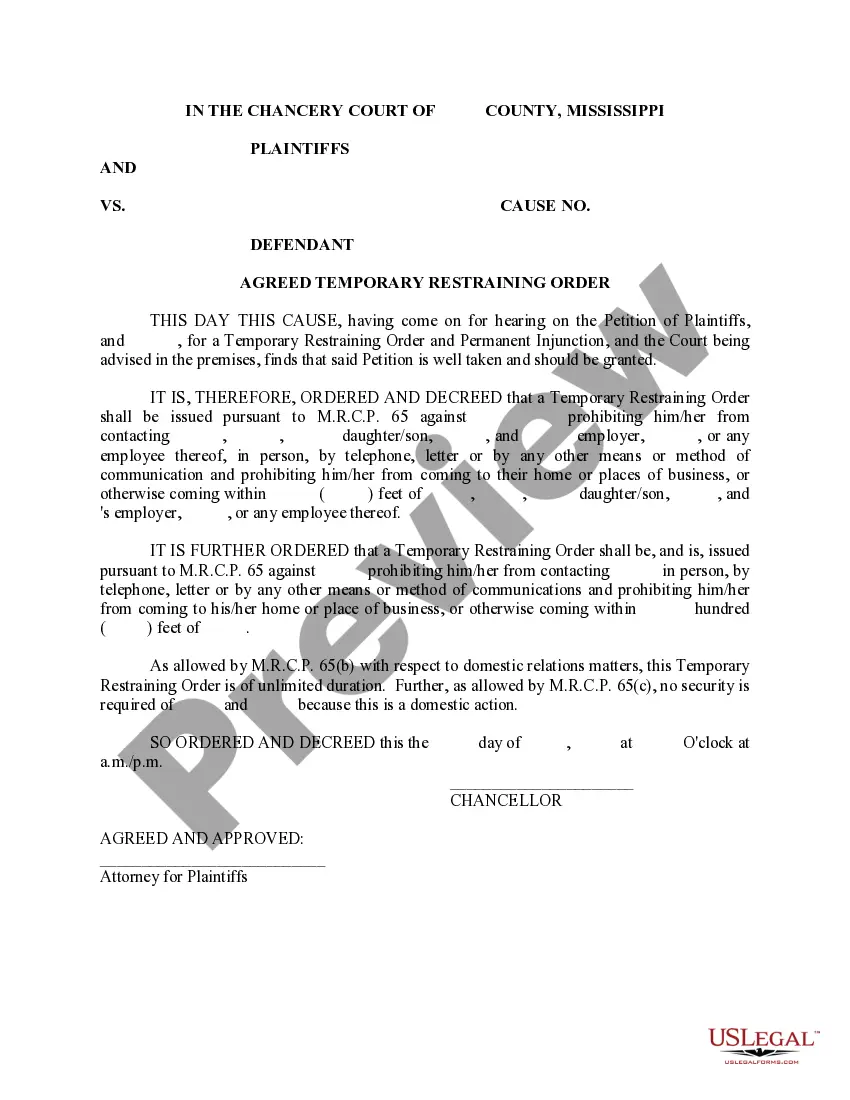
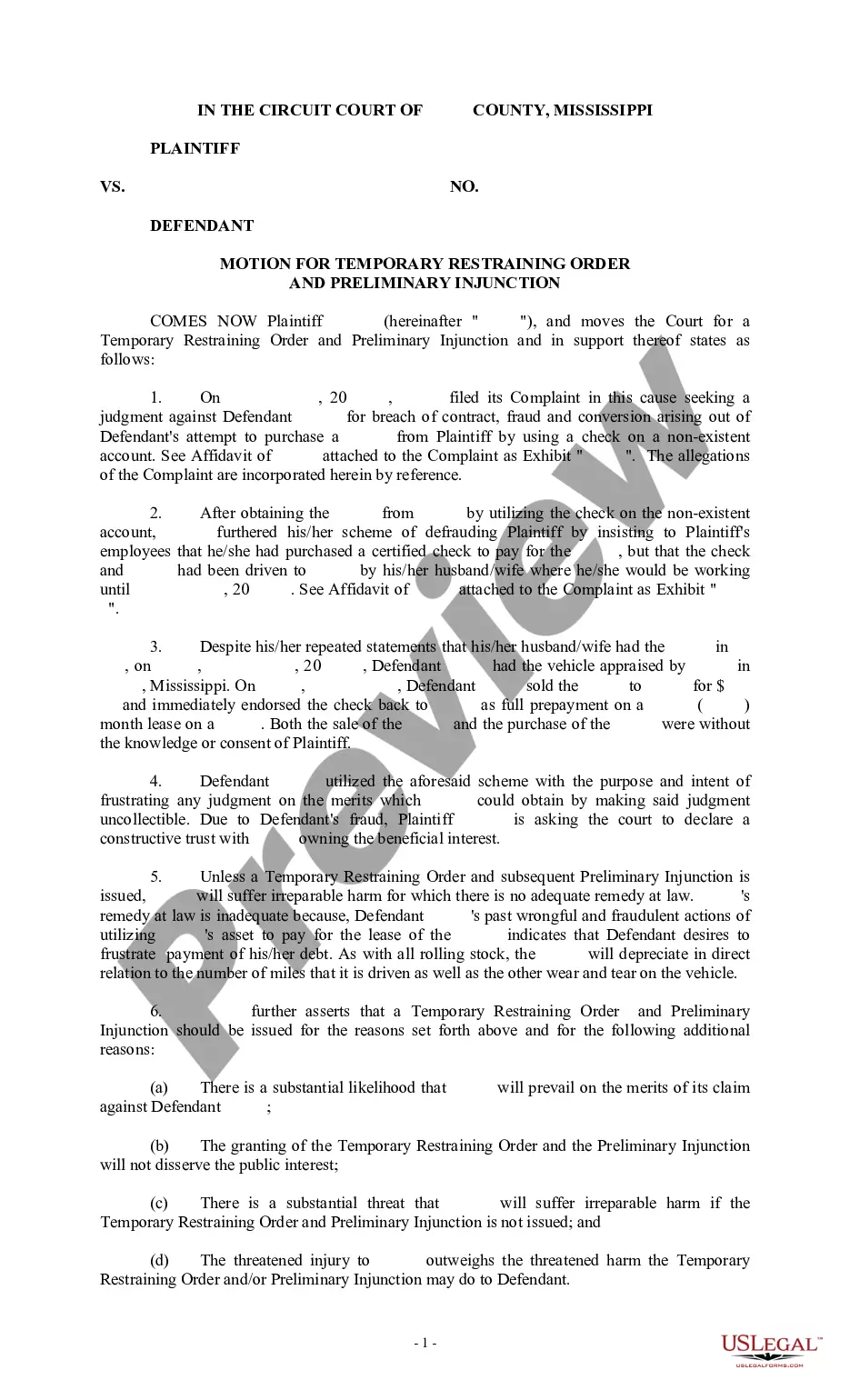
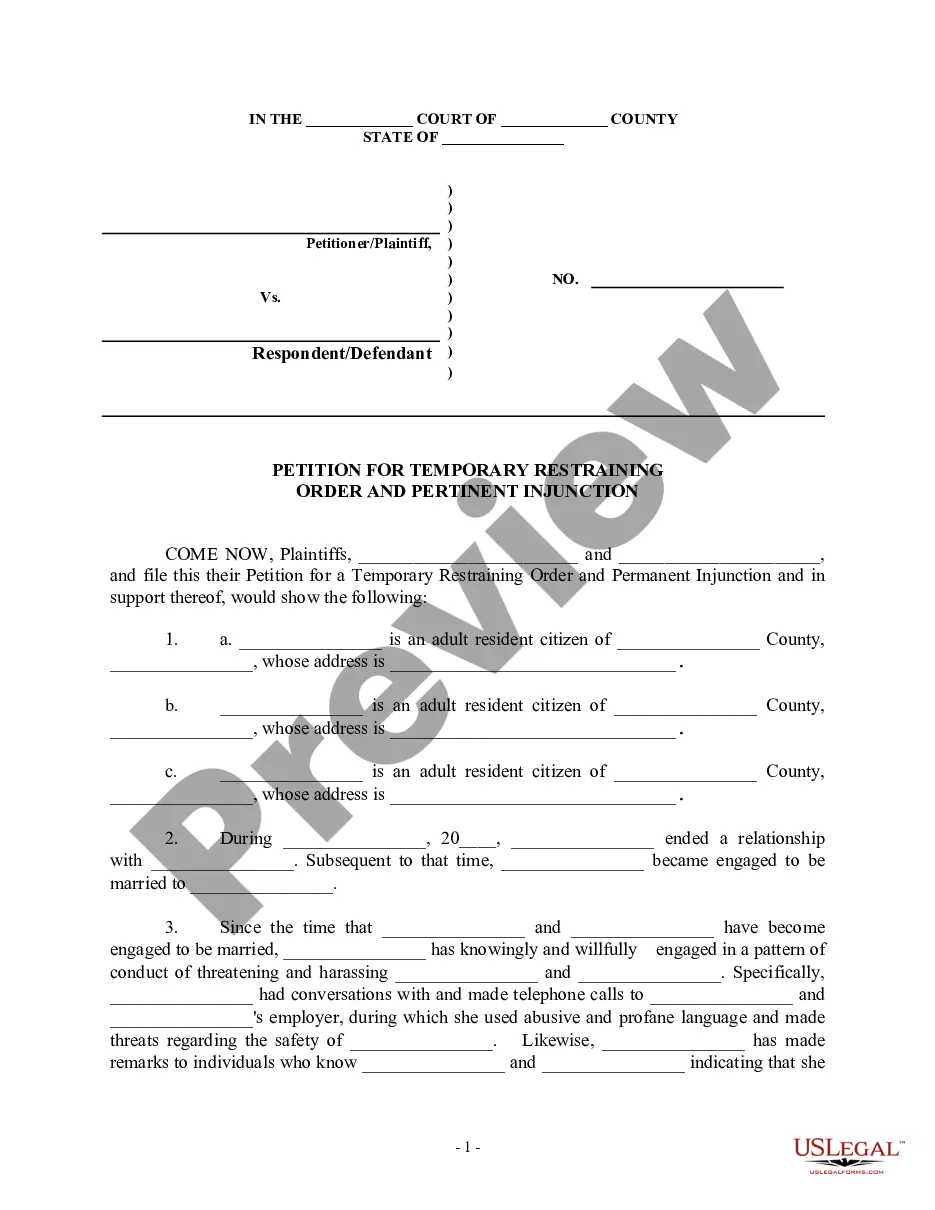
The Agreed Temporary Restraining Order is a legal document issued to protect a petitioner from potential harm or harassment by a defendant. This order prohibits the defendant from contacting the petitioner through any means, including in person, by telephone, or through written communication. Unlike regular restraining orders, this form indicates that both parties have agreed to the terms, providing a quicker resolution to disputes involving threats or domestic issues.
What’s included in this form
- Signature line for the attorney representing the plaintiffs.
- Details outlining the specific restrictions on the defendant's actions.
- Provision for the judgeâs approval, which formalizes the order.
- Clear identification of the parties involved, including the petitioner and defendant.
When this form is needed
This form is typically used in situations where a petitioner feels threatened or harassed by a defendant and seeks immediate protection. Common scenarios include cases of domestic violence, stalking, or harassment. When both parties agree on the need for a restraining order, this form can facilitate a swift and mutual resolution without the need for an extensive court battle.
Who needs this form
This form is intended for:
- Individuals seeking protection from threats or harassment.
- Parties involved in domestic disputes who agree to restrictions on contact.
- Attorneys representing clients in need of an agreed restraining order.
How to complete this form
- Identify the parties by entering the full legal names of the petitioner and the defendant.
- Specify the restrictions on the defendantâs actions, including any required distances from the petitioner.
- Include a statement indicating mutual agreement to the terms set forth in the order.
- Ensure the attorney for the plaintiffs signs the form to validate it.
- Submit the completed form to the court for approval from a judge.
Notarization guidance
This form does not typically require notarization unless specified by local law. Ensure you understand your jurisdiction's requirements before submission to the court.
Get your form ready online
Our built-in tools help you complete, sign, share, and store your documents in one place.
Make edits, fill in missing information, and update formatting in US Legal Forms—just like you would in MS Word.
Download a copy, print it, send it by email, or mail it via USPS—whatever works best for your next step.
Sign and collect signatures with our SignNow integration. Send to multiple recipients, set reminders, and more. Go Premium to unlock E-Sign.
If this form requires notarization, complete it online through a secure video call—no need to meet a notary in person or wait for an appointment.
We protect your documents and personal data by following strict security and privacy standards.

Make edits, fill in missing information, and update formatting in US Legal Forms—just like you would in MS Word.

Download a copy, print it, send it by email, or mail it via USPS—whatever works best for your next step.

Sign and collect signatures with our SignNow integration. Send to multiple recipients, set reminders, and more. Go Premium to unlock E-Sign.

If this form requires notarization, complete it online through a secure video call—no need to meet a notary in person or wait for an appointment.

We protect your documents and personal data by following strict security and privacy standards.
Typical mistakes to avoid
- Failing to properly identify the parties involved, which can lead to delays.
- Not clearly specifying the range of distance the defendant must maintain from the petitioner.
- Overlooking the required signatures from legal representatives.
Advantages of online completion
- Convenient access to legally vetted templates, drafted by licensed attorneys.
- Easy to fill out and customize according to individual needs.
- Ability to download and save the form instantly, ensuring efficiency.
Legal use & context
- An agreed temporary restraining order may have immediate effects on enforcement if both parties consent.
- It serves as a legal record that may be beneficial in future legal proceedings.
- Contact restrictions outlined in the order are enforceable by law and can lead to penalties for violations.
Main things to remember
- The Agreed Temporary Restraining Order is a crucial legal document for protecting individuals from harassment.
- Both parties must agree to the terms for the order to be issued.
- Proper completion and court approval are necessary for the order to be enforceable.
Looking for another form?
Form popularity
FAQ
Temporary restraining orders usually last between 20 and 25 days, until the court hearing date. When you go to court for the hearing that was scheduled for your TRO, the judge may issue a permanent restraining order. They are not really permanent because they usually last up to 5 years.
Under section 93-21-7(2) of the Mississippi Code, there is no cost to file for a protection order. . temporary restraining order. the clerk will fill out the information for you.
Consider Hiring an Attorney. Prepare Your Evidence in an Organized Fashion. Preserve Your Constitutional Right Against Self-Incrimination if a Criminal Case is Pending. Be Mindful of Proof of Service. Do Not Underestimate the Burden of Proof.
If the judge is satisfied, he or she will issue a temporary protective order that will last ten days, but which can be extended upon request, up to the maximum length of one year, but can only last 30 days where the victim has minor children with the abuser.
Normally a TRO lasts for 14 days unless the court decides to dissolve or extend it. A notice for a hearing must be contained in the TRO and the hearing must take place within the 14 days after the TRO is granted.
Stay Away Provision: Ordering the abuser to stay at least a certain number of yards or feet away from the victim, his or her home, job, school, and car. The stay-away distance can vary by state, judge or the lethality of the situation, but is often at least 100 yards or 300 feet.
In most instances, permanent simply means that the restraining order will be enforceable for the specified period of time that is mandated by the court or until a party requests a change. An offender who is subject to a permanent restraining order may be able to file a request to have the order lifted.
If a person is subject to a restraining order and violates it, he or she can face serious penalties.Even if the parties no longer desire the restraining order to be in effect, the restraining order is still valid and enforceable while in effect. In order to remove it, the restraining order must be lifted by the court.
The temporary restraining order in California does not go into the CLETS database and will not come up on a background check. It will also generally not impact the restrained parties' ability to possess a firearm.