Mississippi Right of Way Instrument
What this document covers
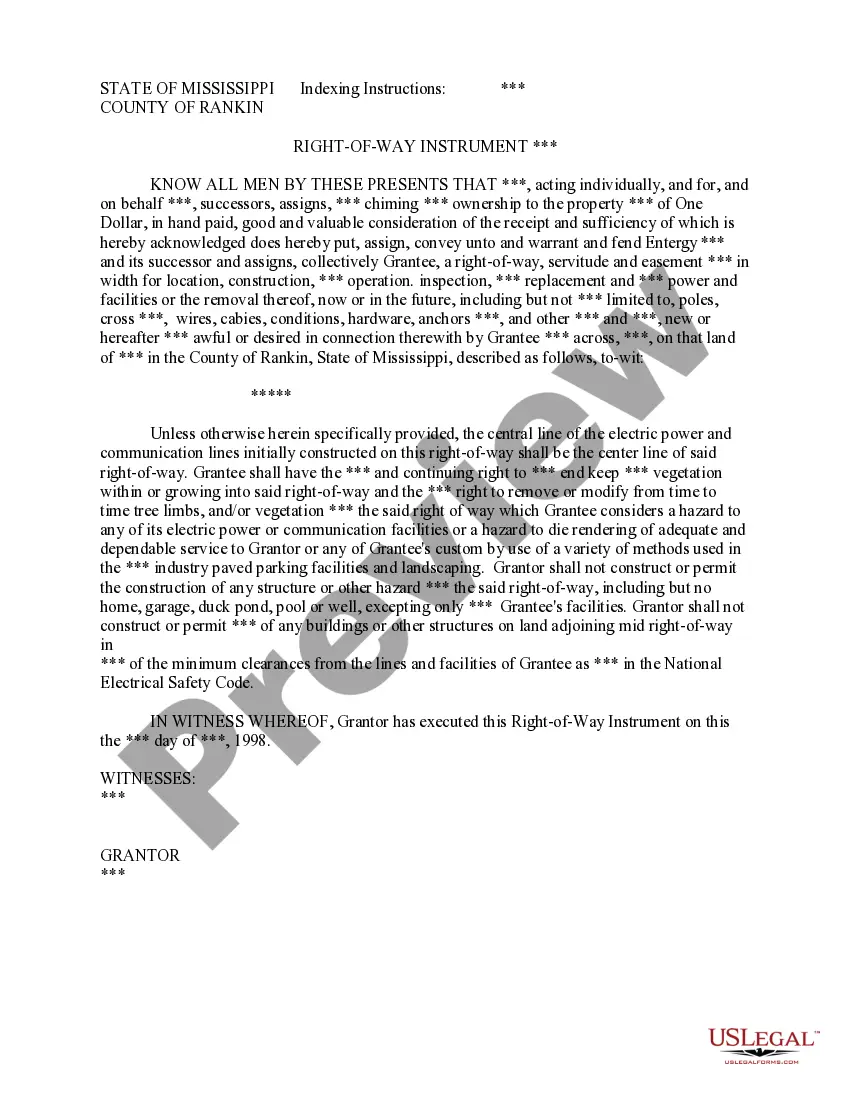
The Right of Way Instrument is a legal document that grants permission for a Grantee, such as a utility company, to access a Grantor's private property for specific purposes. This form is particularly relevant when dealing with utilities such as power lines or cables. It establishes the right to enter the property for maintenance, repair, and installation, which distinguishes it from general easement agreements by focusing on utility access.
Key parts of this document
- Identification of the Grantor and Grantee.
- Description of the property subject to the right of way.
- Specific purposes for the right of way, such as maintenance or installation of utility lines.
- Details about the width and location of the right of way.
- Provisions regarding vegetation management within the right of way.
- Restrictions on construction or other activities by the Grantor near the right of way.

Situations where this form applies
Use the Right of Way Instrument when a property owner (Grantor) needs to allow a utility company (Grantee) access to their land for the purpose of installing, maintaining, or repairing utility lines or cables. This is relevant in situations where the utility requires ongoing access to ensure safe and reliable service. It is particularly useful for homeowners or landowners whose properties are crossed by power lines or other utility infrastructures.
Intended users of this form
This form is intended for:
- Property owners granting access to utility companies.
- Utility companies requiring a legal right of access to maintain infrastructure.
- Individuals or businesses involved in land development projects that intersect with existing utility lines.
Instructions for completing this form
- Identify and fill in the names of the Grantor and Grantee.
- Specify the legal description of the property involved.
- Clearly outline the purpose of the right of way, including the types of utilities covered.
- Indicate the width of the right of way and any specific locations as necessary.
- Ensure all parties sign and date the document to validate the agreement.
Notarization guidance
This form must be notarized to be legally valid. US Legal Forms provides secure online notarization powered by Notarize, allowing you to complete the process through a verified video call.
Get your form ready online
Our built-in tools help you complete, sign, share, and store your documents in one place.
Make edits, fill in missing information, and update formatting in US Legal Forms—just like you would in MS Word.
Download a copy, print it, send it by email, or mail it via USPS—whatever works best for your next step.
Sign and collect signatures with our SignNow integration. Send to multiple recipients, set reminders, and more. Go Premium to unlock E-Sign.
If this form requires notarization, complete it online through a secure video call—no need to meet a notary in person or wait for an appointment.
We protect your documents and personal data by following strict security and privacy standards.

Make edits, fill in missing information, and update formatting in US Legal Forms—just like you would in MS Word.

Download a copy, print it, send it by email, or mail it via USPS—whatever works best for your next step.

Sign and collect signatures with our SignNow integration. Send to multiple recipients, set reminders, and more. Go Premium to unlock E-Sign.

If this form requires notarization, complete it online through a secure video call—no need to meet a notary in person or wait for an appointment.

We protect your documents and personal data by following strict security and privacy standards.
Typical mistakes to avoid
- Failing to accurately describe the property involved.
- Leaving out important details regarding the purpose of the right of way.
- Not obtaining necessary signatures from all parties involved.
- Neglecting local regulations or requirements for utility easements.
Advantages of online completion
- Convenience of downloading the document anytime without waiting for mail delivery.
- Editability allows customization to fit specific needs before printing.
- Access to templates created by licensed attorneys ensures legal reliability.
Legal use & context
- The Right of Way Instrument grants the Grantee the legal right to enter the Grantor's property for specified purposes.
- Failure to use this form properly could lead to unauthorized access or disputes regarding property rights.
- This instrument must comply with local laws regarding easements and property transactions.
Looking for another form?
Form popularity
FAQ
Public rights of way can come into existence through creation (either by legal order or by an agreement made with the landowner) or dedication by the landowner (either expressly or by presumption or by deemed dedication following 20 years' public use).
Easements can a right of way be diverted by the owner of the burdened land?However, it emphasised that the owner of the land burdened by a right of way has no right to alter its route, unless that right is an express or implied term of the grant of the right.
A private Right of Way typically gives one land owner the right to use another's property, usually a road of some kind, to get to and from her land. This right is usually given in the form of a deed, much like a deed to property.The deed granting a Right of Way is often vague, and doesn't help clarify things.
You may pass and repass along a right of way as long as you do not stop and linger on the right of way; if the right of way is obstructed then you may divert along another route provided that the diversion remains on land belonging to the servient tenement (otherwise you would be trespassing on a third party's land);
A: Firstly you should establish whether there is any legal right of way to the property.With an easement your mother may insist your neighbour removes the fence obstructing her right of way. That access has been blocked for two years is likely to be irrelevant. Easements can also be abandoned.
Use it or lose it in fact with a right of way over your neighbour's land, the opposite is true. Case law shows mere failure to use a right does not on its own lead to its loss.Mere failure to use is not by itself enough to destroy the right.
A private Right of Way typically gives one land owner the right to use another's property, usually a road of some kind, to get to and from her land. This right is usually given in the form of a deed, much like a deed to property.
If an authority has an easement registered over your land, they have the right to access the easement to maintain or repair the easement land or their equipment on the land.
A right of way is normally enjoyed along a specific route over someone's land. The case has confirmed that a landowner has no right to re-route a right of way (unless the terms of the right of way expressly allow this).