Mississippi Notice of Successor Administrator's Lien
What is this form?
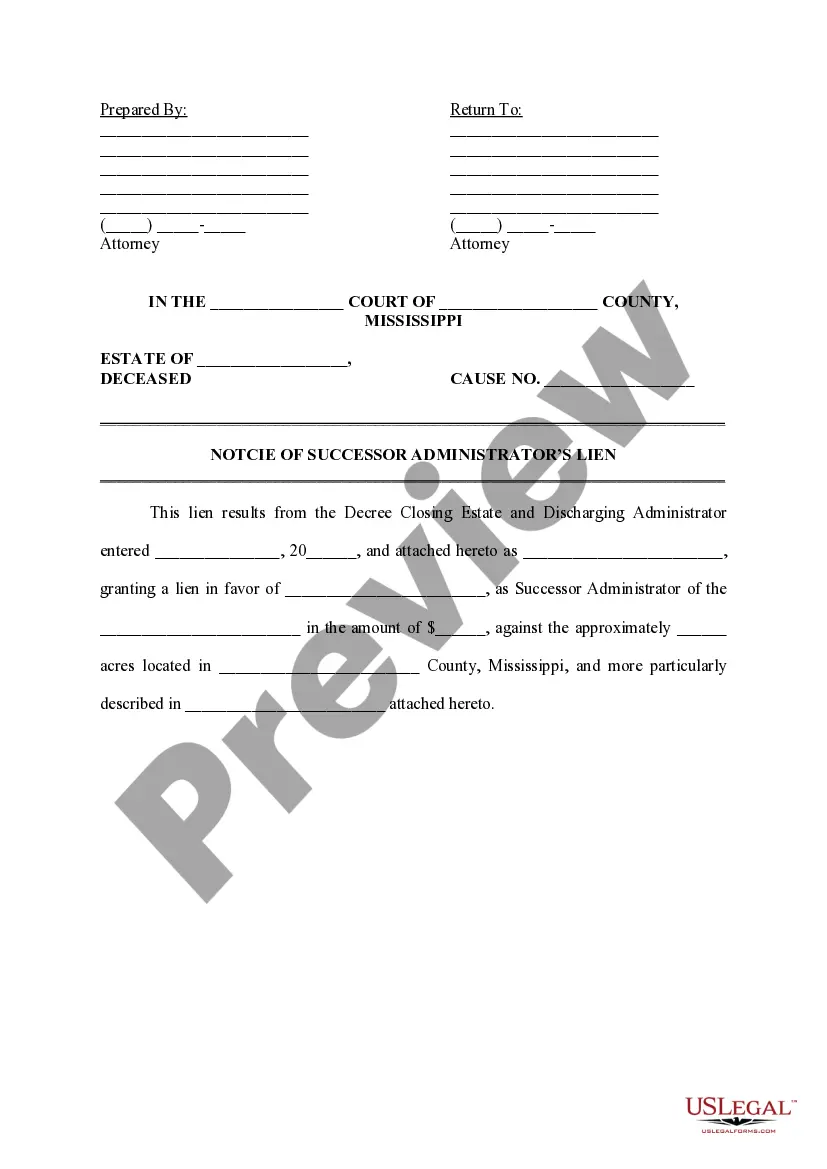
The Notice of Successor Administrator's Lien is a legal document that establishes a lien on real property following a Decree Closing Estate and Discharging Administrator. This form is specifically designed for successor administrators to secure their financial interests in the estate. Unlike other lien forms, this specific notice focuses on the authority granted by the court in the context of estate administration.
Key components of this form
- Identification of the successor administrator and the estate.
- Details of the property to which the lien applies.
- Legal basis for the lien as stated in the decree.
- Space for notarization to validate the document.
When this form is needed
This form should be used when a successor administrator wishes to secure a lien on real property as a result of closing the estate and discharging the previous administrator. It is necessary when there are outstanding debts or obligations that the estate must satisfy before distributing assets to beneficiaries.
Who needs this form
- Successor administrators appointed by the court.
- Individuals managing the affairs of a deceased person's estate.
- Attorneys representing successors in estate matters.
Instructions for completing this form
- Identify the successor administrator by entering their name and contact information.
- Specify the details of the estate, including the case number and the judicial authority.
- Describe the property subject to the lien, including its location and description.
- State the legal basis for the lien as outlined in the court decree.
- Complete the notarization section, ensuring you have a notary public witness your signature.
Is notarization required?
Yes, this form must be notarized to be legally valid. Using US Legal Formsâ integrated online notarization service, you can complete this process securely via video call at any time, eliminating the need to travel and ensuring compliance with legal requirements.
Get your form ready online
Our built-in tools help you complete, sign, share, and store your documents in one place.
Make edits, fill in missing information, and update formatting in US Legal Forms—just like you would in MS Word.
Download a copy, print it, send it by email, or mail it via USPS—whatever works best for your next step.
Sign and collect signatures with our SignNow integration. Send to multiple recipients, set reminders, and more. Go Premium to unlock E-Sign.
If this form requires notarization, complete it online through a secure video call—no need to meet a notary in person or wait for an appointment.
We protect your documents and personal data by following strict security and privacy standards.

Make edits, fill in missing information, and update formatting in US Legal Forms—just like you would in MS Word.

Download a copy, print it, send it by email, or mail it via USPS—whatever works best for your next step.

Sign and collect signatures with our SignNow integration. Send to multiple recipients, set reminders, and more. Go Premium to unlock E-Sign.

If this form requires notarization, complete it online through a secure video call—no need to meet a notary in person or wait for an appointment.

We protect your documents and personal data by following strict security and privacy standards.
Typical mistakes to avoid
- Failing to correctly identify the property to which the lien applies.
- Neglecting to provide the necessary details about the estate.
- Forgetting to obtain notarization, which may invalidate the lien.
Why use this form online
- Convenient downloading and immediate access to the form.
- Editability to ensure all information is accurate before printing.
- Reliability with templates created by licensed attorneys, ensuring legal compliance.
Summary of main points
- The Notice of Successor Administrator's Lien is essential for protecting estate interests.
- Correctly completing and notarizing the form is critical for its validity.
- Using this form can help streamline estate settlement and preserve legitimacy.
Looking for another form?
Form popularity
FAQ
When comparing the difference between power of attorney and conservatorship, keep in mind that a person creates a power of attorney before a person they are incapacitated. In contrast, a conservatorship is formed after a person is no longer able to competently make critical financial decisions on his or her own.
File a Petition For Conservatorship with the court: File a Confidential Supplemental Information Form: File a Confidential Conservatorship Screening Form: File a Duties of Conservator Form: Serve Notice on the Conservatee: Provide Notice to the Conservatee's Relatives:
The conservator has the power to collect all the conservatee's assets, pay bills, make investments, etc. The conservator must seek court supervision for major transactions, such as purchase or sale of property, borrowing money, or gifting of assets.
However, California law provides that conservators can receive reasonable compensation, payable from the conservatees estate. You may be paid an hourly fee for the work you perform as a conservator, which means you will need to maintain detailed records of the services you provide.
A conservator will pay $465 for almost every single petition filed, and yet another $465 for each objection. On average, in the first year of an uncontested conservatorship proceeding, the filing fees and mandatory court costs are over $3,000.
A conservator of the person is supposed to make sure that your personal needs are met. A conservator of the estate is supposed to protect your finances or manage your money. In general, a conservator has a duty to protect you from abuse or neglect, and to help you integrate in society.
A conservatorship is a court case where a judge appoints a responsible person or organization (called the conservator) to care for another adult (called the conservatee) who cannot care for himself or herself or manage his or her own finances.
Does Conservatorship Override Power of Attorney? While a power of attorney arrangement is formed before a person becomes incapacitated, a conservatorship is formed after it occurs. Even with a conservatorship in place, a durable power of attorney may continue to be in effect.