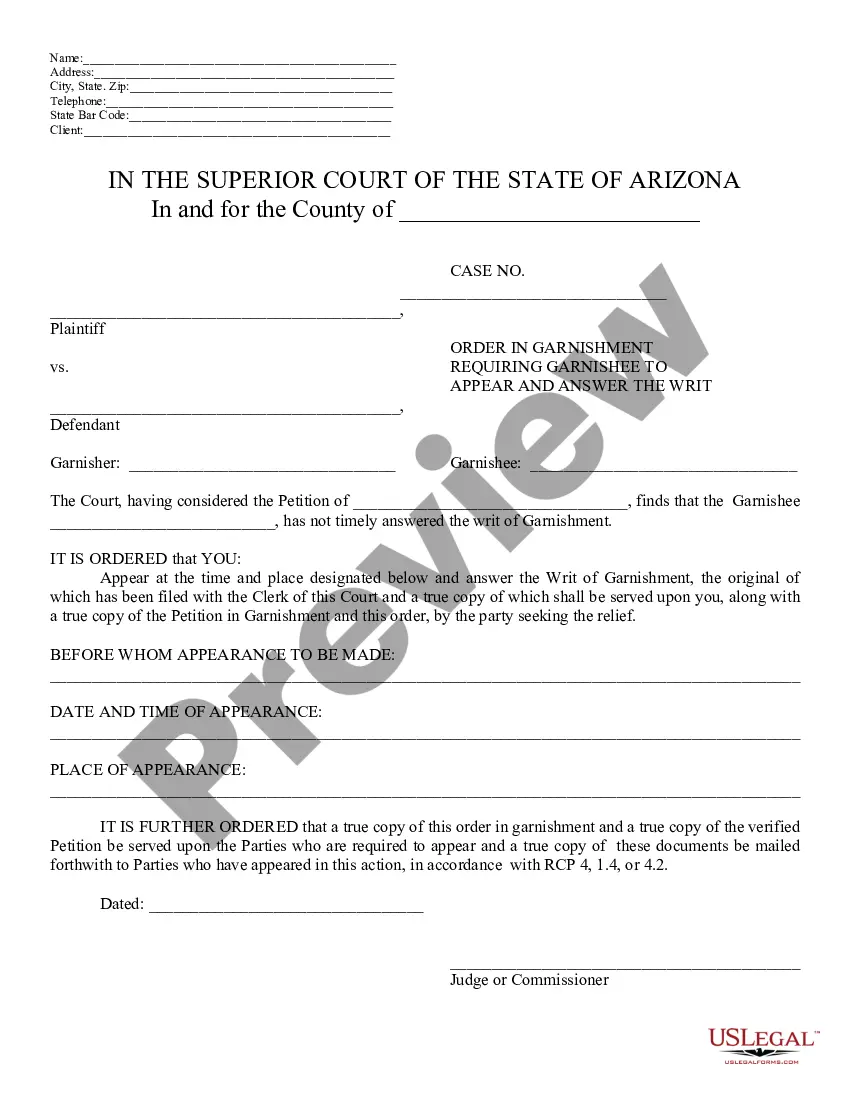
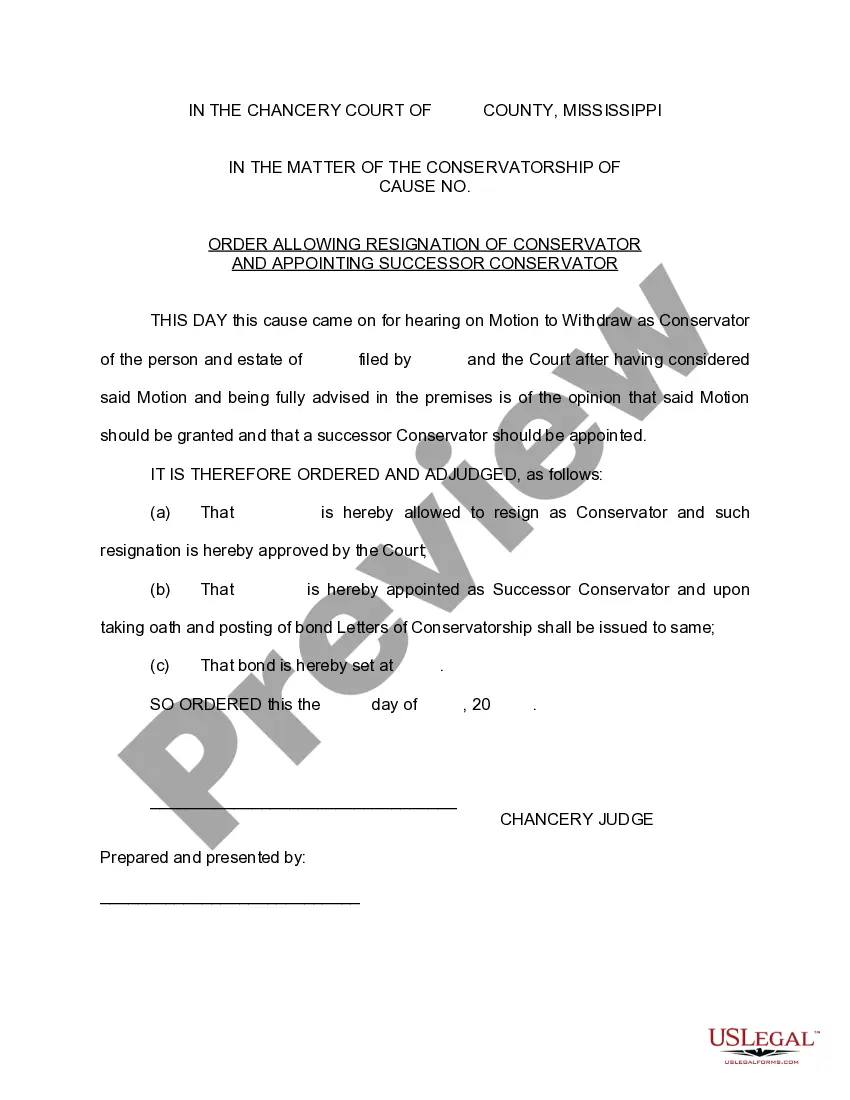
Mississippi Order Allowing Resignation of Conservator and Appointing Successor Conservator
What is this form?
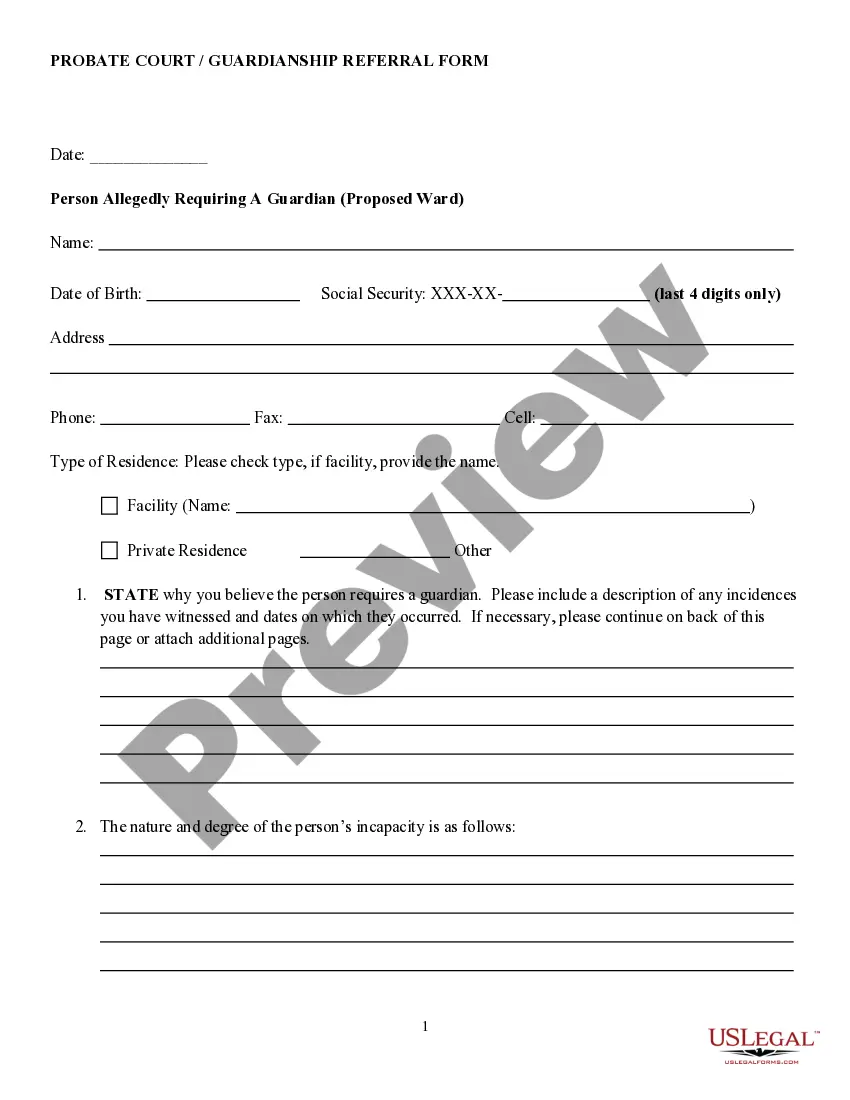
The Order Allowing Resignation of Conservator and Appointing Successor Conservator is a legal document issued by the court. It formally permits an appointed conservator to resign their duties and designates a new conservator to take over. This form is essential in cases where a conservator can no longer fulfill their responsibilities, ensuring the continued management of the individualâs affairs. Unlike general court orders, this specific form addresses the transition of conservatorship directly, making it critical for maintaining proper legal oversight.
What’s included in this form
- Title of the order indicating the purpose.
- Details of the current conservator who is resigning.
- Name and qualifications of the successor conservator.
- Effective date of the resignation and appointment.
- Judicial signatures confirming the court's approval.


Situations where this form applies
This form should be used when a conservator wishes to resign from their position due to personal reasons, incapacity, or other circumstances that prevent them from effectively managing the affairs of the individual under conservatorship. It is also necessary when appointing a new conservator to ensure that the individualâs best interests continue to be served without any disruption.
Who should use this form
This form is intended for:
- The current conservator seeking to resign.
- The individual being appointed as the successor conservator.
- Legal representatives or attorneys involved in conservatorship matters.
Instructions for completing this form
- Identify the current conservator and include their full name and address.
- Provide the name and contact information of the successor conservator.
- State the effective date for the resignation and appointment.
- Ensure that all necessary parties sign the document where indicated.
- File the completed form with the court to obtain judicial approval.
Does this form need to be notarized?
This form does not typically require notarization unless specified by local law. It is always advisable to check your stateâs requirements or consult a legal professional to ensure that all legal formalities are correctly followed.
Get your form ready online
Our built-in tools help you complete, sign, share, and store your documents in one place.
Make edits, fill in missing information, and update formatting in US Legal Forms—just like you would in MS Word.
Download a copy, print it, send it by email, or mail it via USPS—whatever works best for your next step.
Sign and collect signatures with our SignNow integration. Send to multiple recipients, set reminders, and more. Go Premium to unlock E-Sign.
If this form requires notarization, complete it online through a secure video call—no need to meet a notary in person or wait for an appointment.
We protect your documents and personal data by following strict security and privacy standards.

Make edits, fill in missing information, and update formatting in US Legal Forms—just like you would in MS Word.

Download a copy, print it, send it by email, or mail it via USPS—whatever works best for your next step.

Sign and collect signatures with our SignNow integration. Send to multiple recipients, set reminders, and more. Go Premium to unlock E-Sign.

If this form requires notarization, complete it online through a secure video call—no need to meet a notary in person or wait for an appointment.

We protect your documents and personal data by following strict security and privacy standards.
Mistakes to watch out for
- Failing to include all required signatures.
- Not specifying the effective date of the resignation and appointment.
- Using outdated or incorrect language that does not comply with state requirements.
- Neglecting to provide clear contact information for the successor conservator.
Advantages of online completion
- Immediate access to the latest legal form formats.
- Ability to download and customize the form according to specific needs.
- Convenience of completing the form from home without needing to visit an attorney.
- Works well with online platforms that may offer guidance or support for completing legal documents.
Key takeaways
- The form is essential for transitioning conservatorship roles legally.
- It ensures the ongoing protection of the conservatee.
- Proper completion and submission to the court are vital for validity.
- Stay informed about specific state requirements and potential notarization needs.
Looking for another form?

Form popularity
FAQ
An emergency conservatorship takes 5 court days notice. In other words, you can file a petition for the conservatorship, mail copies of the documents to all legally required persons, and and the court will set a hearing on the matter within 5 days.
Yes, a conservatorship can be contested in any state. Sometimes, the simplest way to contest a conservatorship is to object to the petition for conservatorship to stop the conservatorship in the first place, or to file a competing petition for conservatorship.
LPS conservatorships MUST be started by a local government agency, usually a county's Public Guardian or Public Conservator. LPS conservatorships last for only 1 year. If they are needed longer than that, they must be restarted and the conservator must be reappointed by the court.
You have a couple of options. You can ask the court to terminate the conservatorship, or you can ask the court to give you a new conservator. To terminate the conservatorship, you have to prove that you no longer need it.
A conservator over the estate is responsible for marshalling, protecting, and managing the conservatee's assets that remain in their estate. A conservator reports to the court that appointed them, and is monitored by the supervising judicial court in the county in which the conservatee permanently resides.
The conservator has the power to collect all the conservatee's assets, pay bills, make investments, etc. The conservator must seek court supervision for major transactions, such as purchase or sale of property, borrowing money, or gifting of assets.
(a) A conservatorship terminates upon the death of the protected person or upon order of the court.The Court then sets a hearing date on the Petition and the Conservator provides notice of the hearing to all Interested Persons. After the hearing the Court issues an Order discharging the Conservator.
Some adults find it difficult to get out of a conservatorship after they recover from the issue that placed them under the guardianship of another person.Supervision through the courts usually catches these issues, but with overworked court systems, not all adults receive the care they need.