Mississippi Judgment of Adoption
Overview of this form
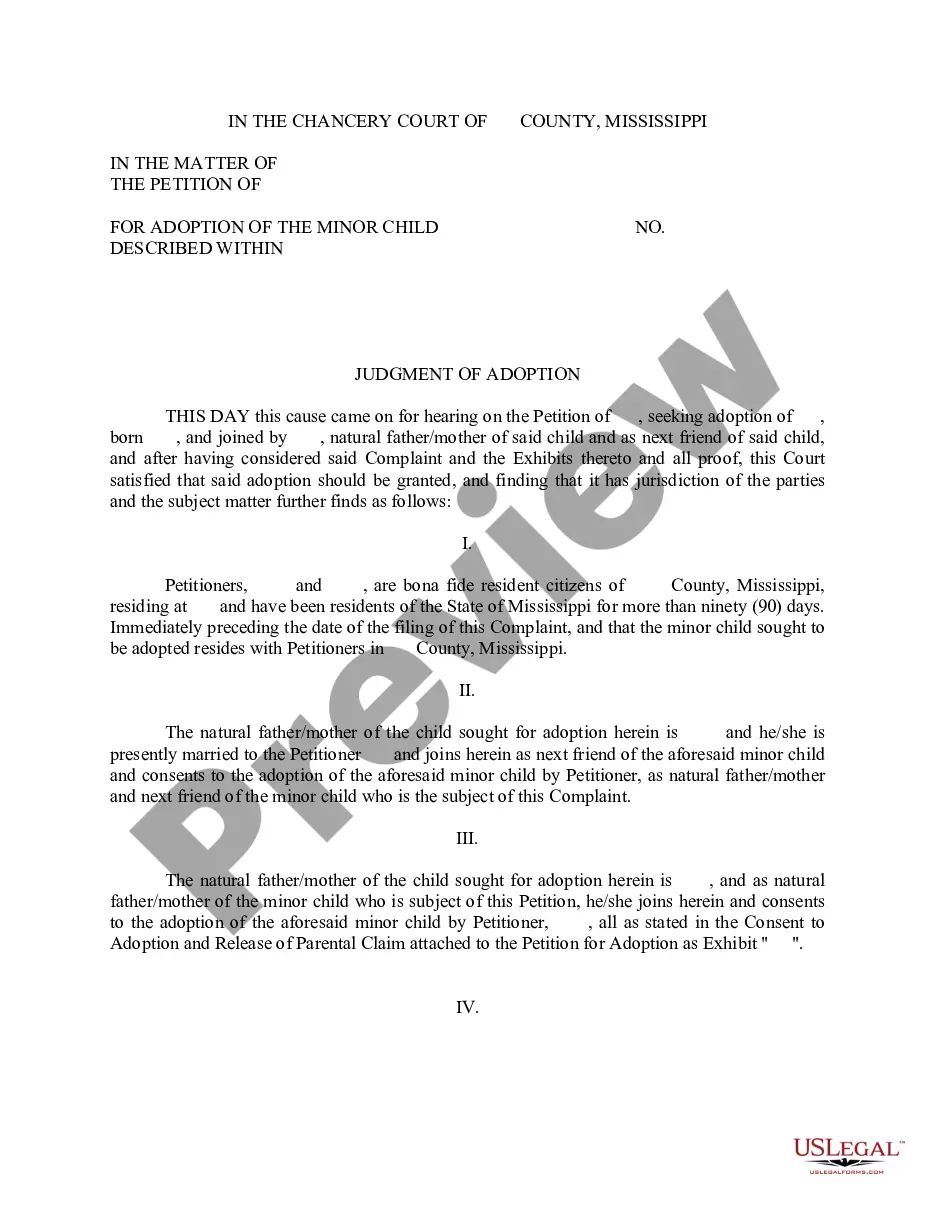
The Judgment of Adoption is a legal document used to formalize the adoption of a minor child. This form serves to make the adoption legally binding once signed by a judge. It distinguishes itself from other adoption-related forms by specifically addressing the final judgment issued by the court, setting forth the rights and responsibilities of both the adoptive and biological parents after the adoption is finalized.
Key components of this form
- Information about the petitioners and the minor child.
- Consent from natural parents or legal guardians for the adoption.
- Details concerning the jurisdiction and residency of the petitioners.
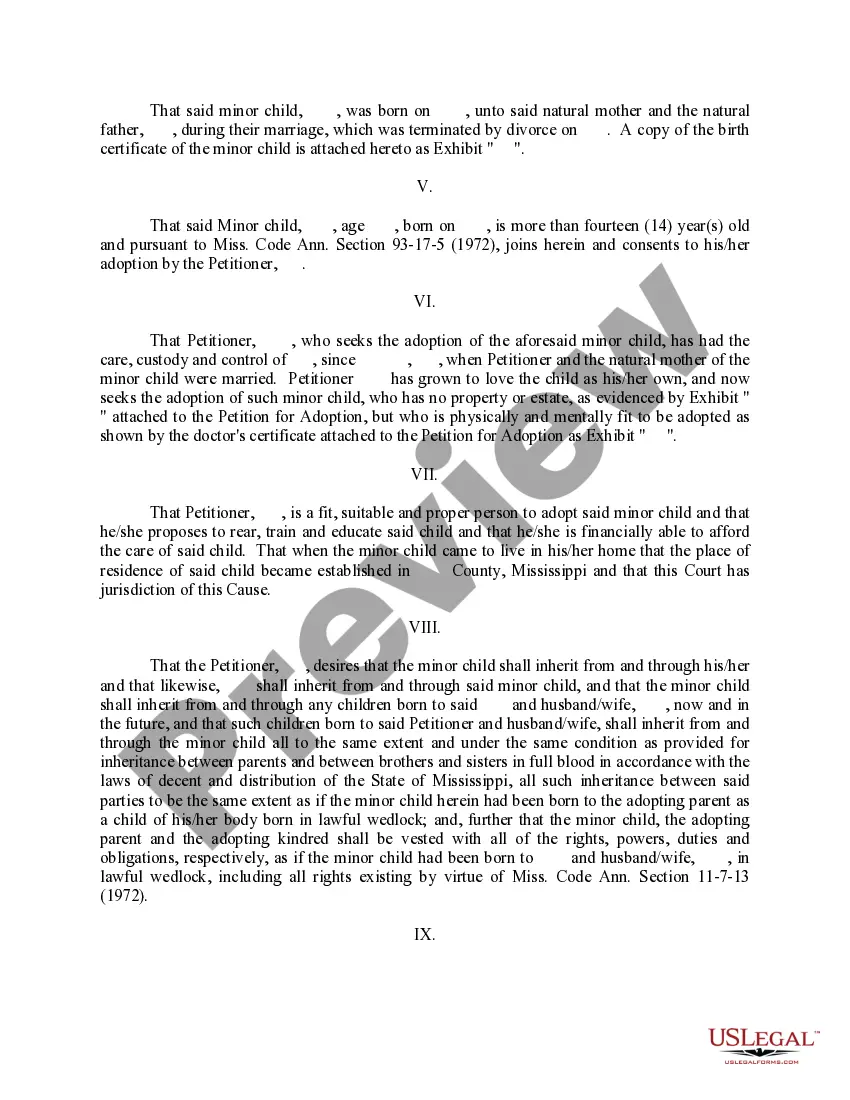
- Adoption agreement outlining inheritance rights and legal responsibilities.
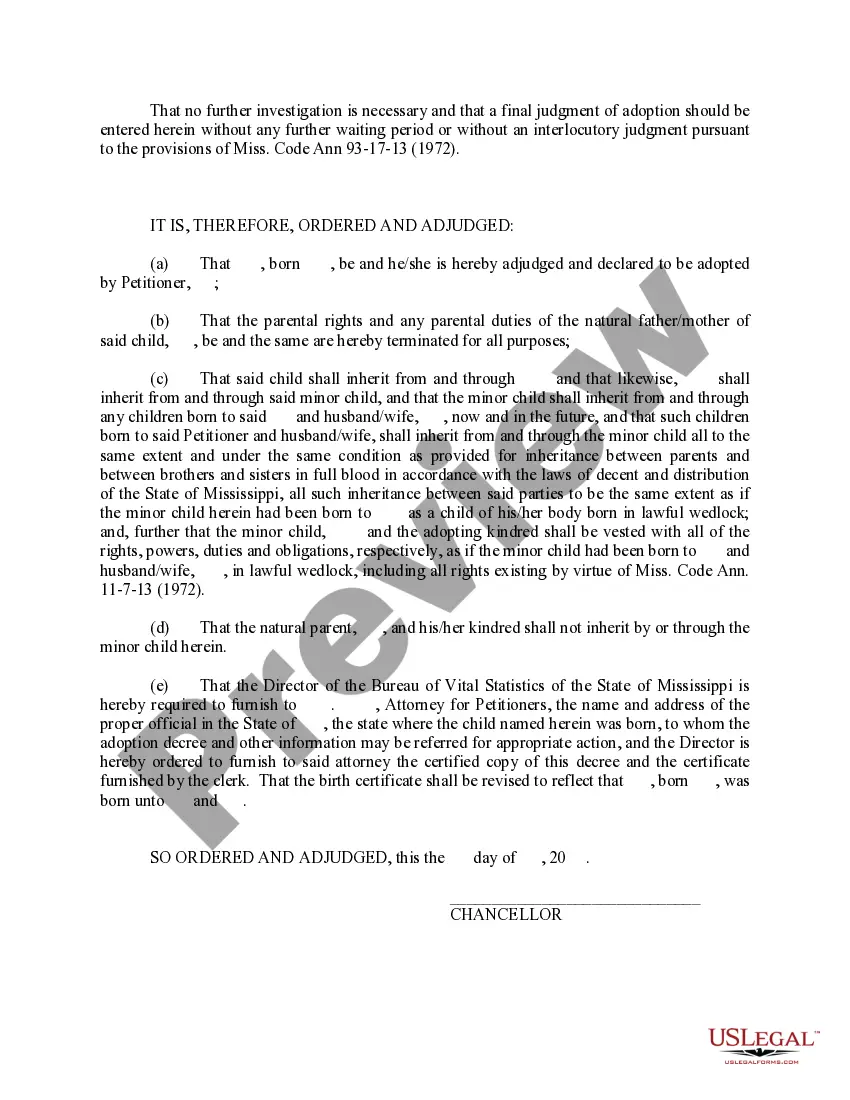
- Final judgment clauses detailing the termination of parental rights of the natural parents.


When this form is needed
This form is necessary when an individual or couple wishes to formally adopt a minor child. It should be used after the court has reviewed and approved the adoption petition. This is typically required when the biological parents have consented, and the petitioners have established a home for the child, demonstrating their readiness to assume parental responsibilities.
Who can use this document
- Individuals or couples seeking to adopt a minor child.
- Biological parents who are legally terminating their parental rights.
- Legal guardians or next friends of the child involved in the adoption process.
- Attorneys representing adopters in the legal process.
Steps to complete this form
- Identify the petitioners and the minor child involved in the adoption.
- Gather necessary consents from natural parents or legal guardians.
- Complete sections indicating residency and jurisdiction details.
- Detail any agreements concerning inheritance rights for the adopted child.
- Ensure the form is signed by all parties in the presence of appropriate legal counsel to facilitate court approval.
Notarization requirements for this form
Notarization is not commonly needed for this form. However, certain documents or local rules may make it necessary. Our notarization service, powered by Notarize, allows you to finalize it securely online anytime, day or night.
Get your form ready online
Our built-in tools help you complete, sign, share, and store your documents in one place.
Make edits, fill in missing information, and update formatting in US Legal Forms—just like you would in MS Word.
Download a copy, print it, send it by email, or mail it via USPS—whatever works best for your next step.
Sign and collect signatures with our SignNow integration. Send to multiple recipients, set reminders, and more. Go Premium to unlock E-Sign.
If this form requires notarization, complete it online through a secure video call—no need to meet a notary in person or wait for an appointment.
We protect your documents and personal data by following strict security and privacy standards.

Make edits, fill in missing information, and update formatting in US Legal Forms—just like you would in MS Word.

Download a copy, print it, send it by email, or mail it via USPS—whatever works best for your next step.

Sign and collect signatures with our SignNow integration. Send to multiple recipients, set reminders, and more. Go Premium to unlock E-Sign.

If this form requires notarization, complete it online through a secure video call—no need to meet a notary in person or wait for an appointment.

We protect your documents and personal data by following strict security and privacy standards.
Common mistakes to avoid
- Failing to obtain proper consent from all biological parents.
- Omitting important personal information about the petitioners or the child.
- Not including supporting documents, such as the birth certificate.
- Inadequately addressing jurisdictional requirements as per state law.
Why use this form online
- Convenience of completing the form from home without the need for in-person visits.
- Editability allows users to ensure that all information is accurate and complete before submission.
- Access to forms drafted by licensed attorneys, ensuring legal validity and compliance.
Looking for another form?
Form popularity
FAQ
Statistics indicate that about 10 percent of adoptions disrupt (fail between placement and finalization), and between one and three percent are dissolved (fail after finalization) because the child has problems that the adoptive parents are not equipped to support.
Minnesota. Nebraska. New Hampshire. New Mexico. Oklahoma. Oregon. Tennessee. Utah.
Foster care adoption is the least expensive adoption process, with the average being just $2,744. You work with your state's foster care system, and if you foster a child that may eventually be up for adoption, you'll be first on the list.
From any page on Ancestry, click the Search tab and select Birth, Marriage & Death. Enter the name, birthdate, and birth location of the adopted child, then click Search.
The best place to start looking for Birth Parents, even if you cannot access adoption records, is a Mutual Consent registry such as International Soundex Reunion Registry (ISSR). Mutual consent registries require both parties to register on the site to make a reunion possible.
After the adoption is finalized, the original birth certificate is sealed and kept confidential by the state registrar of vital records, according to the U.S. Department of Child Welfare.As with domestic adoptions, the state will retain the child's original foreign birth certificate or documentation under seal.
Mississippi established a Child Adoption Credit of up to $2,500 for qualified adoption expenses. Qualified applicants can apply for the credit the year the adoption is finalized, and unused credit may be carried forward for three years.
Adoption Records in Mississippi prior to 1955 are cosidered open records and available from the county. Nonidentifying information is availble to adult age adoptees, parents or guardians of a minor adoptee, birth parents and family. Adoptees of age 21 or older are allowed to view identifying information and records.
Birth parents may, at any time, file an affidavit with the Mississippi bureau authorizing the bureau to provide the adopted person with their original birth certificate, or an affidavit prohibiting the release of any information. Said affidavit may be revoked at any time by written notification to the bureau.