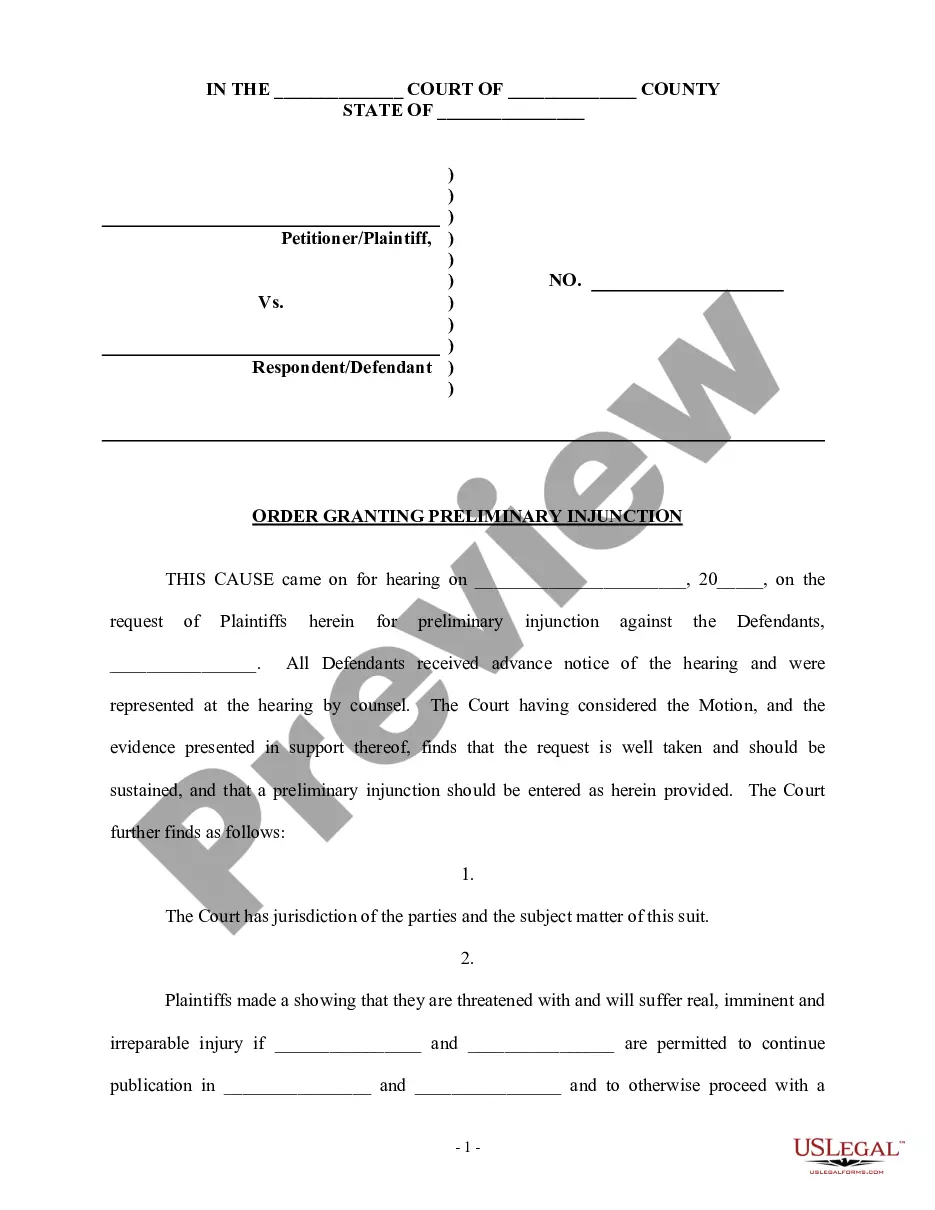
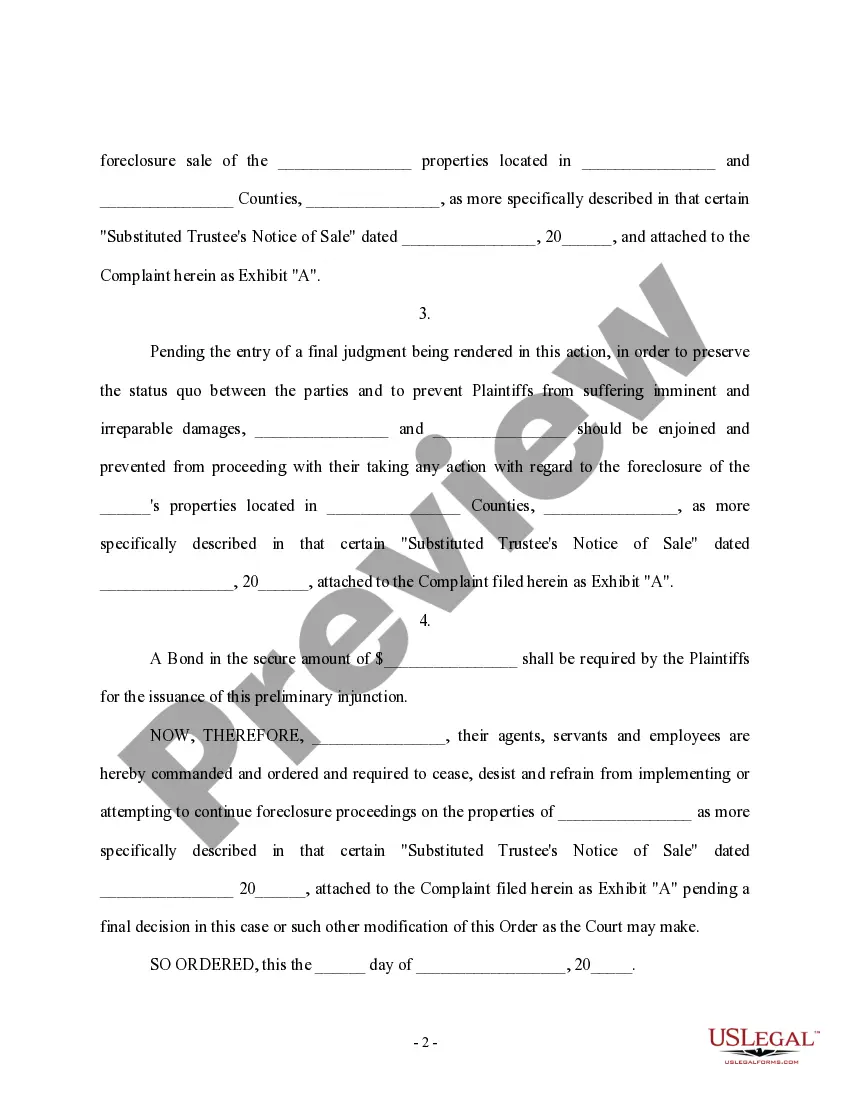
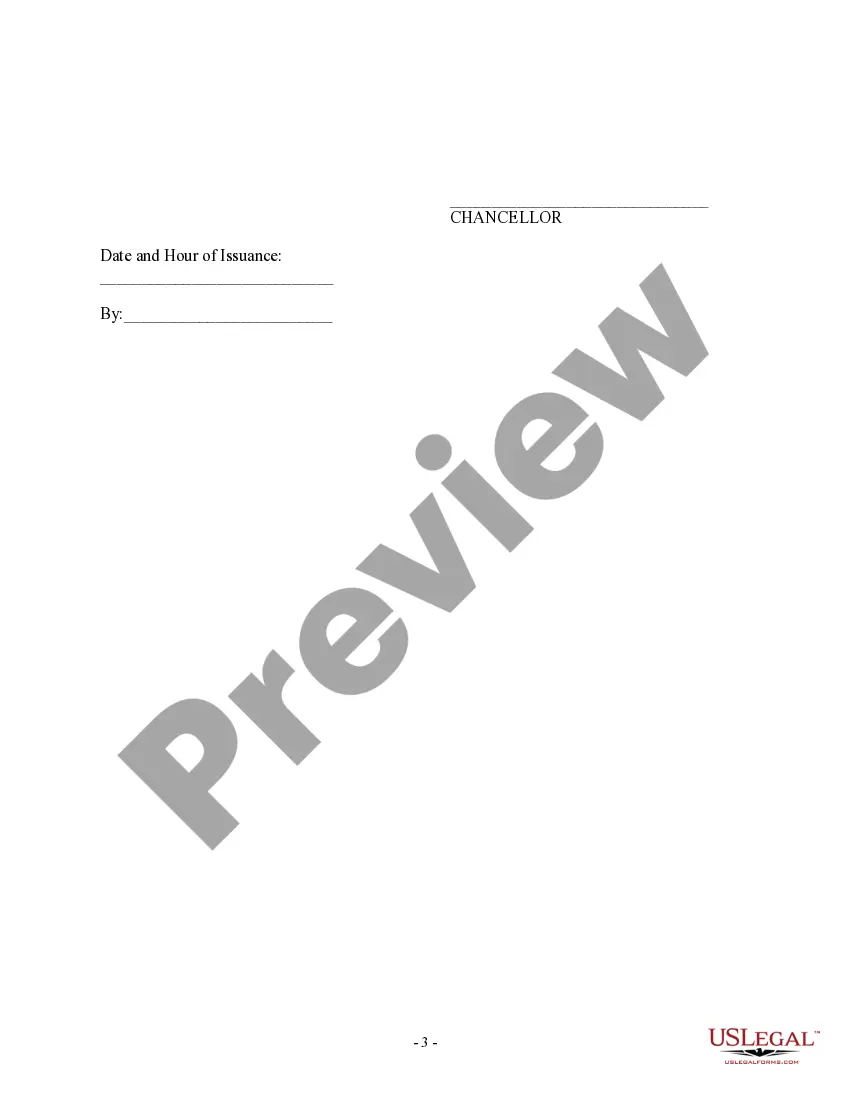
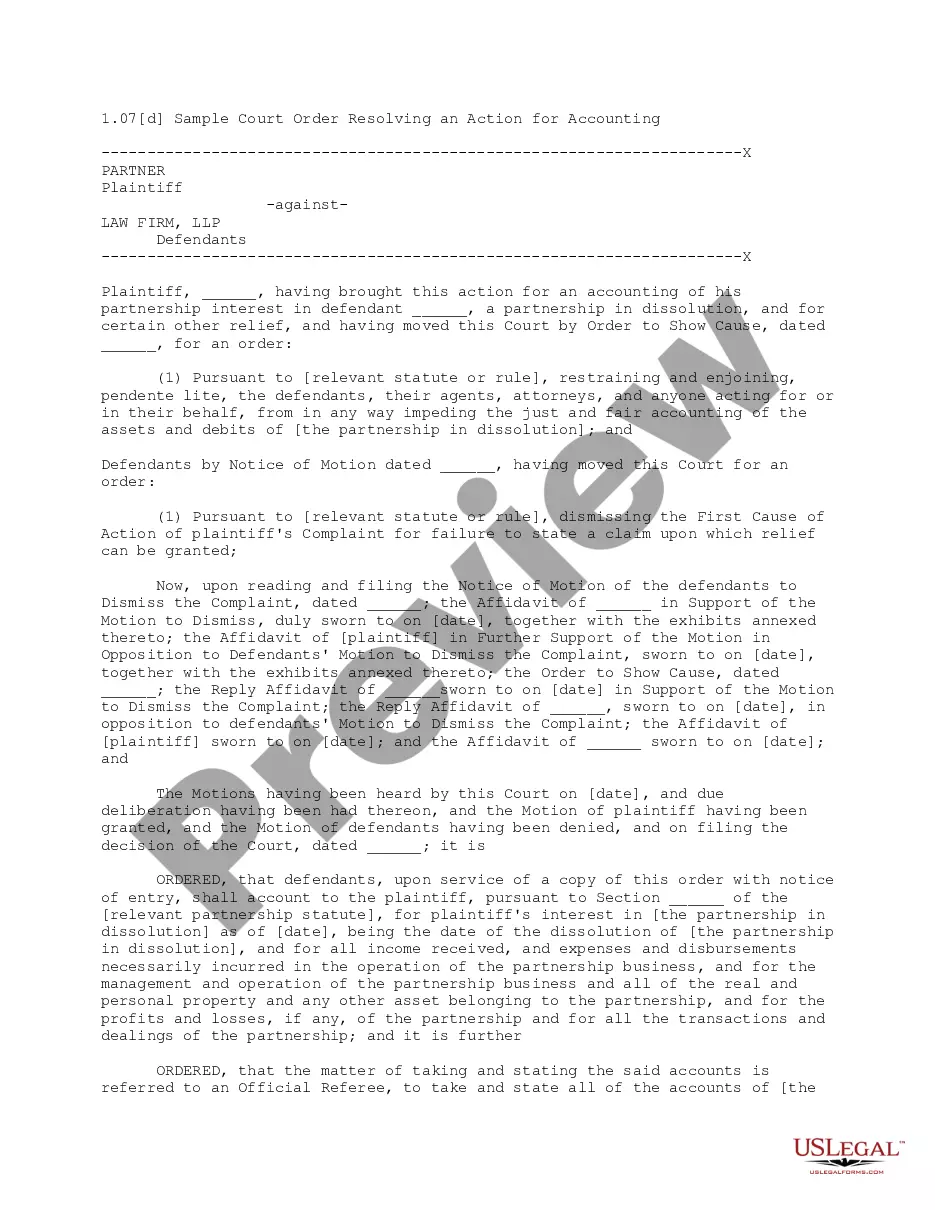
This is an Order Granting a Preliminary Injunction against defendants. The order provides that the court having considered the motion and the evidence submitted in support of the motion, finds that the request is well taken and should be sustained.
Missouri Order Granting Preliminary Injunction
State:
Multi-State
Category:
Control #:
US-01009
Format:
Word;
Rich Text
272 downloads
Description
Free preview


Get your form ready online
Our built-in tools help you complete, sign, share, and store your documents in one place.
Built-in online Word editor
Make edits, fill in missing information, and update formatting in US Legal Forms—just like you would in MS Word.
Export easily
Download a copy, print it, send it by email, or mail it via USPS—whatever works best for your next step.
E-sign your document
Sign and collect signatures with our SignNow integration. Send to multiple recipients, set reminders, and more. Go Premium to unlock E-Sign.
Notarize online 24/7
If this form requires notarization, complete it online through a secure video call—no need to meet a notary in person or wait for an appointment.
Store your document securely
We protect your documents and personal data by following strict security and privacy standards.
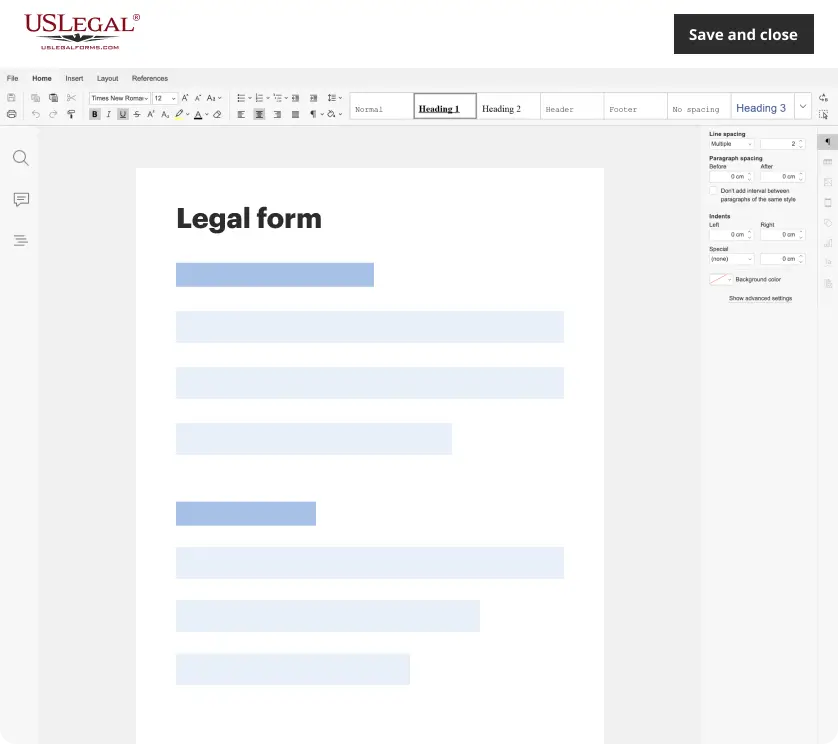
Make edits, fill in missing information, and update formatting in US Legal Forms—just like you would in MS Word.
Download a copy, print it, send it by email, or mail it via USPS—whatever works best for your next step.
Sign and collect signatures with our SignNow integration. Send to multiple recipients, set reminders, and more. Go Premium to unlock E-Sign.

If this form requires notarization, complete it online through a secure video call—no need to meet a notary in person or wait for an appointment.
We protect your documents and personal data by following strict security and privacy standards.
Looking for another form?
How to fill out Order Granting Preliminary Injunction?
If you wish to complete, acquire, or print legal document templates, utilize US Legal Forms, the largest collection of legal forms available online.
Employ the website's straightforward and user-friendly search to locate the documents you need.
A range of templates for business and personal applications are organized by categories and states, or keywords. Use US Legal Forms to find the Missouri Order Granting Preliminary Injunction in just a few clicks.
Every legal document template you obtain is yours forever. You can access every form you downloaded within your account. Visit the My documents section and choose a form to print or download again.
Stay competitive and obtain, and print the Missouri Order Granting Preliminary Injunction with US Legal Forms. There are numerous professional and state-specific forms available for your business or personal needs.
- If you are already a US Legal Forms customer, Log In to your account and click the Acquire button to access the Missouri Order Granting Preliminary Injunction.
- You can also reach forms you previously downloaded from the My documents tab of your account.
- If you are using US Legal Forms for the first time, follow the steps below.
- Step 1. Ensure you have selected the form for the correct area/state.
- Step 2. Utilize the Review feature to examine the form's content. Remember to read the details.
- Step 3. If you are not satisfied with the form, use the Search field at the top of the screen to find other versions of the legal form template.
- Step 4. After locating the form you need, click the Get now button. Choose the pricing plan you prefer and enter your credentials to sign up for an account.
- Step 5. Complete the transaction. You can use your Visa or Mastercard or PayPal account to finalize the purchase.
- Step 6. Select the format of the legal form and download it to your device.
- Step 7. Fill out, edit, and print or sign the Missouri Order Granting Preliminary Injunction.
Form popularity
FAQ
For example, if a lawsuit is filed challenging the validity of a new government regulation, the court might issue a preliminary injunction preventing the government from enforcing the regulation until the court can decide whether the regulation is valid.
It is well established that, to determine whether an injunction is ?just and proper,? courts apply the ?familiar set of four equitable factors: the movant's likelihood of success on the merits; the possibility of irreparable injury to the moving party; the extent to which the balance of hardships favors each party; and ...
To seek a permanent injunction, the plaintiff must pass the four-step test: (1) that the plaintiff has suffered an irreparable injury; (2) that remedies available at law, such as monetary damages, are inadequate to compensate for the injury; (3) that the remedy in equity is warranted upon consideration of the balance ...
It is well established that, to determine whether an injunction is ?just and proper,? courts apply the ?familiar set of four equitable factors: the movant's likelihood of success on the merits; the possibility of irreparable injury to the moving party; the extent to which the balance of hardships favors each party; and ...
In determining whether to issue a TRO or preliminary injunction, in the non-compete context or otherwise, Missouri courts consider: (1) the probability of success on the merits of the underlying claim; (2) whether the movant will suffer irreparable harm absent entry of an injunctive order; (3) whether the harm to be ...
When an appeal is taken from a judgment granting, dissolving, or denying an injunction, the court in its discretion may suspend, modify, restore, or grant an injunction during the pendency of the appeal upon such terms as to bond or otherwise as it considers proper for the security of the rights of the adverse party.
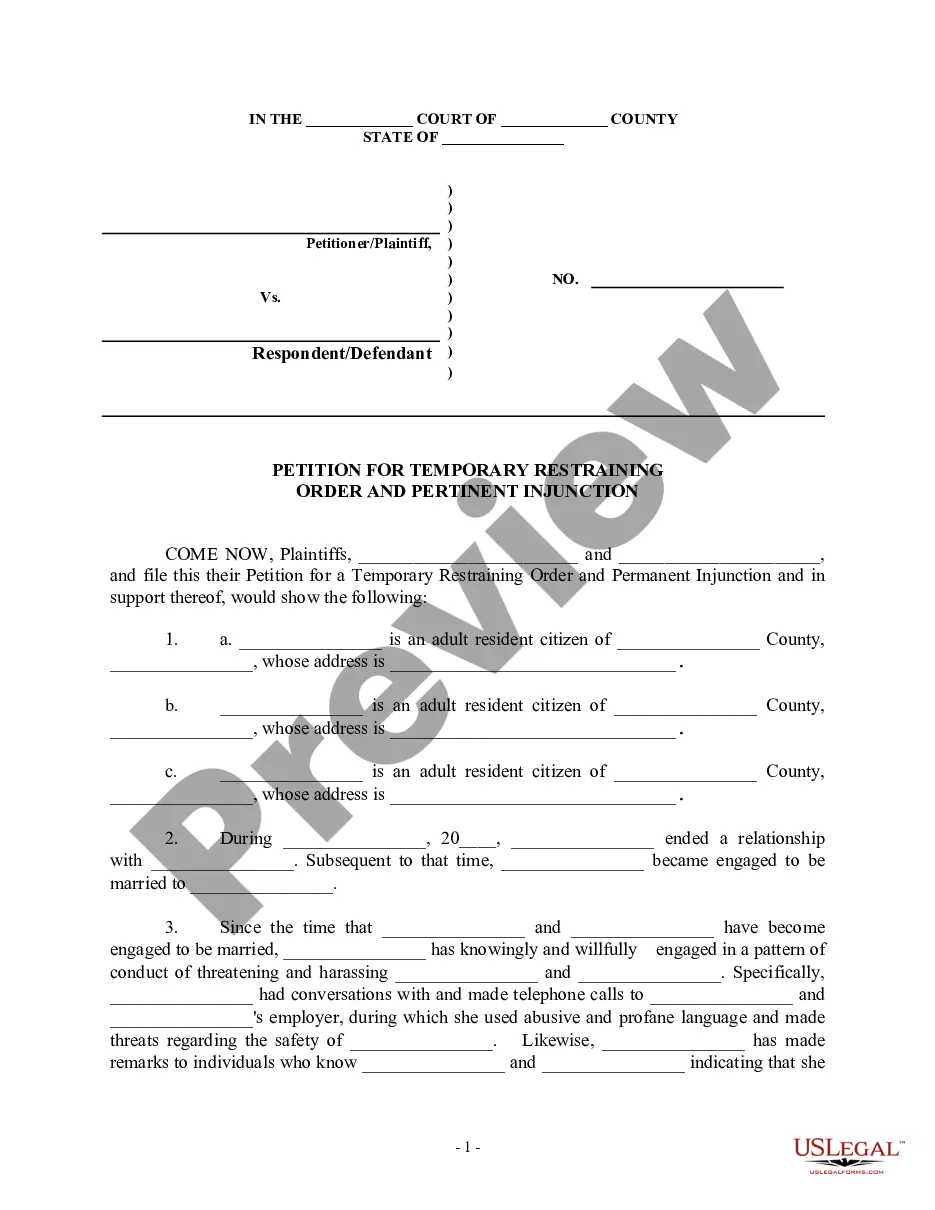
Description. An injunction or temporary restraining order is an order from the court prohibiting a party from performing or ordering a specified act, either temporarily or permanently.