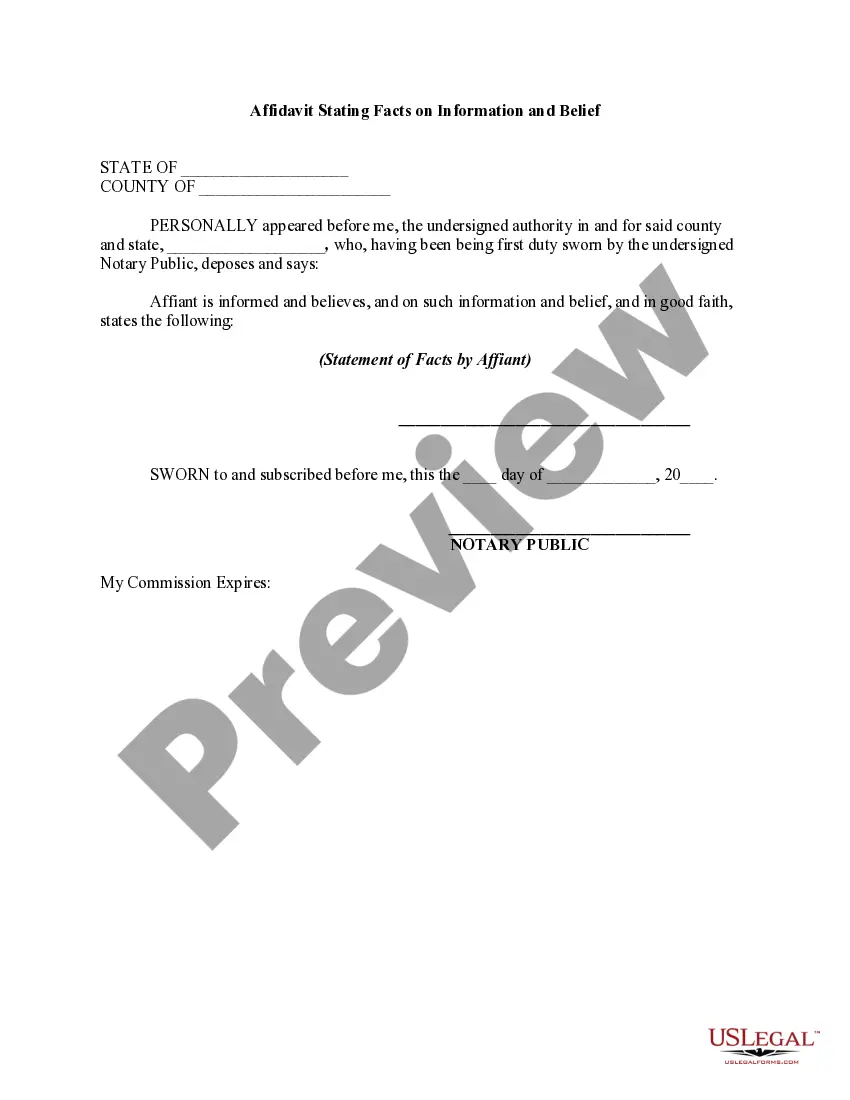
Missouri Affidavit Stating Facts on Information and Belief
Description
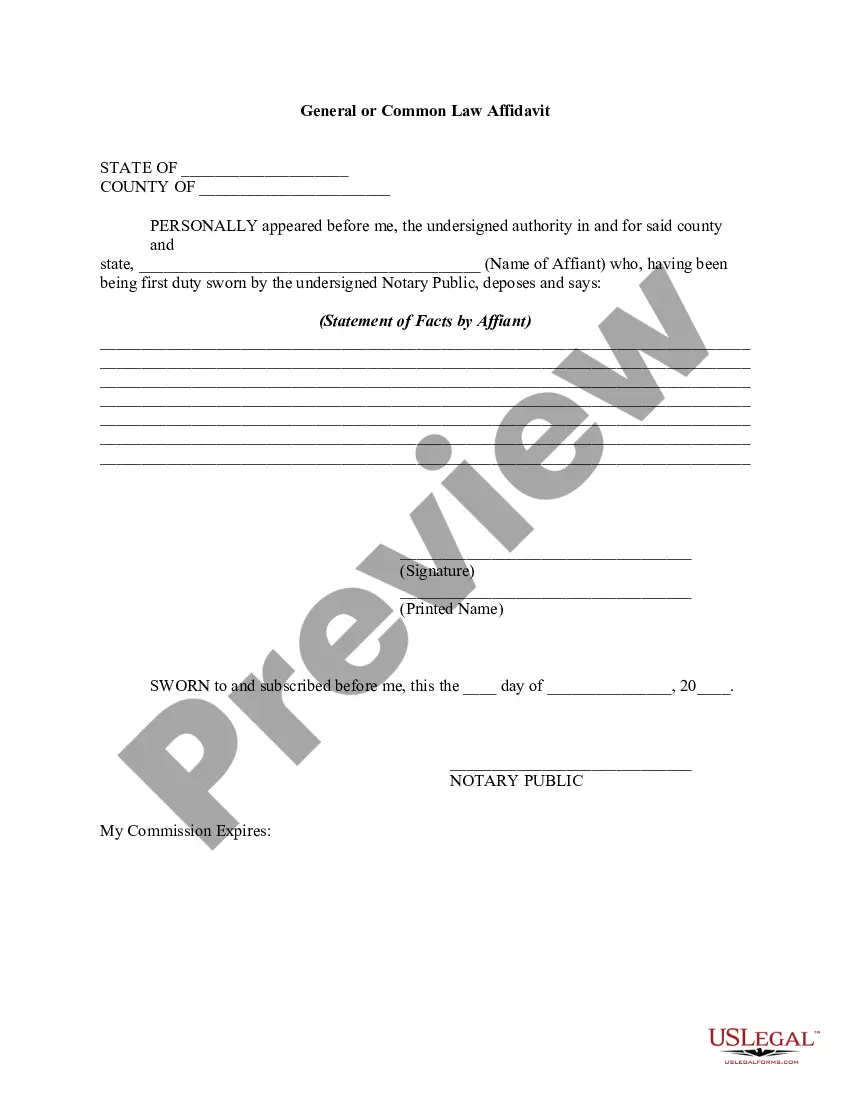

Get your form ready online
Our built-in tools help you complete, sign, share, and store your documents in one place.
Make edits, fill in missing information, and update formatting in US Legal Forms—just like you would in MS Word.
Download a copy, print it, send it by email, or mail it via USPS—whatever works best for your next step.
Sign and collect signatures with our SignNow integration. Send to multiple recipients, set reminders, and more. Go Premium to unlock E-Sign.
If this form requires notarization, complete it online through a secure video call—no need to meet a notary in person or wait for an appointment.
We protect your documents and personal data by following strict security and privacy standards.

Make edits, fill in missing information, and update formatting in US Legal Forms—just like you would in MS Word.

Download a copy, print it, send it by email, or mail it via USPS—whatever works best for your next step.

Sign and collect signatures with our SignNow integration. Send to multiple recipients, set reminders, and more. Go Premium to unlock E-Sign.

If this form requires notarization, complete it online through a secure video call—no need to meet a notary in person or wait for an appointment.

We protect your documents and personal data by following strict security and privacy standards.
Looking for another form?


How to fill out Affidavit Stating Facts On Information And Belief?
Have you ever been in a situation where you need to have documentation for either organizational or personal purposes almost every time.
There are numerous legal document templates accessible online, but finding ones you can rely on is not simple.
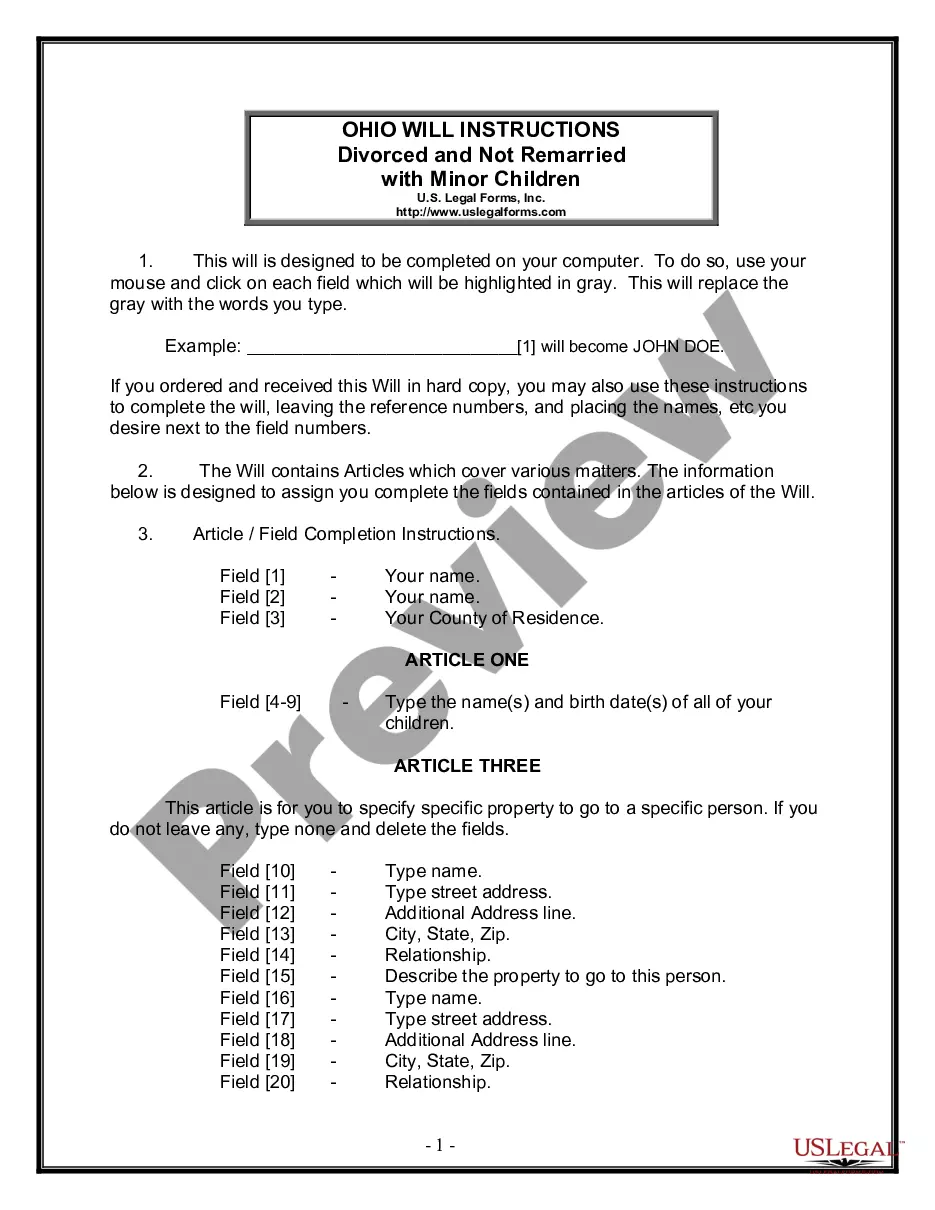
US Legal Forms offers thousands of document templates, such as the Missouri Affidavit Stating Facts on Information and Belief, which can be tailored to meet state and federal requirements.
Once you find the correct document, click Acquire now.
Select the payment plan you prefer, complete the necessary details to create your account, and pay for the order using your PayPal, Visa, or Mastercard.
- If you are already familiar with the US Legal Forms website and possess an account, simply Log In.
- Then, you can download the Missouri Affidavit Stating Facts on Information and Belief template.
- If you do not have an account and wish to start using US Legal Forms, follow these steps.
- Obtain the document you require and ensure it is for the correct city/state.
- Use the Preview button to review the form.
- Read the description to ensure you have selected the right document.
- If the document is not what you need, use the Search field to locate the form that fits your needs.
Form popularity
FAQ
? That the people shall be secure in their persons, papers, homes, effects, and electronic communications and data, from unreasonable searches and seizures; and no warrant to search any place, or seize any person or thing, or access electronic data or communication, shall issue without describing the place to be ...
Affidavits are written documents attached to an affirmation, such as a notary public oath, which states that the statements in the document are true. Declarations are written documents the writer believes are true, but the statements contained in the declaration are made without the writer being sworn in.
??The requirement that warrants shall particularly describe the things to be seized makes general searches under them impossible and prevents the seizure of one thing under a warrant describing another.
Once the affidavit is witnessed and attested to by a notary public or other official, it holds the force of law and binds the individual to the truthfulness of the information that they have provided.
Service by publication shall be proved by an affidavit showing the dates upon which and the newspaper in which the notice was published. A copy of the notice shall be attached to the affidavit which shall be filed.
A search warrant shall be executed as soon as practicable and shall expire if it is not executed and the return made within ten days after the date of the making of the application.
Warrant Requirement For Missouri police officers to obtain a warrant, they need to first sign an affidavit detailing circumstances and facts which will form a reasonable basis to search. An affidavit in support of the warrant will always include the police officer's observations and findings.
If you have a "Showcause/Failure to Pay" warrant: You must either pay the amount shown in full or appear before the judge during "walk-in" times. You can pay these charges by phone and have the warrant removed without having to appear before the judge.
A search warrant shall be executed as soon as practicable and shall expire if it is not executed and the return made within ten days after the date of the making of the application.
A sworn declaration (also called a sworn statement or a statement under penalty of perjury) is a document that recites facts pertinent to a legal proceeding. It is very similar to an affidavit but is not witnessed and sealed by an official such as a notary public.