Missouri Entry of Appearance
Understanding this form
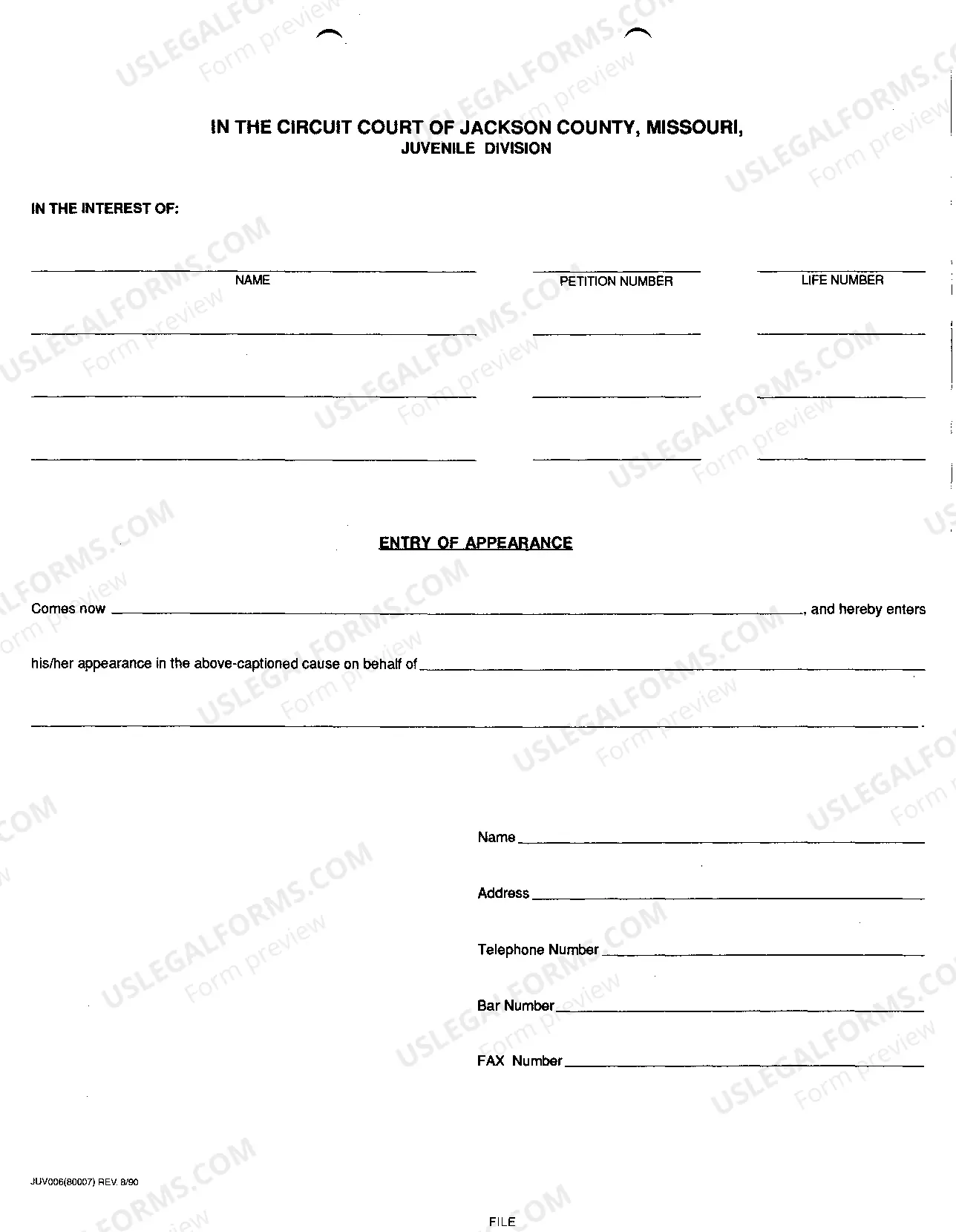
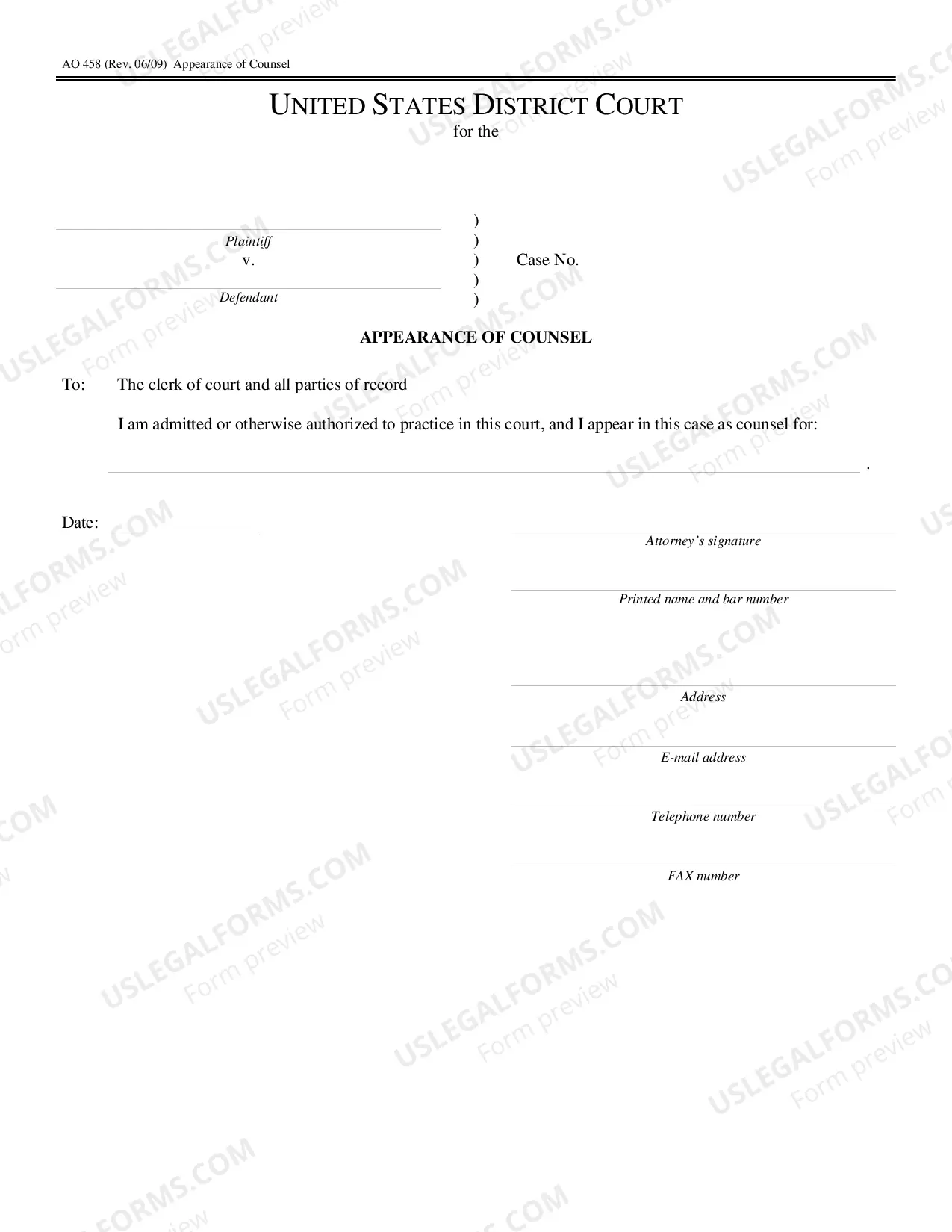
The Entry of Appearance is a legal document used by an attorney to formally notify the court and other parties that they represent a client in a legal proceeding. This form aims to establish the attorney's presence in the case and differentiate it from similar documents, such as a notice of appearance. By signing this form, the attorney accepts responsibility for the case and communicates their involvement to the court.
Key components of this form
- Case identification: Includes the court name and case number.
- Attorney information: Fields for the attorney's name, address, and contact details.
- Client representation: Declaration by the attorney stating their entry of appearance on behalf of the client.
- Signature: Space for the attorney's signature, which confirms their intent to represent the client.
Common use cases
This form is necessary when an attorney wishes to formally represent a client in a court case, particularly in the juvenile division of the Circuit Court. It should be used at the beginning of a case or whenever a new attorney steps in to represent a party in ongoing proceedings.
Who should use this form
The Entry of Appearance should be used by:
- Attorneys representing clients in juvenile court cases.
- Legal professionals who need to formally document their involvement in a case.
- Any party to a legal proceeding who has hired legal representation and wants the court to recognize their attorney.
Completing this form step by step
- Enter the name of the case and the petition number at the top of the form.
- Provide the attorney's name, address, and contact information in the designated fields.
- Clearly state the client's name that the attorney represents.
- Include the attorney's bar number and any relevant fax number.
- Sign and date the form to finalize the entry of appearance.
Is notarization required?
This form does not typically require notarization unless specified by local law. Be sure to check any specific court requirements that may apply in your jurisdiction.
Get your form ready online
Our built-in tools help you complete, sign, share, and store your documents in one place.
Make edits, fill in missing information, and update formatting in US Legal Forms—just like you would in MS Word.
Download a copy, print it, send it by email, or mail it via USPS—whatever works best for your next step.
Sign and collect signatures with our SignNow integration. Send to multiple recipients, set reminders, and more. Go Premium to unlock E-Sign.
If this form requires notarization, complete it online through a secure video call—no need to meet a notary in person or wait for an appointment.
We protect your documents and personal data by following strict security and privacy standards.

Make edits, fill in missing information, and update formatting in US Legal Forms—just like you would in MS Word.

Download a copy, print it, send it by email, or mail it via USPS—whatever works best for your next step.

Sign and collect signatures with our SignNow integration. Send to multiple recipients, set reminders, and more. Go Premium to unlock E-Sign.

If this form requires notarization, complete it online through a secure video call—no need to meet a notary in person or wait for an appointment.

We protect your documents and personal data by following strict security and privacy standards.
Avoid these common issues
- Failing to include all required attorney information.
- Not signing the form, which invalidates the entry of appearance.
- Using an incorrect case number or court name.
- Submitting the form after the deadline has passed for entering an appearance in a specific case.
Why complete this form online
- Convenient access allows you to download and complete the form at your own pace.
- Editability ensures you can make corrections easily before finalizing.
- Offers legal reliability, since all forms are drafted by licensed attorneys.
Legal use & context
- The Entry of Appearance is a legal requirement for attorneys to represent clients in court.
- Failure to file this form could result in the attorney not being recognized as the legal representative.
- This form helps in maintaining proper court records and ensures due process is followed.
Summary of main points
- The Entry of Appearance formally informs the court of an attorney's representation.
- It is essential to complete the form accurately and timely to protect client interests.
- Always check for jurisdiction-specific requirements before submission.
Looking for another form?


Form popularity
FAQ
Federal Rule 33 governs interrogatories in federal civil cases, outlining how parties may request information from each other. This rule allows for a structured way to gather facts, helping each side prepare for trial. Knowing about Federal Rule 33 can be particularly beneficial when you are involved in any interstate matters, especially if you also file the Missouri Entry of Appearance.
Common examples of Rule 33 include interrogatories, which are written questions that one party sends to another, requiring written responses. These can cover various topics related to the case, such as facts, evidence, or witness information. Familiarity with Rule 33 can enhance your understanding of the discovery process, especially when you file the Missouri Entry of Appearance.
Rule 25.05 in Missouri refers to the procedures for amending pleadings and motions. This rule provides guidelines for how and when a party can modify their filed documents to reflect changes in their claims or defenses. Being familiar with Rule 25.05 is advantageous, especially when preparing your Missouri Entry of Appearance, as it helps you adapt your legal strategy.
In Missouri, a party typically has 30 days to respond to a motion to dismiss after it is served. This timeframe is important as it allows you to present your arguments and defend against the motion effectively. By filing the Missouri Entry of Appearance, you establish your involvement, ensuring you meet all deadlines and requirements in the case.
Rule 33.5 in Missouri pertains to the procedures surrounding discovery requests in civil cases. This rule outlines how parties must respond to discovery inquiries, ensuring a fair exchange of information. Understanding Rule 33.5 can be crucial, especially when navigating the Missouri Entry of Appearance, as it impacts how you manage your case's documentation.
Entering an appearance means officially notifying the court and other parties that you are involved in a legal matter. This action indicates your intention to participate in the proceedings, whether you are representing yourself or have an attorney. By filing the Missouri Entry of Appearance, you assert your presence in the case, which is essential for protecting your legal rights.
A general entry of appearance is a specific type of entry that allows a party to participate in a legal case without contesting personal jurisdiction. This means you acknowledge the court's authority while reserving the right to raise any defenses later on. Utilizing the Missouri Entry of Appearance can help streamline your legal process and demonstrate your intent to engage with the court.
An entry of appearance form is a document filed with a court to notify that a party is participating in a legal proceeding. This form signals to the court and other parties that you intend to represent yourself or have retained an attorney. By submitting the Missouri Entry of Appearance, you ensure that you're officially recognized in the case, protecting your rights and interests.
The entry of appearance in Missouri is a formal document filed by an attorney to represent a client in a legal matter. Coupled with a waiver of service, it allows the attorney to handle communications and proceedings on behalf of their client, streamlining the process. This ensures that clients can focus on their case while their attorney manages the legal aspects effectively. For assistance in drafting these documents, consider using the US Legal Forms platform, which simplifies the process of completing your Missouri Entry of Appearance.
The initial appearance in Missouri is the first court date where a defendant appears before a judge. During this appearance, the judge informs the defendant of the charges and their rights. It's an important step in the legal process, as it sets the stage for future proceedings. If you're navigating this process, understanding your Missouri Entry of Appearance is essential.