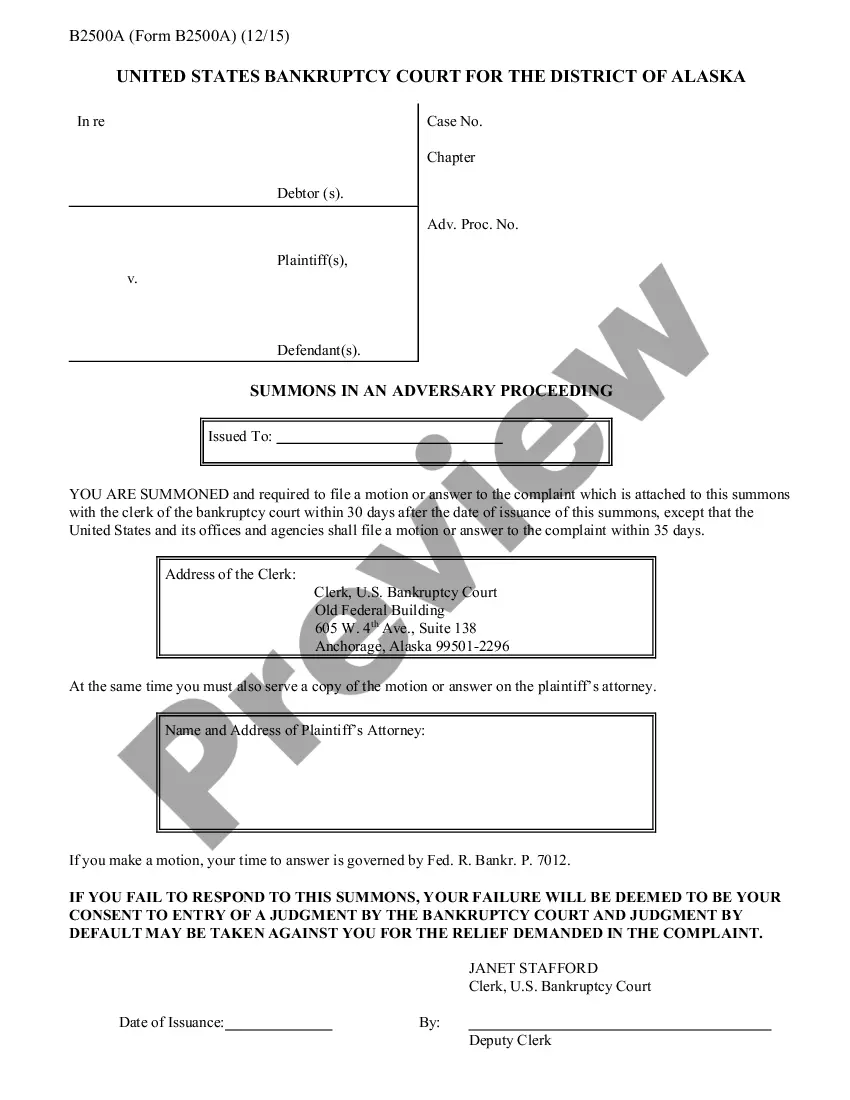
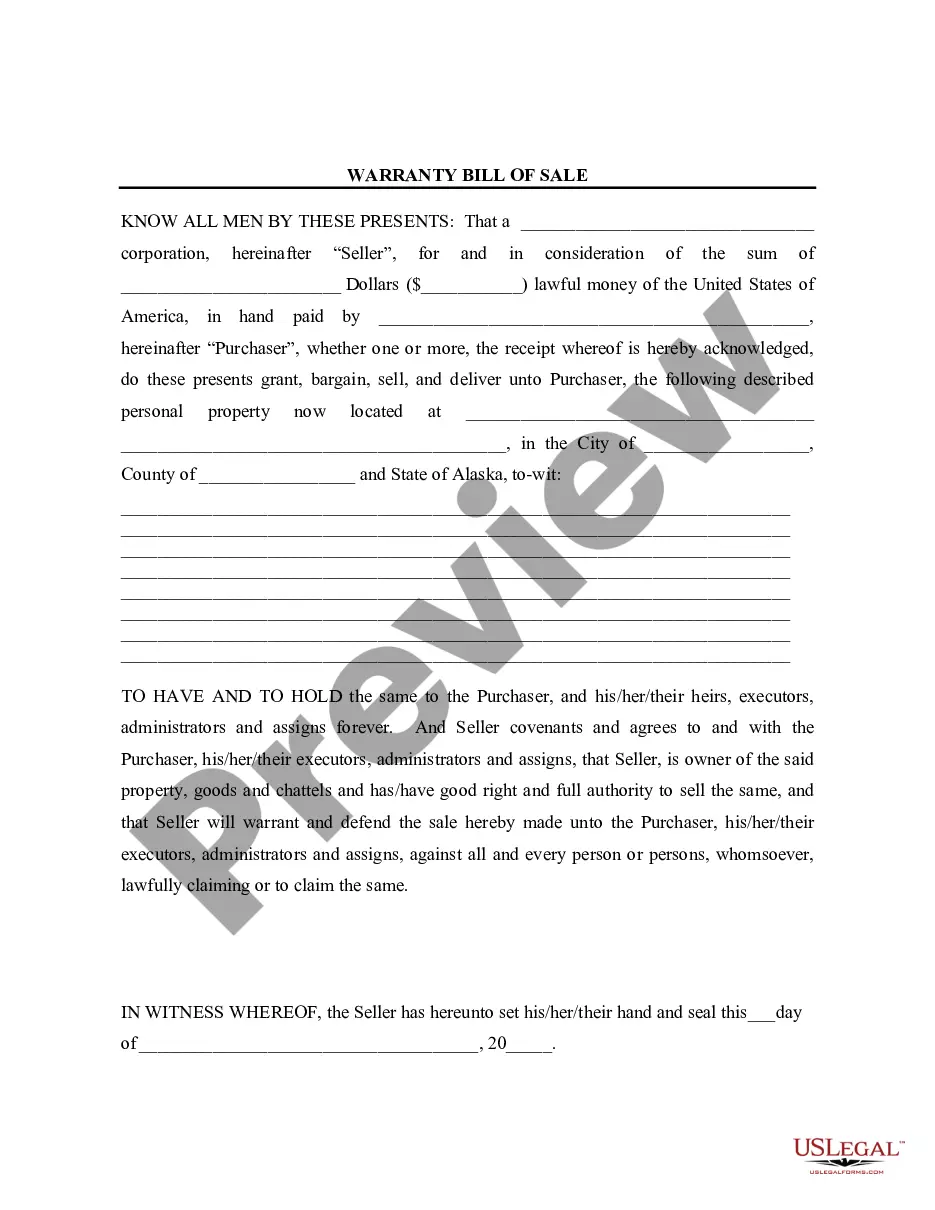
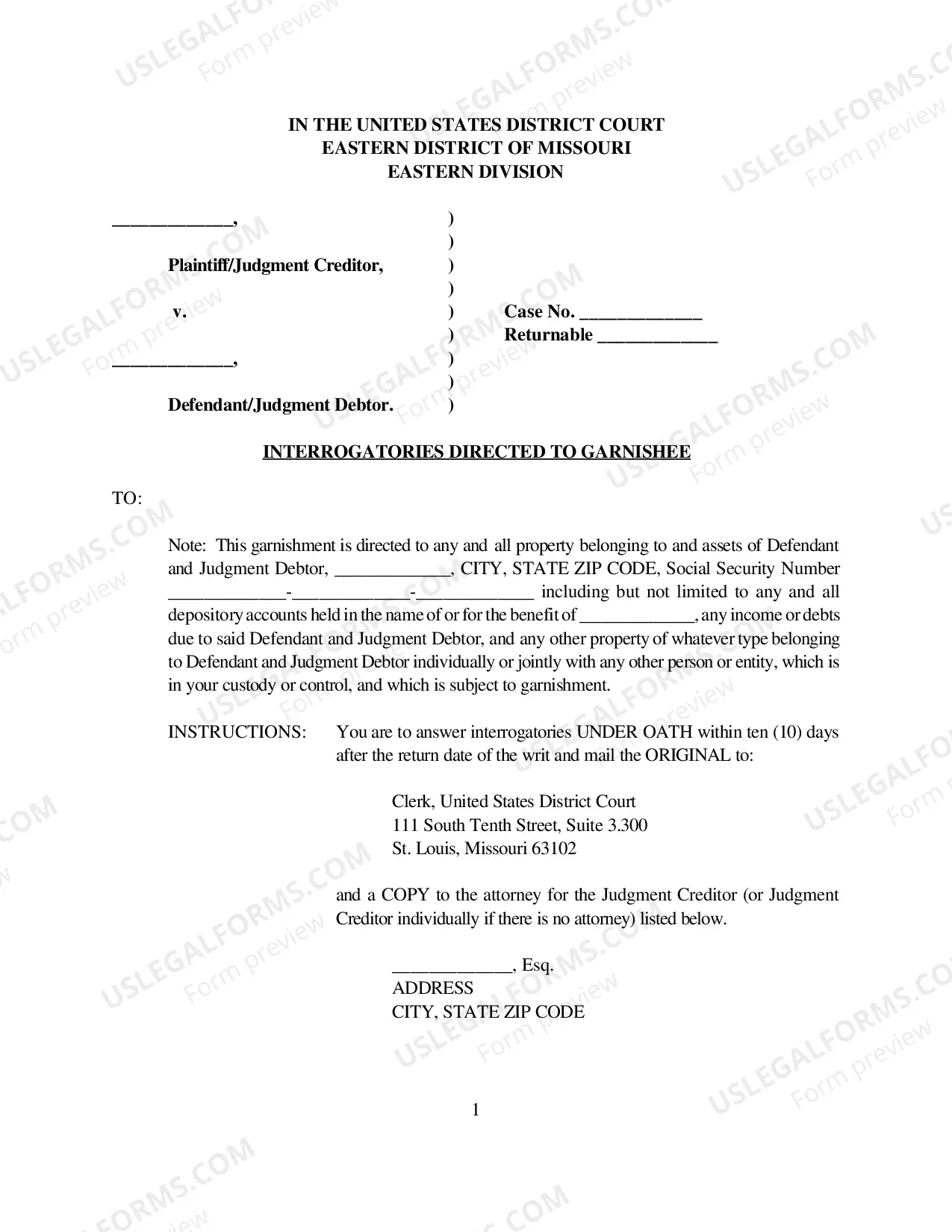
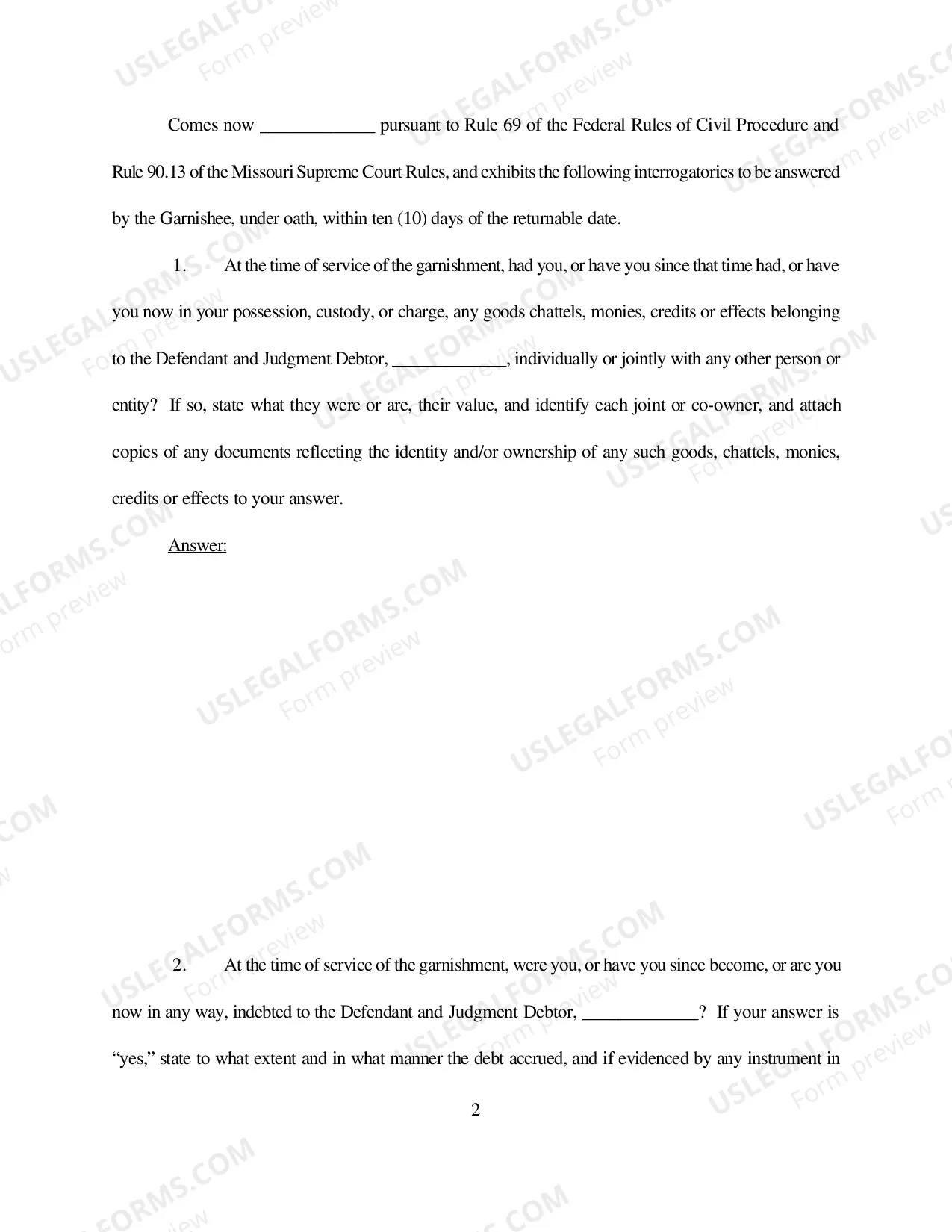
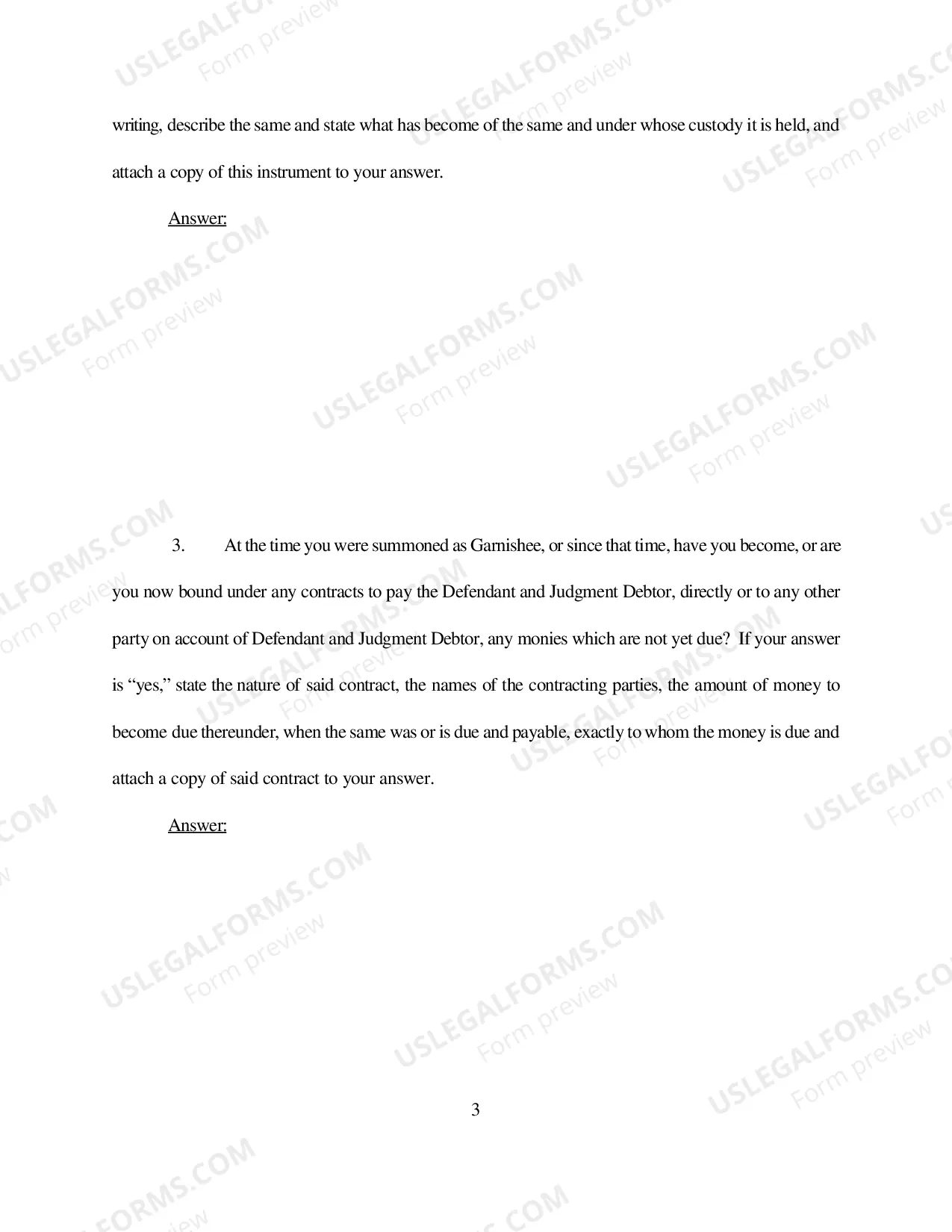
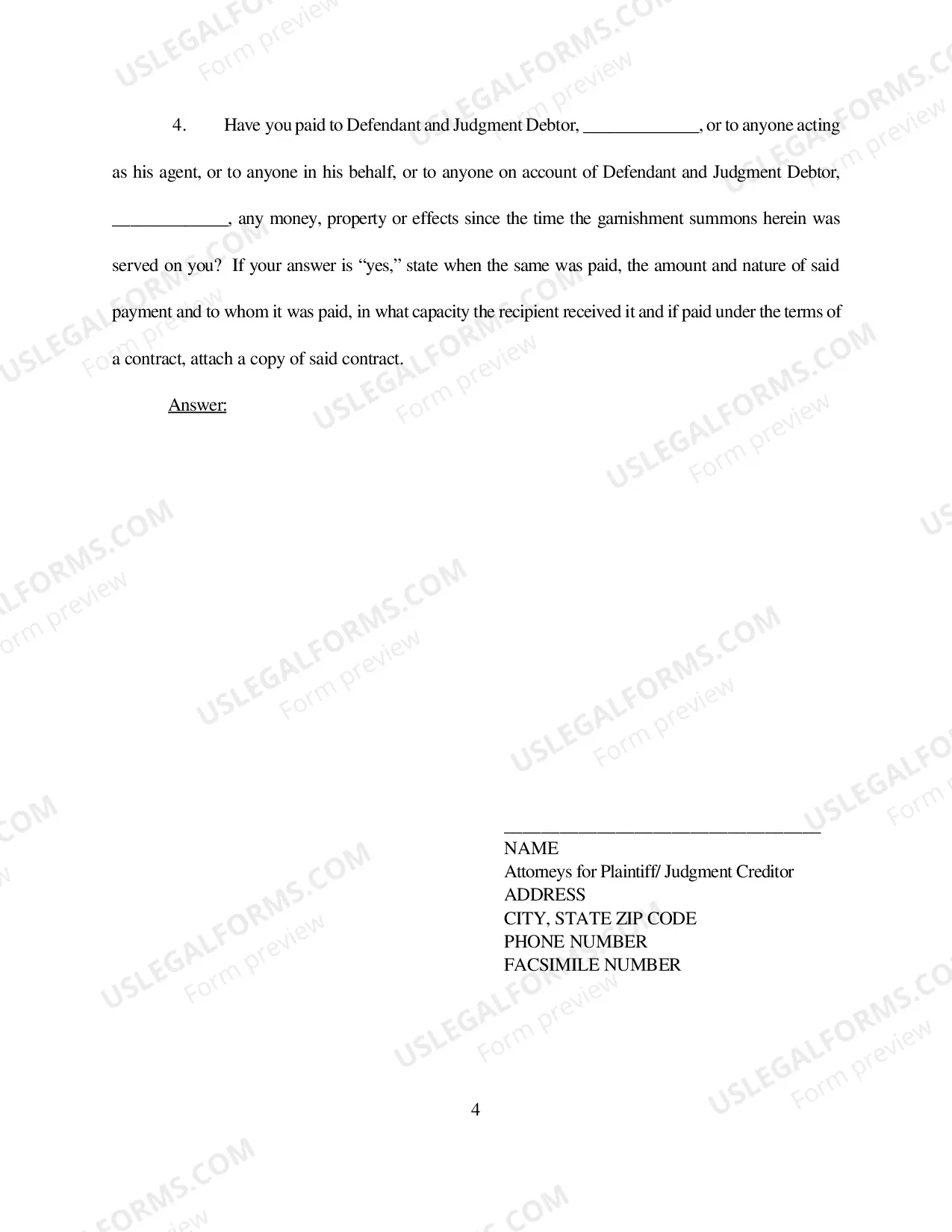
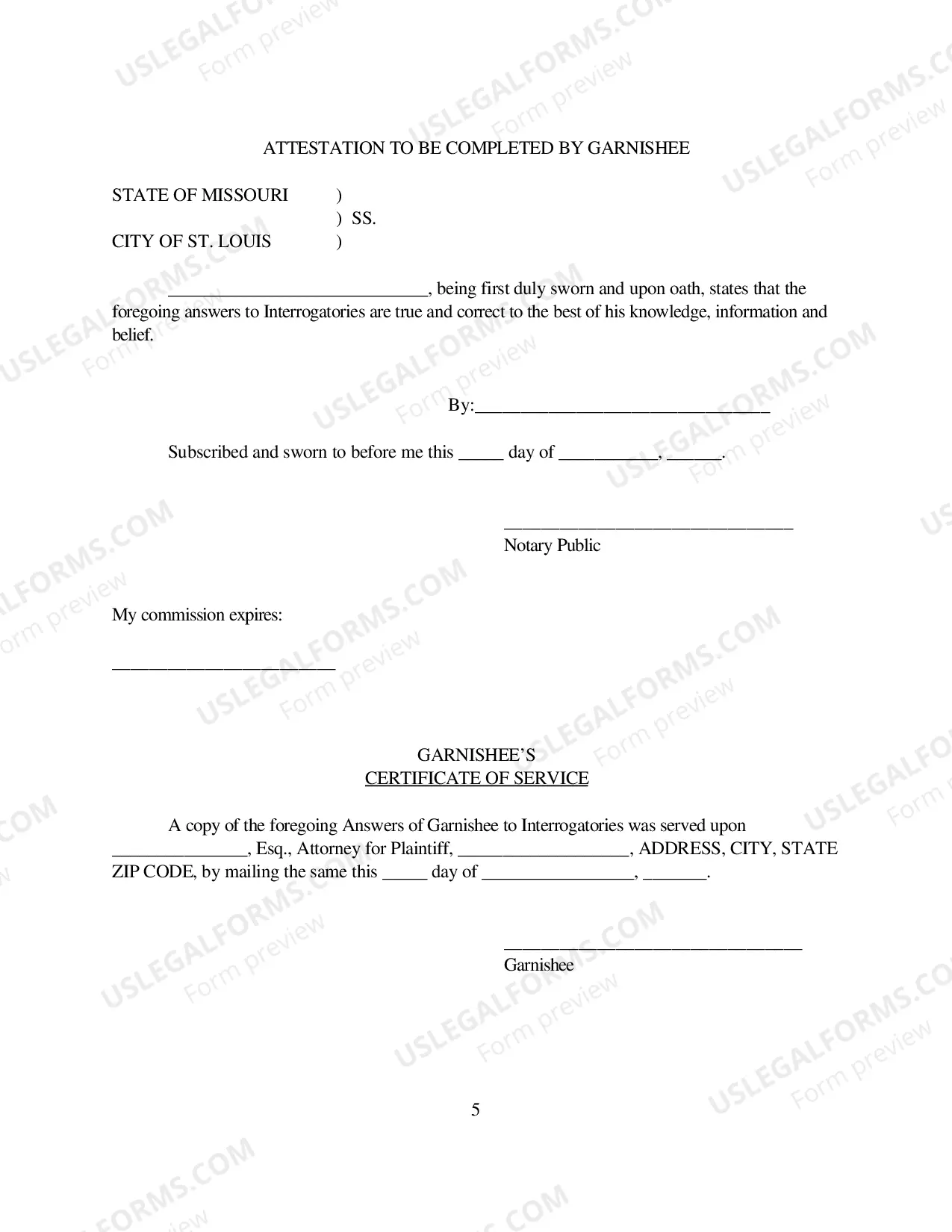
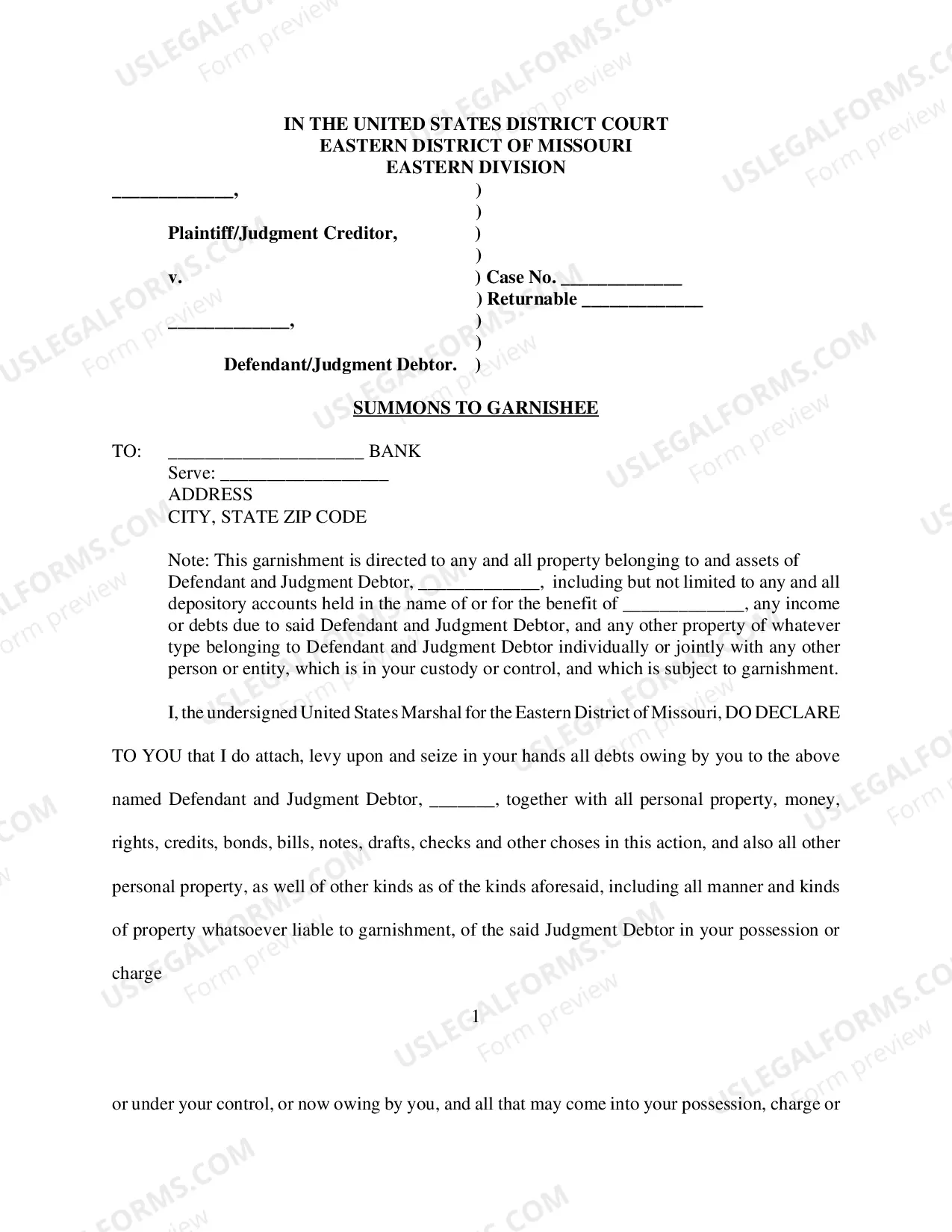
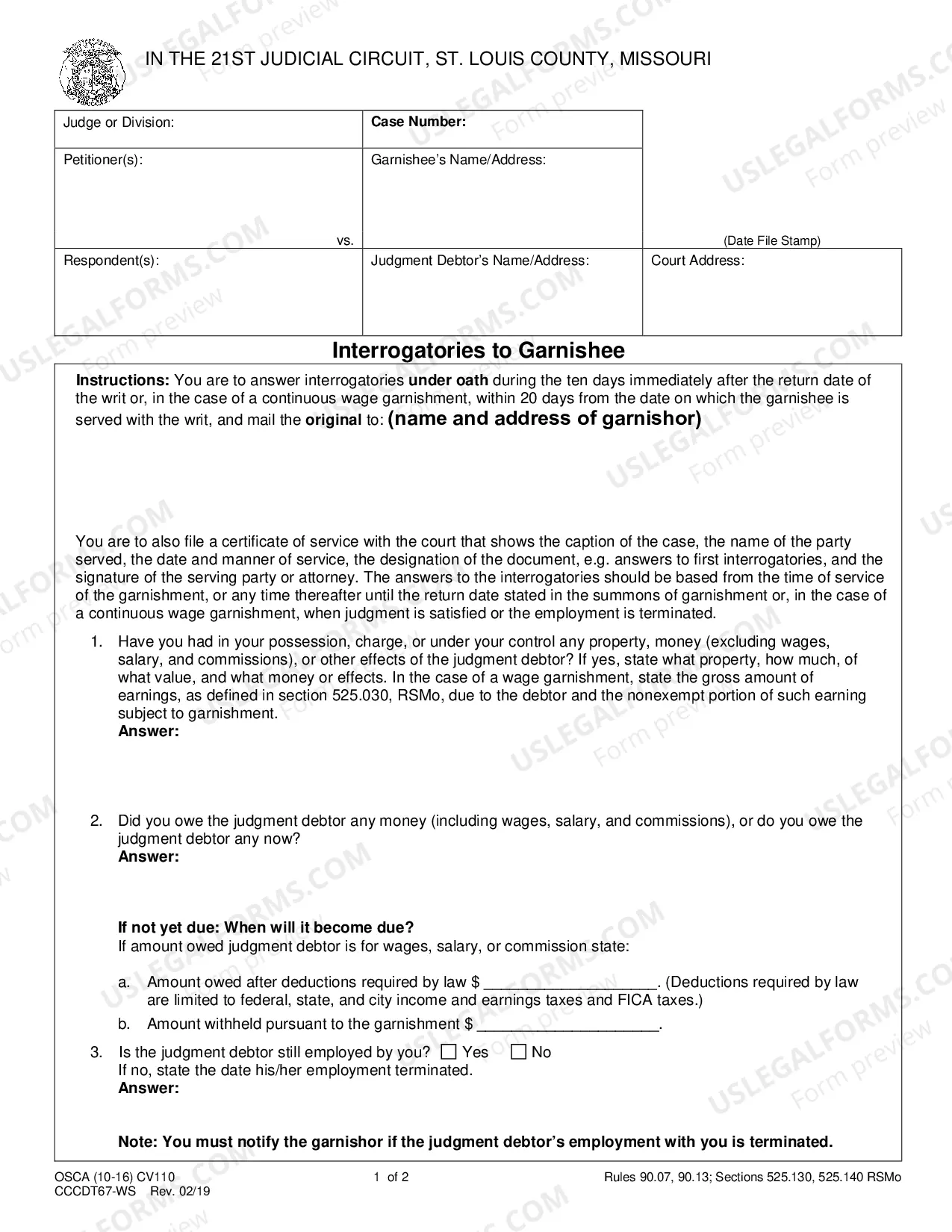
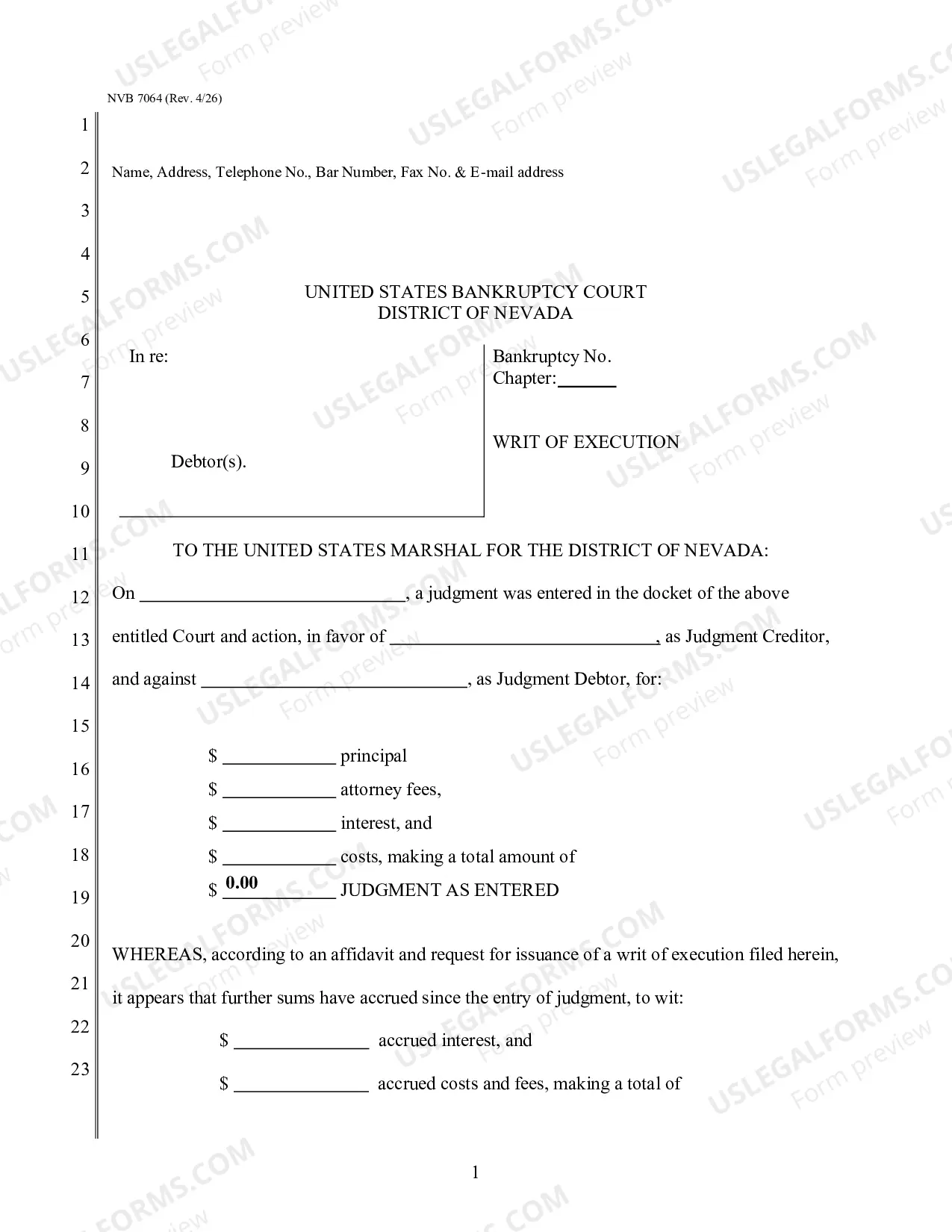
Missouri Interrogatories Directed To Garnishee (Writ of Execution) is a legal document issued by a court in which the court orders a third party (the “Garnishee”) to answer questions posed by the plaintiff (the “Judgment Creditor”) regarding its ability to satisfy the plaintiff’s judgment against the defendant (the “Judgment Debtor”). The questions posed in the interrogatories are intended to discover any assets or funds that the Garnishee may have in its possession that belong to the Judgment Debtor, and whether those assets or funds can be used to satisfy the Judgment Creditor’s claim. There are two types of Missouri Interrogatories Directed To Garnishee (Writ of Execution): 1) Interrogatories Directed To Garnishee, and 2) Garnishee’s Answer to Interrogatories. The Interrogatories Directed To Garnishee are the questions posed by the Judgment Creditor to the Garnishee; the Garnishee’s Answer to Interrogatories is the Garnishee’s response to the questions posed by the Judgment Creditor.
Missouri Interrogatories Directed To Garnishee (Writ of Execution)
Description
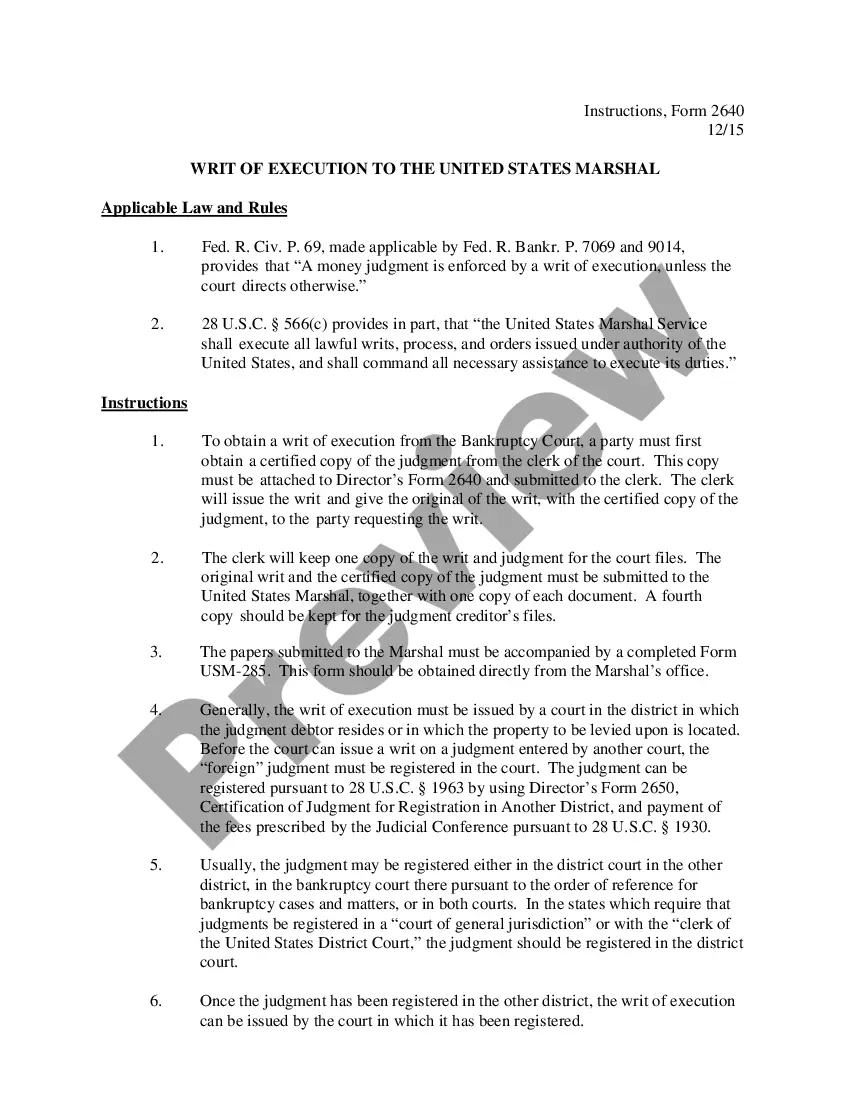
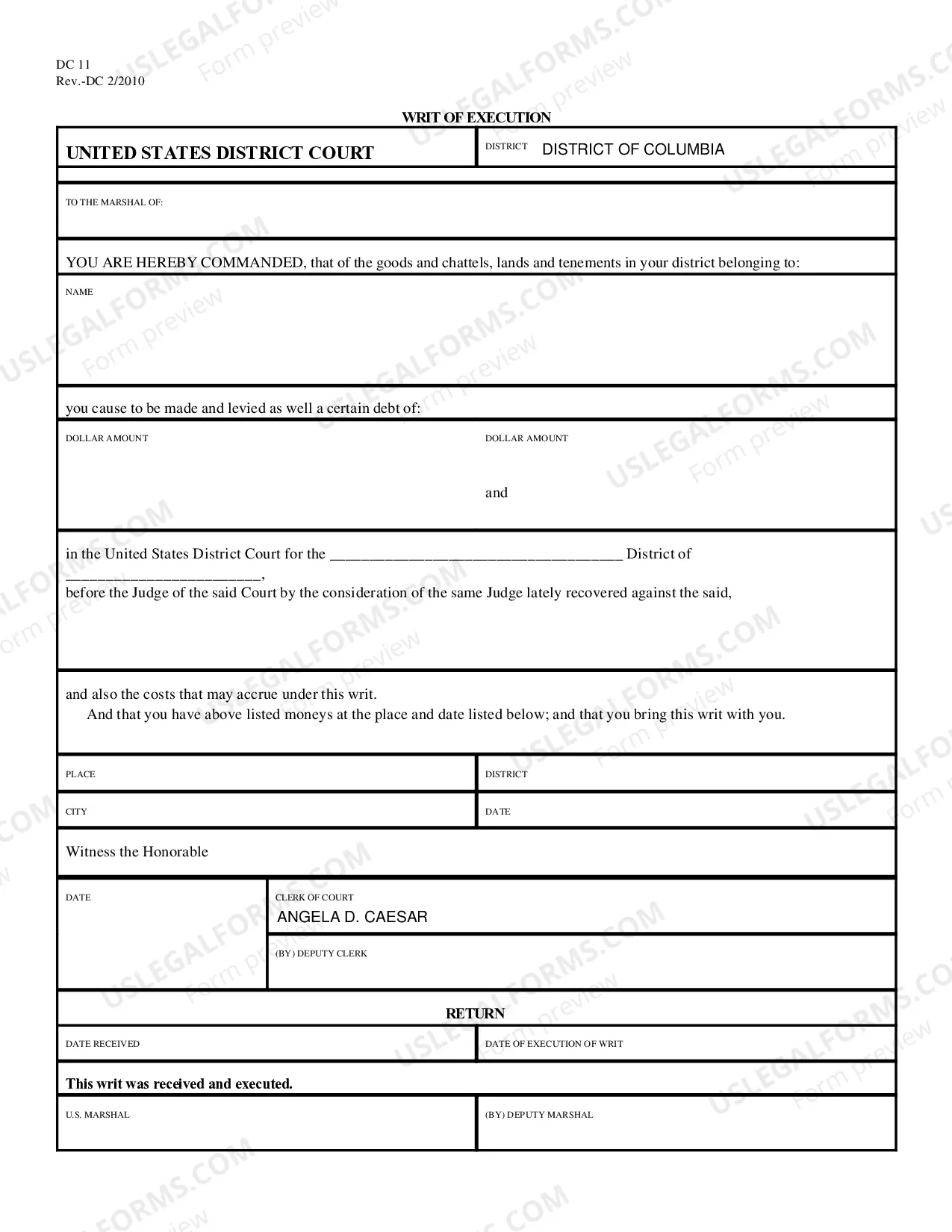
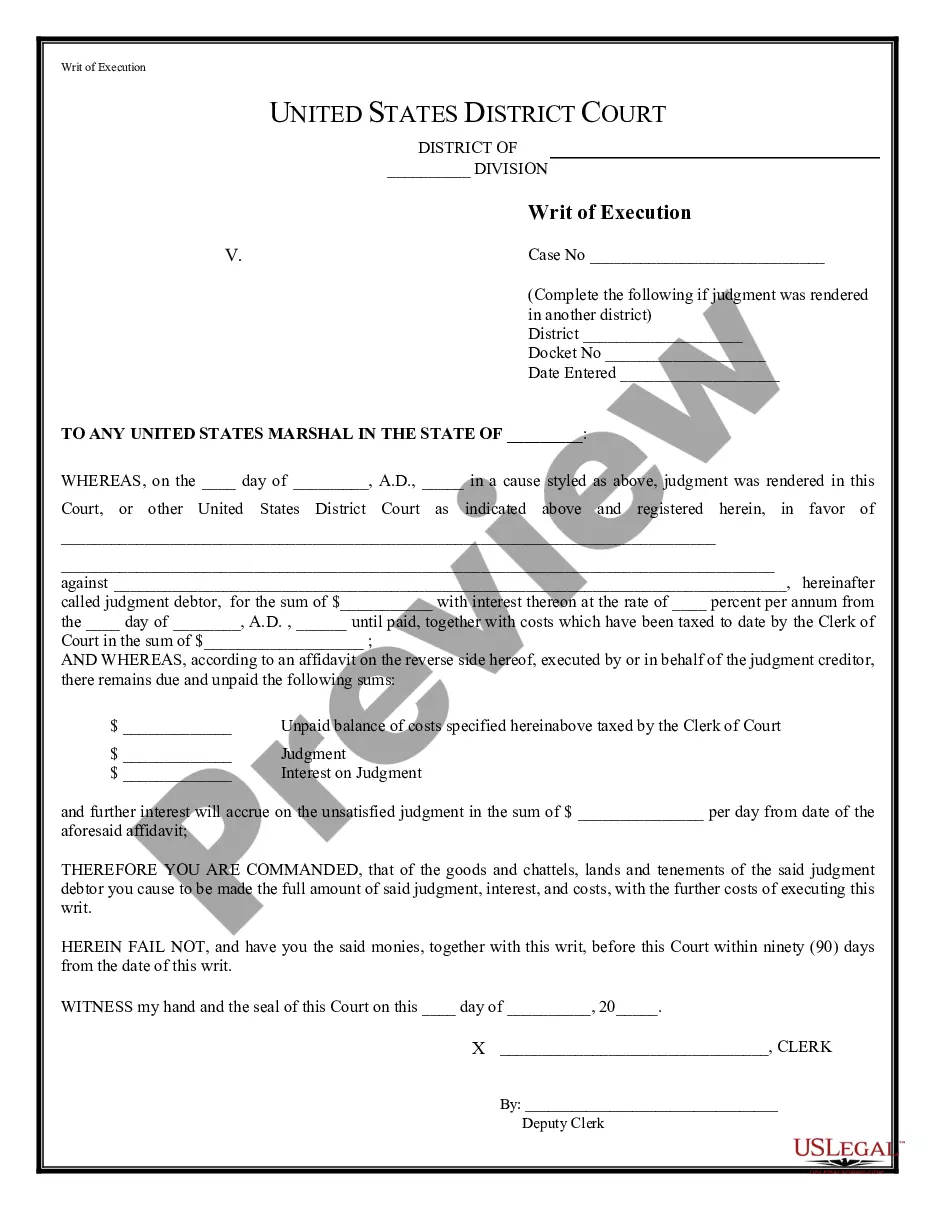
Get your form ready online
Our built-in tools help you complete, sign, share, and store your documents in one place.
Make edits, fill in missing information, and update formatting in US Legal Forms—just like you would in MS Word.
Download a copy, print it, send it by email, or mail it via USPS—whatever works best for your next step.
Sign and collect signatures with our SignNow integration. Send to multiple recipients, set reminders, and more. Go Premium to unlock E-Sign.
If this form requires notarization, complete it online through a secure video call—no need to meet a notary in person or wait for an appointment.
We protect your documents and personal data by following strict security and privacy standards.

Make edits, fill in missing information, and update formatting in US Legal Forms—just like you would in MS Word.

Download a copy, print it, send it by email, or mail it via USPS—whatever works best for your next step.

Sign and collect signatures with our SignNow integration. Send to multiple recipients, set reminders, and more. Go Premium to unlock E-Sign.

If this form requires notarization, complete it online through a secure video call—no need to meet a notary in person or wait for an appointment.

We protect your documents and personal data by following strict security and privacy standards.
Looking for another form?


How to fill out Missouri Interrogatories Directed To Garnishee (Writ Of Execution)?
How much time and resources do you typically allocate to creating formal documents.
There’s a more efficient alternative to obtaining such forms than hiring legal professionals or spending excessive time searching the internet for a suitable template.
Establish an account and process your subscription payment. You can pay using your credit card or through PayPal - our service is completely secure for that.
Download your Missouri Interrogatories Directed To Garnishee (Writ of Execution) onto your device and complete it on a printed hard copy or digitally.
- US Legal Forms is the premier online repository that provides expertly crafted and validated state-specific legal paperwork for any purpose, such as the Missouri Interrogatories Directed To Garnishee (Writ of Execution).
- To acquire and prepare an appropriate Missouri Interrogatories Directed To Garnishee (Writ of Execution) template, follow these straightforward steps.
- Examine the form content to ensure it adheres to your state regulations. To verify this, review the form description or utilize the Preview option.
- If your legal template does not fulfill your requirements, find another one by using the search bar at the top of the page.
- If you already possess an account with us, Log In and download the Missouri Interrogatories Directed To Garnishee (Writ of Execution). If not, continue to the subsequent steps.
- Click Buy now once you locate the appropriate document. Select the subscription plan that best meets your needs to access our library’s complete service.
Form popularity
FAQ
To write a hardship letter to stop a garnishment, start by clearly stating your financial situation and the impact of the garnishment on your life. Explain the reasons for your hardship, such as job loss or medical expenses, and provide supporting documentation if possible. It is essential to request a specific resolution, such as a temporary pause on the garnishment. Utilizing resources like USLegalForms can guide you in drafting a compelling letter that addresses your circumstances effectively.
The purpose of Missouri Interrogatories Directed To Garnishee (Writ of Execution) is to gather information from a third party who may hold funds belonging to a debtor. This legal tool helps creditors identify the assets available for garnishment. By submitting these interrogatories, you can ensure that you receive accurate details about the debtor's financial situation. Ultimately, this process can facilitate the recovery of owed amounts effectively.
A writ of garnishment specifically targets funds owed to the debtor by a third party, whereas a writ of execution allows the seizure of the debtor's property directly. The writ of garnishment focuses on collecting debts from wages or bank accounts, while the writ of execution can extend to physical assets. Both tools can be used effectively in conjunction with Missouri Interrogatories Directed To Garnishee (Writ of Execution) to maximize recovery efforts. Understanding these differences can empower you in debt recovery strategies.
Interrogatories in garnishment are written questions that the creditor sends to the garnishee, aimed at uncovering the debtor's financial status. These questions seek information about what assets the garnishee holds on behalf of the debtor. Responding to Missouri Interrogatories Directed To Garnishee (Writ of Execution) is crucial, as it determines the extent to which the creditor can collect from the debtor. This process helps ensure a fair and transparent resolution to debt collection.
In Missouri, the garnishment process begins when a creditor obtains a court judgment against a debtor. The creditor then files a request for a writ of garnishment, which directs a third party, known as the garnishee, to withhold funds owed to the debtor. The garnishee must respond to Missouri Interrogatories Directed To Garnishee (Writ of Execution) to provide details about the debtor's assets. This process allows creditors to collect debts directly from the debtor's wages or bank accounts.
The bank garnishment is good for 30, 60, 90 or 180 days, at the choice of the judgment creditor (plaintiff). The expiration date of the bank garnishment is called the "return date."
Under Missouri law, for any workweek, a creditor can garnish the lesser of: 25% of your disposable earnings, or 10% of your disposable earnings if you're the head of a family and a resident of the state, or. the amount by which your weekly disposable earnings exceed 30 times the federal hourly minimum wage. (Mo.
90.08. If the garnishee fails to answer or improperly answers interrogatories, the court shall, upon motion, order the garnishee to answer or properly answer the interrogatories.
?Missouri discovery rules allow so-called 'contention interrogatories,' which allow a party to discover the factual theory of the adversary's case. Rule 57.01(c).? State ex rel. Dean v. Cunningham, 182 S.W.
90.18 STAYING, QUASHING, OR VACATING WRIT Reasonable notice of the time of the hearing on the motion shall be given to all interested parties.