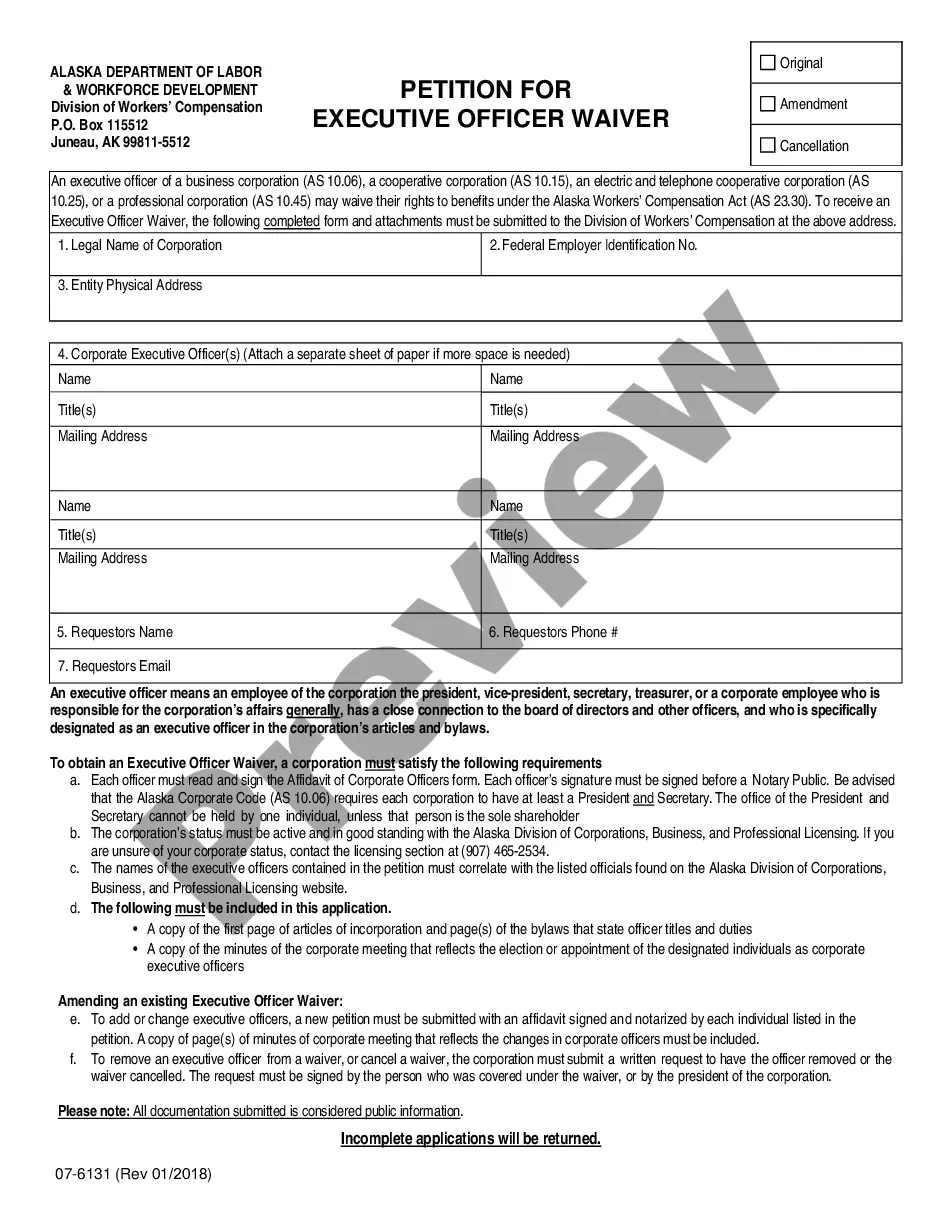
The Missouri Audio Recording Order is a state law that regulates the circumstances in which an individual or business may record audio of a conversation or activity. This law applies to all audio recordings made in the state of Missouri, regardless of the location of the recorder or the participants in the conversation. The law covers both digital and analog recordings. There are two types of Missouri Audio Recording Order: one-party and two-party. Under one-party recording, only one person in the conversation needs to be aware that the conversation is being recorded. Under two-party recording, all parties must give their consent before the recording can take place. In either case, the person or business recording must inform all parties that the recording is taking place. In addition, the recordings must take place in an area where the conversation cannot be overheard by others. The Missouri Audio Recording Order also has provisions for the use of recordings in court proceedings. The recordings must be admissible as evidence in court and must be properly authenticated in order to be accepted. The Missouri Audio Recording Order is designed to protect the privacy of individuals and businesses. It is important to understand the law and abide by its provisions in order to ensure the legality of audio recordings.
Missouri Audio Recording Order
Description
Get your form ready online
Our built-in tools help you complete, sign, share, and store your documents in one place.
Make edits, fill in missing information, and update formatting in US Legal Forms—just like you would in MS Word.
Download a copy, print it, send it by email, or mail it via USPS—whatever works best for your next step.
Sign and collect signatures with our SignNow integration. Send to multiple recipients, set reminders, and more. Go Premium to unlock E-Sign.
If this form requires notarization, complete it online through a secure video call—no need to meet a notary in person or wait for an appointment.
We protect your documents and personal data by following strict security and privacy standards.

Make edits, fill in missing information, and update formatting in US Legal Forms—just like you would in MS Word.

Download a copy, print it, send it by email, or mail it via USPS—whatever works best for your next step.

Sign and collect signatures with our SignNow integration. Send to multiple recipients, set reminders, and more. Go Premium to unlock E-Sign.

If this form requires notarization, complete it online through a secure video call—no need to meet a notary in person or wait for an appointment.

We protect your documents and personal data by following strict security and privacy standards.
Looking for another form?
How to fill out Missouri Audio Recording Order?
How much time and resources do you generally allocate for creating official documents.
There’s a more efficient method to obtain such forms than employing legal professionals or spending countless hours searching online for a suitable template. US Legal Forms is the premier online repository that provides expertly crafted and validated state-specific legal documents for any purpose, such as the Missouri Audio Recording Order.
Another advantage of our service is that you can access previously downloaded documents that you securely store in your profile under the My documents tab. Retrieve them anytime and re-complete your paperwork as often as necessary.
Conserve time and effort completing legal documents with US Legal Forms, one of the most trustworthy online solutions. Join us today!
- Review the form content to confirm it complies with your state regulations. To do this, examine the form description or use the Preview option.
- If your legal template does not fulfill your needs, search for another one using the search tab at the top of the page.
- If you are already registered with our service, Log In and download the Missouri Audio Recording Order. If not, continue to the following steps.
- Click Buy now once you discover the appropriate blank. Choose the subscription plan that best fits your needs to access our library’s complete service.
- Create an account and pay for your subscription. You can complete your payment with a credit card or through PayPal - our service is completely secure for that.
- Download your Missouri Audio Recording Order onto your device and fill it out on a printed hard copy or electronically.
Form popularity
FAQ
Several states, including Missouri, operate under 1 party consent laws for recording conversations. This means that only one person involved in the conversation needs to agree to the recording. Other states with similar laws include California, Texas, and New York, among others. It's important to understand the laws in each state, especially if you plan to use the recording in legal proceedings or discussions, such as those outlined in the Missouri Audio Recording Order.
Yes, you can potentially sue someone for recording you without your permission in Missouri, particularly if you were not part of the conversation. Legal actions may arise if the recording violates your privacy rights under the Missouri Audio Recording Order. However, you should consult with a legal expert to assess the viability of your case. They can provide guidance on the best course of action based on the specifics of your situation.
In Missouri, a coworker can legally record you without your consent if they are a participant in the conversation. This falls under the state's 1 party consent law. However, it’s important to consider workplace policies and ethical implications of such actions. If you feel uncomfortable about being recorded, you should address this with your coworker or consult HR about your rights.
Recording a conversation without asking can be illegal in Missouri, but it largely depends on whether you are part of the conversation. In a 1 party consent state like Missouri, you may record as long as you are one of the participants. However, if you are not part of the conversation, recording without consent could lead to legal troubles. Always refer to the Missouri Audio Recording Order for guidance on specific scenarios.
Yes, Missouri is a 1 party consent recording state. This means that only one party involved in the conversation needs to consent to the recording for it to be legal. Therefore, if you are part of the conversation and you choose to record it, you do not need permission from the other party. However, understanding the implications of the Missouri Audio Recording Order is crucial to avoid potential legal issues.
To get an audio recording into evidence, you must first ensure that it complies with Missouri Audio Recording Order regulations. This typically involves demonstrating that the recording was made legally, either by obtaining consent or ensuring that the recording falls under an exemption. Next, you should properly authenticate the recording, which may require witness testimony or other documentation. Consulting with a legal professional can help you navigate the complexities of this process.
One-party consent states are: Alabama. Alaska. Arizona. Arkansas. Colorado. Connecticut (for in-person conversations or phone calls recorded by a participant of the conversation) Delaware. District of Columbia.
Eleven states require the consent of every party to a phone call or conversation in order to make the recording lawful. These "two-party consent" laws have been adopted in California, Connecticut, Florida, Illinois, Maryland, Massachusetts, Montana, New Hampshire, Pennsylvania and Washington.
Eleven states require two-party consent, however. In other words, everyone involved in a conversation must agree to be recorded. Those states are California, Delaware, Florida, Illinois, Maryland, Massachusetts, Montana, Nevada, New Hampshire, Pennsylvania, and Washington. (Don't let the phrase ?two-party? throw you.
One-party consent or single-party consent means that you can record a call or meeting as long as you have consent from one of the parties in the meeting.