Missouri Trustee's Deed - Two Trustees to Husband and Wife / Two Individuals
About this form
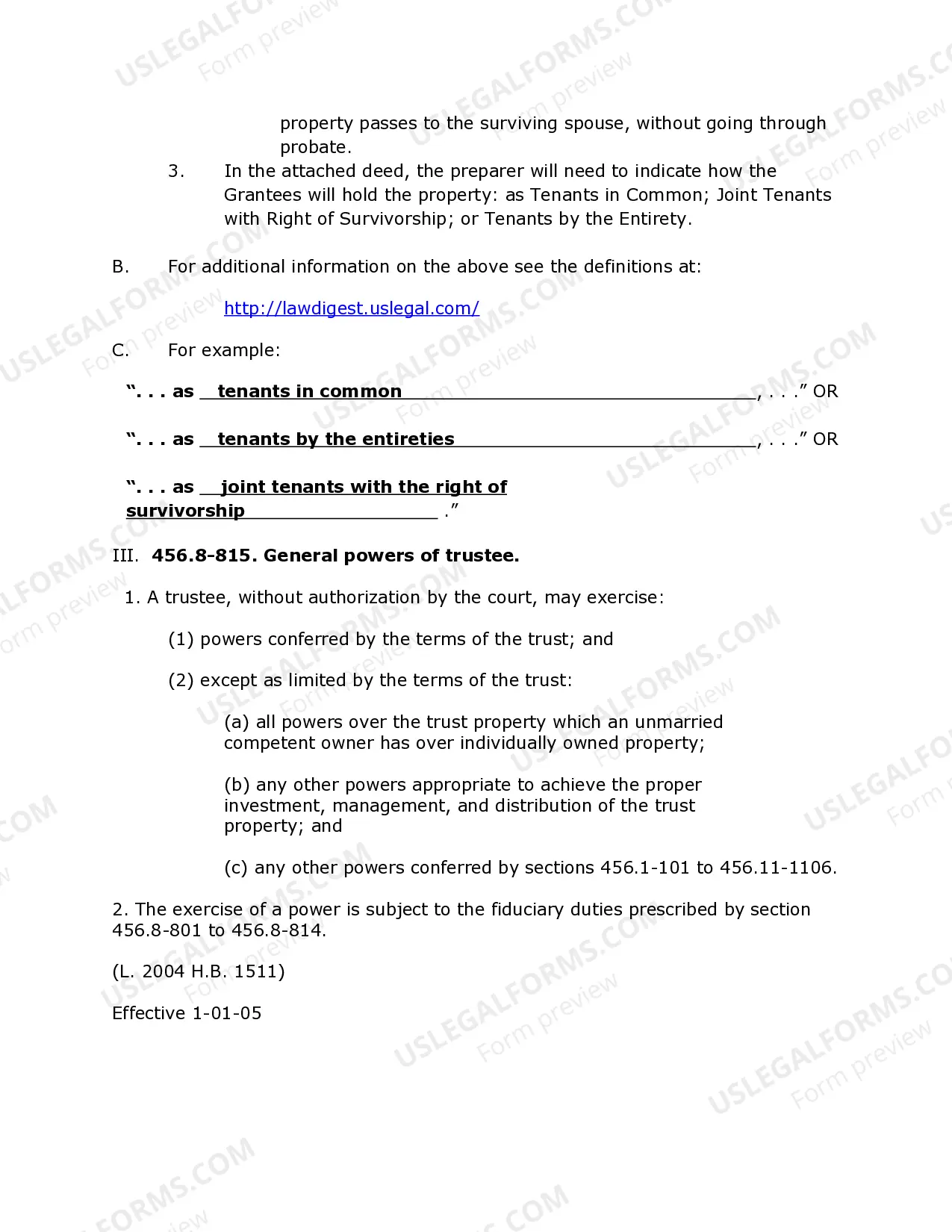
The Trustee's Deed is a legal document that allows trustees of a trust to convey property to two individuals, such as a husband and wife, or to two individuals who are not married. This form is distinct from other property transfer instruments because it specifies that the grantors (the trustees) are only warranting the title against issues that occurred while the property was held in the trust, ensuring a level of protection for the grantees.
What’s included in this form
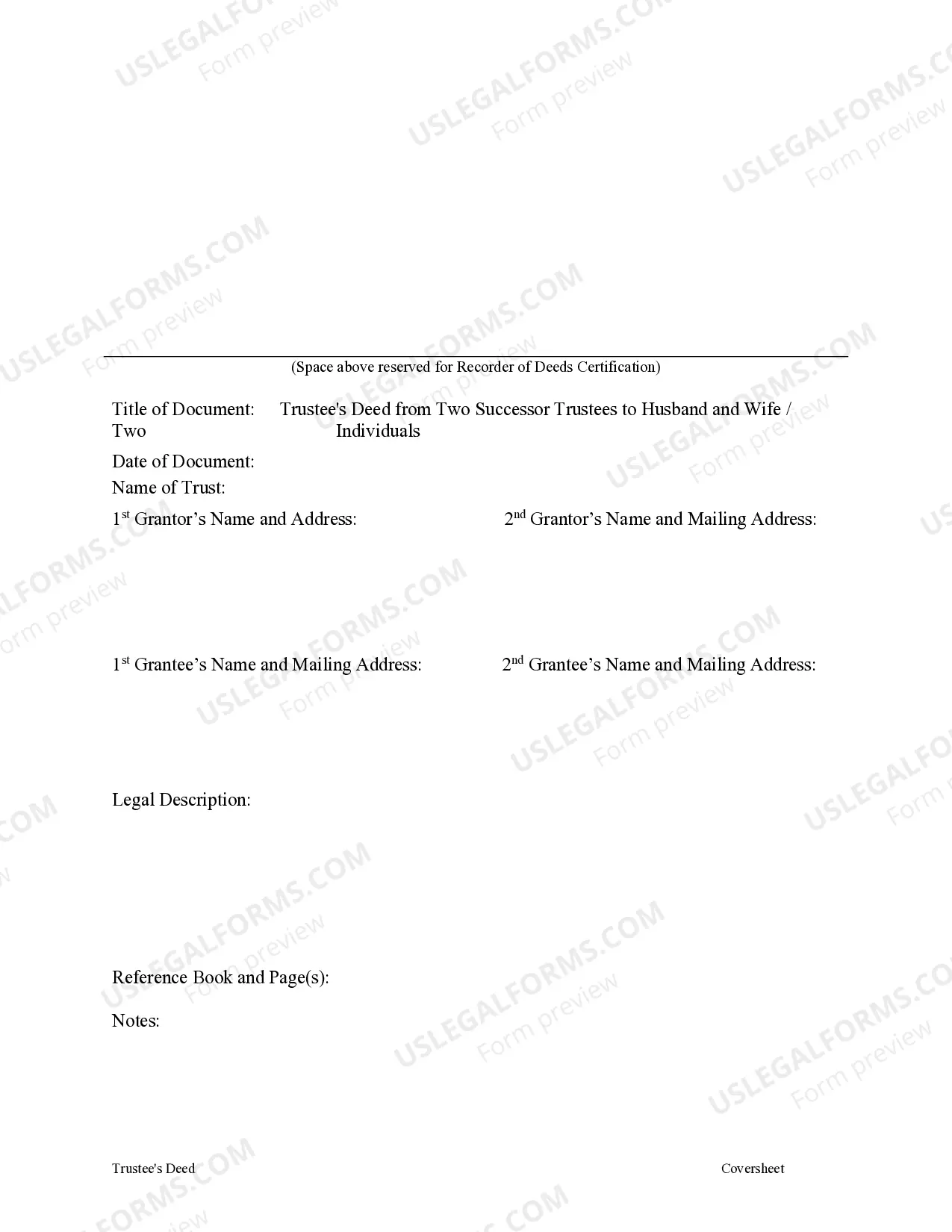
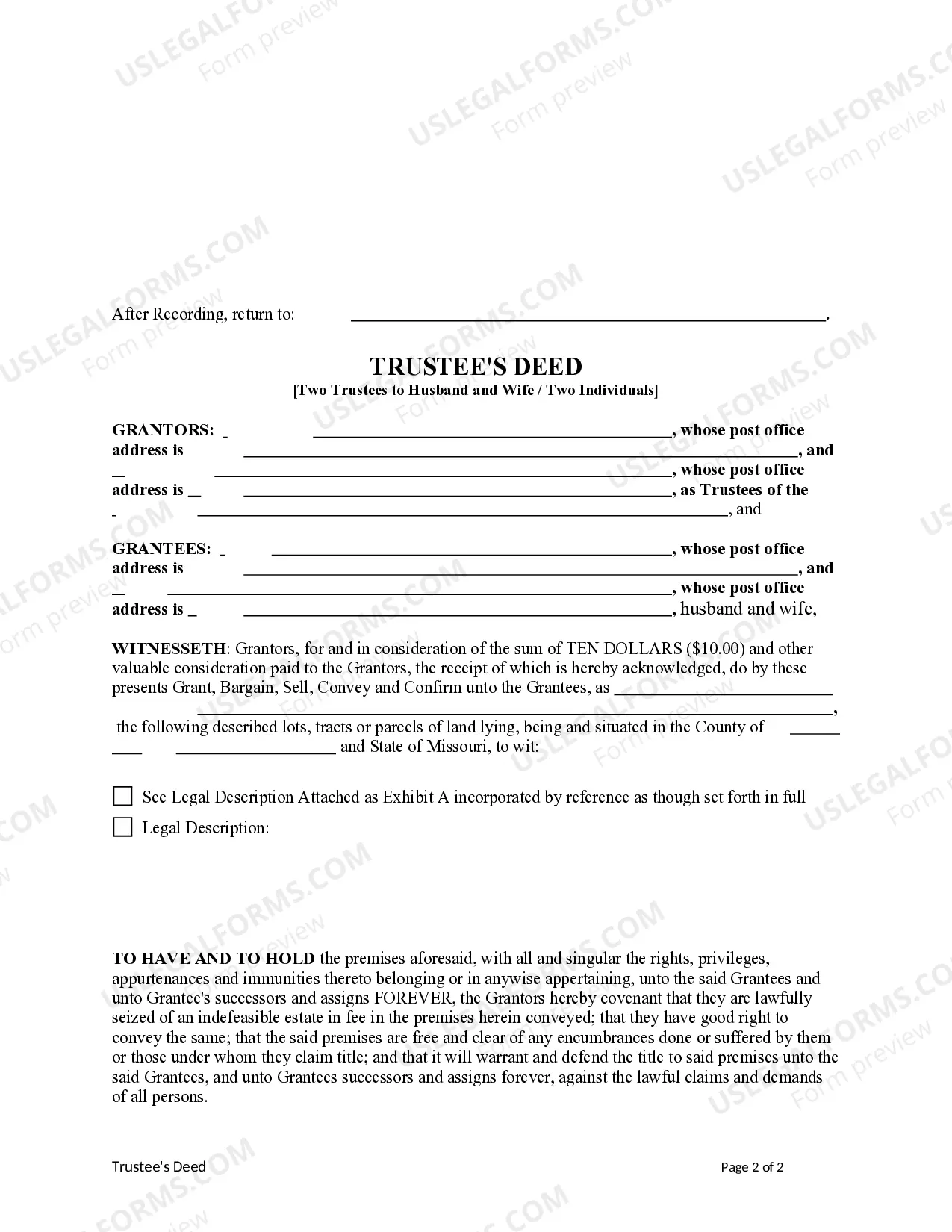
- Identification of grantors (trustees) and grantees (recipients of the property).
- Description of the property being conveyed.
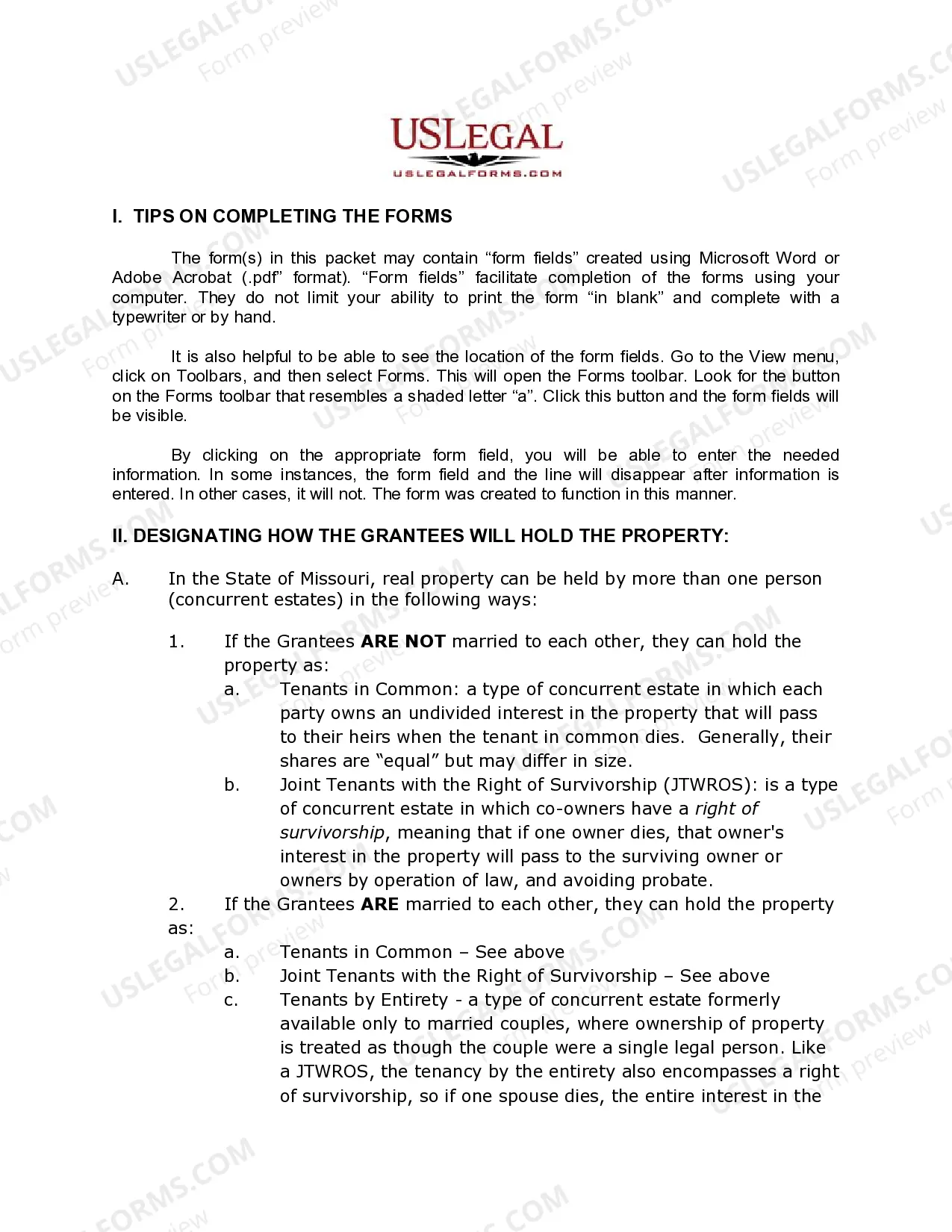
- Options for how the grantees can hold the property (e.g., tenants in common, joint tenants with right of survivorship, tenants by the entirety).
- Warrant of title by the grantor based on specific conditions.
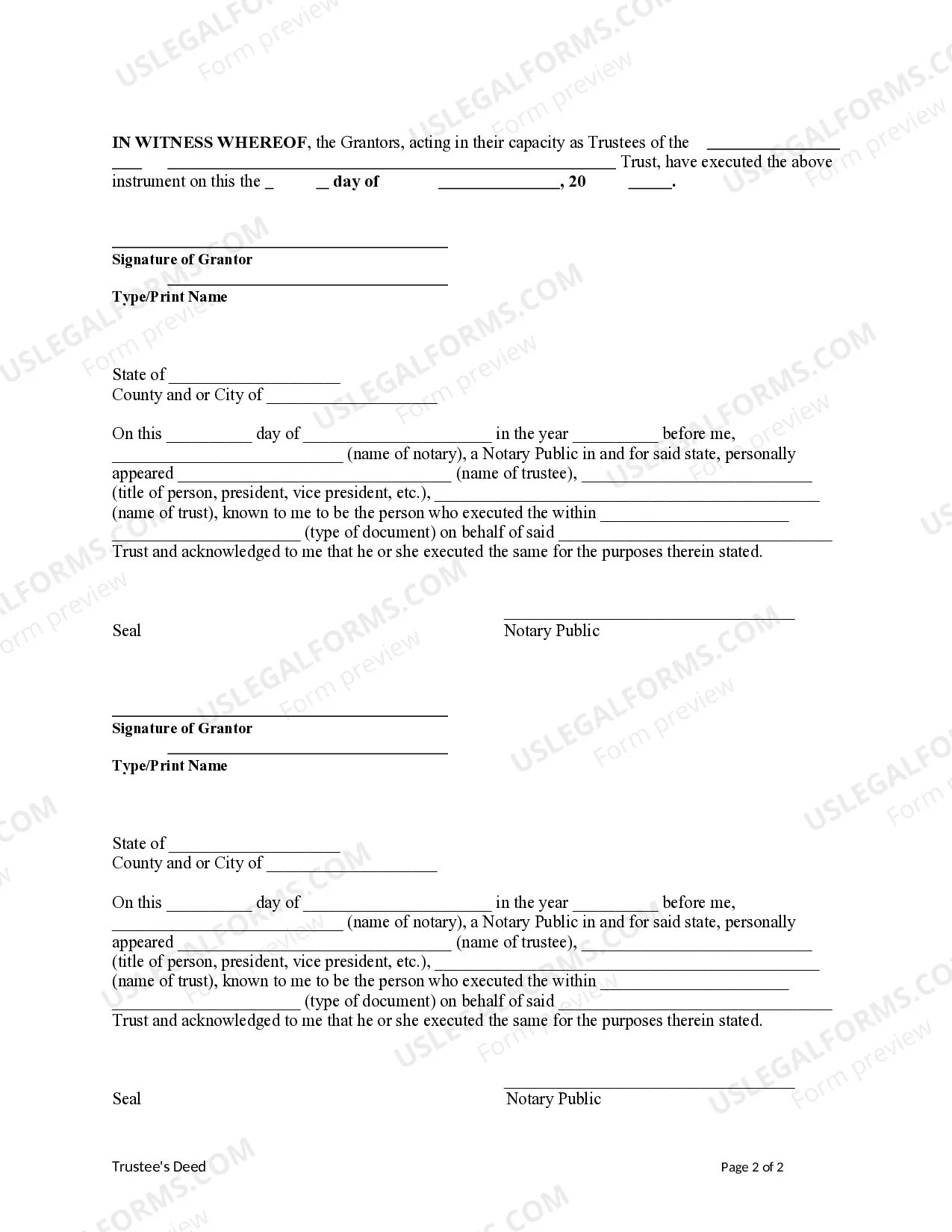
- Signature areas for the trustees and any necessary notarization details.





When this form is needed
This form should be used when trustees of a trust need to transfer real property to two individuals. It is commonly needed in situations such as family estate planning, transfers of property among family members, or when setting up joint ownership arrangements. Using this deed helps ensure that the property is properly titled and that grantees have clear ownership rights.
Who needs this form
- Trustees of a trust who are authorized to convey real estate.
- Couples (married or not) wishing to hold property together.
- Individuals involved in estate planning or property transfers.
Steps to complete this form
- Identify all parties involved: grantors (trustees) and grantees (individuals receiving the property).
- Complete the description of the property being conveyed, including parcel numbers and location.
- Select the manner in which the grantees will hold the property (e.g., tenants in common, joint tenants with right of survivorship, or tenants by the entirety).
- Sign and date the deed in the presence of a notary public, if required.
- File the completed deed with the appropriate county recorderâs office to ensure it is legally recognized.
Does this document require notarization?
Yes, this form must be notarized to be legally valid. The notaryâs signature serves to authenticate the identities of the parties involved in the property transfer, providing an additional layer of legal protection. US Legal Forms offers integrated online notarization services, allowing you to secure a notarized document from the comfort of your home.
Get your form ready online
Our built-in tools help you complete, sign, share, and store your documents in one place.
Make edits, fill in missing information, and update formatting in US Legal Forms—just like you would in MS Word.
Download a copy, print it, send it by email, or mail it via USPS—whatever works best for your next step.
Sign and collect signatures with our SignNow integration. Send to multiple recipients, set reminders, and more. Go Premium to unlock E-Sign.
If this form requires notarization, complete it online through a secure video call—no need to meet a notary in person or wait for an appointment.
We protect your documents and personal data by following strict security and privacy standards.

Make edits, fill in missing information, and update formatting in US Legal Forms—just like you would in MS Word.

Download a copy, print it, send it by email, or mail it via USPS—whatever works best for your next step.

Sign and collect signatures with our SignNow integration. Send to multiple recipients, set reminders, and more. Go Premium to unlock E-Sign.

If this form requires notarization, complete it online through a secure video call—no need to meet a notary in person or wait for an appointment.

We protect your documents and personal data by following strict security and privacy standards.
Avoid these common issues
- Failing to accurately describe the property being transferred.
- Not selecting the correct ownership option for the grantees.
- Neglecting to have the document notarized if required.
- Forgetting to file the deed with the recorderâs office after completion.
Benefits of completing this form online
- Convenient access to properly formatted legal documents.
- Ability to edit the form fields to ensure all necessary information is included.
- Provides peace of mind knowing the forms are created based on state-specific laws.
Key takeaways
- The Trustee's Deed is used to transfer property from a trust to individuals, ensuring clear ownership rights.
- Designating how grantees hold the property is crucial for legal clarity and future asset management.
- Utilizing this form can simplify the estate planning process and help avoid potential disputes.
Looking for another form?

Form popularity
FAQ
In addition to these duties (which are the subject of much litigation), only an individual or a domestic corporation (one domiciled in Missouri) may serve as trustee. A foreign corporation may only serve if serving as a co-trustee with a domestic Missouri corporation or an individual who is domiciled in Missouri.
California Property TaxesTransferring real property to yourself as trustee of your own revocable living trust -- or back to yourself -- does not trigger a reassessment for property tax purposes. (Cal. Rev. & Tax Code § 62(d).)
The We The People Promissory Note form is used to document that a borrower (the maker) agrees or promises to pay back money to a lender (the holder) according to specified terms. When used with a We The People Deed of Trust, the Promissory Note is secured with a lien on the real estate listed in the Deed of Trust.
Some states have laws governing who may or may not serve as a trustee in a deed of trust. Generally, the trustee must be an attorney, title insurance company, trust company, bank, savings and loan, credit union, or other company specifically authorized by law to serve as a trustee.
The lender is the person or legal entity providing the loan to the borrower. The trustee is a neutral third-party who holds the legal title to a property until the borrower pays off the loan in full. They're called a trustee because they hold the property in trust for the lender.
How to sign as a Trustee. When signing anything on behalf of the trust, always sign as John Smith, Trustee. By signing as Trustee, you will not be personally liable for that action as long as that action is within the scope of your authority under the trust.
The person who reposes or declares the confidence is called the author of the trust; The person who accepts the confidence is called the trustee; the person for whose benefit the confidence is accepted is called the beneficiary; the subject-matter of the trust is called trust property or trust money; the
A deed of trust is a method of securing a real estate transaction that includes three parties: a lender, borrower and a third-party trustee.
Trustees aren't allowed to sell trust property to themselves unless the trust agreement has explicitly allowed them to do so. They also shouldn't sell the trust property to another trust that they manage, or borrow trust funds for personal use.