Missouri Quitclaim Deed - Individual to a Trust
What this document covers
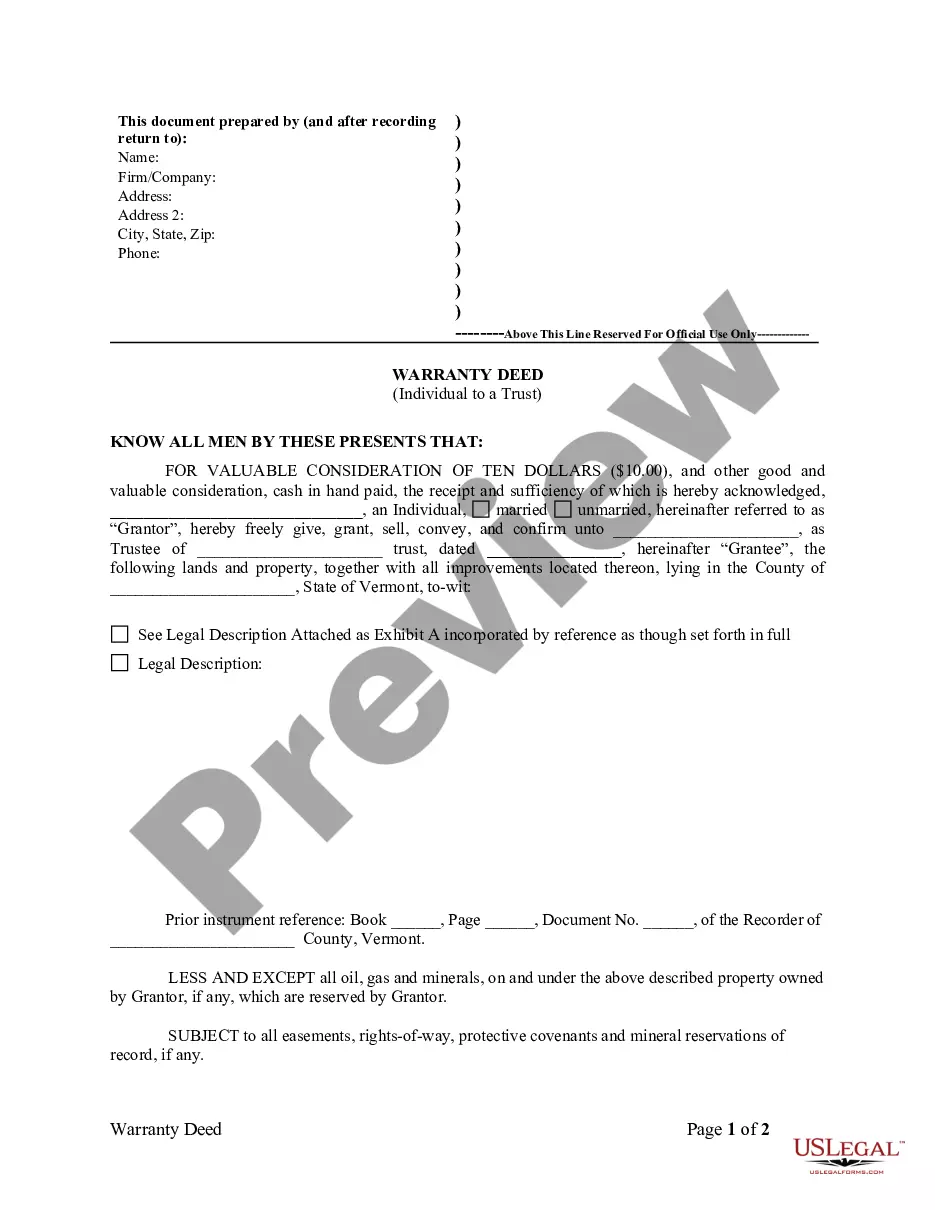
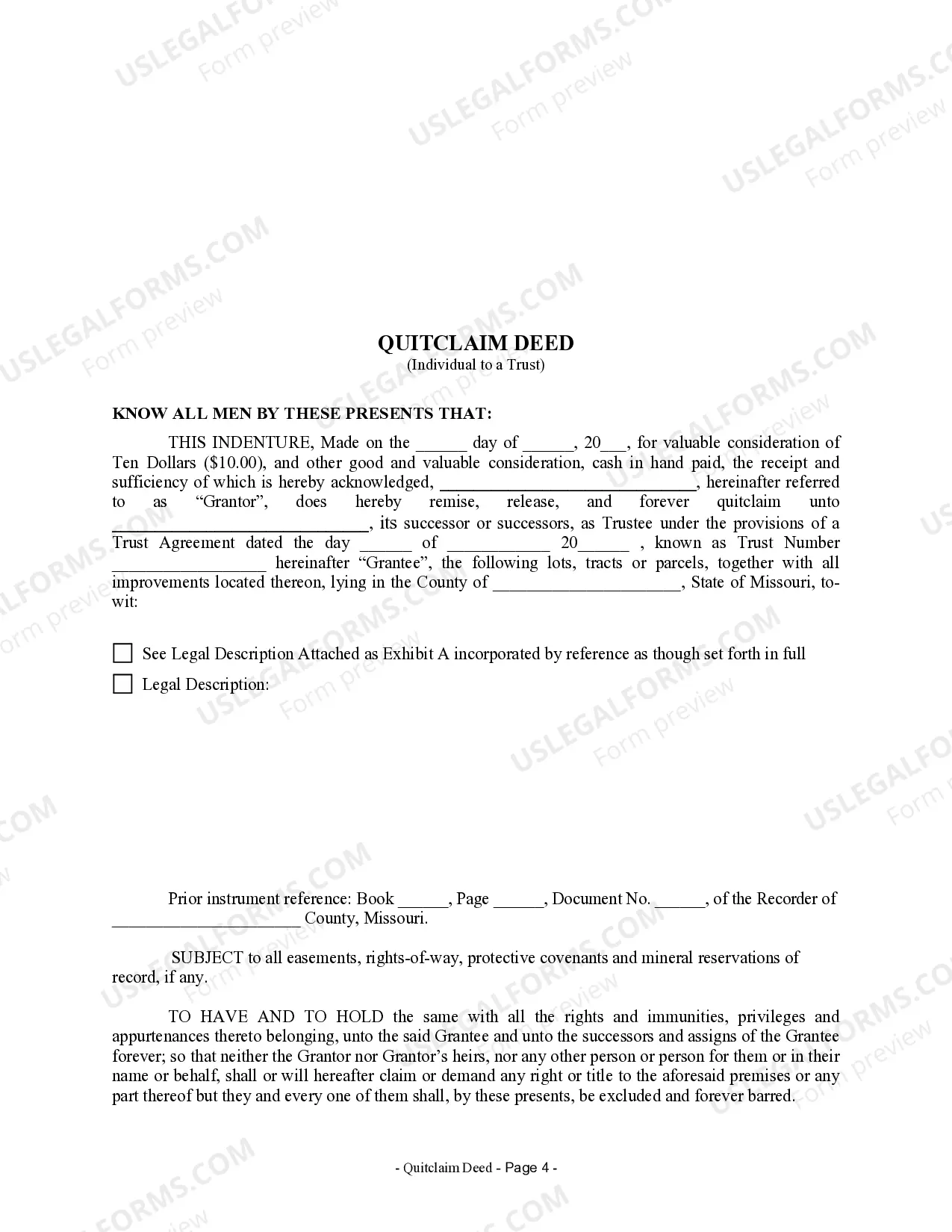
The Quitclaim Deed - Individual to a Trust is a legal document used to transfer property ownership from an individual (Grantor) to a trustee acting on behalf of a trust (Grantee). This type of deed allows the Grantor to convey any interest in the property without guaranteeing that the title is free of issues. Unlike other deed types that warrant the property title, a quitclaim deed simply transfers whatever interest the Grantor has, making it essential in property transfers to trusts.
Main sections of this form
- Identification of the Grantor and Grantee, including their roles in the transaction.
- Description of the property being transferred, providing clear details for legal identification.
- A statement regarding the nature of the conveyance, indicating that the Grantor does not guarantee title.
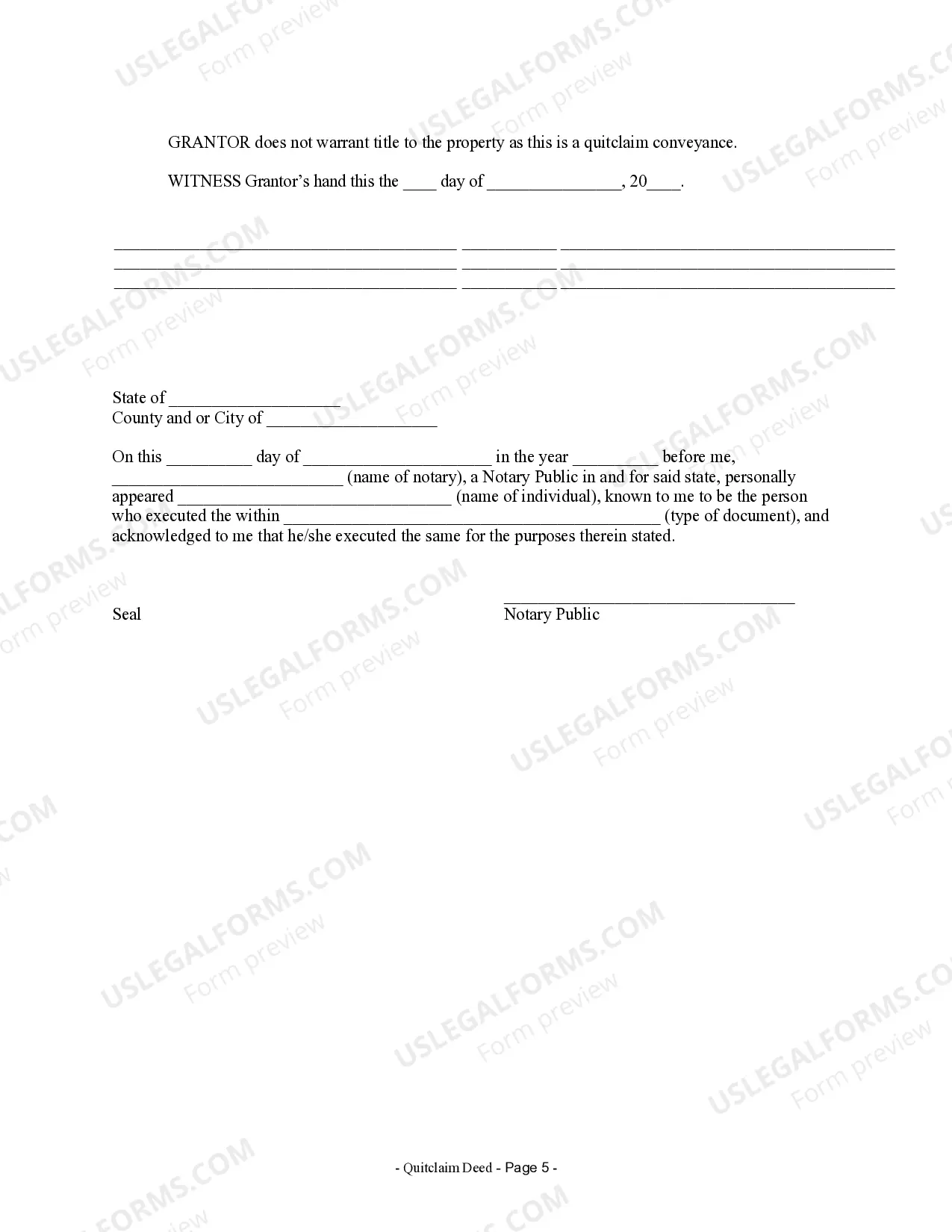
- Signature lines for the Grantor, along with a date field for formal execution.
- Witness and notarization sections, depending on state requirements.
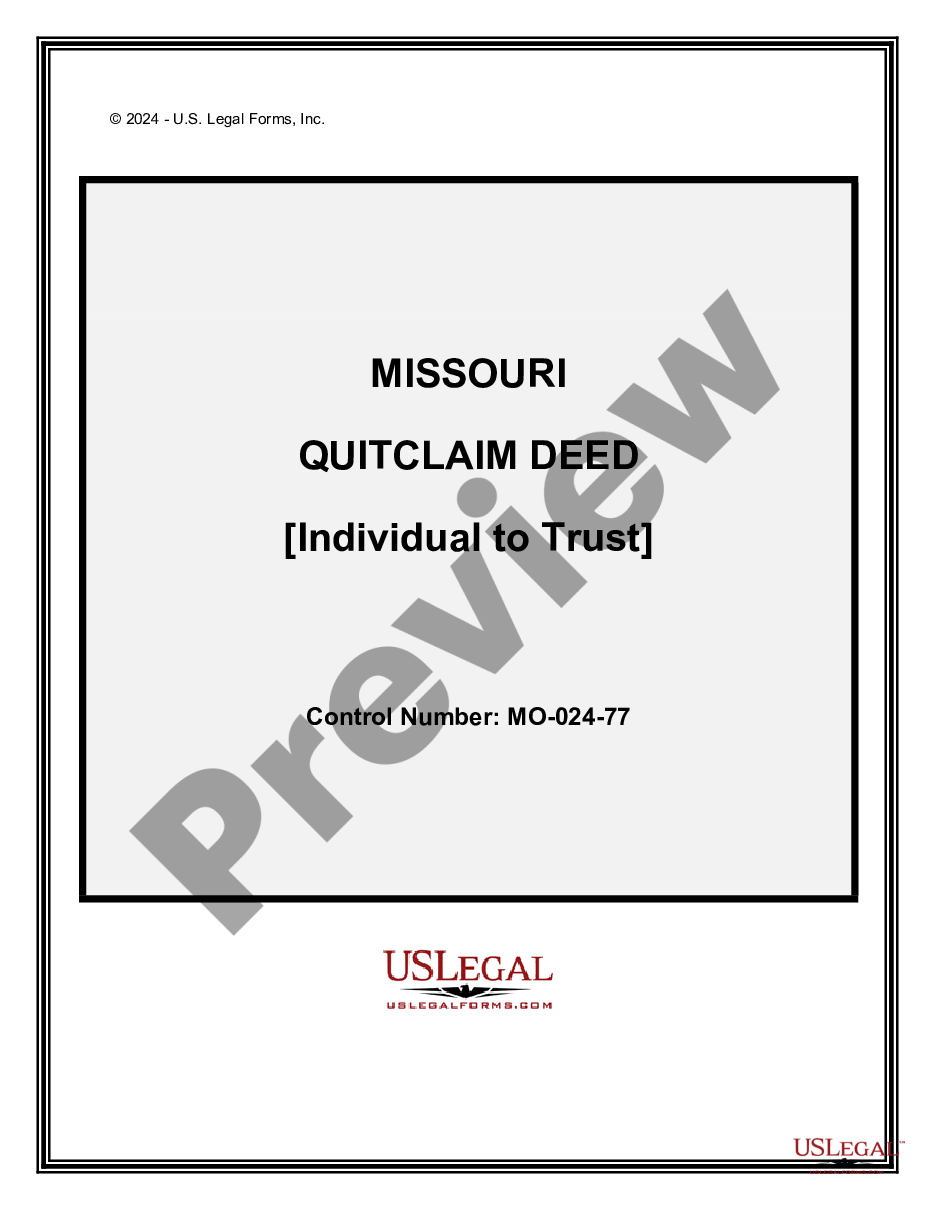






When to use this form
This form is useful in situations where an individual wants to transfer their interest in a property to a trust, typically for estate planning or asset protection purposes. It is often utilized when the Grantor wishes to simplify the transfer process without undertaking a full warranty deed.
Who can use this document
- Individuals transferring real estate to a family trust or other type of trust.
- Trustees seeking to formalize the addition of property into a trust.
- Property owners wishing to avoid the complexities of warranty deeds.
How to prepare this document
- Identify the Grantor by entering their full name and address.
- Specify the Grantee as the trustee along with the name of the trust.
- Provide a detailed legal description of the property being transferred.
- Enter the date of execution and sign where indicated as the Grantor.
- If required, ensure that the document is witnessed and notarized as per state regulations.
Notarization requirements for this form
This form must be notarized to be legally valid. US Legal Forms provides secure online notarization powered by Notarize, allowing you to complete the process through a verified video call.
Get your form ready online
Our built-in tools help you complete, sign, share, and store your documents in one place.
Make edits, fill in missing information, and update formatting in US Legal Forms—just like you would in MS Word.
Download a copy, print it, send it by email, or mail it via USPS—whatever works best for your next step.
Sign and collect signatures with our SignNow integration. Send to multiple recipients, set reminders, and more. Go Premium to unlock E-Sign.
If this form requires notarization, complete it online through a secure video call—no need to meet a notary in person or wait for an appointment.
We protect your documents and personal data by following strict security and privacy standards.

Make edits, fill in missing information, and update formatting in US Legal Forms—just like you would in MS Word.

Download a copy, print it, send it by email, or mail it via USPS—whatever works best for your next step.

Sign and collect signatures with our SignNow integration. Send to multiple recipients, set reminders, and more. Go Premium to unlock E-Sign.

If this form requires notarization, complete it online through a secure video call—no need to meet a notary in person or wait for an appointment.

We protect your documents and personal data by following strict security and privacy standards.
Common mistakes to avoid
- Failing to provide a complete legal description of the property.
- Not signing the deed or neglecting to include the correct date.
- Overlooking the requirement for witness or notary signatures, if applicable.
Why use this form online
- Convenient access to legal forms that can be downloaded and completed at your pace.
- Edit and save the forms directly on your computer for easy management.
- Forms are drafted by licensed attorneys, ensuring they meet legal standards.
Looking for another form?
Form popularity
FAQ
A Missouri Quitclaim Deed - Individual to a Trust typically does not go through probate. When you transfer property to a trust, it is managed according to the trust’s terms, bypassing the probate process. This can save time and reduce costs for your heirs. For clear guidance on the implications of using a quitclaim deed, consider exploring resources from US Legal Forms.
To transfer property using a Missouri Quitclaim Deed - Individual to a Trust, you first need to prepare the deed document. Include details such as the names of the grantor and the trust, a legal description of the property, and the date of transfer. After signing the deed, you must file it with the county recorder's office to make the transfer official. Using a reliable platform like US Legal Forms can simplify this process, providing the necessary templates and guidance.
A Missouri Quitclaim Deed - Individual to a Trust can indeed help avoid probate under certain conditions. By transferring property directly into a trust, you can bypass the lengthy probate process upon your death. This means your beneficiaries can access the assets more quickly, offering peace of mind during a difficult time. However, it's essential to ensure the trust is properly set up and funded to achieve this benefit.
Filing a Missouri Quitclaim Deed - Individual to a Trust requires a few key steps. First, you need to complete the deed form with accurate information about the property and the parties involved. Next, you must sign the deed in front of a notary public. Finally, submit the completed deed to the appropriate county recorder's office for official recording. Utilizing platforms like US Legal Forms can streamline this process by providing you with the correct forms and guidance.
When considering a Missouri Quitclaim Deed - Individual to a Trust, it is important to understand its limitations. One major disadvantage is that this type of deed does not guarantee clear title. This means that if there are any existing liens or claims on the property, the new owner may inherit those issues. Additionally, a quitclaim deed does not provide legal protections against potential disputes, which can be a significant drawback for some individuals.
It's usually a very straightforward transaction, but it's possible for a quitclaim deed to be challenged. If a quitclaim deed is challenged in court, the issue becomes whether the property was legally transferred and if the grantor had the legal right to transfer the property.
If the quitclaim deed requires the signature of all co-owners, the deed is invalid unless all co-owners have signed it and the deed is then delivered to the grantee.If one individual owns real estate and desires to add a co-owner such as a spouse, a quitclaim deed might be used.
Recording fees for quitclaim deeds vary among counties. In Clay County and Platte County, the fee is $24 for the first page and $3 for each additional page.
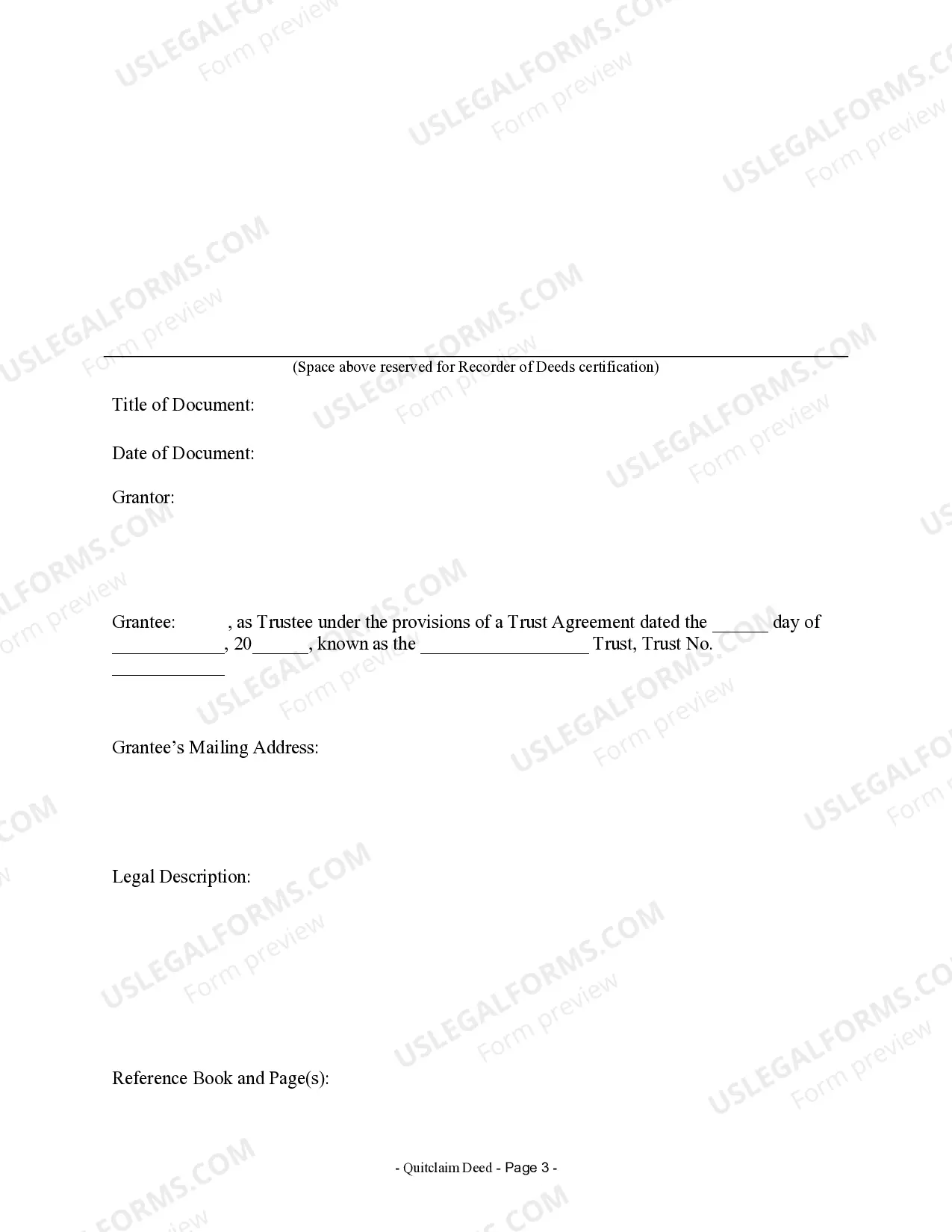
The title of the document. The date of the transfer. All grantors' names. Any grantees' names. Statutory addresses. A legal description for the property. References to the page numbers of the reference books, if applicable.