Minnesota Instructions — Execution Levy on Earnings is a legal process that allows creditors to collect unpaid debts from individuals or businesses that are delinquent in payments. This process is defined by Chapter 571 of the Minnesota Statutes and applies to any judgment rendered by a court in the state. The creditor may request the court to issue an “Execution Levy on Earnings”, which is a writ of garnishment that orders an employer to withhold a portion of the employee’s wages and pay it directly to the creditor. There are two types of Minnesota Instructions — Execution Levy on Earnings: one for an individual debtor and one for a business debtor. For an individual debtor, the employer must withhold a minimum of 10% of the debtor’s net disposable earnings, or up to 50% of the debtor’s net disposable earnings, depending on the amount of the debt. For a business debtor, the employer must withhold a minimum of 25% of the debtor’s net disposable earnings, or up to 75% of the debtor’s net disposable earnings. The employer must then forward the withheld wages directly to the creditor.
Minnesota Instructions - Execution Levy on Earnings
Description

Get your form ready online
Our built-in tools help you complete, sign, share, and store your documents in one place.
Make edits, fill in missing information, and update formatting in US Legal Forms—just like you would in MS Word.
Download a copy, print it, send it by email, or mail it via USPS—whatever works best for your next step.
Sign and collect signatures with our SignNow integration. Send to multiple recipients, set reminders, and more. Go Premium to unlock E-Sign.
If this form requires notarization, complete it online through a secure video call—no need to meet a notary in person or wait for an appointment.
We protect your documents and personal data by following strict security and privacy standards.

Make edits, fill in missing information, and update formatting in US Legal Forms—just like you would in MS Word.

Download a copy, print it, send it by email, or mail it via USPS—whatever works best for your next step.

Sign and collect signatures with our SignNow integration. Send to multiple recipients, set reminders, and more. Go Premium to unlock E-Sign.

If this form requires notarization, complete it online through a secure video call—no need to meet a notary in person or wait for an appointment.

We protect your documents and personal data by following strict security and privacy standards.
Looking for another form?
How to fill out Minnesota Instructions - Execution Levy On Earnings?
Drafting legal documents can be quite a hassle unless you have accessible fillable templates. With the US Legal Forms digital repository of formal papers, you can trust the fields you encounter, as they all align with federal and state laws and are reviewed by our experts.
Acquiring your Minnesota Instructions - Execution Levy on Earnings from our repository is as straightforward as ABC. Previously registered users with an active subscription need only Log In and click the Download button after they find the correct template. Later, if they wish, users can access the same document from the My documents section of their account. However, even if you are new to our service, signing up with a valid subscription will only take a few moments. Here’s a quick guide for you.
Haven’t you explored US Legal Forms yet? Subscribe to our service now to obtain any formal document swiftly and effortlessly whenever you require it, and keep your paperwork organized!
- Document compliance verification. You should carefully examine the content of the form you desire and verify whether it meets your requirements and adheres to your state law stipulations. Previewing your document and reviewing its general description will assist you in achieving this.
- Alternative search (optional). If there are any discrepancies, search the library using the Search tab above until you locate the suitable blank, and click Buy Now once you identify the one you require.
- Account registration and form purchase. Establish an account with US Legal Forms. After account validation, Log In and choose your desired subscription plan. Make a payment to continue (PayPal and credit card options are available).
- Template download and further usage. Select the file format for your Minnesota Instructions - Execution Levy on Earnings and click Download to store it on your device. Print it to complete your documents manually, or utilize a feature-rich online editor to create an electronic version more quickly and efficiently.
Form popularity
FAQ
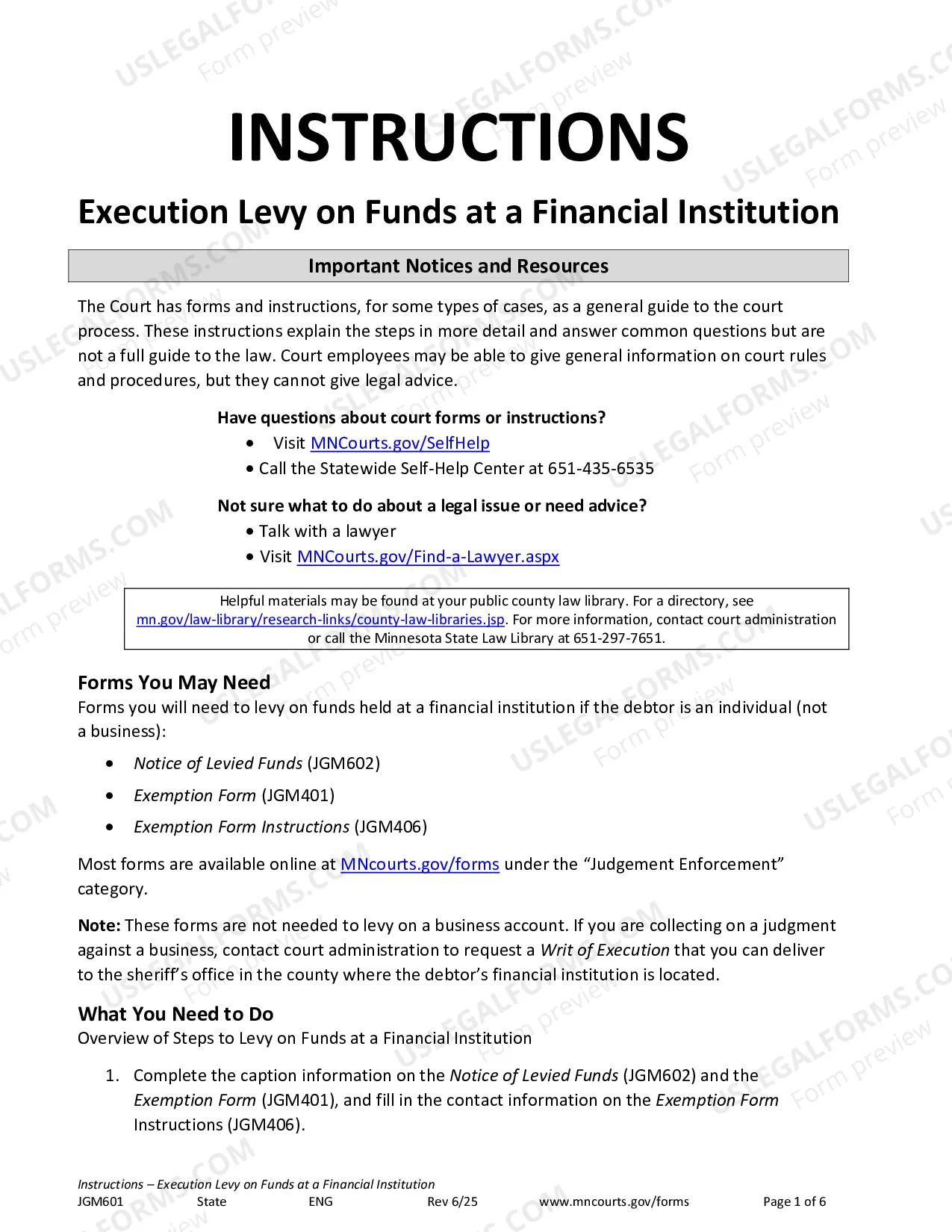
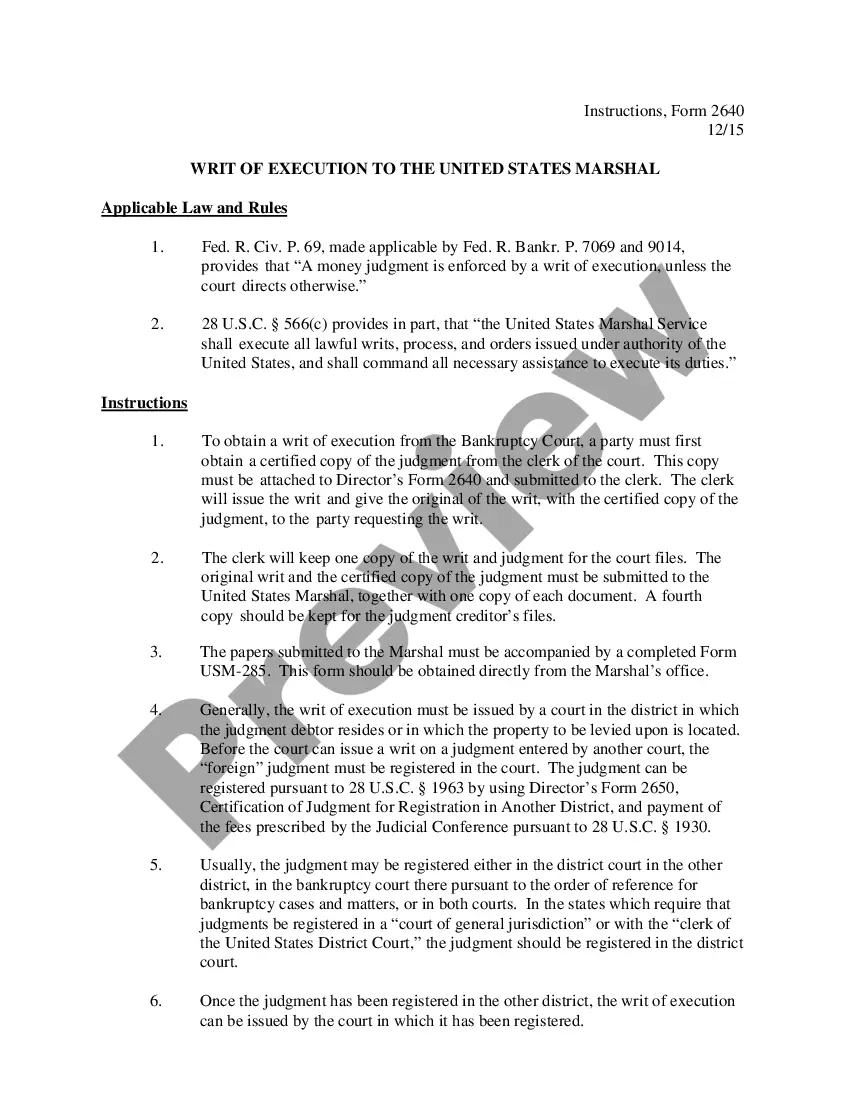
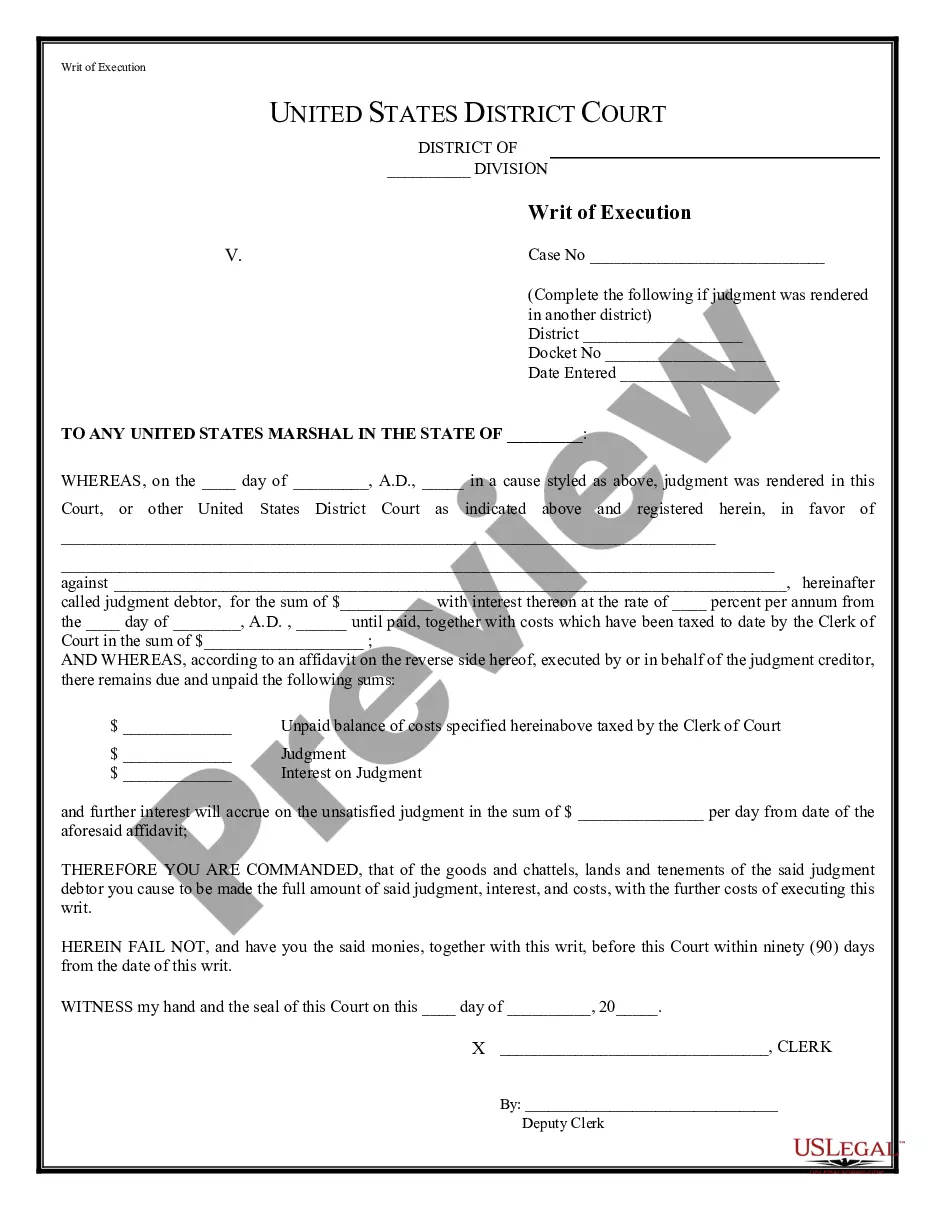
The Writ of Execution in Minnesota is a legal document that enables a creditor to enforce a judgment by seizing your property or assets. This writ is essential for initiating a wage levy and is part of the Minnesota Instructions - Execution Levy on Earnings. Once the writ is issued, it authorizes the sheriff to collect the owed amount through various means, including garnishing wages. Familiarizing yourself with this process can empower you to manage your financial responsibilities.
In Minnesota, a wage levy allows creditors to collect debts directly from your earnings. This process is initiated through the Minnesota Instructions - Execution Levy on Earnings, which outlines how much of your paycheck can be withheld. Typically, a creditor must obtain a court order before initiating a wage levy. If you face this situation, understanding your rights and options can help you navigate the process effectively.
The purpose of a writ of execution is to enforce a court judgment, ensuring that the creditor receives payment owed to them. It serves as a mechanism for creditors to recover debts by allowing the seizure of a debtor's income or property. By following the Minnesota Instructions - Execution Levy on Earnings, you can navigate the process effectively. US Legal Forms provides comprehensive resources to help you understand and utilize this legal tool.
A writ of execution in Minnesota is a legal order that allows a creditor to collect a debt by seizing the debtor's property or earnings. This document is issued by the court after a judgment has been made in favor of the creditor. It specifically authorizes the enforcement of the judgment, enabling the creditor to levy earnings or other assets. For detailed guidance, refer to the Minnesota Instructions - Execution Levy on Earnings available through US Legal Forms.
Writs of Execution are orders issued by district court directing the sheriff to satisfy a judgment. They must be directed to the Sheriff of the county in which the assets to satisfy the judgment are located and they may be for personal or real property.
WHAT IS A LEVY? Once a judgment is entered, Minnesota law allows the judgment creditor to seize the defendant's assets (?levy?) by sending a notice or order to the entity having custody.
Levy. 1) v. to seize (take) property upon a writ of execution (an order to seize property) issued by the court to pay a money judgment granted in a lawsuit.
A levy is a legal seizure of your property to satisfy a tax debt. Levies are different from liens. A lien is a legal claim against property to secure payment of the tax debt, while a levy actually takes the property to satisfy the tax debt.
After you get a Writ of Execution, you can use it to ask that money be taken from the other side's bank account. This is called a bank levy.
The writ of execution is an order for the sheriff to seize the debtor's nonexempt property and take into legal custody (in custodia legis)? what is otherwise known as levy. The writ is only valid for a limited time determined by state law, usually 60 to 180 days.