Minnesota Mail and Post Instructions
Overview of this form
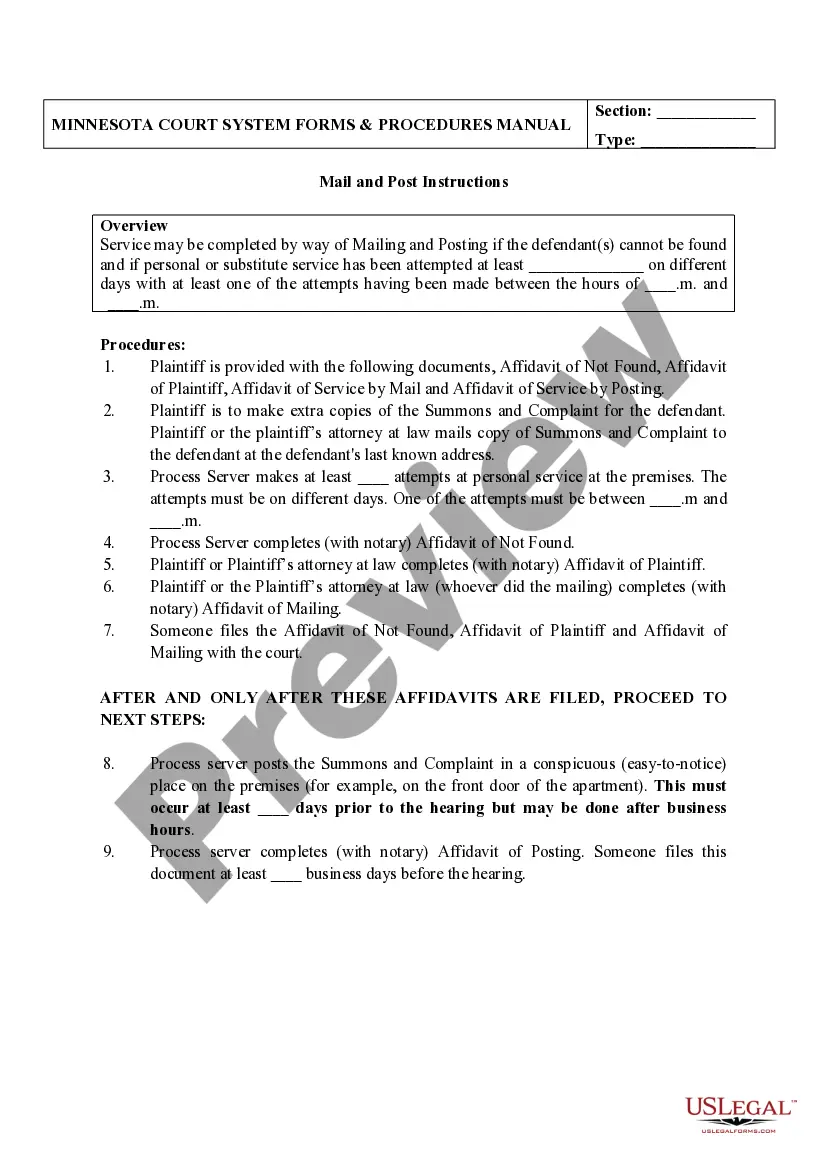
The Mail and Post Instructions form provides clear guidance on how to properly serve a defendant when they cannot be located. This form is essential for cases where personal or substitute service has been attempted, allowing plaintiffs to proceed with mailing and posting procedures as required by law. It helps streamline the process of notification, ensuring that all necessary affidavits are completed and filed correctly.
Key components of this form
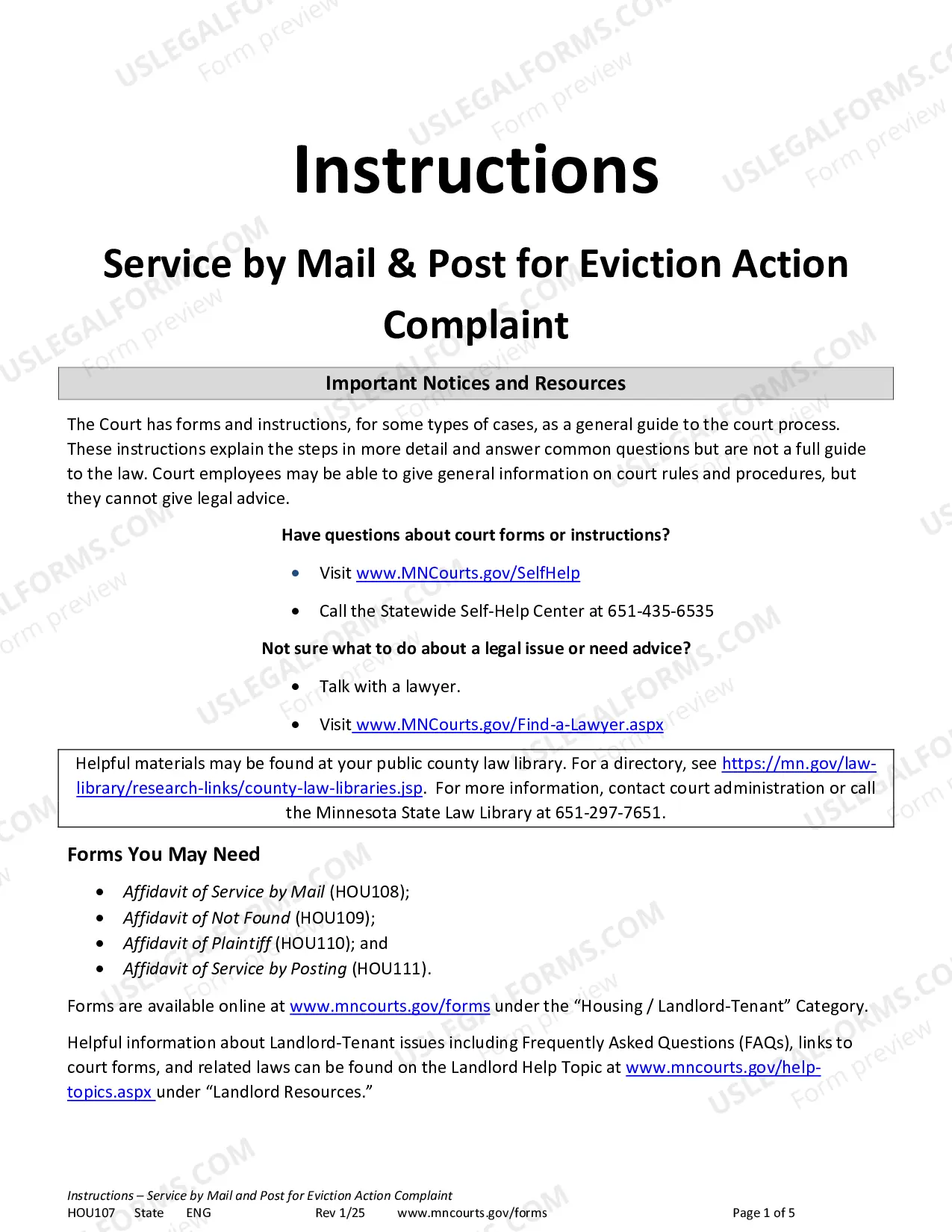
- Affidavit of Not Found: Confirms attempts to locate the defendant.
- Affidavit of Plaintiff: Statement from the plaintiff regarding the case.
- Affidavit of Service by Mail: Details of mailing the Summons and Complaint.
- Affidavit of Service by Posting: Verification that the documents were posted on the premises.
- Instructions for multiple attempts: Requirements for service attempts on different days and times.
When this form is needed
This form should be used when a plaintiff has made several attempts to personally serve a defendant but has been unsuccessful. It is applicable in situations where the defendant cannot be found at their last known address, allowing for service via mail and posting to ensure legal notifications are fulfilled.
Intended users of this form
- Individuals involved in civil lawsuits seeking to serve a defendant who cannot be located.
- Attorneys representing clients in cases requiring service by mail and posting.
- Parties who have already attempted personal or substitute service unsuccessfully.
Completing this form step by step
- Document attempts: Ensure that multiple attempts to personally serve the defendant are documented.
- Fill out necessary affidavits: Complete the Affidavit of Not Found and Affidavit of Plaintiff, ensuring they are notarized.
- Mail the Summons and Complaint: Send copies to the defendantâs last known address and complete the Affidavit of Mailing.
- Post the documents: Affix the Summons and Complaint in a conspicuous location at the premises.
- File affidavits with the court: Submit all completed affidavits to the court before the scheduled hearing.
Notarization requirements for this form
Yes, this form must be notarized to be legally valid. All affidavits referred to in the Mail and Post Instructions require notarization. US Legal Forms offers integrated online notarization services, available 24/7 via secure video calls for added convenience and legal equivalence, eliminating the need for in-person visits.
Get your form ready online
Our built-in tools help you complete, sign, share, and store your documents in one place.
Make edits, fill in missing information, and update formatting in US Legal Forms—just like you would in MS Word.
Download a copy, print it, send it by email, or mail it via USPS—whatever works best for your next step.
Sign and collect signatures with our SignNow integration. Send to multiple recipients, set reminders, and more. Go Premium to unlock E-Sign.
If this form requires notarization, complete it online through a secure video call—no need to meet a notary in person or wait for an appointment.
We protect your documents and personal data by following strict security and privacy standards.

Make edits, fill in missing information, and update formatting in US Legal Forms—just like you would in MS Word.

Download a copy, print it, send it by email, or mail it via USPS—whatever works best for your next step.

Sign and collect signatures with our SignNow integration. Send to multiple recipients, set reminders, and more. Go Premium to unlock E-Sign.

If this form requires notarization, complete it online through a secure video call—no need to meet a notary in person or wait for an appointment.

We protect your documents and personal data by following strict security and privacy standards.
Common mistakes to avoid
- Not making sufficient attempts at personal service before resorting to mailing and posting.
- Failing to complete or notarize required affidavits.
- Not filing affidavits with the court in a timely manner.
- Overlooking specific timing requirements for service attempts.
Why complete this form online
- Convenience of downloading the form anytime, from anywhere.
- Editability allows users to fill out the form accurately and efficiently.
- Reliable templates drafted by licensed attorneys help ensure legal compliance.
Looking for another form?


Form popularity
FAQ
To file in Minnesota district court, you must prepare the necessary documents and submit them according to the court's rules. It's crucial to follow proper procedures, including serving other parties and filing your documents correctly. Using Minnesota Mail and Post Instructions can simplify this process, ensuring you meet all requirements and deadlines.
Proof of service in Minnesota is a document that verifies that legal papers have been properly delivered to the involved parties. This proof is essential for the court to recognize that all parties received the necessary information. Adhering to Minnesota Mail and Post Instructions will help you create accurate proof of service, supporting your case.
A Rule 5 hearing in Minnesota focuses on issues related to the service of documents and the compliance with Rule 5. During this hearing, the court examines whether proper procedures were followed. By understanding Minnesota Mail and Post Instructions, you can better prepare for these hearings and ensure your documents are served correctly.
A Rule 5 appearance refers to the formal acknowledgment by a party that they have received documents served under Rule 5. This appearance is crucial for ensuring that all parties are aware of the proceedings. When you follow Minnesota Mail and Post Instructions, you help establish clear communication and maintain the integrity of your case.
Rule 5 of the Minnesota Rules of Civil Procedure details the methods for serving documents in civil cases, including mail, electronic service, and personal delivery. This rule aims to promote fairness by ensuring that all parties receive necessary information. Utilizing Minnesota Mail and Post Instructions can help you navigate these procedures with ease.
The order 5 rule pertains to the formal procedures outlined in Minnesota law regarding the service of documents. It emphasizes the importance of timely and proper delivery of legal papers to all involved parties. By following Minnesota Mail and Post Instructions, you can ensure your documents reach the right people efficiently and effectively.
Rule 5 in Minnesota refers to the procedures for serving documents in civil cases. This rule outlines how parties must provide notice and deliver documents to each other. Understanding Minnesota Mail and Post Instructions is essential because it ensures that you comply with legal requirements for communication and document service.