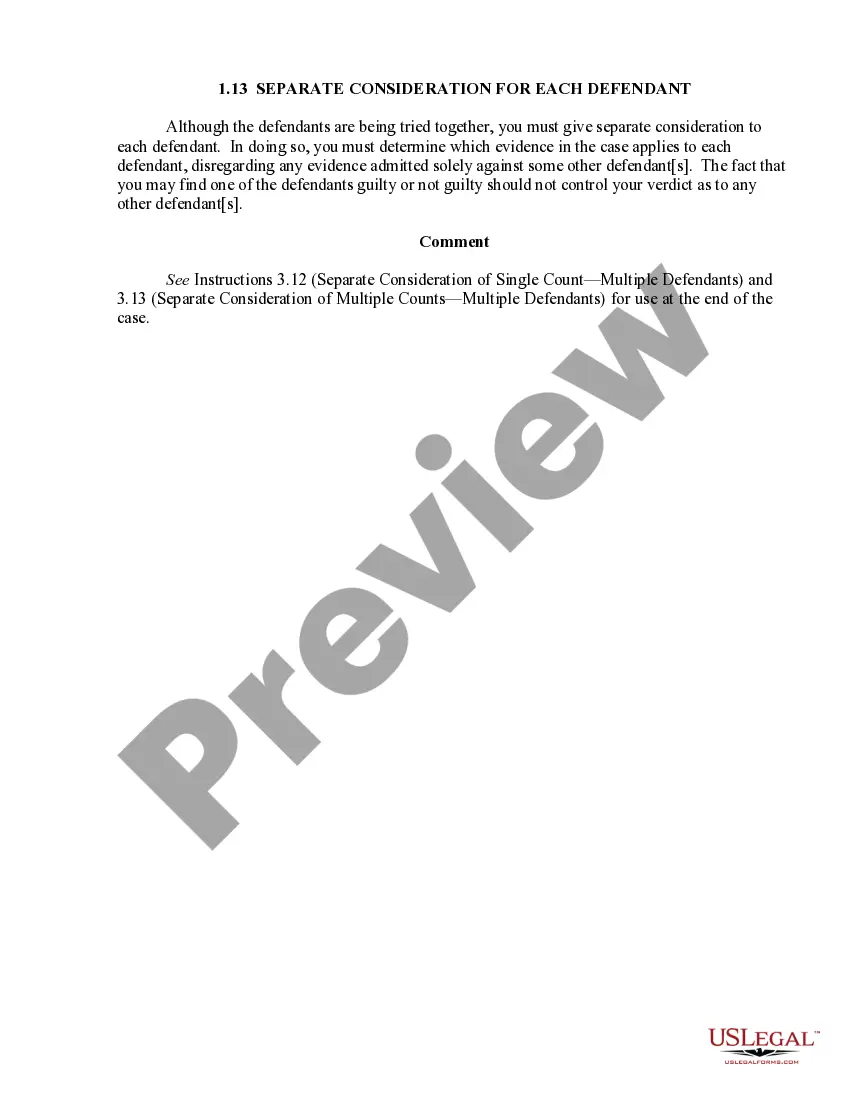
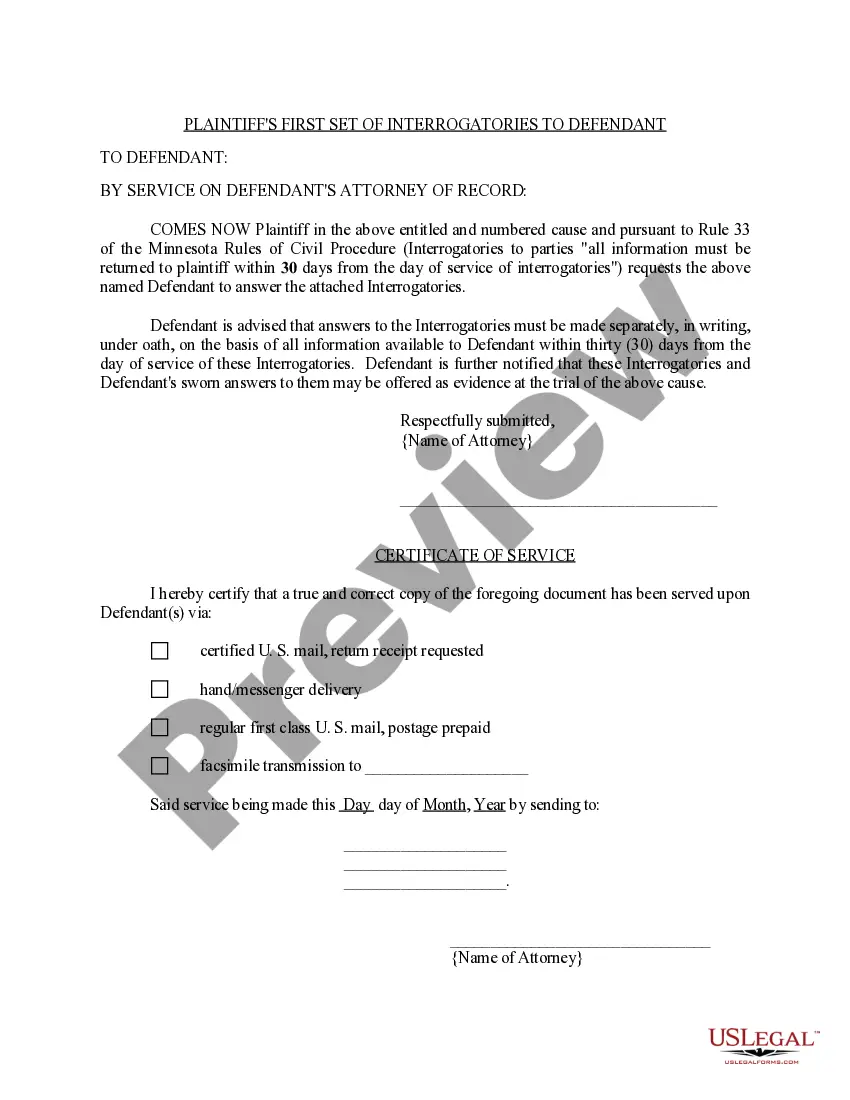
Minnesota Discovery - Plaintiff's Interrogatories - template - with Certificate Of Service
What this document covers
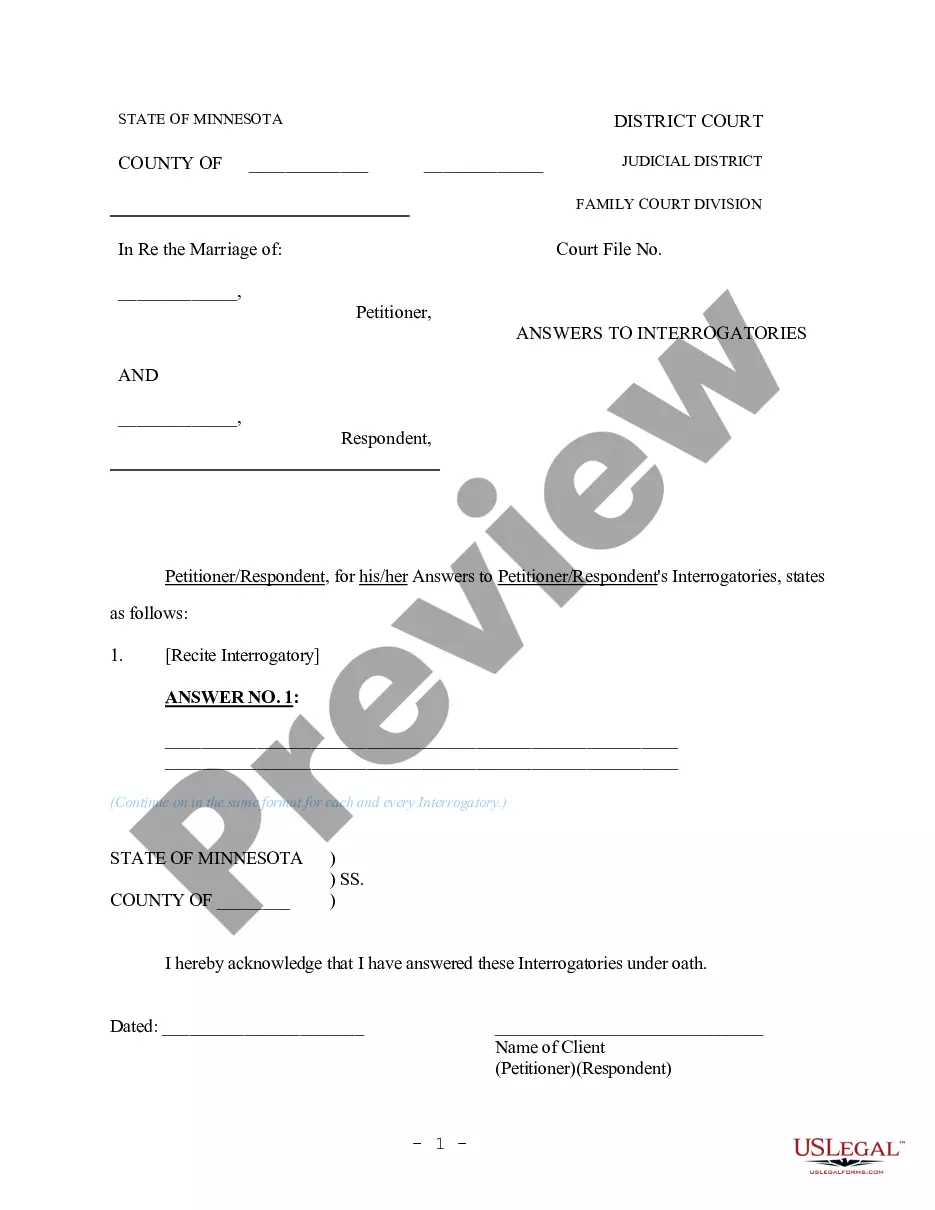
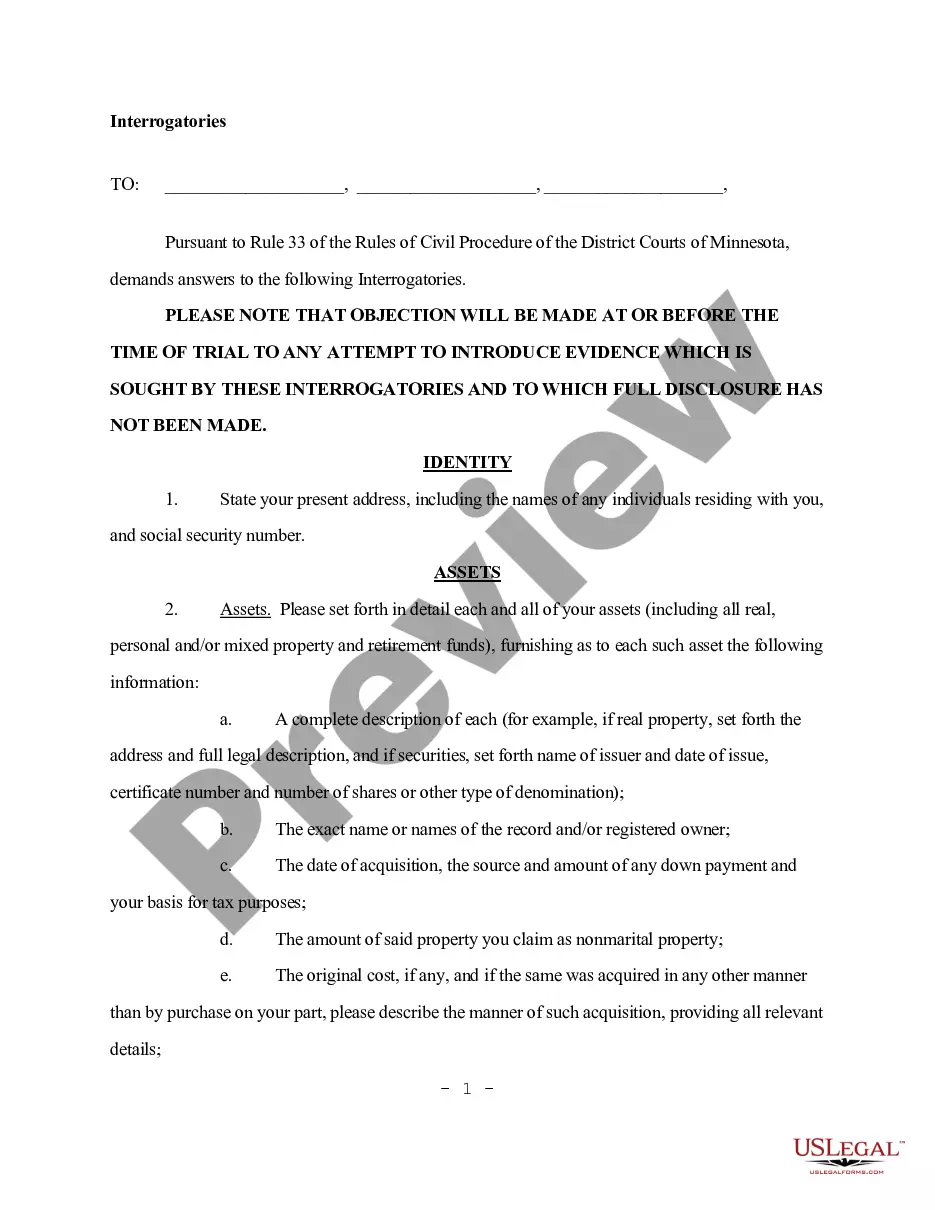
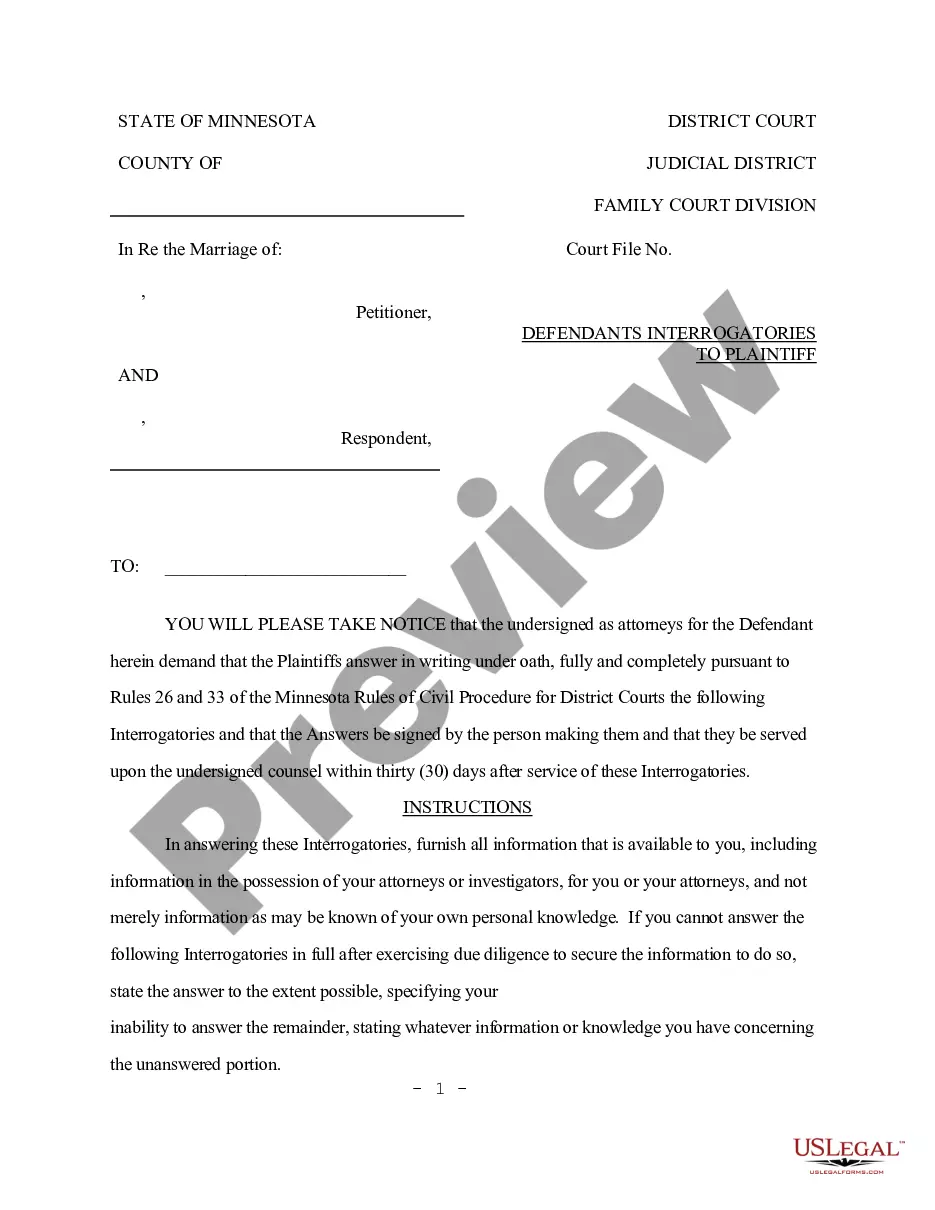
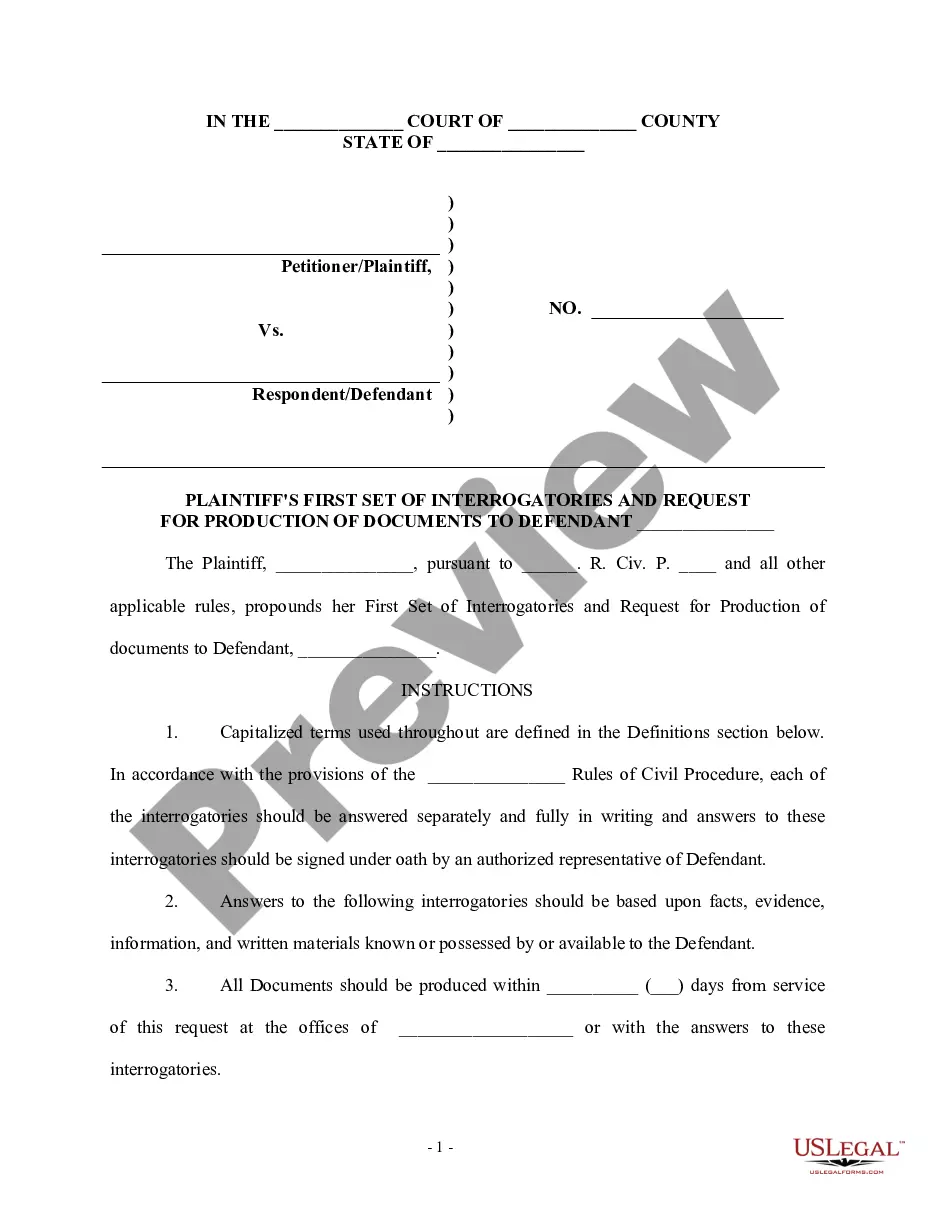
The Discovery - Plaintiff's Interrogatories form is a legal document used to request information from the defendant in a civil lawsuit. This template includes interrogatories, which are written questions that the defendant must answer under oath. Unlike similar forms, this template is specifically structured to comply with the Minnesota Rules of Civil Procedure, enhancing its credibility and usability in legal proceedings.
Key components of this form
- Preamble outlining the legal basis for the request.
- Interrogatories that must be answered by the defendant within thirty days.
- Instructions for submitting sworn answers in writing.
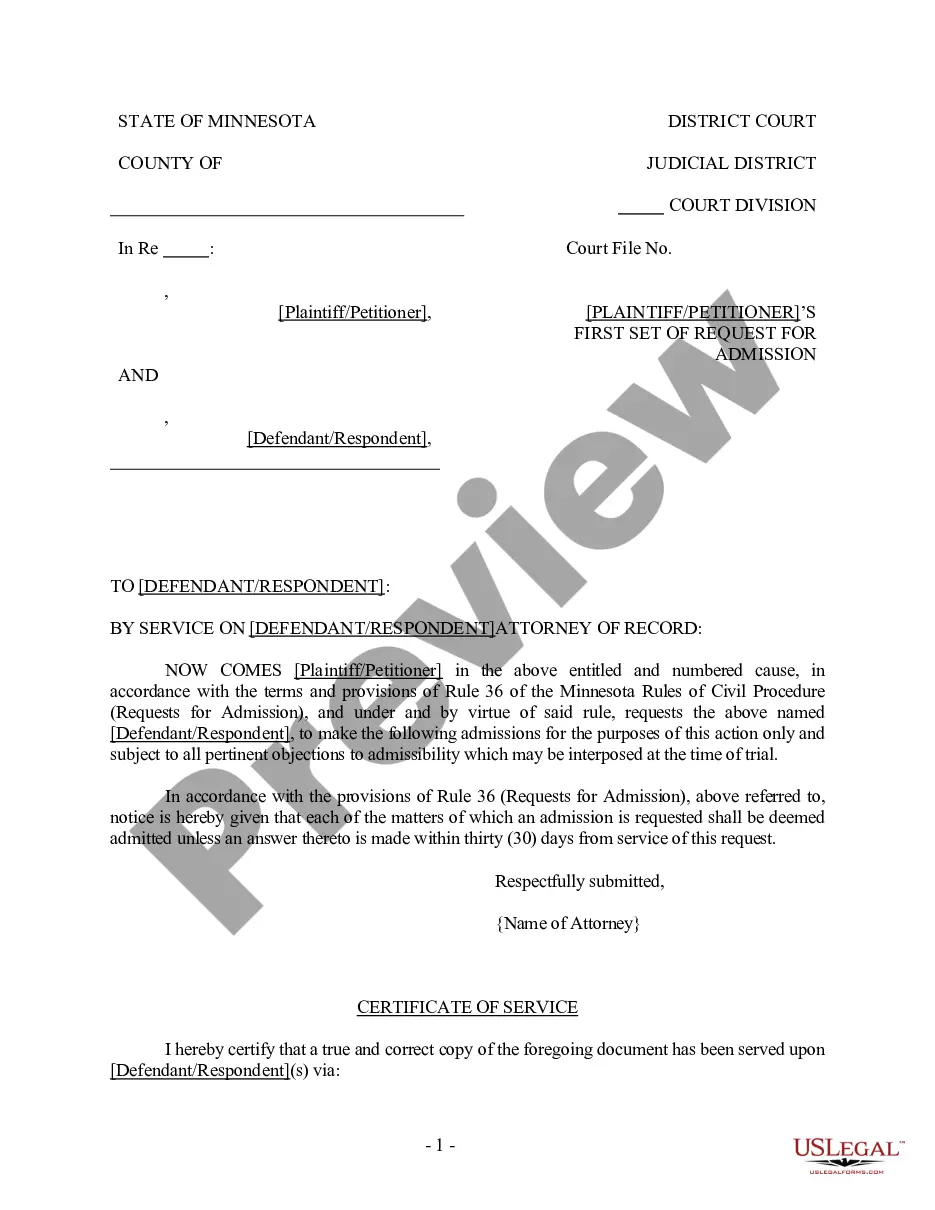
- Certificate of service to confirm the document has been shared with the defendant.
Common use cases
This form is necessary when a plaintiff needs to gather factual information from the defendant to prepare for trial. It is often used in cases where evidence is required to support a claim or defense, and it helps to clarify issues in dispute before the trial proceeds.
Who can use this document
This form is intended for:
- Individuals acting as plaintiffs in civil lawsuits.
- Attorneys representing plaintiffs seeking evidence from defendants.
Completing this form step by step
- Identify the parties involved in the case.
- Draft the interrogatories, ensuring that they are clear and concise.
- Include the necessary legal language in the preamble.
- Complete the certificate of service to document how the form is delivered to the defendant.
- Verify all information is accurate and sign the document as required.
Is notarization required?
This form does not typically require notarization unless specified by local law. However, the sworn answers provided by the defendant must be made under oath.
Get your form ready online
Our built-in tools help you complete, sign, share, and store your documents in one place.
Make edits, fill in missing information, and update formatting in US Legal Forms—just like you would in MS Word.
Download a copy, print it, send it by email, or mail it via USPS—whatever works best for your next step.
Sign and collect signatures with our SignNow integration. Send to multiple recipients, set reminders, and more. Go Premium to unlock E-Sign.
If this form requires notarization, complete it online through a secure video call—no need to meet a notary in person or wait for an appointment.
We protect your documents and personal data by following strict security and privacy standards.

Make edits, fill in missing information, and update formatting in US Legal Forms—just like you would in MS Word.

Download a copy, print it, send it by email, or mail it via USPS—whatever works best for your next step.

Sign and collect signatures with our SignNow integration. Send to multiple recipients, set reminders, and more. Go Premium to unlock E-Sign.

If this form requires notarization, complete it online through a secure video call—no need to meet a notary in person or wait for an appointment.

We protect your documents and personal data by following strict security and privacy standards.
Common mistakes to avoid
- Failing to serve the interrogatories within the legally required timeframe.
- Not providing clear or concise questions, leading to ambiguous answers.
- Neglecting to sign the certificate of service.
Why complete this form online
- Immediate access to a compliant form tailored to Minnesota law.
- Easy customization to fit specific case needs.
- Ability to download and print forms directly from your device.
Legal use & context
- Interrogatories are legally binding, and responses can be used as evidence in court.
- Failure to respond adequately can lead to legal consequences, including dismissal of claims or penalties.
Key takeaways
- The Discovery - Plaintiff's Interrogatories form is essential for collecting information from defendants.
- Completing this form properly is crucial to ensure compliance with state laws and rules.
- Utilizing this form online offers convenience and compliance benefits for litigants.
Looking for another form?


Form popularity
FAQ
Personal/Corporate information of opposing party. Identifying information of witnesses. Contact information & background of expert witnesses. Insurance information.
In law, interrogatories (also known as requests for further information) are a formal set of written questions propounded by one litigant and required to be answered by an adversary in order to clarify matters of fact and help to determine in advance what facts will be presented at any trial in the case.
Be alert to possible objections while you're drafting. Ask about particular contentions. Refer to allegations in the pleading. Ask for facts on which the contention is based.
So, can you refuse to answer interrogatories? The answer is, no, you may not.That answer must either permit inspection of the requested information or object to the production of the information for a specific reason.
Your answers to the interrogatories should usually be short, clear, and direct and should answer only the question that is being asked. This is not the time to set out your entire case or defense to the other side. Take the time to make sure your answers are correct and truthful.
Form rogs aren't objection-proof, though much of the time, the objections are nonsensical. The parties have to meet and confer to resolve a discovery dispute anyway.
Have a strategy. Adjust the scope of your requests to the questions at issue. Send clear requests. Always consider how your client would be prepared to respond to similar requests. Make your objections clear and specific.
Your answers to the interrogatories should usually be short, clear, and direct and should answer only the question that is being asked. This is not the time to set out your entire case or defense to the other side. Take the time to make sure your answers are correct and truthful.
A: Assuming that I draft about 30 - 40 questions per set, and assuming that I can re-use some of my special interrogatories from other past cases, then maybe 2 - 3 hours of my time to prepare a set of special interrogatories. Then another 1 - 2 hours afterward to review and discuss their responses with you.