Minnesota Release of Claim for Attorney's Fees
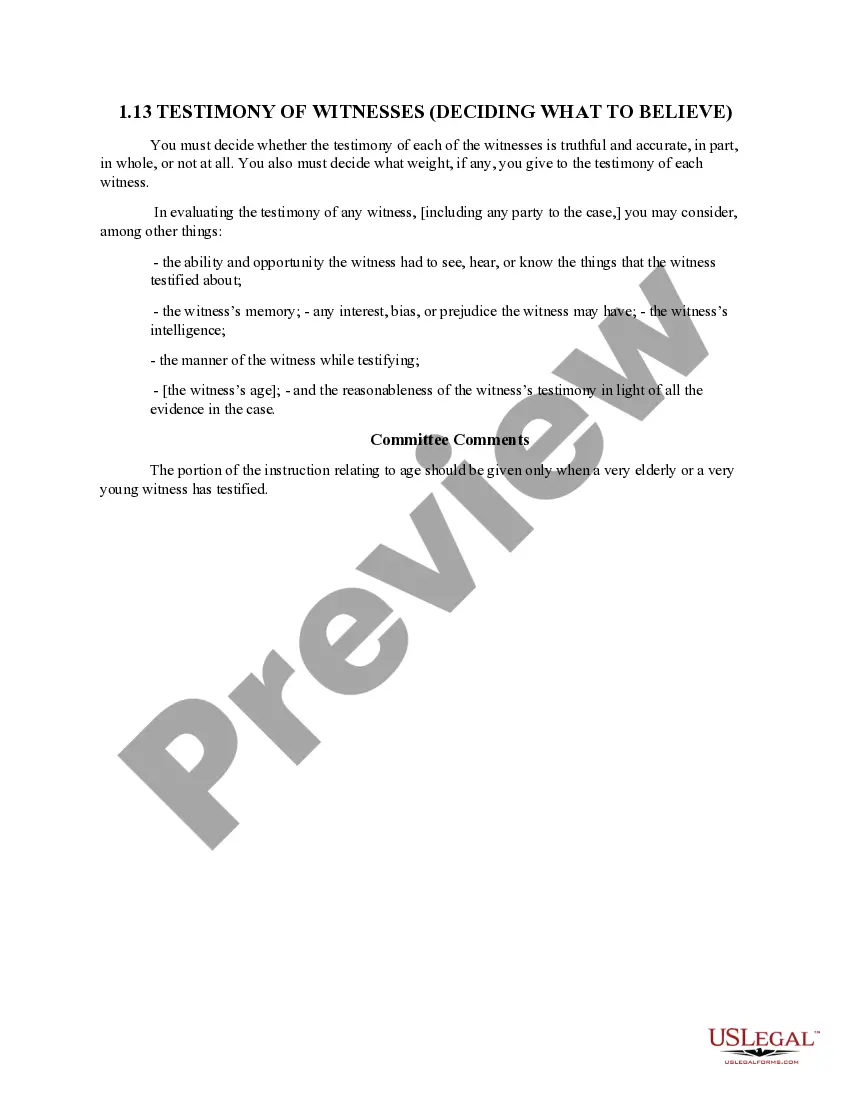
What this document covers
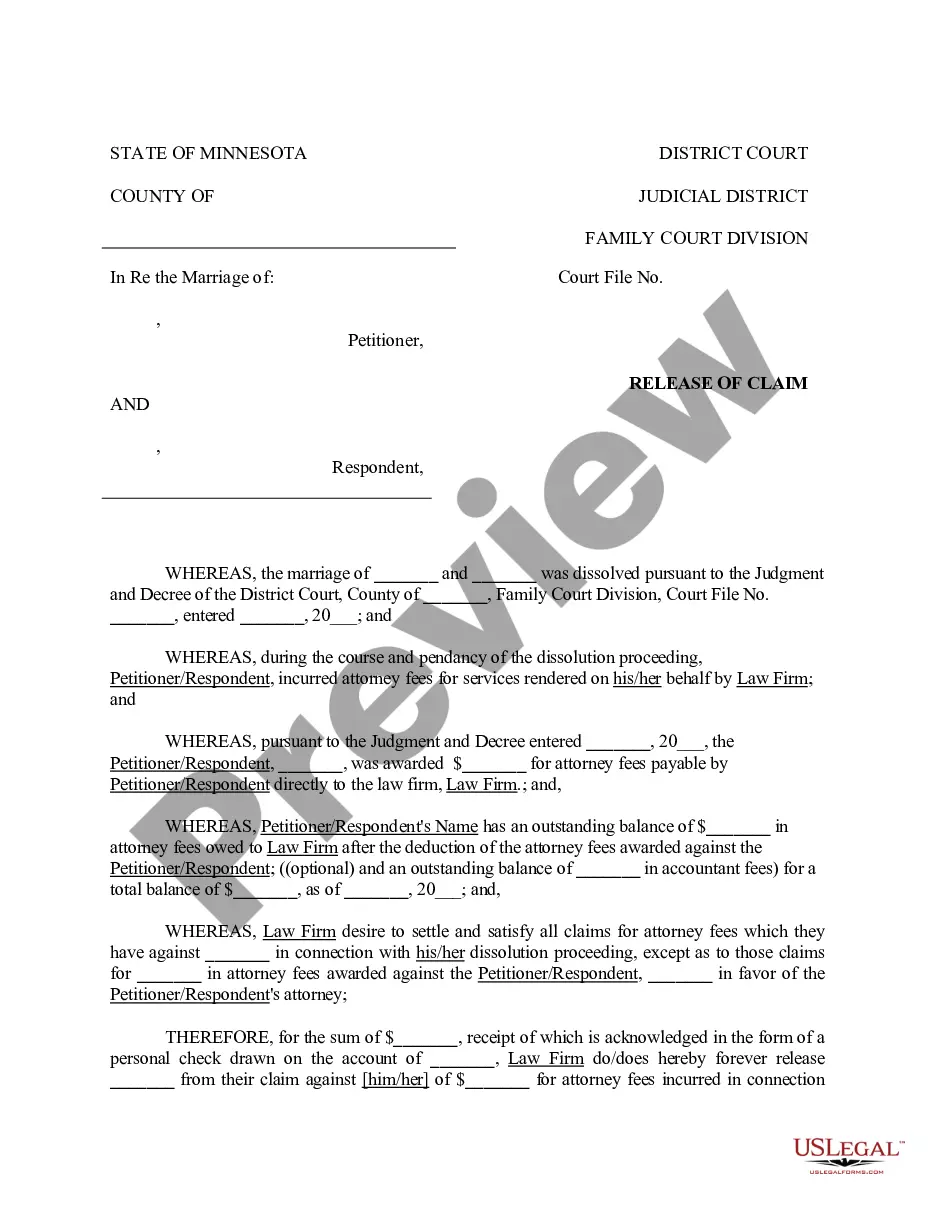
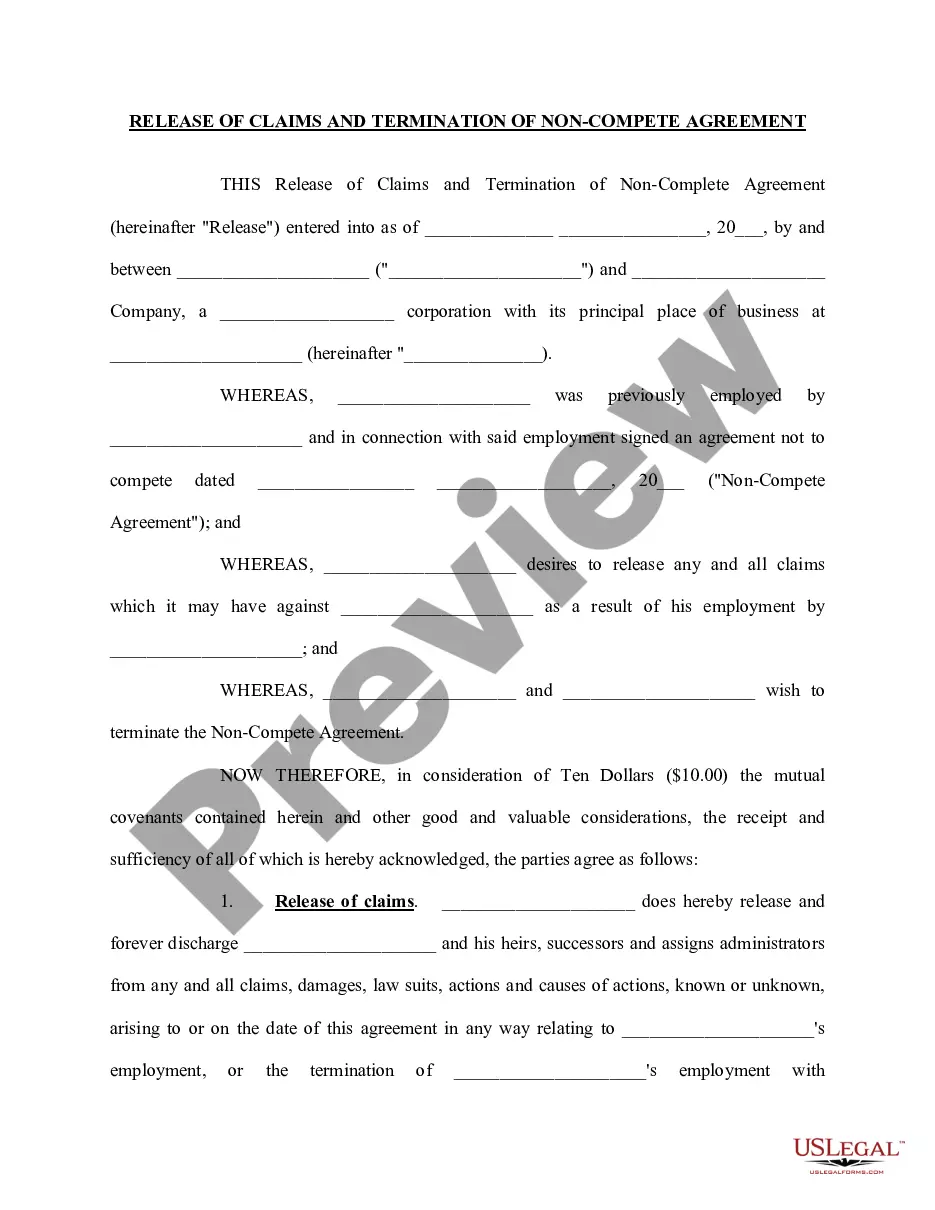
The Release of Claim for Attorney's Fees is a legal document used to acknowledge the settlement of attorney fees between a client and their law firm. When a law firm accepts partial payment in settlement of the total fees owed, this form releases the client from further claims regarding those fees. This form is crucial during dissolution proceedings, particularly when addressing outstanding balances for legal services rendered. It is distinct from other legal release forms as it specifically pertains to attorney fees and settlements.
Main sections of this form
- Identification of the Petitioner/Respondent and Law Firm.
- Details of the attorney fees awarded by the court.
- Outstanding balance of attorney fees post-deduction.
- The specified amount accepted as settlement.
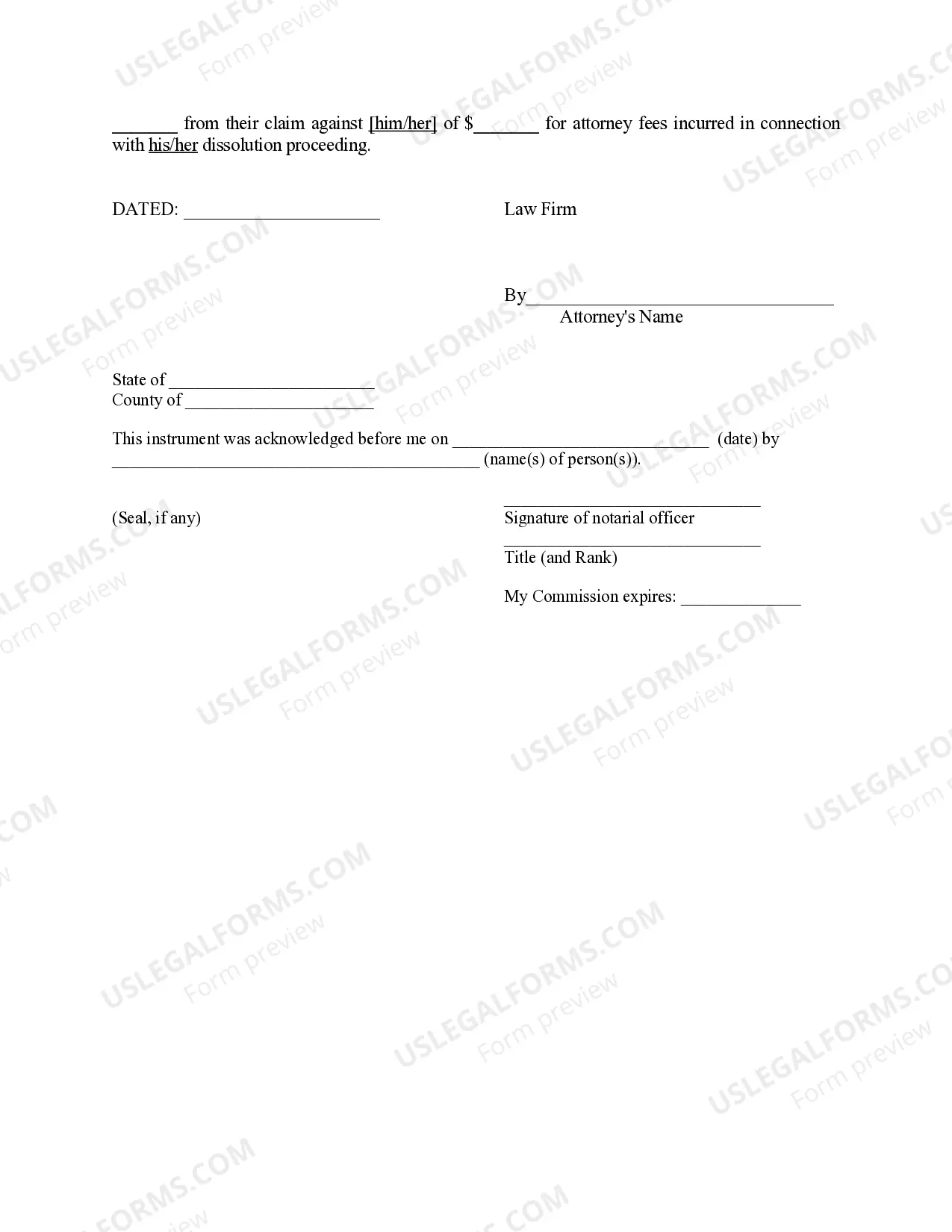
- Signature of the law firm and notarization details.
When to use this document
This form should be used when a client wishes to settle their outstanding attorney fees with their law firm as part of a dissolution proceeding. It is particularly important when there is an agreed amount for fees already awarded in court, and the client has an remaining balance that they want to resolve. Completing this form formalizes the agreement and protects both parties by releasing the claim for fees paid.
Intended users of this form
- Clients undergoing dissolution proceedings who owe attorney fees.
- Law firms accepting partial payment for services rendered.
- Individuals looking to settle legal fees and avoid further claims.
Completing this form step by step
- Identify the parties involved (Petitioner/Respondent and Law Firm).
- Enter the judgment date and the amount awarded for attorney fees.
- Specify the outstanding balance after deductions.
- State the settlement amount and confirm the method of payment.
- Have the law firm's representative sign the document and ensure notarization.
Notarization guidance
This form needs to be notarized to ensure legal validity. US Legal Forms provides secure online notarization powered by Notarize, allowing you to complete the process through a verified video call, available anytime.
Get your form ready online
Our built-in tools help you complete, sign, share, and store your documents in one place.
Make edits, fill in missing information, and update formatting in US Legal Forms—just like you would in MS Word.
Download a copy, print it, send it by email, or mail it via USPS—whatever works best for your next step.
Sign and collect signatures with our SignNow integration. Send to multiple recipients, set reminders, and more. Go Premium to unlock E-Sign.
If this form requires notarization, complete it online through a secure video call—no need to meet a notary in person or wait for an appointment.
We protect your documents and personal data by following strict security and privacy standards.

Make edits, fill in missing information, and update formatting in US Legal Forms—just like you would in MS Word.

Download a copy, print it, send it by email, or mail it via USPS—whatever works best for your next step.

Sign and collect signatures with our SignNow integration. Send to multiple recipients, set reminders, and more. Go Premium to unlock E-Sign.

If this form requires notarization, complete it online through a secure video call—no need to meet a notary in person or wait for an appointment.

We protect your documents and personal data by following strict security and privacy standards.
Avoid these common issues
- Failing to specify the correct outstanding balance of attorney fees.
- Not having the form notarized if required by state law.
- Missing signatures from both parties.
- Using incorrect or outdated version of the form.
Why use this form online
- Convenience of filling out and downloading the form at any time.
- Editability allows for accurate input of specific details.
- Access to attorney-drafted templates ensures legal reliability.
Legal use & context
- This form serves as a release from claims for fees associated with the dissolution proceedings.
- It is enforceable upon completion and notarization, providing legal protection for the law firm and client.
- Failure to use this form could result in unresolved claims for attorney fees.
Quick recap
- The Release of Claim for Attorney's Fees is vital for settling legal fee disputes.
- Complete all sections accurately to ensure validity.
- Do not forget to notarize the document as required.
Looking for another form?
Form popularity
FAQ
The typical attorney-fee clause states that if one party breaches the contract, the other party can sue and recover its attorney fees for bringing the suit. If you have a contract dispute or you if you are negotiating a contract, you should pay careful attention to any language on attorneys' fees.
If you are the one who is being divorced (the respondent), the Court might order you to pay the legal fees of both sides. This is unjust, but it is based on the old court principles that if you can prove your case before them, then you will also get your costs.
The primary issue in Kay v. Ehrler is, simply put, whether a pro se litigant who also happens to be a lawyer is entitled to attorney fees under the Civil Rights Attorneys' Fee Awards Act.On the contrary there also are a number of federal courts that have permitted pro se attorneys to recover fees under Section 1988.
As a general rule, a wife cannot force her husband to pay for their divorce. Each party in the divorce action pays for his or her attorney fees and costs. However, there are circumstances in which a judge may order a husband to pay the wife's attorney fees and costs.
Attorney's fees are often expensive, and you may be hoping that your ex will have to pay your legal bills. The answer is: probably not, unless extreme circumstances warrant it.This means that even if you think you do not have the money to pay your legal bills, the judge does not have to award you attorney's fees.
If you are forced to defend yourself in the case, and you prevail, you can collect your attorneys' fees from the party truly at fault. For instance, if you are a general contractor, and one of your subcontractors burns the project down, the owner will probably sue you for the damage.
The American Rule states that each party pays its own attorneys' fees, regardless of who is the prevailing party.There are thus conditions to recover your attorneys' fees in a legal matter, and attorneys' fees are never recovered in California unless a lawsuit has been filed.
You cannot sue your ex for legal fees because you did not like the representation your attorney gave you. You could have fired your attorney at any time if you did not agree with the way he or she handled the case.