Minnesota Affidavit for Order to Show Cause
What this document covers
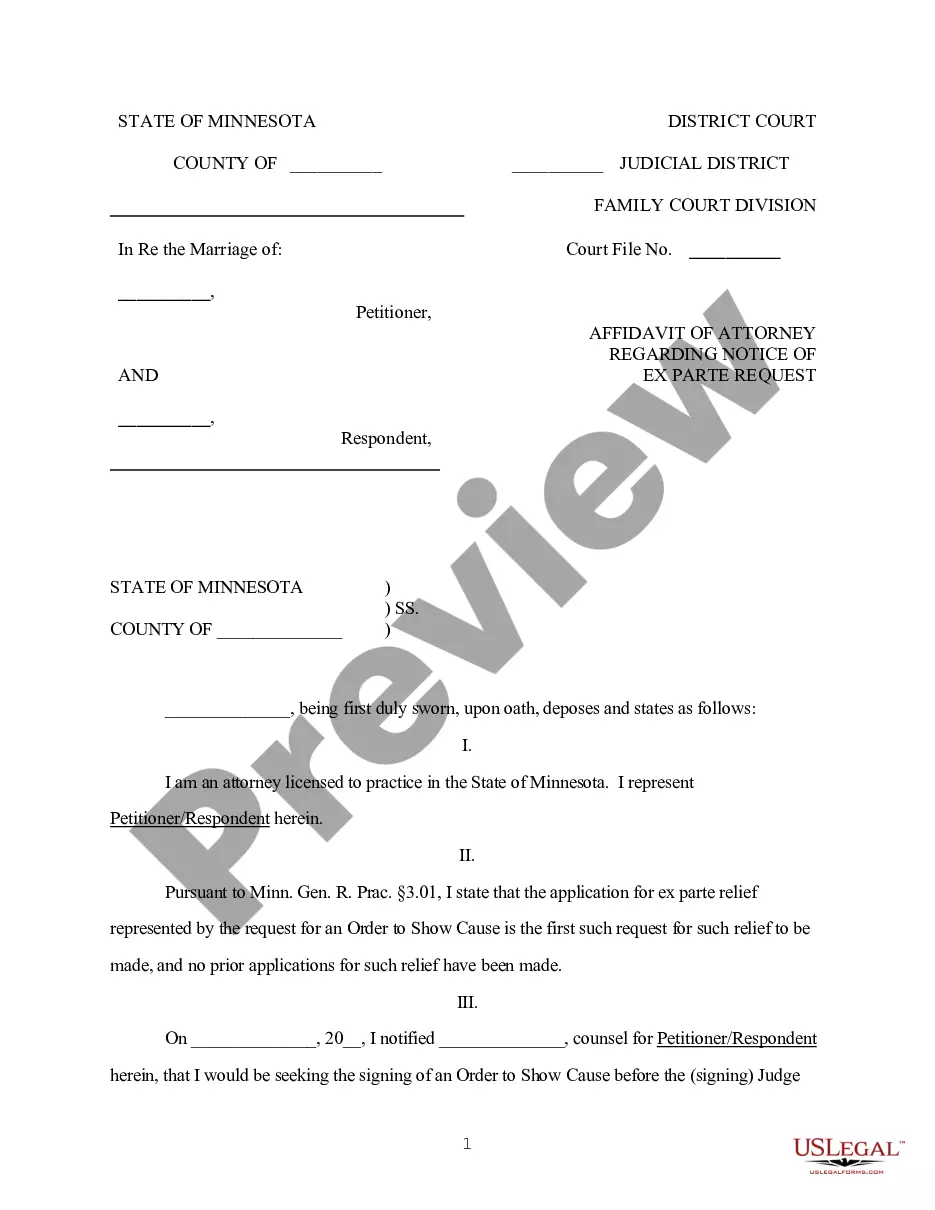
The Affidavit for Order to Show Cause is a legal document used by attorneys in Minnesota to formally affirm the notice of an ex parte request. It serves to notify the court and opposing counsel regarding the application for urgent relief, distinguishing it from other types of affidavits due to its specific focus on ex parte proceedings. This form ensures that all parties are informed about the request for an order to show cause before a court hearing.
Key components of this form
- Identification of the affiant as a licensed attorney.
- Statement affirming the request for an ex parte order is the first of its kind for the case.
- Date of notification to opposing counsel regarding the request.
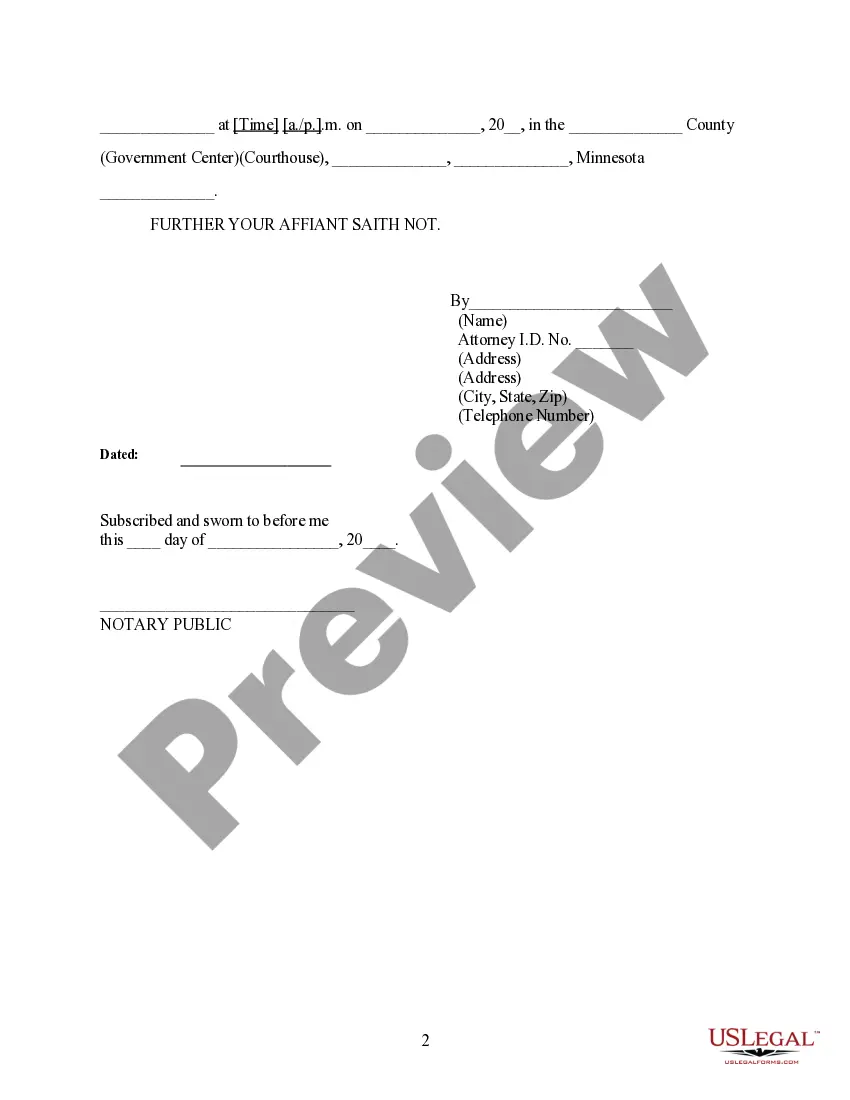
- Details of the scheduled hearing, including time and location.
- Signature of the affiant, along with their attorney identification number.
- Notary public acknowledgment of the affidavit.
Common use cases
This form is utilized when an attorney needs to request an urgent court order without notifying the other party in advance. Common scenarios include cases where immediate relief is necessary to prevent harm or preserve rights, such as in emergencies involving custody issues or protection orders. The affidavit informs the court of the urgency and the prior notification to the other partyâs counsel.
Who can use this document
- Licensed attorneys practicing in Minnesota.
- Attorneys representing clients seeking urgent court relief.
- Legal professionals involved in family law, emergency motions, or similar cases.
Completing this form step by step
- Identify the affiant as a licensed attorney and fill in their name.
- State that this is the first application for ex parte relief in the matter.
- Enter the date when notice was provided to the opposing counsel.
- Include details of the hearing: date, time, and location.
- Sign the affidavit in the presence of a notary public.
Is notarization required?
Yes, this form must be notarized to be legally valid. The affiant must sign the document in the presence of a notary public, ensuring the authenticity of the affidavit. US Legal Forms offers integrated online notarization, allowing for secure video calls and 24/7 availability without the need for travel.
Get your form ready online
Our built-in tools help you complete, sign, share, and store your documents in one place.
Make edits, fill in missing information, and update formatting in US Legal Forms—just like you would in MS Word.
Download a copy, print it, send it by email, or mail it via USPS—whatever works best for your next step.
Sign and collect signatures with our SignNow integration. Send to multiple recipients, set reminders, and more. Go Premium to unlock E-Sign.
If this form requires notarization, complete it online through a secure video call—no need to meet a notary in person or wait for an appointment.
We protect your documents and personal data by following strict security and privacy standards.

Make edits, fill in missing information, and update formatting in US Legal Forms—just like you would in MS Word.

Download a copy, print it, send it by email, or mail it via USPS—whatever works best for your next step.

Sign and collect signatures with our SignNow integration. Send to multiple recipients, set reminders, and more. Go Premium to unlock E-Sign.

If this form requires notarization, complete it online through a secure video call—no need to meet a notary in person or wait for an appointment.

We protect your documents and personal data by following strict security and privacy standards.
Mistakes to watch out for
- Failing to provide accurate information regarding the hearing date and location.
- Not notifying the opposing counsel before submitting the request.
- Omitting the notary public's signature or stamp.
- Incorrectly stating this is the first request for ex parte relief when previous requests exist.
Benefits of completing this form online
- Convenience of downloading the form at any time.
- Editability allows for customization based on specific case details.
- Reliability, as forms are drafted by licensed attorneys to meet legal standards.
Looking for another form?
Form popularity
FAQ
Yes, in Minnesota, an affidavit typically must be notarized to be considered valid. Notarization adds an additional layer of authenticity to your document, ensuring that the information presented is credible. When you prepare your Minnesota Affidavit for Order to Show Cause, it is essential to find a notary public to verify your signature before submitting it to the court. This step helps strengthen your case and enhances the trustworthiness of your affidavit.
An order to show cause is a serious legal matter that can significantly impact the involved parties. If the court grants the order, it can lead to immediate changes in custody arrangements, financial obligations, or other critical issues. It's important to prepare a comprehensive Minnesota Affidavit for Order to Show Cause to effectively communicate your case, as the court takes these requests seriously. Consulting with a legal professional can provide guidance on how to navigate these proceedings successfully.
An order to show cause hearing in Minnesota is a legal proceeding where one party requests the court to order another party to explain why a specific action should not be taken. This type of hearing is often used in family law cases, such as custody or support disputes, to resolve urgent matters. To initiate this process, you typically need to file a Minnesota Affidavit for Order to Show Cause, which outlines your reasons for the request. This document is essential for ensuring that your concerns are formally presented to the court.
A show cause order is a court directive that requires a party to appear and explain why a particular action should not occur. For instance, in family law, a judge may issue a show cause order related to child custody or support issues. The Minnesota Affidavit for Order to Show Cause typically accompanies this order, outlining the reasons for the request. If you are unsure how to draft such documents, USLegalForms provides useful templates and examples to assist you.
To fill out an order to show cause, begin by gathering all necessary documentation related to your case. Complete the Minnesota Affidavit for Order to Show Cause, ensuring that you detail your claims and the relief you seek. After filling out the order, review it for accuracy and clarity before submitting it to the appropriate court. For additional support, USLegalForms offers templates and information to help you navigate this process effectively.
Filling out an Order to Show Cause involves several key steps. First, you must complete the required forms, including the Minnesota Affidavit for Order to Show Cause, which outlines your request. Be sure to provide clear and concise information regarding your situation and the reasons for your request. If you need assistance, consider using the resources available on USLegalForms, which can guide you through the process.
To draft an order to show cause effectively, start by outlining the facts of your case. Clearly state the relief you seek and the reasons for your request. Incorporate the Minnesota Affidavit for Order to Show Cause to provide context and strengthen your position. A well-prepared draft can significantly impact the outcome of your case.
A draft Order to Show Cause is a preliminary version of the formal document that you plan to submit to the court. It outlines the main arguments and supporting evidence, including the Minnesota Affidavit for Order to Show Cause. Creating a draft allows you to refine your points and ensure all necessary information is included before filing.
An example of an Order to Show Cause could involve a parent requesting a change in custody arrangements. The parent would submit the Minnesota Affidavit for Order to Show Cause, explaining the circumstances that necessitate this change. This helps the court understand the urgency and need for the requested modification.
In Minnesota, an order to show cause is a legal directive that compels a party to appear before a judge and explain why a specific action should or should not occur. This order often arises in family law cases or other civil matters. The Minnesota Affidavit for Order to Show Cause serves as the supporting document that details the reasons behind the request.