Minnesota Glossary of Child Custody Terminology - for Client
About this form
The Glossary of Child Custody Terminology form is a comprehensive resource that defines key terms related to child custody. This form is designed for clients navigating divorce proceedings and seeking to understand the terminology often used in legal contexts. By clarifying the terminology such as legal custody, physical custody, and visitation, this glossary assists users in making informed decisions regarding their child's best interests during custody arrangements. This form differs from other legal forms as it focuses specifically on terminology and definitions rather than formal agreements or applications.
Key parts of this document
- Definitions of child custody terms, including legal custody and physical custody.
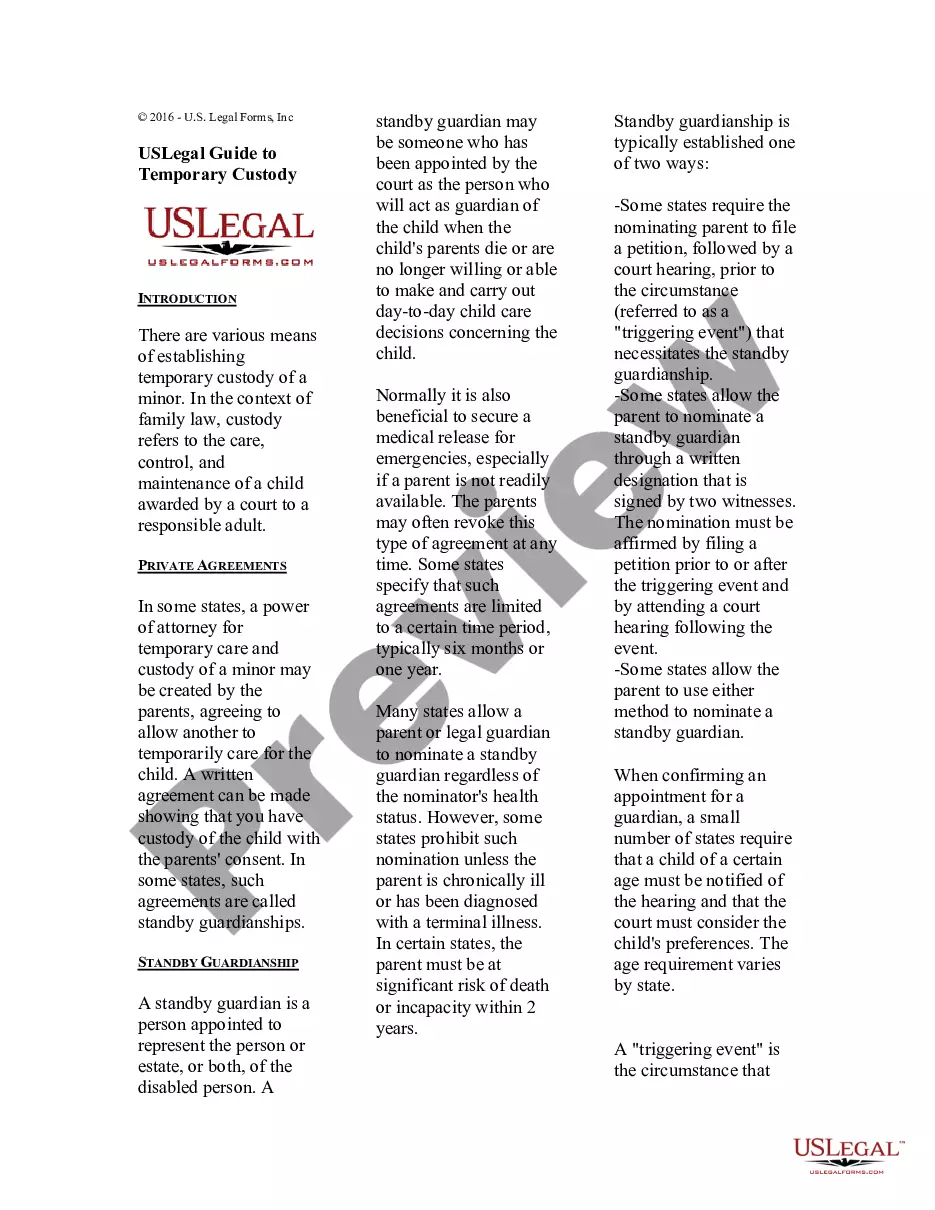
- Criteria used by courts to determine custody based on a child's best interests.
- Explanations of sole and joint custody arrangements.
- Information on visitation rights and child support obligations.
- Insights into common legal terminology related to divorce and custody proceedings.


Situations where this form applies
This glossary should be used by individuals going through divorce proceedings that involve child custody issues. It is particularly useful for parents who are unfamiliar with legal jargon, those preparing for court hearings, or anyone seeking clarification on child custody terms to better understand their rights and responsibilities regarding child custody arrangements.
Who can use this document
- Parents involved in divorce proceedings.
- Guardians seeking understanding of custody terms.
- Individuals preparing for legal consultations.
- Anyone looking to educate themselves on child custody issues.
Steps to complete this form
- Read through the glossary to familiarize yourself with the terminology.
- Identify key terms that are relevant to your custody situation.
- Use the definitions provided to understand your rights and obligations.
- Discuss any confusion regarding terms with your attorney for clarity.
- Refer back to the glossary as needed during your legal proceedings.
Notarization guidance
This form does not typically require notarization to be legally valid. However, some jurisdictions or document types may still require it. US Legal Forms provides secure online notarization powered by Notarize, available 24/7 for added convenience.
Get your form ready online
Our built-in tools help you complete, sign, share, and store your documents in one place.
Make edits, fill in missing information, and update formatting in US Legal Forms—just like you would in MS Word.
Download a copy, print it, send it by email, or mail it via USPS—whatever works best for your next step.
Sign and collect signatures with our SignNow integration. Send to multiple recipients, set reminders, and more. Go Premium to unlock E-Sign.
If this form requires notarization, complete it online through a secure video call—no need to meet a notary in person or wait for an appointment.
We protect your documents and personal data by following strict security and privacy standards.

Make edits, fill in missing information, and update formatting in US Legal Forms—just like you would in MS Word.

Download a copy, print it, send it by email, or mail it via USPS—whatever works best for your next step.

Sign and collect signatures with our SignNow integration. Send to multiple recipients, set reminders, and more. Go Premium to unlock E-Sign.

If this form requires notarization, complete it online through a secure video call—no need to meet a notary in person or wait for an appointment.

We protect your documents and personal data by following strict security and privacy standards.
Common mistakes
- Failure to understand the difference between legal and physical custody.
- Misinterpreting visitation rights and responsibilities.
- Neglecting to consider the best interests of the child when discussing custody terms.
- Using outdated terminology that may no longer apply in your state.
Why complete this form online
- Immediate access to essential terminology without the need for extensive legal consultations.
- The ability to download and reference the glossary at any time.
- Customizable format to take notes or highlight key terms relevant to your case.
Legal use & context
- This glossary is intended for educational purposes and does not constitute legal advice.
- Understanding these terms can improve your communication with legal professionals.
- Clarifying custody terminology can help prevent misunderstandings in custody agreements.
Summary of main points
- This glossary provides essential definitions related to child custody.
- Understanding custody terminology is crucial for navigating divorce proceedings.
- Consulting legal professionals can enhance comprehension of terms and rights.
Legal terms and meanings
- Legal Custody: The right to make significant decisions regarding a child's upbringing.
- Physical Custody: The actual physical care and residence of the child.
- Sole Custody: When one parent has exclusive legal and/or physical custody of the child.
- Joint Custody: An arrangement where both parents share the responsibilities of raising the child.
- Visitation: Time spent with a child by the non-custodial parent.
Looking for another form?
Form popularity
FAQ
In simple terms, custody means who has the legal right to care for and make decisions for a child. It encompasses various aspects, such as where the child lives and how parents share responsibilities. When you explore the Minnesota Glossary of Child Custody Terminology - for Client, you will find clear definitions that help demystify the concept of custody, making it easier to understand your rights and responsibilities as a parent.
The chain of custody refers to the process that ensures the integrity of evidence from the moment it is collected until it is presented in court. Key terms in this context include 'evidence,' 'collection,' 'documentation,' and 'transfer.' Understanding these terms is essential, especially when navigating custody disputes. The Minnesota Glossary of Child Custody Terminology - for Client provides clarity on these concepts, helping you grasp their significance in legal proceedings.
The term 'custody' has evolved, and many now refer to it as 'parenting time' or 'parental responsibilities.' This change reflects a shift towards a more collaborative approach in child-rearing after separation or divorce. In the Minnesota Glossary of Child Custody Terminology - for Client, you will find definitions that emphasize the importance of shared parenting, ensuring that both parents remain involved in their child's life.
Documenting custody violations is crucial for protecting your rights and ensuring the best interests of your child. Start by keeping a detailed log of each incident, including dates, times, and any witnesses present. You can also gather any relevant communications, such as texts or emails, that demonstrate the violation. For further assistance, refer to the Minnesota Glossary of Child Custody Terminology - for Client, which can provide clarity on specific terms and processes involved in custody matters.
One of the biggest mistakes in a custody battle is failing to prioritize the child's best interests. When parents become overly focused on winning or engaging in conflict, they may lose sight of what is truly important. By using the Minnesota Glossary of Child Custody Terminology - for Client, you can gain insights into strategies that emphasize cooperation and the well-being of your child, ultimately leading to a more favorable outcome.
An unstable parent is often characterized by inconsistent behavior, emotional volatility, or an inability to provide a safe environment for their child. Courts may assess stability based on factors such as mental health, substance abuse, and the ability to maintain a routine. Understanding this definition through the Minnesota Glossary of Child Custody Terminology - for Client can help you identify what the courts may consider when determining custody.
The vocabulary of custody encompasses terms that are essential for navigating your case, such as 'joint custody,' 'visitation,' and 'best interests of the child.' Familiarizing yourself with this vocabulary can empower you to articulate your position effectively. The Minnesota Glossary of Child Custody Terminology - for Client serves as an excellent resource to clarify these important terms and guide your discussions.
Certain behaviors can negatively impact your standing in a custody battle. For instance, demonstrating a lack of cooperation with the other parent or failing to meet your child's needs can raise concerns. Understanding these pitfalls through the Minnesota Glossary of Child Custody Terminology - for Client can equip you with strategies to present yourself positively during the proceedings.
In a child custody trial, the best witnesses often include family members, teachers, and childcare providers who can speak to the child's well-being. Their testimonies can provide insight into the child’s daily life and the parenting capabilities of each parent. Utilizing the Minnesota Glossary of Child Custody Terminology - for Client can help you understand the roles of these witnesses and how their input can influence the case.