Minnesota Motion for Order Compelling Financial Disclosure by Judgment Debtor
What is this form?
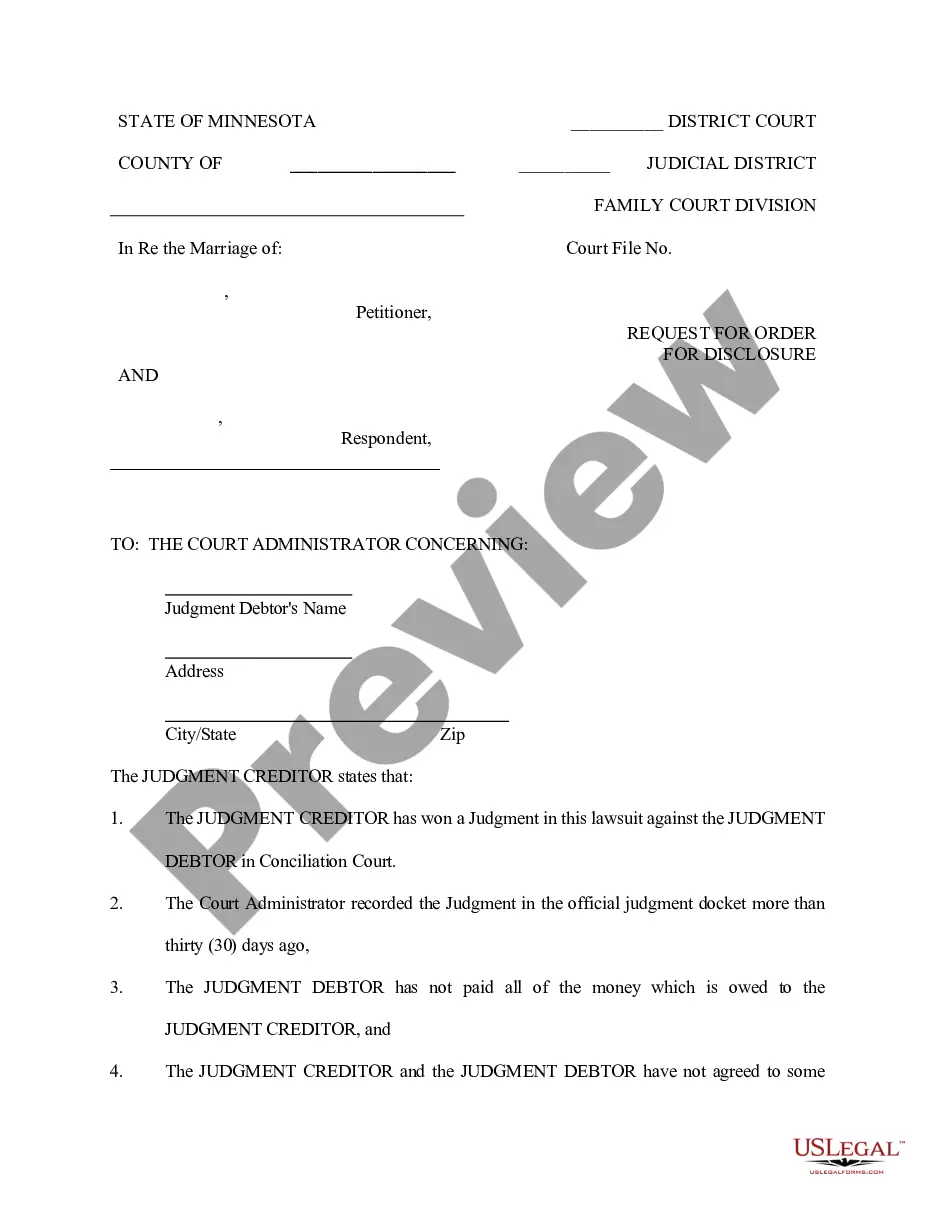
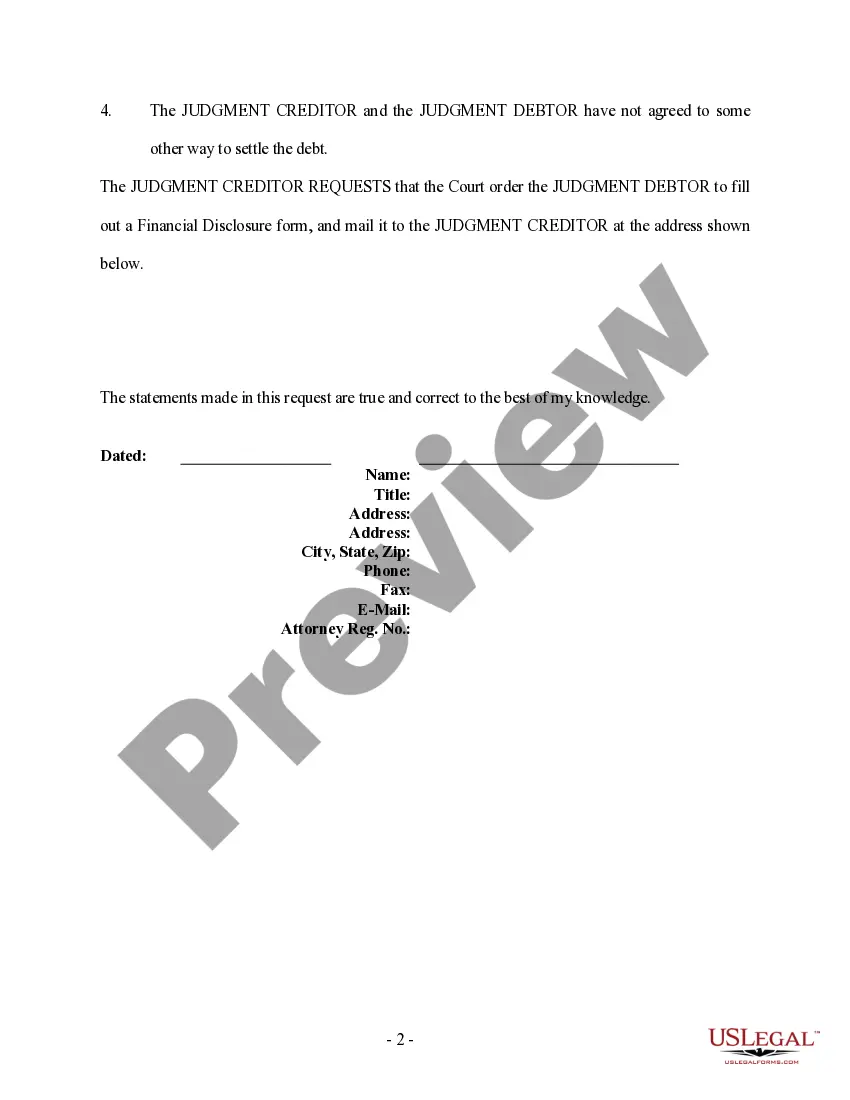
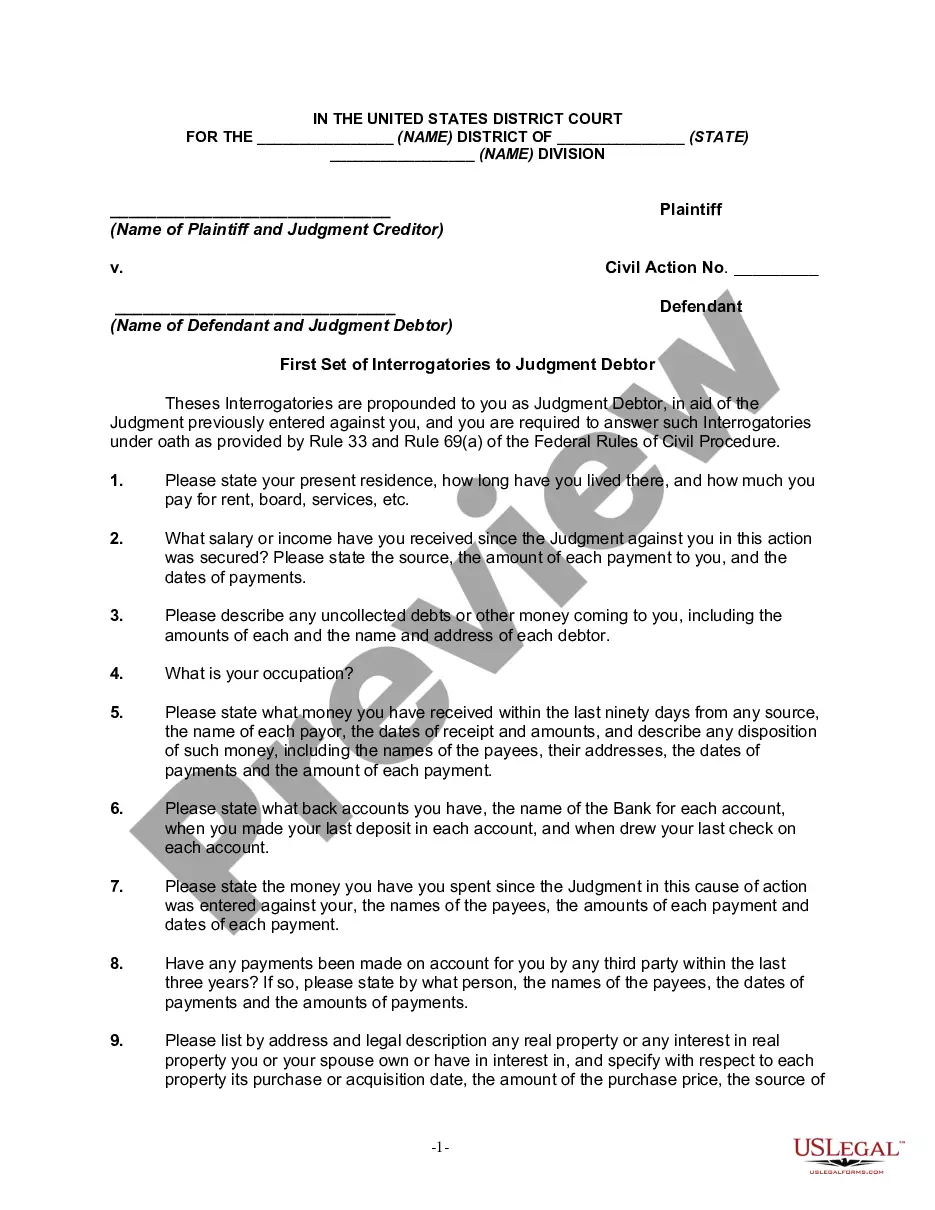
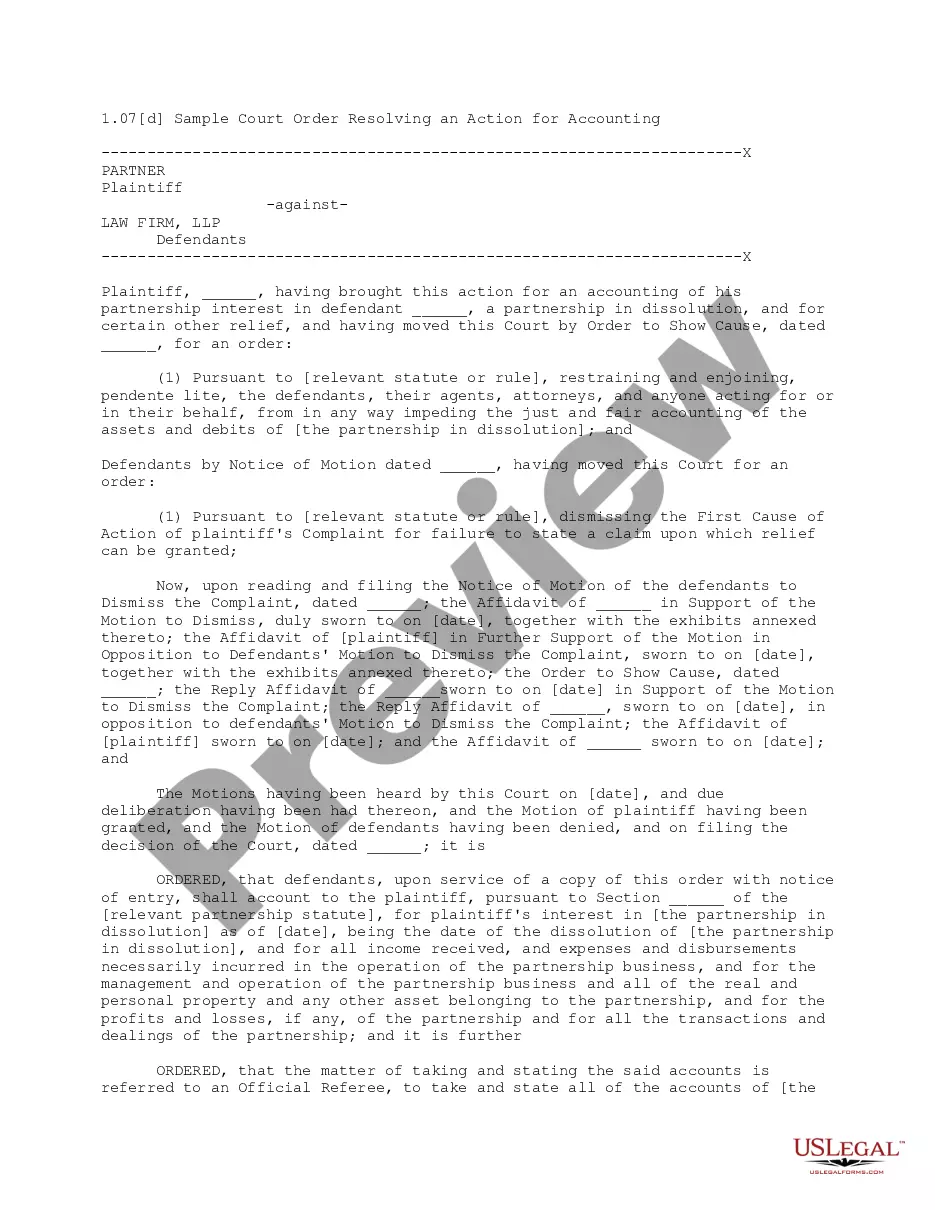
The Motion for Order Compelling Financial Disclosure by Judgment Debtor is a legal document that allows a judgment creditor to request a court order requiring the judgment debtor to provide information about their financial situation. The purpose of this form is to compel the debtor to disclose financial details necessary for the creditor to pursue the collection of an outstanding judgment. This form differs from general financial disclosure forms as it specifically seeks court intervention to enforce compliance.
Key parts of this document
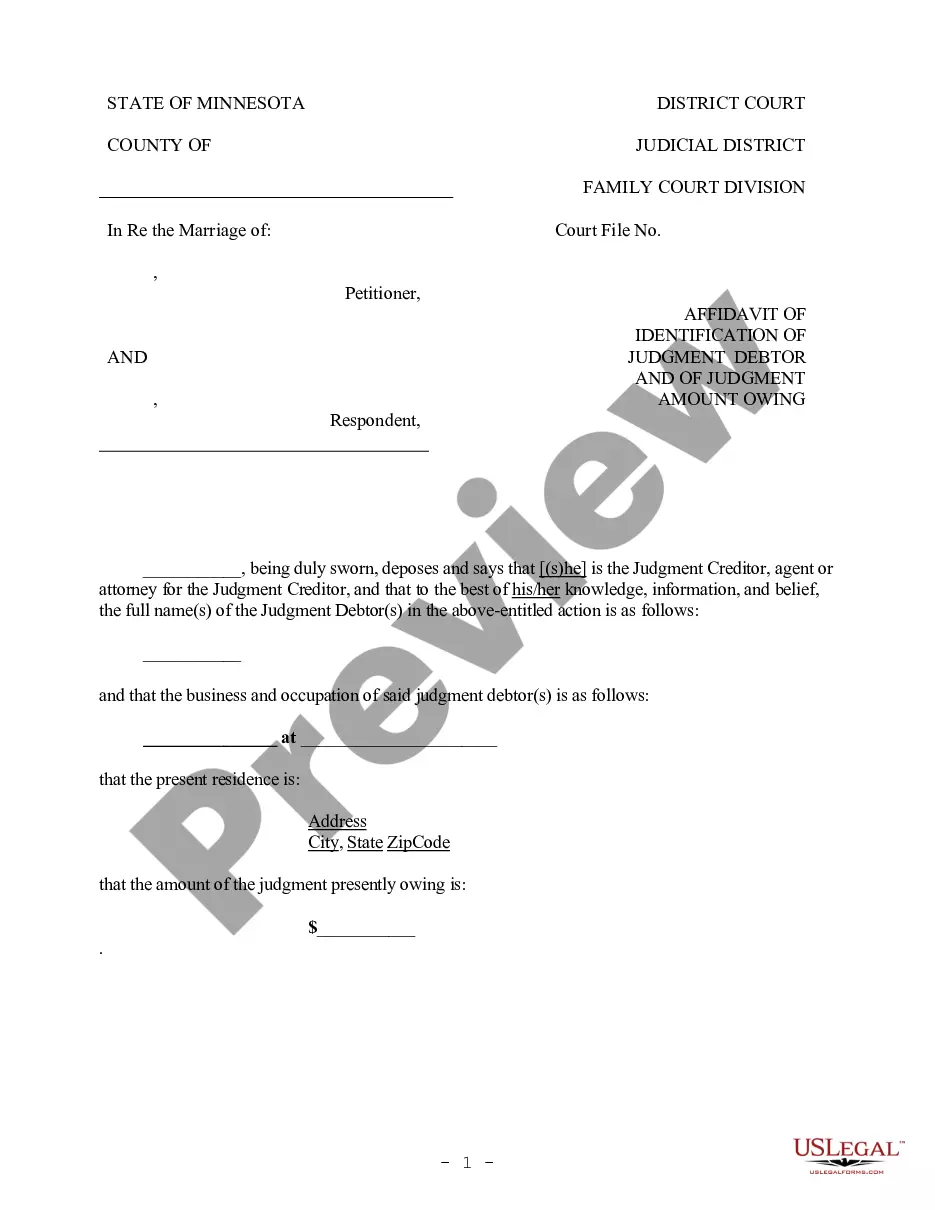
- Judgment debtor's name and address: Identifies the individual required to disclose financial information.
- Judgment creditor's statement: Confirms that a judgment has been awarded and not fully paid.
- Request for court order: Explicit request to the court for enforcement of financial disclosure.
- Contact information: Includes phone, fax, email, and attorney registration number for the judgment creditor.
Situations where this form applies
This form should be used when a judgment creditor has successfully obtained a judgment against a debtor but has not received full payment. If the debtor has failed to make payments and no alternative settlement has been negotiated, this form can be employed to request a court-ordered financial disclosure, helping the creditor understand the debtor's financial capabilities.
Who can use this document
- Judgment creditors who have won a judgment in court and are seeking financial information from the debtor.
- Individuals or businesses that have outstanding debts owed by judgment debtors.
- Attorneys representing creditors in enforcement of judgments.
Instructions for completing this form
- Fill out the judgment debtor's name and address accurately.
- State the judgment creditor's details including name, title, and contact information.
- Clearly outline the statement indicating that the judgment has been awarded and not fully paid.
- Provide a formal request for the court to compel the judgment debtor to complete the financial disclosure.
- Sign and date the form, ensuring to include any necessary attorney details if applicable.
Does this form need to be notarized?
This form does not typically require notarization unless specified by local law. Always check local regulations to ensure compliance. If required, you may use US Legal Forms' online notarization service, which is available 24/7 through secure video calls, ensuring legal equivalence without the need for traveling.
Get your form ready online
Our built-in tools help you complete, sign, share, and store your documents in one place.
Make edits, fill in missing information, and update formatting in US Legal Forms—just like you would in MS Word.
Download a copy, print it, send it by email, or mail it via USPS—whatever works best for your next step.
Sign and collect signatures with our SignNow integration. Send to multiple recipients, set reminders, and more. Go Premium to unlock E-Sign.
If this form requires notarization, complete it online through a secure video call—no need to meet a notary in person or wait for an appointment.
We protect your documents and personal data by following strict security and privacy standards.

Make edits, fill in missing information, and update formatting in US Legal Forms—just like you would in MS Word.

Download a copy, print it, send it by email, or mail it via USPS—whatever works best for your next step.

Sign and collect signatures with our SignNow integration. Send to multiple recipients, set reminders, and more. Go Premium to unlock E-Sign.

If this form requires notarization, complete it online through a secure video call—no need to meet a notary in person or wait for an appointment.

We protect your documents and personal data by following strict security and privacy standards.
Typical mistakes to avoid
- Failing to include complete and accurate contact information for both parties.
- Not properly stating that the judgment has been entered and is unpaid.
- Omitting the date of the judgment or other critical case details.
- Neglecting to sign and date the form, which can lead to delays or rejections.
Advantages of online completion
- Convenience: Access and complete the form from anywhere at any time.
- Editability: Easily modify fields to suit individual cases or circumstances.
- Reliability: Ensure that the form complies with current legal standards and requirements.
Looking for another form?
Form popularity
FAQ
Rule of Practice 521 in Minnesota governs the procedures for financial disclosure in civil cases. This rule establishes the framework for how parties must disclose financial information, especially in cases involving judgments. By filing a Minnesota Motion for Order Compelling Financial Disclosure by Judgment Debtor, you can invoke this rule to compel the debtor to provide necessary financial records. Knowing this rule empowers you to navigate the legal process with confidence.
The 181.79 law in Minnesota pertains to the disclosure of financial records in legal contexts. This law outlines the obligations of judgment debtors to provide accurate financial information when requested. Utilizing a Minnesota Motion for Order Compelling Financial Disclosure by Judgment Debtor can leverage this law to ensure compliance from the debtor. Understanding 181.79 helps you strategize your legal approach effectively.
The purpose of disclosure is to ensure that all relevant financial information is available during legal proceedings. By obtaining this information, parties can make informed decisions regarding judgments and settlements. Filing a Minnesota Motion for Order Compelling Financial Disclosure by Judgment Debtor allows you to pursue necessary financial details that support your case. Ultimately, disclosure promotes fairness and accountability in legal matters.
An order for disclosure in Minnesota is a court directive that mandates a party to reveal specific financial information. This order is often issued after a Minnesota Motion for Order Compelling Financial Disclosure by Judgment Debtor is filed. The court typically requires the debtor to disclose assets, income, and expenses to help satisfy the judgment. Understanding this order can help you navigate the legal landscape effectively.
In Minnesota, disclosure laws require parties to provide certain financial information during legal proceedings. These laws aim to ensure transparency and fairness in financial matters, especially in judgment collections. When you file a Minnesota Motion for Order Compelling Financial Disclosure by Judgment Debtor, you invoke these laws to access critical information that can help enforce your judgment. Compliance with these laws is essential for a smooth legal process.
A motion to compel discovery in Minnesota is a legal request made to the court to enforce the disclosure of relevant information. If a judgment debtor fails to provide financial details, you may file a Minnesota Motion for Order Compelling Financial Disclosure by Judgment Debtor. This motion seeks to obtain the necessary financial records to facilitate the collection of a judgment. The court can then order the debtor to comply with the disclosure requirements.
A Rule 60 motion in Minnesota allows a party to seek relief from a judgment or order due to specific reasons such as mistake, inadvertence, or newly discovered evidence. This motion can be essential if you believe the judgment debtor's financial disclosure was inaccurate or incomplete, impacting your Minnesota Motion for Order Compelling Financial Disclosure by Judgment Debtor. Rule 60 motions are often complex, so using the UsLegalForms platform can provide valuable guidance and templates to streamline your filing process.