Minnesota Affidavit in Support of Motion to Remove Presiding Judge
Overview of this form
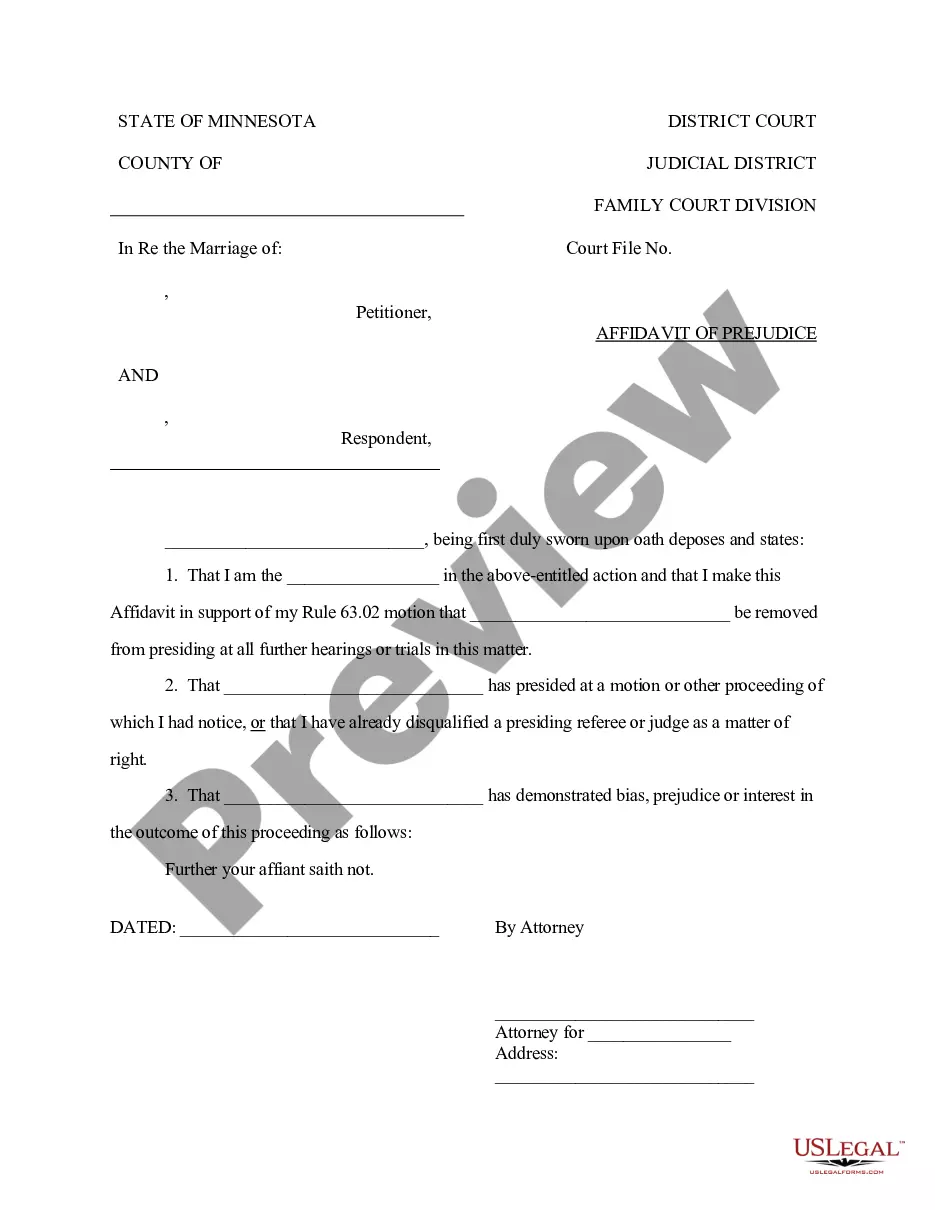
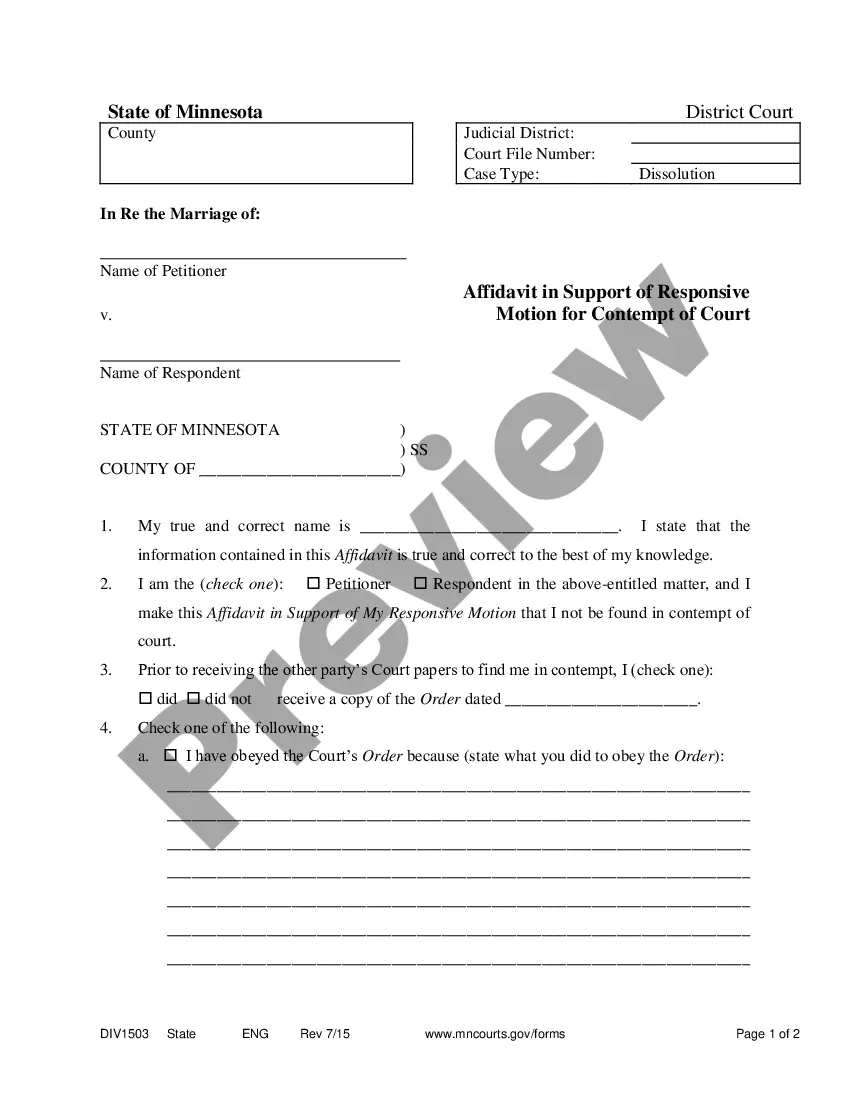
The Affidavit in Support of Motion to Remove Presiding Judge is a legal document filed to request the removal of a judge from a case due to demonstrated bias, prejudice, or personal interest in the proceedings. This form is founded on Rule 63, which allows parties to challenge a judge if they believe fairness in the trial may be compromised by the judge's conduct. This form is distinct from general motions, specifically targeting allegations of judicial impropriety.
Form components explained
- Identification of the judge: The form requires stating the name of the presiding judge whose removal is requested.
- Allegations of bias: A section to explain how the judge has shown bias or prejudice regarding the case.
- Date and signature: The form must be dated and signed by the requesting party or their attorney for validity.
- Attorney information: If the filing is done by an attorney, their contact information and registration number must be included.
- Confirmation statement: A declaration affirming that the claims made in the affidavit are true to the best knowledge of the affiant.

When to use this form
This form should be used when a party in a legal proceeding believes the presiding judge exhibits bias or conflict of interest, which may affect the fairness of the trial. Common scenarios include instances where the judge has made previous statements or rulings suggesting a predetermined bias, or when a personal connection exists between the judge and one of the parties involved.
Who should use this form
- Litigants involved in a case where they believe the judge cannot be impartial.
- Attorneys representing clients in proceedings where bias is perceived.
- Any party to a legal action seeking to ensure a fair trial by requesting a different presiding judge.
Completing this form step by step
- Identify the presiding judge by writing their name in the designated field.
- Detail the specific instances of perceived bias or prejudice exhibited by the judge.
- Include the date of completion at the bottom of the form.
- Sign the form, either as an individual or an attorney representing a party.
- Provide the attorney's contact information, including registration number if applicable.
Does this document require notarization?
This form needs to be notarized to ensure legal validity. US Legal Forms provides secure online notarization powered by Notarize, allowing you to complete the process through a verified video call, available anytime.
Get your form ready online
Our built-in tools help you complete, sign, share, and store your documents in one place.
Make edits, fill in missing information, and update formatting in US Legal Forms—just like you would in MS Word.
Download a copy, print it, send it by email, or mail it via USPS—whatever works best for your next step.
Sign and collect signatures with our SignNow integration. Send to multiple recipients, set reminders, and more. Go Premium to unlock E-Sign.
If this form requires notarization, complete it online through a secure video call—no need to meet a notary in person or wait for an appointment.
We protect your documents and personal data by following strict security and privacy standards.

Make edits, fill in missing information, and update formatting in US Legal Forms—just like you would in MS Word.

Download a copy, print it, send it by email, or mail it via USPS—whatever works best for your next step.

Sign and collect signatures with our SignNow integration. Send to multiple recipients, set reminders, and more. Go Premium to unlock E-Sign.

If this form requires notarization, complete it online through a secure video call—no need to meet a notary in person or wait for an appointment.

We protect your documents and personal data by following strict security and privacy standards.
Common mistakes
- Failing to provide clear examples of bias or prejudice, which can weaken the case.
- Neglecting to sign and date the affidavit, as it must be properly executed to be considered valid.
- Incorrectly identifying the presiding judge or providing incomplete information.
Why use this form online
- Convenience: Access and complete the form from anywhere at any time.
- Editability: Make changes easily without dealing with paper copies.
- Guidance: Receive supportive prompts to help complete sections accurately.
Legal use & context
- This affidavit can be a crucial step in ensuring a fair trial when judicial bias is suspected.
- It must be filed correctly and timely to adhere to court regulations and timings.
- Proper grounds for disqualification can be based on previous rulings, comments, or relationships that may suggest bias.
What to keep in mind
- The affidavit is a specific legal document aimed at removing a judge perceived to be biased in a case.
- It is essential to provide concrete examples of bias to support the request.
- This form is widely usable but may have variations based on local jurisdictional requirements.
Looking for another form?
Form popularity
FAQ
A Rule 60 motion in Minnesota allows a party to request relief from a final judgment or order under certain conditions. This motion can be crucial if new evidence emerges or if there was a clerical mistake. If you believe that a Minnesota Affidavit in Support of Motion to Remove Presiding Judge is necessary, you may also consider whether a Rule 60 motion applies to your situation. USLegalForms can assist you in drafting this motion, ensuring it meets the legal requirements.
The rule of practice 521 in Minnesota pertains to the procedures for filing motions and supporting documents. This rule ensures that all motions, including a Minnesota Affidavit in Support of Motion to Remove Presiding Judge, are submitted correctly and timely. Familiarizing yourself with this rule can help streamline your court processes and avoid potential delays. Resources like USLegalForms provide templates that comply with these practices, making your task easier.
Rule 63.03 of the Minnesota Rules of Civil Procedure addresses the disqualification of a judge. This rule outlines the circumstances under which a judge can be removed from a case due to bias or conflict of interest. When filing a Minnesota Affidavit in Support of Motion to Remove Presiding Judge, understanding this rule is crucial, as it lays the foundation for your argument. Always ensure your motion aligns with the guidelines set forth in this rule.
An affidavit in support of motion is a written statement made under oath, used to provide evidence for a motion in court. In the context of a Minnesota Affidavit in Support of Motion to Remove Presiding Judge, it serves to outline the reasons for requesting the change. This document must be factual and relevant, helping the court understand the grounds for your request. Utilizing resources like USLegalForms can simplify the process of creating this affidavit.
The main purpose of an affidavit is to provide a sworn statement of facts that can be used in legal proceedings. In the context of a Minnesota Affidavit in Support of Motion to Remove Presiding Judge, it helps to substantiate claims made in court. This document plays a vital role in ensuring transparency and accountability within the judicial process. By utilizing platforms like USLegalForms, you can create affidavits that are clear, concise, and legally sound.
To vacate a judgment in Minnesota, you must file a motion with the court, including a Minnesota Affidavit in Support of Motion to Remove Presiding Judge if necessary. This affidavit should contain relevant facts and arguments that support your request to vacate the judgment. It's important to adhere to specific legal procedures and timelines, so seeking guidance from resources like USLegalForms can be beneficial. They provide templates and instructions to help you navigate this process effectively.
The purpose of an affidavit of support is to provide a formal declaration that supports a specific legal motion or request. In cases involving a Minnesota Affidavit in Support of Motion to Remove Presiding Judge, this affidavit aims to outline the reasons and evidence for the judge's removal. It helps to establish credibility and seriousness of the claims being made. By using USLegalForms, you can create a well-structured affidavit that meets legal standards.
An affidavit in support of a motion is a written statement made under oath, submitted to the court to support a party's request. In the context of a Minnesota Affidavit in Support of Motion to Remove Presiding Judge, this document presents facts and evidence to justify the removal. It serves as a crucial tool in legal proceedings, ensuring that the court has all necessary information to make an informed decision. Utilizing platforms like USLegalForms can simplify the process of creating this affidavit.