Minnesota Mare Information Sheet - Horse Equine Forms
Understanding this form
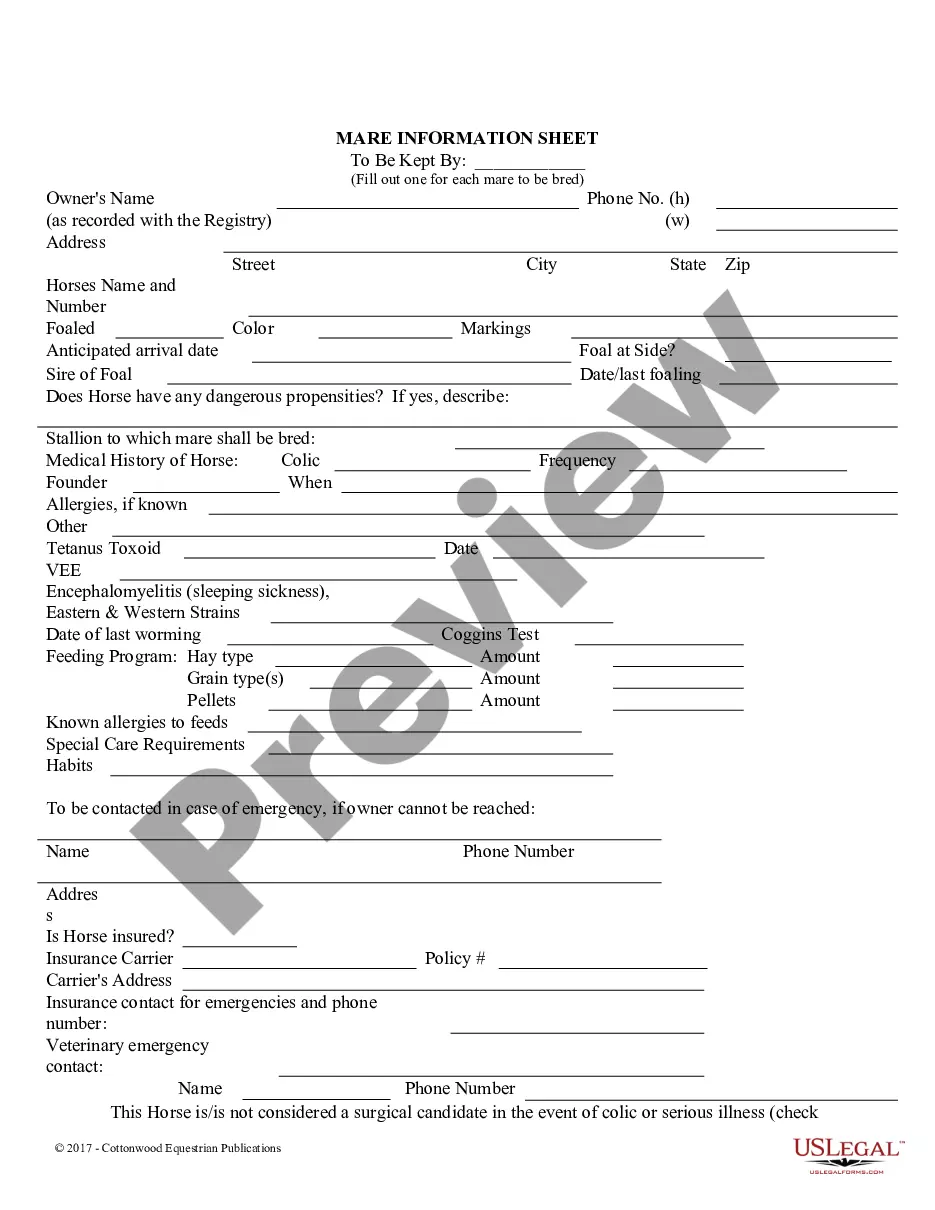
The Mare Information Sheet is a crucial document for horse owners preparing for breeding. This form collects essential details about the mare, the stallion she will be bred to, and any relevant medical information, which helps ensure the health and safety of both animals. Unlike other equine forms, this sheet focuses exclusively on mares and their information, making it tailored specifically for breeders in the horse industry.
What’s included in this form
- Owner's name and contact information.
- Mare's name, registration number, color, and markings.
- Information about the stallion selected for breeding.
- Emergency contact details and medical history of the mare.
- Feeding program specifics and any known allergies.
- Insurance details, including emergency contacts.
When this form is needed
This form should be used when a mare is being prepared for breeding. It is essential for ensuring all relevant information is recorded and readily available for both the owner and the veterinarian. The Mare Information Sheet is useful in scenarios such as prior to a breeding appointment, during a veterinary examination for breeding fitness, or when transporting the mare to a stallion for insemination.
Who should use this form
- Mare owners preparing for breeding.
- Veterinarians assessing breeding readiness.
- Stud farms receiving mares for breeding.
- Equine industry professionals involved in breeding management.
Instructions for completing this form
- Enter the owner's name and contact details, ensuring accuracy for communication.
- Fill in the details of the mare, including her name, registration, color, and any distinguishing markings.
- Provide information about the stallion, including the anticipated foal's sire.
- Document the mare's medical history, including any previous illnesses and current care requirements.
- List emergency contacts and insurance details to ensure comprehensive support in case of unforeseen circumstances.
Does this document require notarization?
Notarization is not commonly needed for this form. However, certain documents or local rules may make it necessary. Our notarization service, powered by Notarize, allows you to finalize it securely online anytime, day or night.
Get your form ready online
Our built-in tools help you complete, sign, share, and store your documents in one place.
Make edits, fill in missing information, and update formatting in US Legal Forms—just like you would in MS Word.
Download a copy, print it, send it by email, or mail it via USPS—whatever works best for your next step.
Sign and collect signatures with our SignNow integration. Send to multiple recipients, set reminders, and more. Go Premium to unlock E-Sign.
If this form requires notarization, complete it online through a secure video call—no need to meet a notary in person or wait for an appointment.
We protect your documents and personal data by following strict security and privacy standards.

Make edits, fill in missing information, and update formatting in US Legal Forms—just like you would in MS Word.

Download a copy, print it, send it by email, or mail it via USPS—whatever works best for your next step.

Sign and collect signatures with our SignNow integration. Send to multiple recipients, set reminders, and more. Go Premium to unlock E-Sign.

If this form requires notarization, complete it online through a secure video call—no need to meet a notary in person or wait for an appointment.

We protect your documents and personal data by following strict security and privacy standards.
Avoid these common issues
- Omitting critical medical information about the mare.
- Failing to update the form if circumstances change, such as a new stallion.
- Not including emergency contact information.
Benefits of using this form online
- Convenient access to the form allows for easy completion from anywhere.
- Edit and save your information securely without the hassle of paper.
- Quickly retrieve the form for multiple mares as needed.
Main things to remember
- The Mare Information Sheet is essential for thorough documentation during breeding.
- Accurate information on medical history and emergency contacts ensures the safety of the mare.
- This form can be used across multiple states, simplifying the breeding process for mare owners.
Looking for another form?
Form popularity
FAQ
The minimum land size for a horse is generally accepted to be around 1.5 to 2 acres. This space ensures that the horse can move, graze, and live comfortably. The exact requirements may vary based on local laws and the type of care you can provide. For comprehensive information, review the Minnesota Mare Information Sheet - Horse Equine Forms to ensure compliance.
The minimum acreage to own a horse typically starts at 1.5 to 2 acres per horse, depending on local regulations and land quality. This space allows for proper grazing, shelter, and exercise. Always check your specific area’s requirements and guidelines for horse ownership. The Minnesota Mare Information Sheet - Horse Equine Forms can provide valuable insights into these regulations.
The 1 2 3 rule for horses is a guideline for managing their care and environment. It suggests that for every horse, you should provide 1 acre of pasture, 2 tons of hay, and 3 gallons of water daily. This rule helps ensure that your horse has adequate resources for a healthy lifestyle. For detailed management tips, refer to the Minnesota Mare Information Sheet - Horse Equine Forms.
Absolutely, Minnesota has a rich horse racing history, featuring several racetracks throughout the state. Events take place regularly, attracting both participants and spectators. Horse racing in Minnesota offers a vibrant community for enthusiasts. To learn more about the legal aspects and necessary documentation, check the Minnesota Mare Information Sheet - Horse Equine Forms.
Yes, you can bet on horse racing in Minnesota. The state has legal provisions that allow for wagering at licensed racetracks and through off-track betting facilities. If you're interested in participating, ensure you understand the local laws and regulations. For more information about horse-related activities, explore the Minnesota Mare Information Sheet - Horse Equine Forms.
Similar to other regions, Minnesota suggests a minimum of 1.5 to 2 acres for each horse. This space provides the environment necessary for the horse's physical and mental health. Additionally, it's essential to consider the type of land, as some areas may require more space for proper management. The Minnesota Mare Information Sheet - Horse Equine Forms can guide you through these requirements.
In Minnesota, the general recommendation is to have at least 1.5 to 2 acres per horse. This space allows for grazing, exercise, and proper care. For optimal health and well-being, consider the quality of the land and the availability of shelter. To ensure you meet all requirements, you can refer to the Minnesota Mare Information Sheet - Horse Equine Forms.
When selling a horse, you typically need a bill of sale that outlines the terms of the sale, along with the horse's registration papers. This documentation ensures a clear transfer of ownership and protects both the buyer and seller. By using the Minnesota Mare Information Sheet - Horse Equine Forms, you can create a comprehensive and legally sound bill of sale for a smooth transaction.
To properly manage a horse, you need several key documents, including registration papers, health records, and transfer of ownership documents. Additional paperwork may be required depending on your state’s regulations and any competitions you plan to enter. The Minnesota Mare Information Sheet - Horse Equine Forms can simplify the process of gathering and organizing these essential documents.
A horse's registration paper typically includes the horse's name, breed, registration number, and the names of its sire and dam. It may also provide details about the horse's color, markings, and microchip information if applicable. Utilizing the Minnesota Mare Information Sheet - Horse Equine Forms will help you collect and organize this vital information effectively.