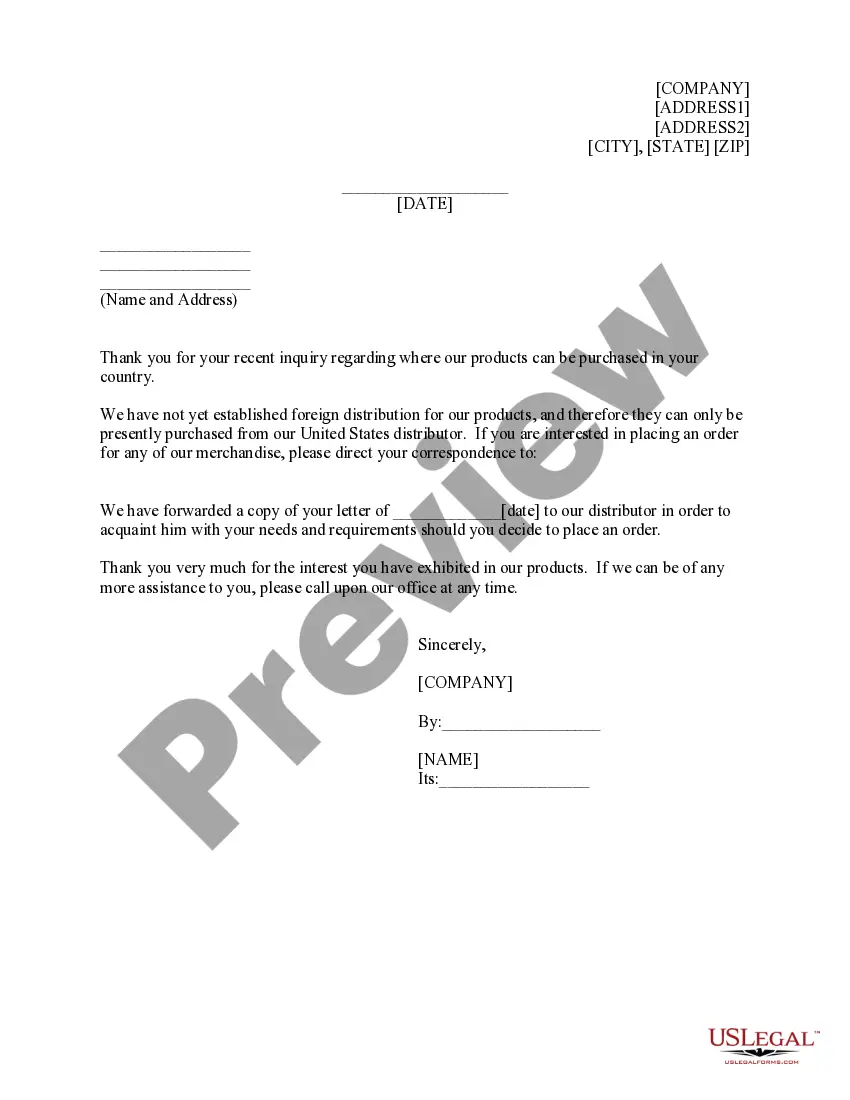
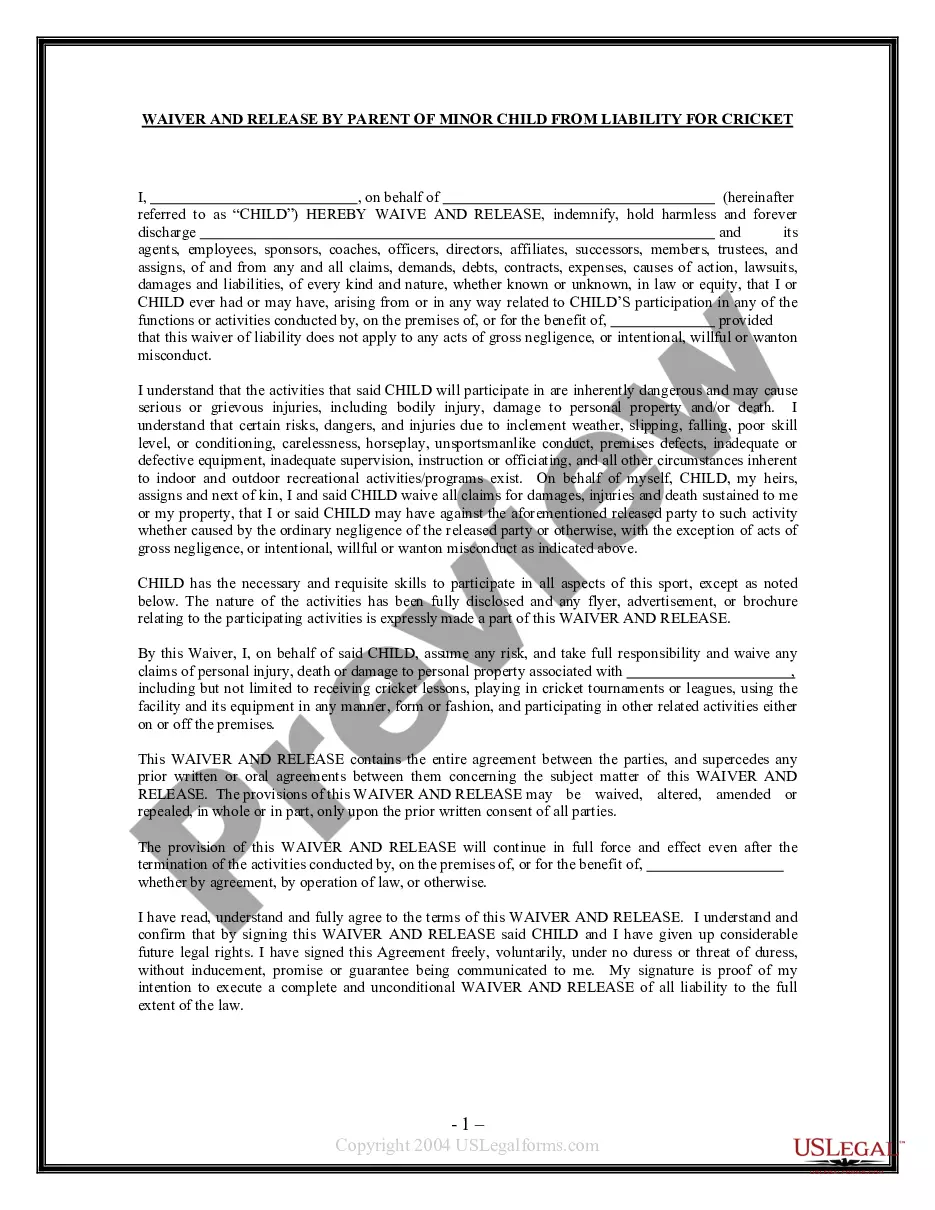
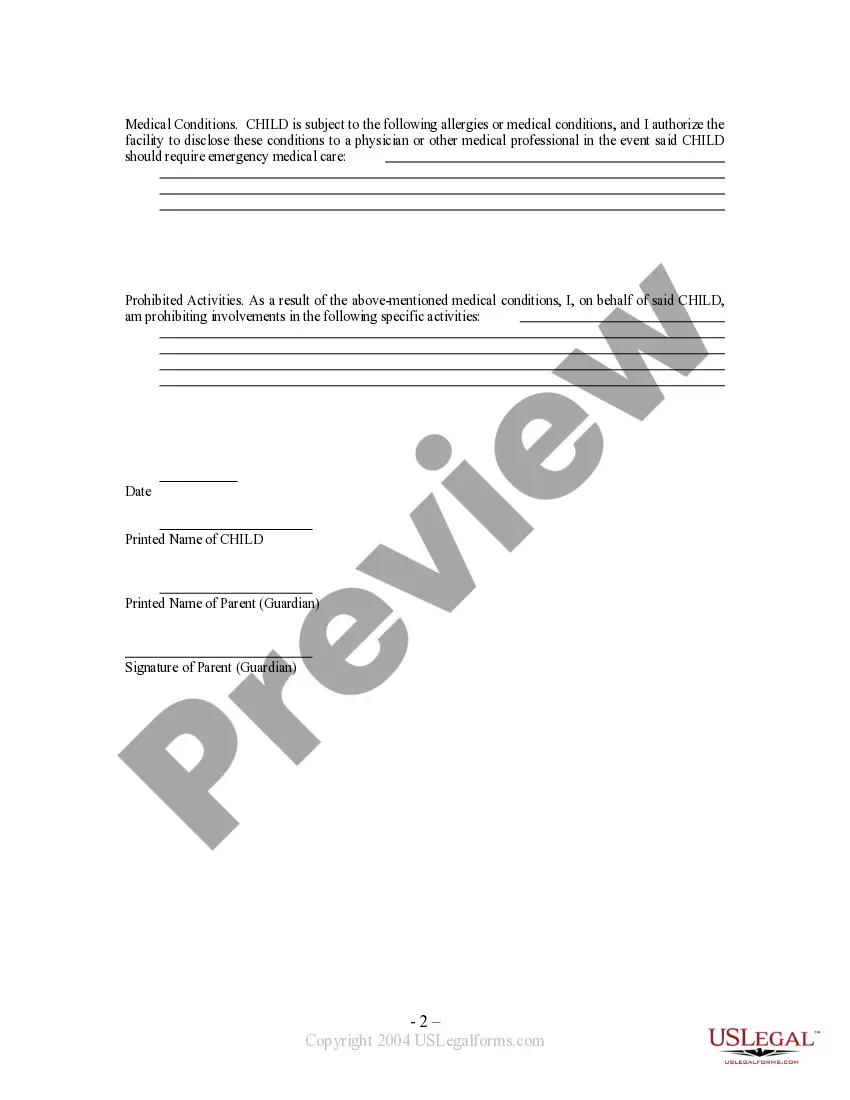
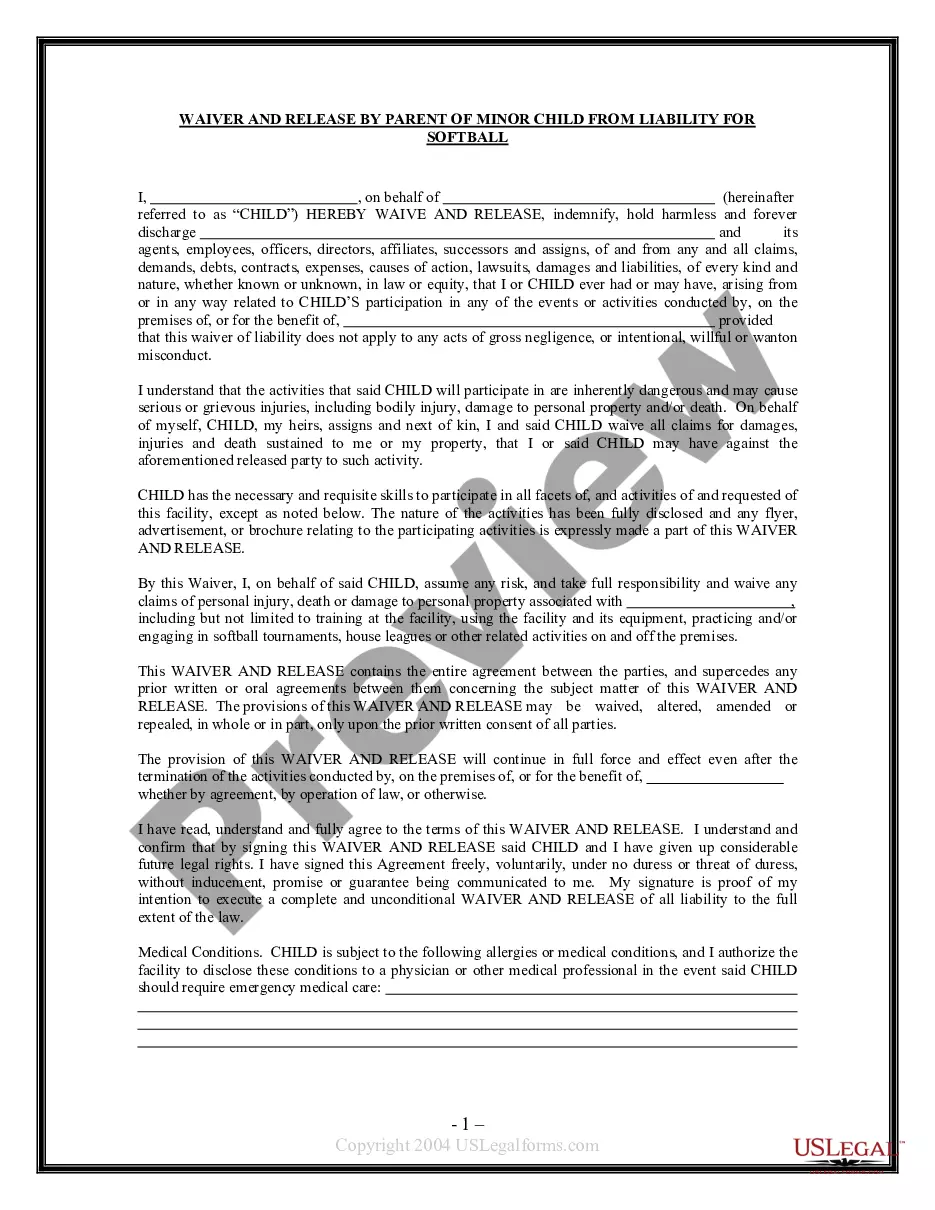
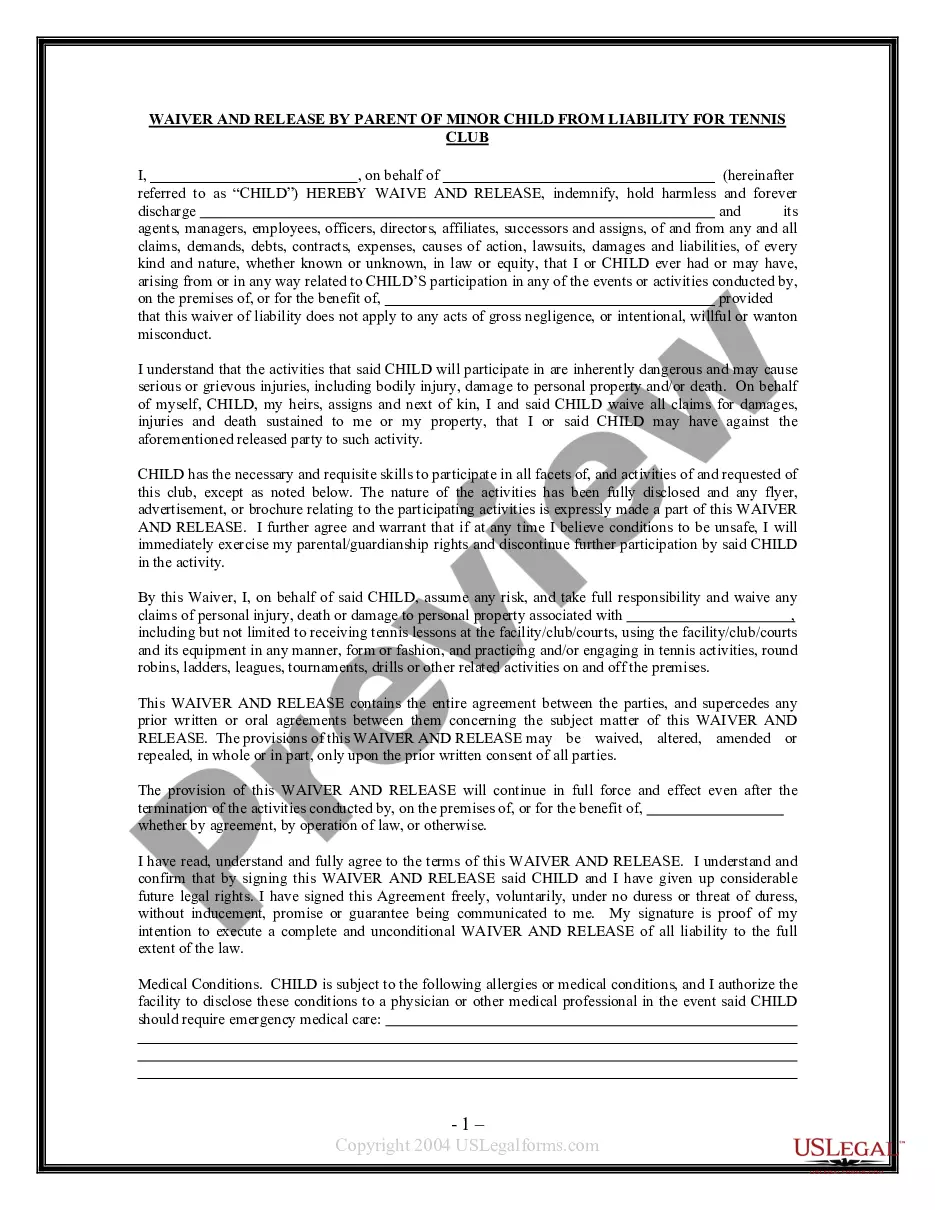
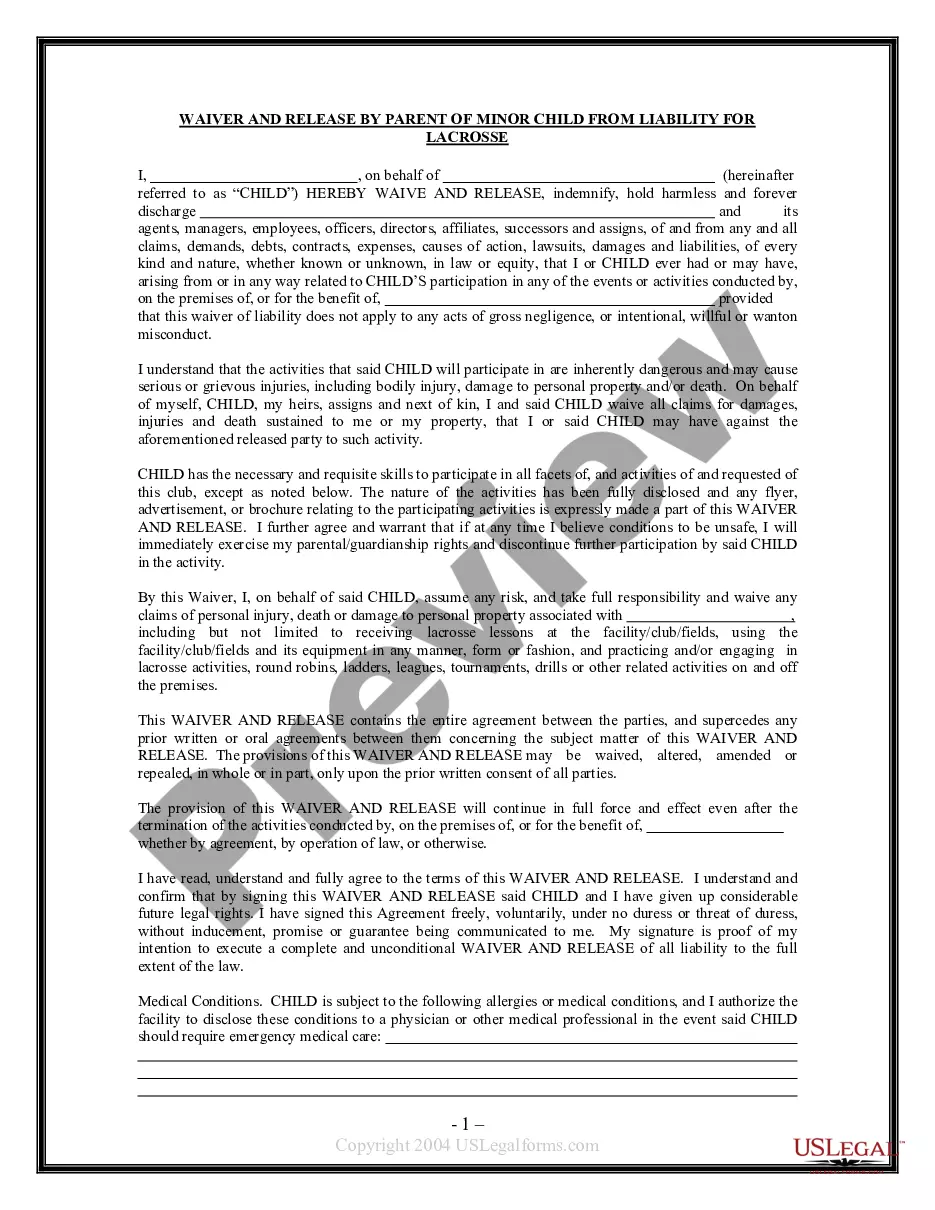
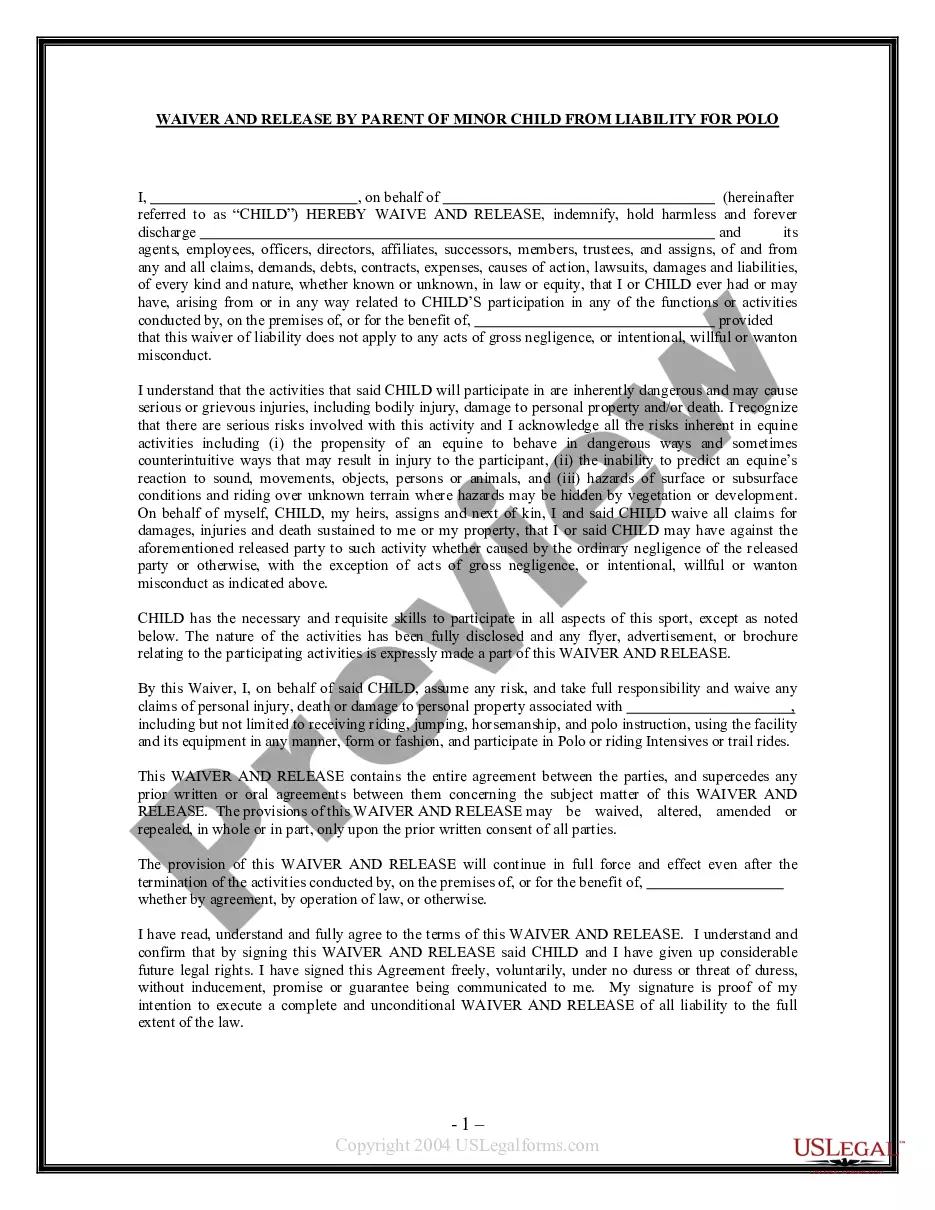
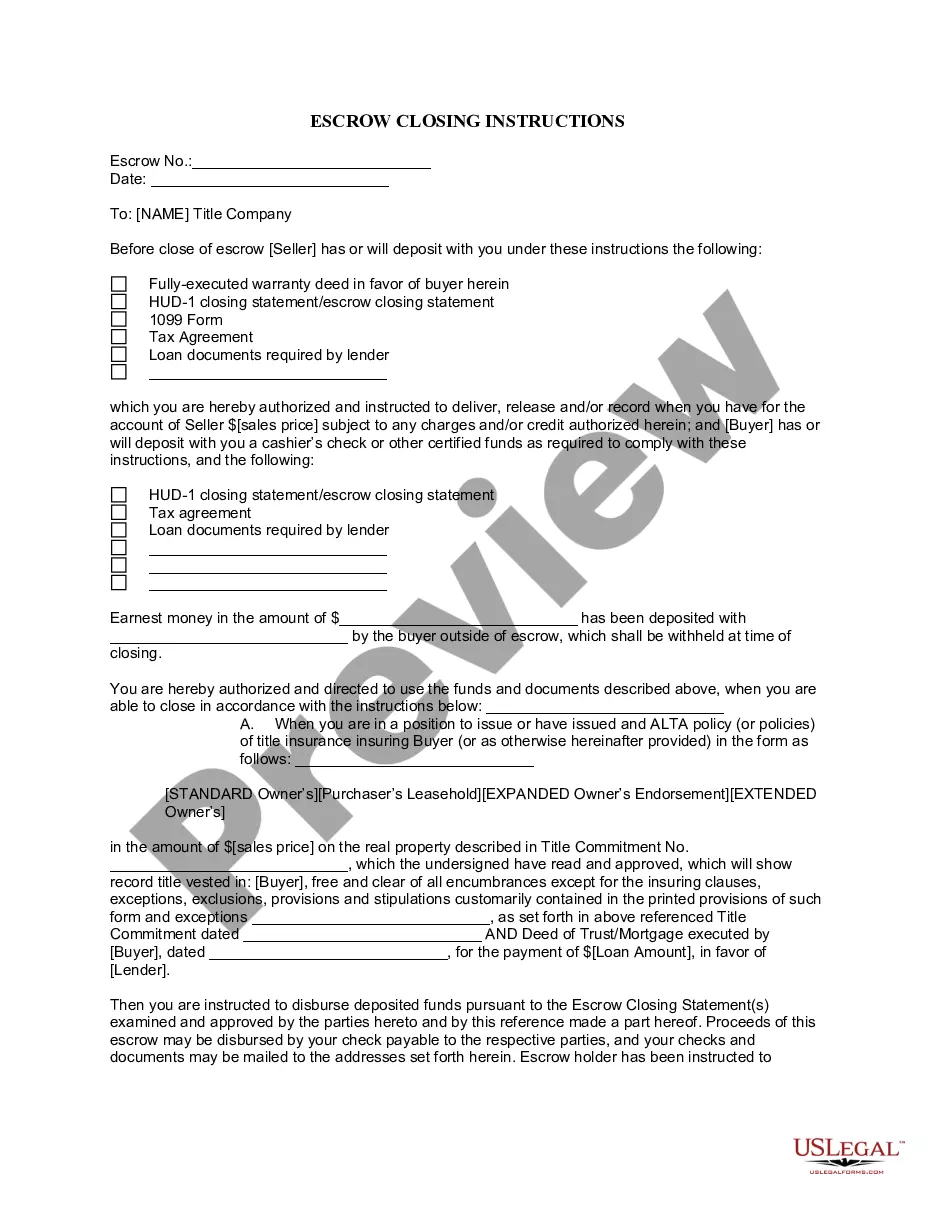
This form allows a parent or guardian to release a minor for criket from liability for injuries which may be incurred by a minor child while on the premises, taking part in activities, etc.
Michigan Waiver and Release From Liability For Minor Child for Cricket
Category:
State:
Multi-State
Control #:
US-WAV-82M
Format:
Word;
Rich Text
Instant download
Description
Free preview



How to fill out Waiver And Release From Liability For Minor Child For Cricket?
US Legal Forms - one of the largest collections of legal documents in the USA - provides a variety of legal form templates that you can download or print. By utilizing the website, you will access thousands of forms for both business and personal purposes, organized by categories, states, or keywords. You can obtain the latest forms such as the Michigan Waiver and Release From Liability For Minor Child for Cricket in just moments.
If you already have an account, Log In and retrieve the Michigan Waiver and Release From Liability For Minor Child for Cricket from the US Legal Forms library. The Obtain button will be visible on every form you encounter. You can access all previously purchased forms from the My documents section of your account.
If you are using US Legal Forms for the first time, here are simple instructions to help you get started: Make sure you have selected the correct form for your city/state. Click the Review button to examine the form's content. Read the form description to ensure you have chosen the right form. If the form does not meet your needs, utilize the Search field at the top of the screen to find one that does. If you are satisfied with the form, confirm your selection by clicking the Buy now button. Then, select the payment plan you wish and provide your details to register for an account. Process the payment. Use your credit card or PayPal account to complete the transaction. Choose the file format and download the form to your device. Make adjustments. Fill out, modify, and print, then sign the obtained Michigan Waiver and Release From Liability For Minor Child for Cricket. Each template you purchase does not have an expiration date and is yours to keep indefinitely. Therefore, if you wish to download or print another copy, simply navigate to the My documents section and click on the form you desire.
- Gain access to the Michigan Waiver and Release From Liability For Minor Child for Cricket with US Legal Forms, the most extensive collection of legal document templates.
- Utilize thousands of professional and state-specific templates that satisfy your business or personal needs and specifications.
Form popularity
FAQ
A waiver is an exculpatory contract. That means it's used to excuse a party from responsibility when the other contracted party is injured by either known or unknown risks in a particular activity. This includes inherent risks and ordinary negligence.
A liability waiver, or release of liability, is a legal document that a company or organization has you sign in order to protect them from being sued in the event that you are injured.
This may seem like a silly distinction to make, but lack of knowledge or willingness is actually one of the biggest reasons lawyers can completely toss out a waiver in a personal injury case.
Liability waivers are enforceable in California solely to the extent they shift to the customer the risk of ordinary negligence. Under California law, a liability waiver cannot excuse an injury caused by a defendant's gross negligence, recklessness or intentionally wrongful act.
Under California law, waivers of liability may not prevent people from suing for injuries resulting from gross negligence, recklessness, intentional torts or illegal acts.
In California, waivers of liability are generally enforceable so long as they have been drafted correctly, are explicit as to the scope of coverage, are legible and use high-visibility text, and do not illegally waive unknown or unrelated claims.
Ambiguous language or missing information can invalidate a waiver. The waiver contains errors that make it invalid. The language of the waiver must obey relevant state laws. An improperly worded or drafted waiver, as well as one that violates the law or public policy, may not hold up in court.
Liability waivers are enforceable in California solely to the extent they shift to the customer the risk of ordinary negligence. Under California law, a liability waiver cannot excuse an injury caused by a defendant's gross negligence, recklessness or intentionally wrongful act.
A release and waiver agreement is an enforceable promise not to pursue legal action in exchange for compensation. The releasee gives money or some other form of compensation to the releasor, who then agrees not to press charges, sue, or take any other legal action against the releasee.
You might think that since you signed a waiver acknowledging the risks of the activity, you have no legal leg to stand on to file a personal injury lawsuit. Waivers can make personal injury lawsuits more complex, but you can still seek damages for injuries that could have and should have been prevented.