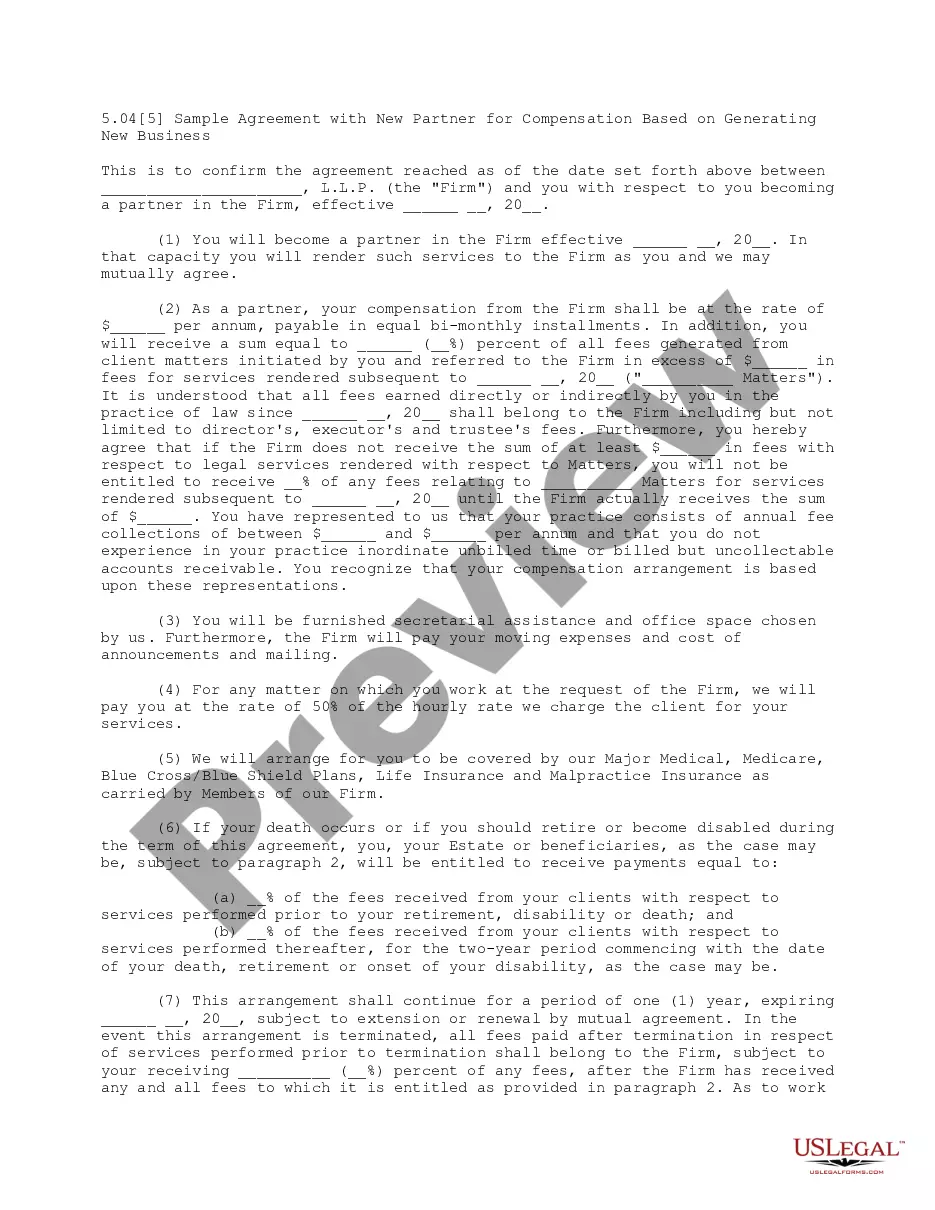
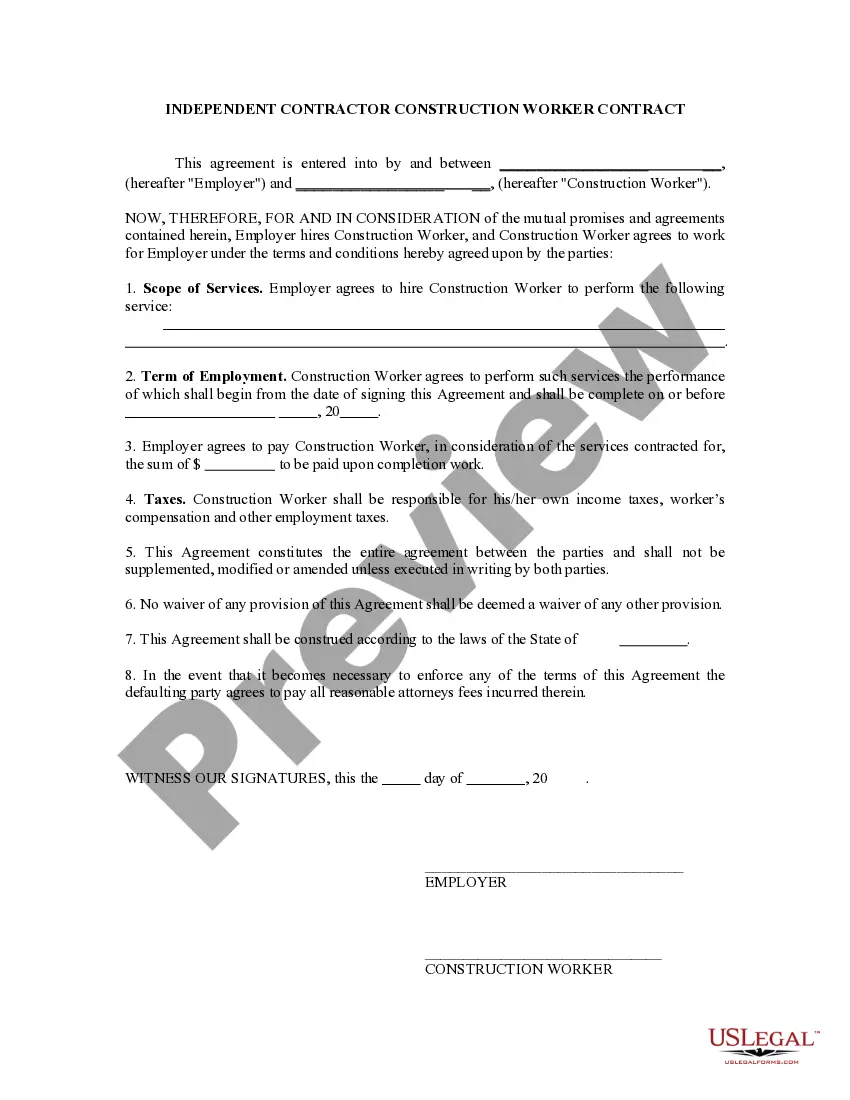
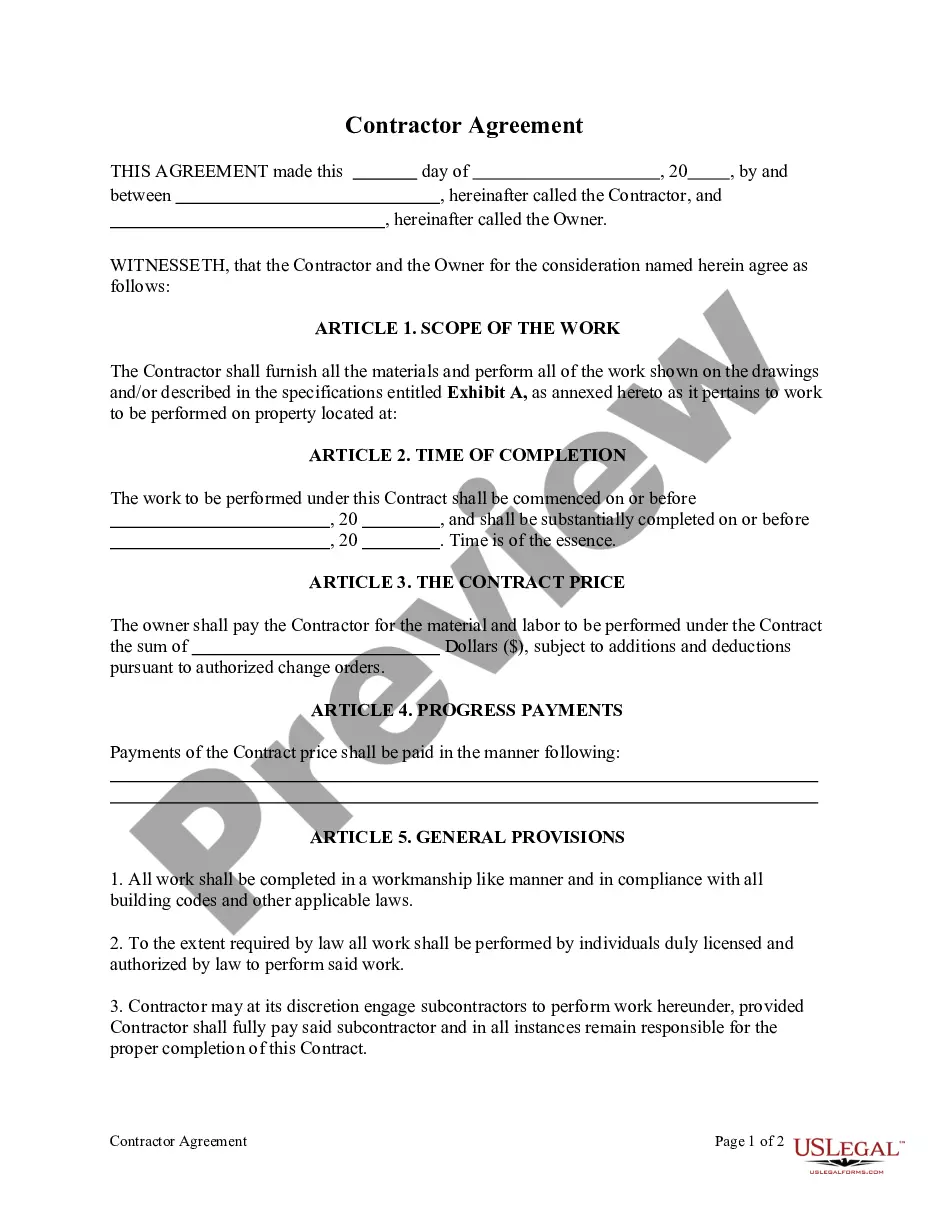
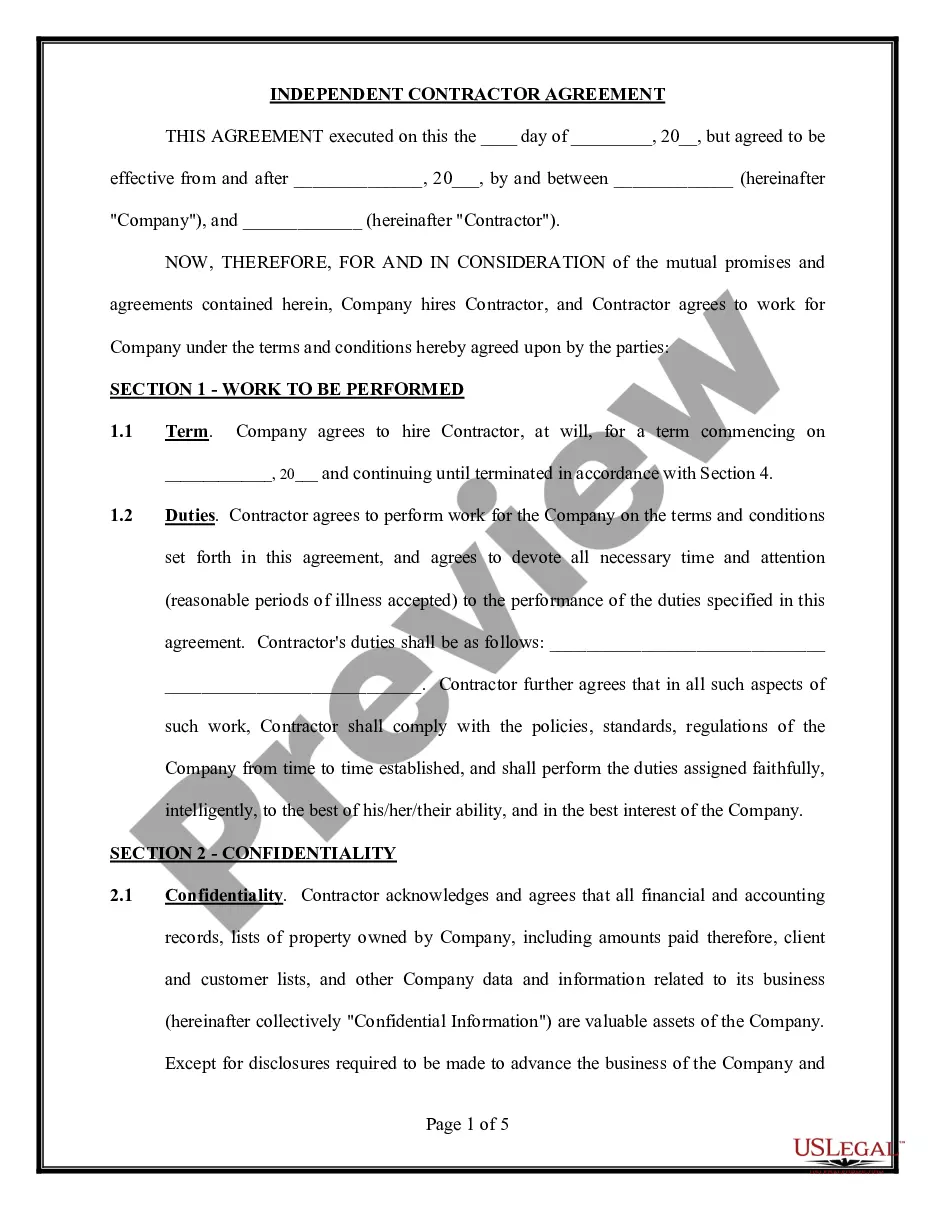
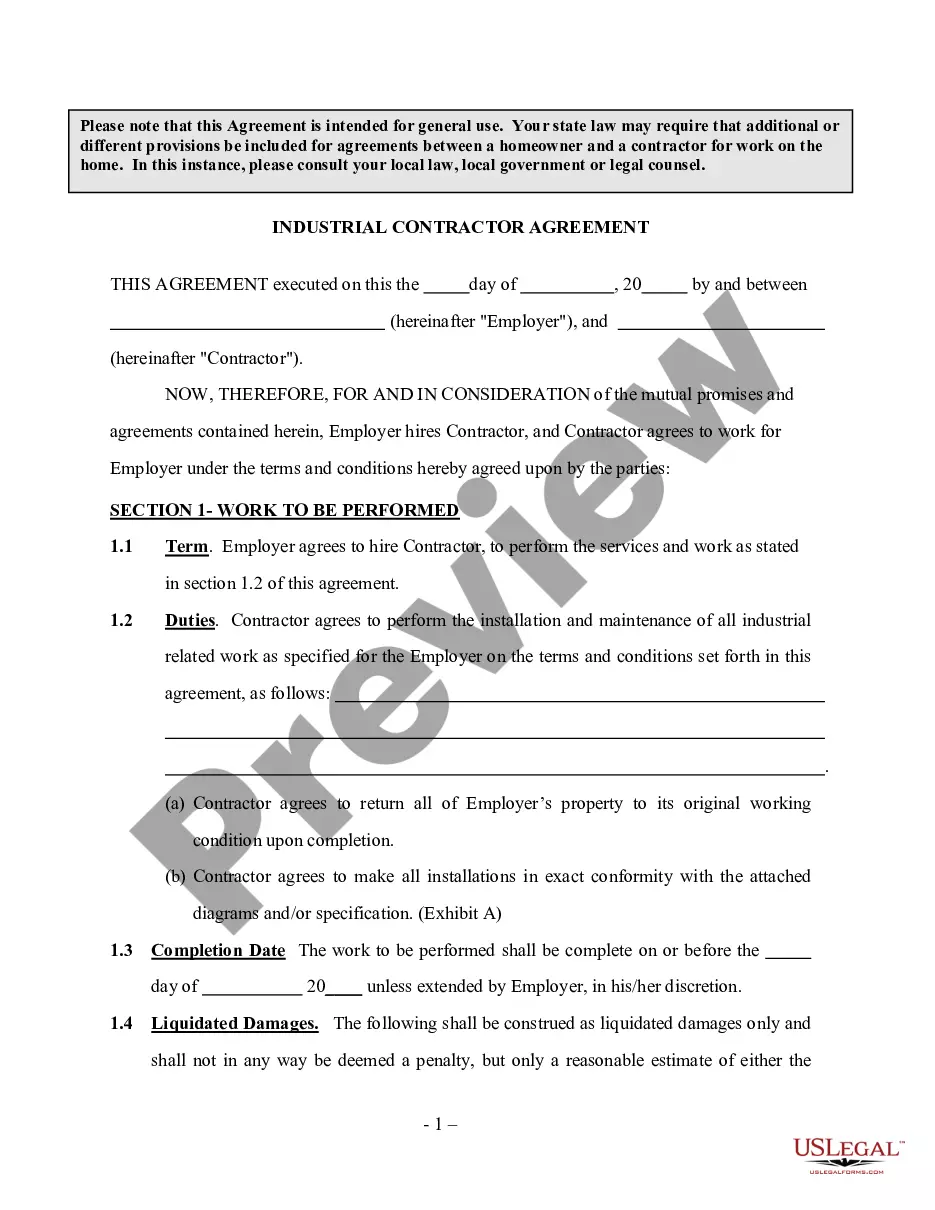
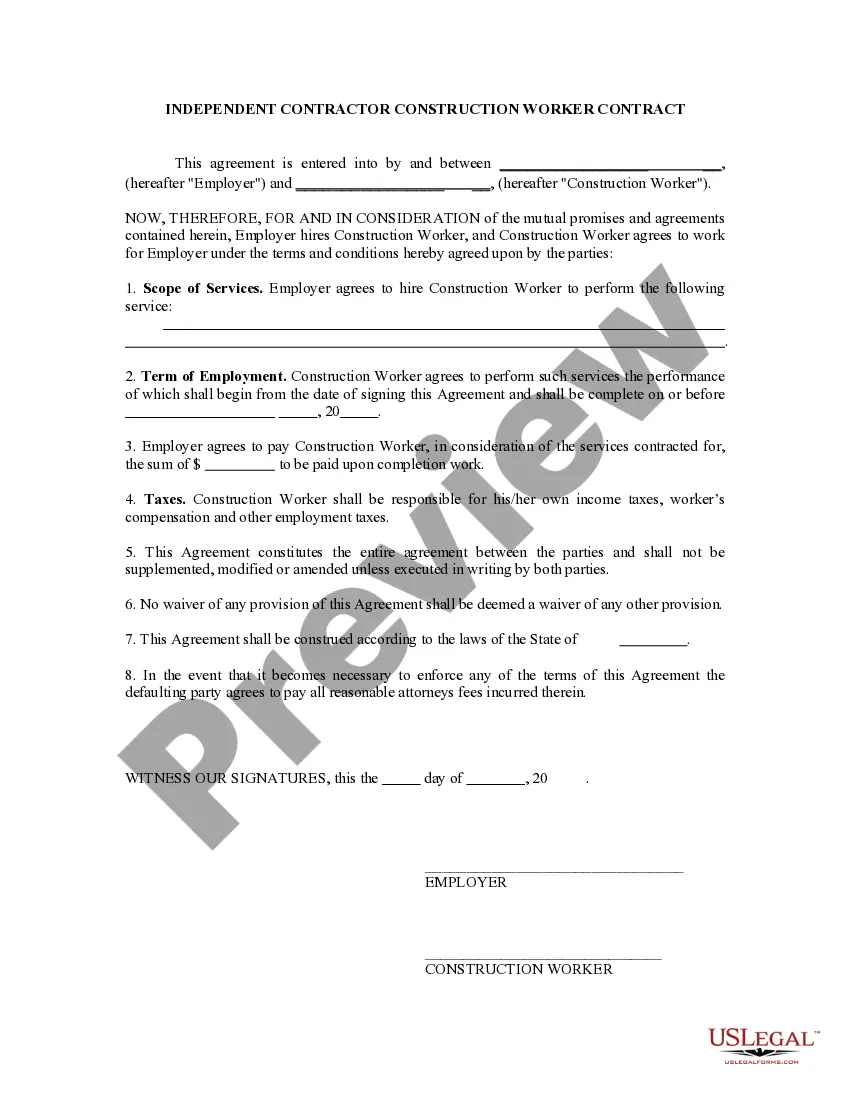
Employer hires a construction worker as an independent contractor to provide various construction help as specified in the Agreement.
Michigan Self-Employed Independent Contractor Construction Worker Contract
State:
Multi-State
Control #:
US-INDC-178
Format:
Word;
Rich Text
Instant download
Description
Get your form ready online
Our built-in tools help you complete, sign, share, and store your documents in one place.
Built-in online Word editor
Make edits, fill in missing information, and update formatting in US Legal Forms—just like you would in MS Word.
Export easily
Download a copy, print it, send it by email, or mail it via USPS—whatever works best for your next step.
E-sign your document
Sign and collect signatures with our SignNow integration. Send to multiple recipients, set reminders, and more. Go Premium to unlock E-Sign.
Notarize online 24/7
If this form requires notarization, complete it online through a secure video call—no need to meet a notary in person or wait for an appointment.
Store your document securely
We protect your documents and personal data by following strict security and privacy standards.

Make edits, fill in missing information, and update formatting in US Legal Forms—just like you would in MS Word.

Download a copy, print it, send it by email, or mail it via USPS—whatever works best for your next step.

Sign and collect signatures with our SignNow integration. Send to multiple recipients, set reminders, and more. Go Premium to unlock E-Sign.

If this form requires notarization, complete it online through a secure video call—no need to meet a notary in person or wait for an appointment.

We protect your documents and personal data by following strict security and privacy standards.
Looking for another form?


How to fill out Self-Employed Independent Contractor Construction Worker Contract?
If you need to complete, download, or create official document templates, utilize US Legal Forms, the largest collection of legal forms available online. Utilize the website's user-friendly and efficient search to find the documents you require. Various templates for business and personal use are categorized by types and states, or keywords. Use US Legal Forms to locate the Michigan Self-Employed Independent Contractor Construction Worker Agreement in just a few clicks.
If you are already a US Legal Forms user, Log In to your account and click the Acquire button to obtain the Michigan Self-Employed Independent Contractor Construction Worker Agreement. You can also access forms you previously saved in the My documents section of your account.
If you are using US Legal Forms for the first time, follow the instructions below: Step 1. Ensure you have selected the form for the correct city/state. Step 2. Use the Preview option to review the form's content. Don't forget to read the description. Step 3. If you are not satisfied with the form, use the Search field at the top of the screen to find alternative types of the legal form template. Step 4. Once you have found the form you want, click the Get now button. Choose the pricing plan you prefer and enter your details to register for an account. Step 5. Complete the payment. You can use your Visa or Mastercard or PayPal account to process the payment. Step 6. Select the format of the legal form and download it to your device. Step 7. Complete, modify, and print or sign the Michigan Self-Employed Independent Contractor Construction Worker Agreement.
- Every legal document template you purchase is yours permanently.
- You have access to every form you saved in your account.
- Click on the My documents section and select a form to print or download again.
- Stay competitive and download, and print the Michigan Self-Employed Independent Contractor Construction Worker Agreement with US Legal Forms.
- There are numerous professional and state-specific forms you can utilize for your business or personal needs.
Form popularity
FAQ
The basic independent contractor agreement outlines fundamental elements such as project scope, payment terms, and the duration of the work. This agreement is designed to clarify expectations and duties between you and your client. A solid contract fosters a professional relationship and promotes transparency. For convenience, consider using USLegalForms to access templates and customize them to suit your specific needs as a Michigan self-employed independent contractor construction worker.
A construction worker can be self-employed if they operate their own business or work as an independent contractor. Being self-employed offers flexibility in choosing projects and clients. However, this also means you handle your own taxes and benefits. As a Michigan self-employed independent contractor construction worker, understanding your responsibilities and freedoms is crucial for business success.
In the U.S., if you earn $600 or more in a tax year as a Michigan self-employed independent contractor construction worker, the client must issue you a Form 1099. This form reports your income to the IRS, ensuring transparency in your earnings. It's important to keep accurate records of your contracts and payments to correctly report your income on your tax return. This documentation supports your status as an independent contractor.
An independent contractor agreement in Michigan is a formal document that outlines the terms of the working relationship between you and your client. This agreement typically includes details about the scope of work, payment arrangements, and timelines. Utilizing a well-drafted agreement helps to protect both parties and minimizes the risk of disputes. Consider using a platform like USLegalForms to create a tailored contract for your specific needs.
The new federal rule focuses on how to classify workers as independent contractors versus employees. This classification affects benefits, taxes, and your rights under labor law. If you operate as a Michigan self-employed independent contractor construction worker, it is important to stay updated on these rules to ensure compliance. Changes could impact how you manage your business operations and contracts.
Yes, having a contract as a Michigan self-employed independent contractor construction worker is essential. A contract outlines the terms of your work, payment, and responsibilities. It protects your rights and ensures that both you and the client have a clear understanding of the project expectations. Without a contract, you may face misunderstandings or disputes down the line.
Creating an independent contractor contract involves clear communication of the terms of your agreement. Start by outlining project details, payment terms, and deadlines. Using a structured format ensures both parties understand their roles. Leveraging tools like the Michigan Self-Employed Independent Contractor Construction Worker Contract from uslegalforms can simplify this process and ensure compliance with state regulations.
To prove you are an independent contractor, gather essential documentation that outlines your business relationship with clients. Key documents include contracts, invoices, and records of communication. Additionally, maintaining a separate business account and tax filings as a self-employed worker strengthens your position. Using a Michigan Self-Employed Independent Contractor Construction Worker Contract can provide clarity and legal backing for both parties involved.