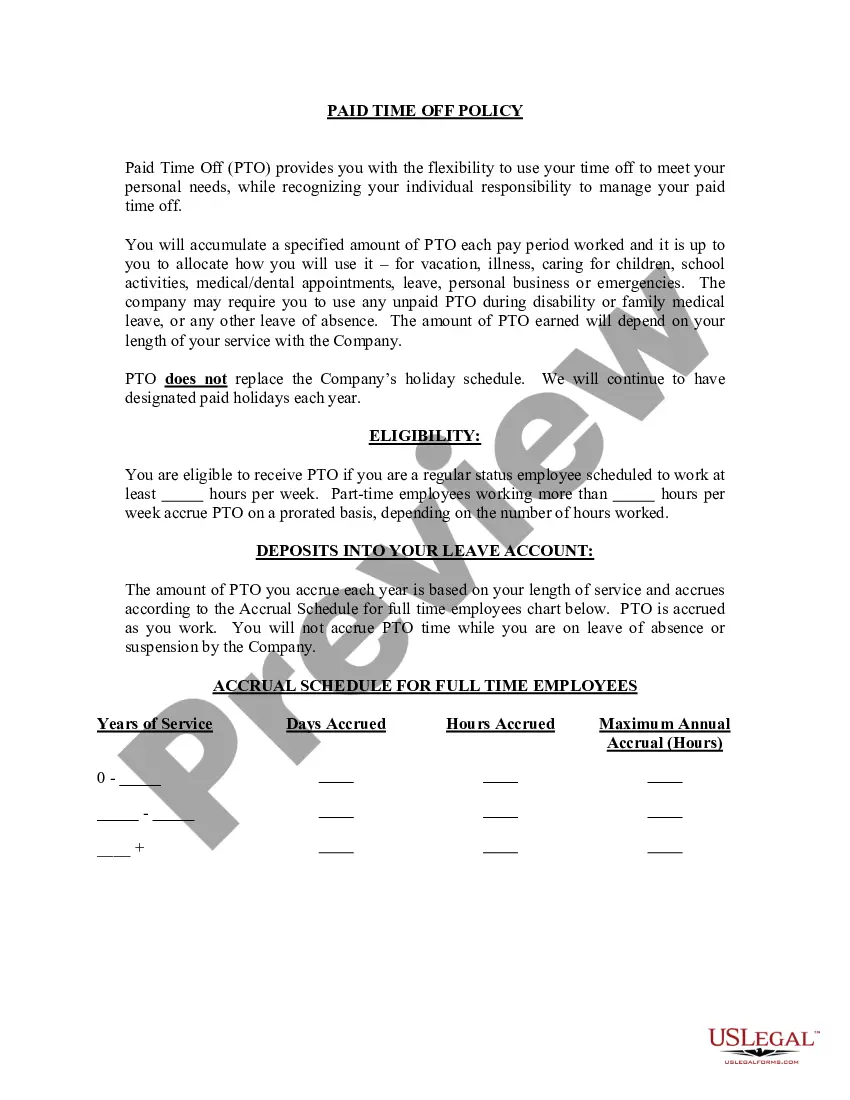
Michigan Paid Time Off Policy - PTO
Description
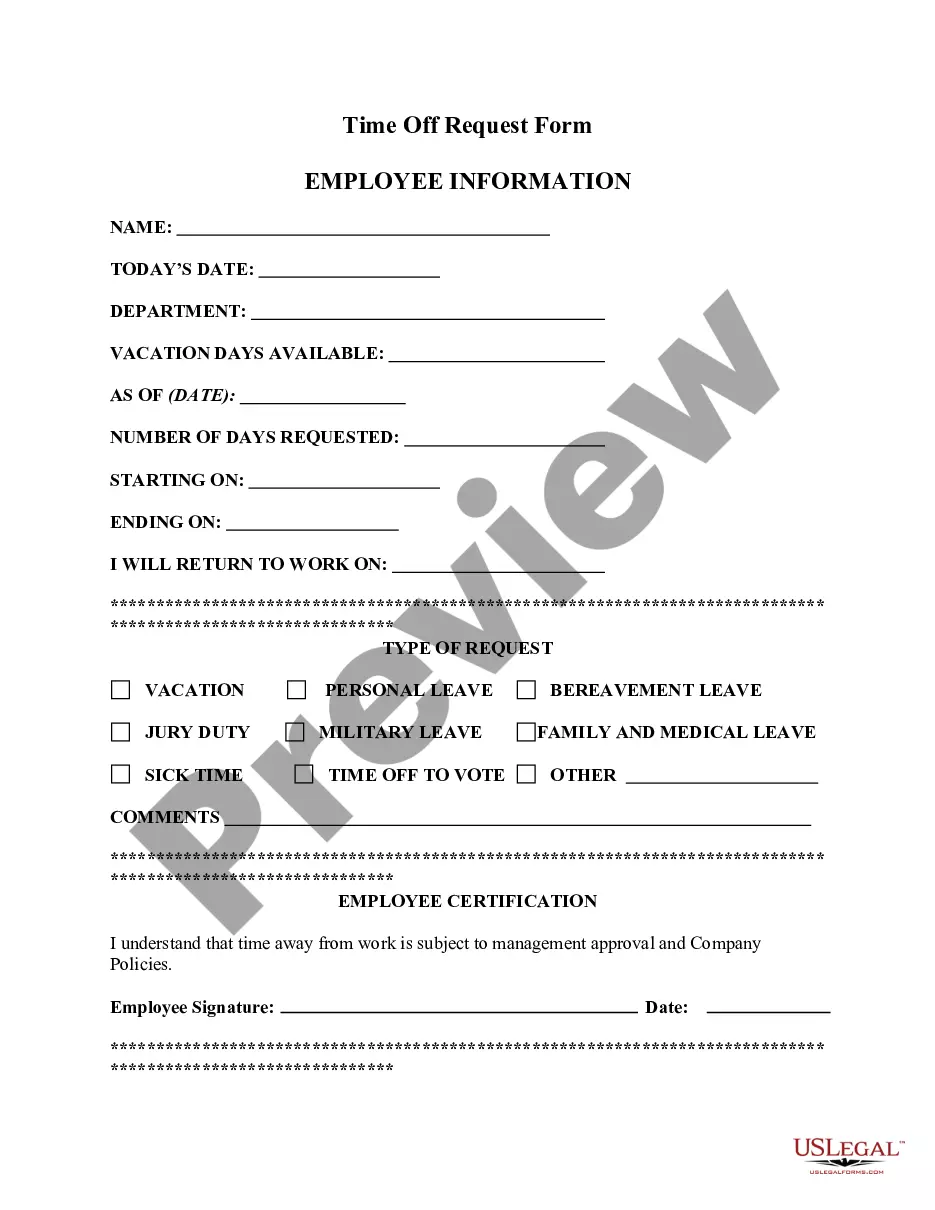

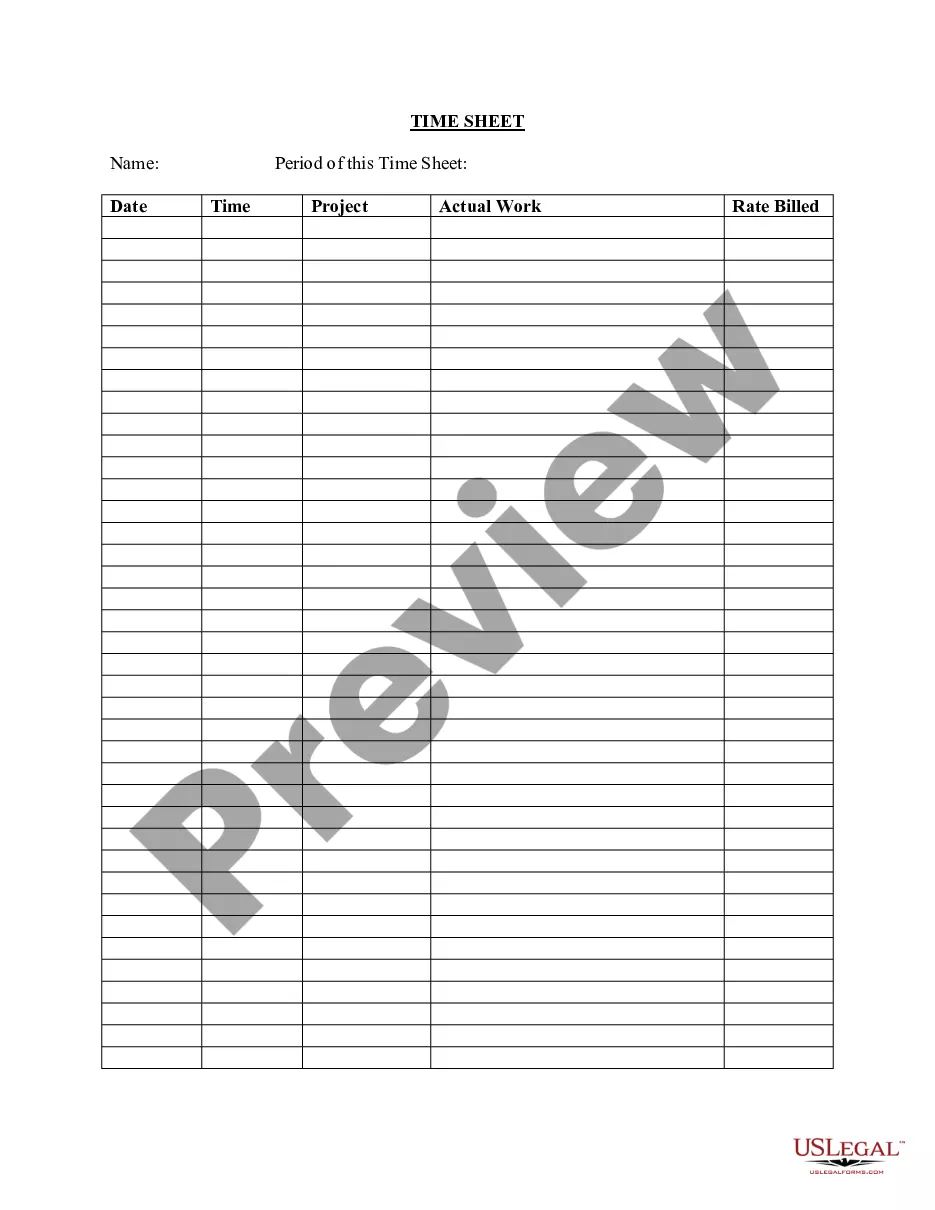
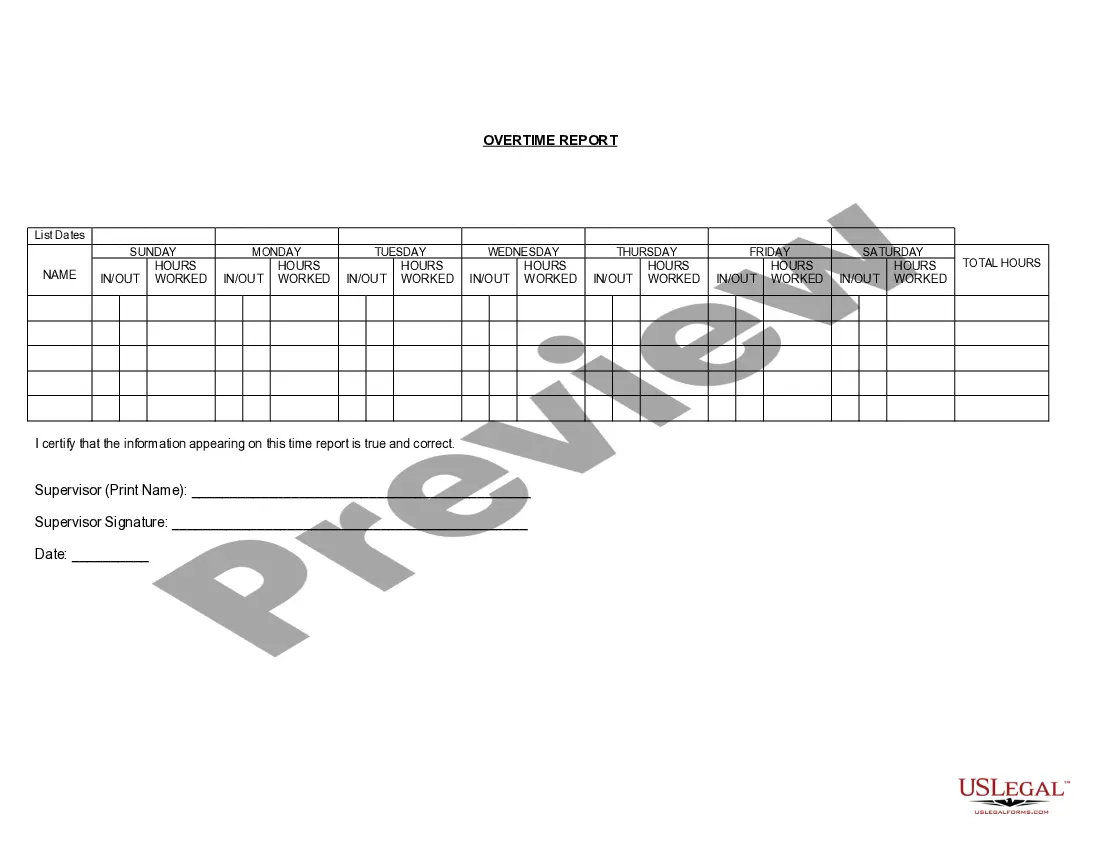
Get your form ready online
Our built-in tools help you complete, sign, share, and store your documents in one place.
Make edits, fill in missing information, and update formatting in US Legal Forms—just like you would in MS Word.
Download a copy, print it, send it by email, or mail it via USPS—whatever works best for your next step.
Sign and collect signatures with our SignNow integration. Send to multiple recipients, set reminders, and more. Go Premium to unlock E-Sign.
If this form requires notarization, complete it online through a secure video call—no need to meet a notary in person or wait for an appointment.
We protect your documents and personal data by following strict security and privacy standards.

Make edits, fill in missing information, and update formatting in US Legal Forms—just like you would in MS Word.

Download a copy, print it, send it by email, or mail it via USPS—whatever works best for your next step.

Sign and collect signatures with our SignNow integration. Send to multiple recipients, set reminders, and more. Go Premium to unlock E-Sign.

If this form requires notarization, complete it online through a secure video call—no need to meet a notary in person or wait for an appointment.

We protect your documents and personal data by following strict security and privacy standards.
Looking for another form?
How to fill out Paid Time Off Policy - PTO?
You can spend numerous hours online trying to find the valid document format that complies with the local and national requirements you require.
US Legal Forms offers thousands of valid forms that can be reviewed by professionals.
It's easy to download or print the Michigan Paid Time Off Policy - PTO from their service.
If available, utilize the Preview button to view the document format as well. If you wish to obtain another version of the form, use the Search field to find the format that fits your needs and requirements.
- If you possess a US Legal Forms account, you can Log In and click on the Download button.
- Then, you can complete, edit, print, or sign the Michigan Paid Time Off Policy - PTO.
- Every valid document format you obtain is yours forever.
- To get another copy of any acquired form, visit the My documents tab and click on the relevant button.
- If you're using the US Legal Forms website for the first time, follow these simple steps.
- First, ensure you have selected the correct document format for the county/town of your choice.
- Review the form outline to confirm you have chosen the right form.
Form popularity
FAQ
The 3 day law in Michigan refers to an employee's entitlement to paid time off under the Michigan Paid Time Off Policy - PTO. This law ensures that employees are provided with a minimum of three paid sick days per year. Employers must communicate their PTO policies clearly, allowing employees to understand when and how they can use their time off. For clarity about your rights and employer obligations, consider exploring USLegalForms for comprehensive resources on Michigan Paid Time Off Policy - PTO.
Yes, you can be denied PTO in Michigan. Employers have the authority to make decisions based on their specific policies and business needs. Familiarize yourself with your Michigan Paid Time Off Policy - PTO to understand the criteria that may affect your request. If you have questions about your rights or the process, consider using uslegalforms for guidance.
There is no specific state-mandated PTO rule in Michigan. Instead, the Michigan Paid Time Off Policy - PTO is determined by individual employers. It's crucial to be aware of your company's policy on accrual, carryover, and usage of PTO. Understanding these rules will help you utilize your benefits effectively.
No, ESTA and PTO are not the same. ESTA refers to the Electronic System for Travel Authorization primarily used for international travel, while PTO stands for Paid Time Off, which is an employment benefit. When focusing on your Michigan Paid Time Off Policy - PTO, remember that it is designed to provide you with paid leave, offering flexibility for vacation, personal time, or illness.
Yes, an employer can deny PTO requests in Michigan, depending on their specific company policies. Employers might decline requests based on business needs or staffing levels. Therefore, it is important to check your Michigan Paid Time Off Policy - PTO and discuss your request with your employer well in advance. Clear communication can help improve your chances of getting the time off you need.
Michigan does not have a state law requiring employers to provide paid time off. However, employers who offer PTO must follow their stated policies. It's essential to review your Michigan Paid Time Off Policy - PTO for details on accrual rates, usage, and any stipulations. If you need assistance understanding these laws, uslegalforms can provide valuable resources.
The Michigan Paid Time Off Policy - PTO does not legally mandate a specific minimum amount of paid time off. Employers in Michigan have the flexibility to determine their own PTO policies. However, many companies choose to offer competitive amounts of time off to attract and retain valuable employees. Understanding your employer's specific policy will help you plan your time off effectively.
PTO and OOO (Out of Office) serve different purposes under the Michigan Paid Time Off Policy - PTO. PTO refers to the paid time off that you have accrued to use at your discretion, while OOO is a status indicating that you are not available for work, often used in conjunction with taking PTO. Understanding this distinction helps both you and your employer manage time off effectively.
You can typically use PTO time whenever you need it, based on the Michigan Paid Time Off Policy - PTO. Common reasons for using PTO include illness, family matters, or planned vacations. However, it's essential to notify your employer in advance and adhere to the company's guidelines to ensure a smooth process.
Yes, in many instances, vacation time falls under the umbrella of the Michigan Paid Time Off Policy - PTO. This means that, depending on your employer's specific policy, you may use your vacation days in the same way as PTO for time away from work. It's crucial to familiarize yourself with your company's policies to understand how vacation time is categorized and utilized.