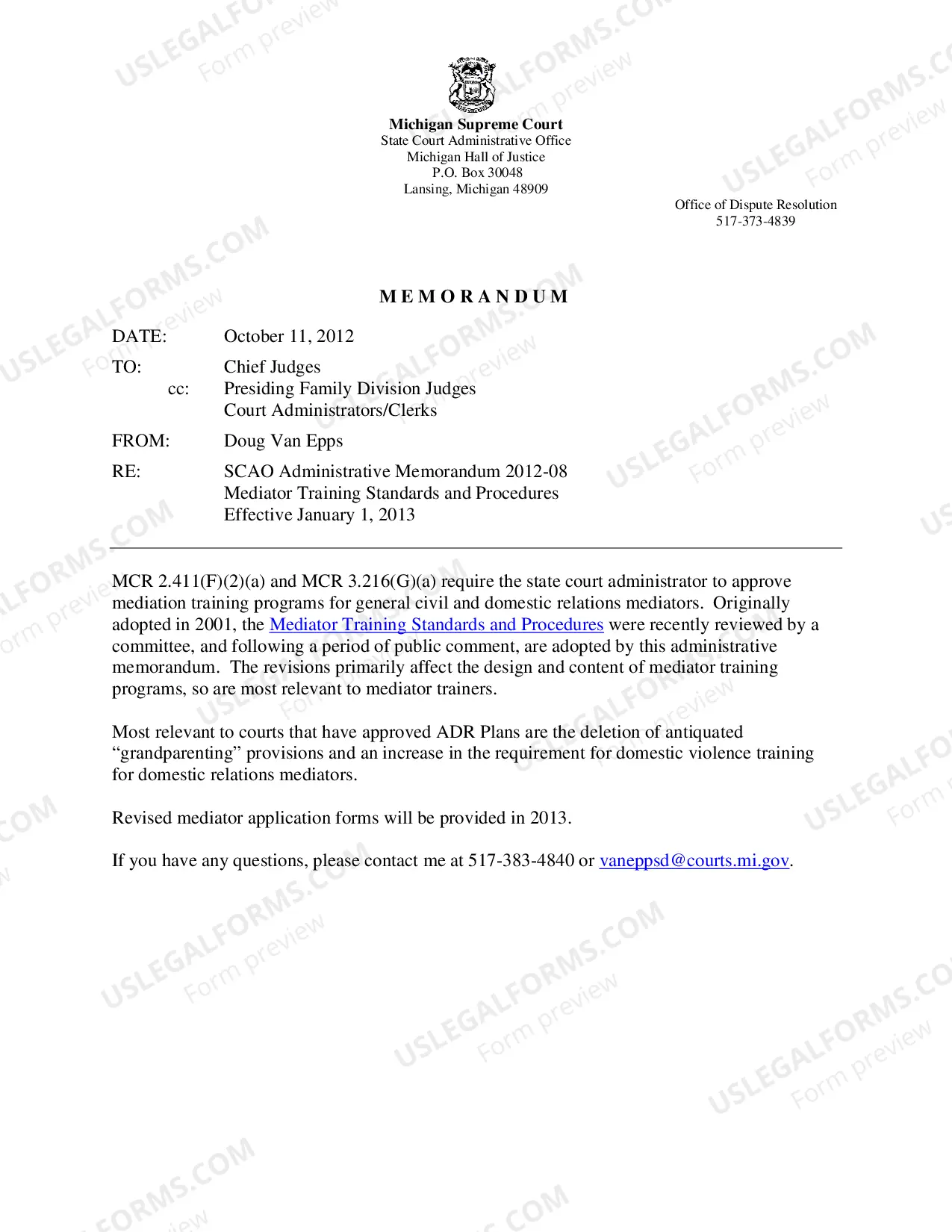
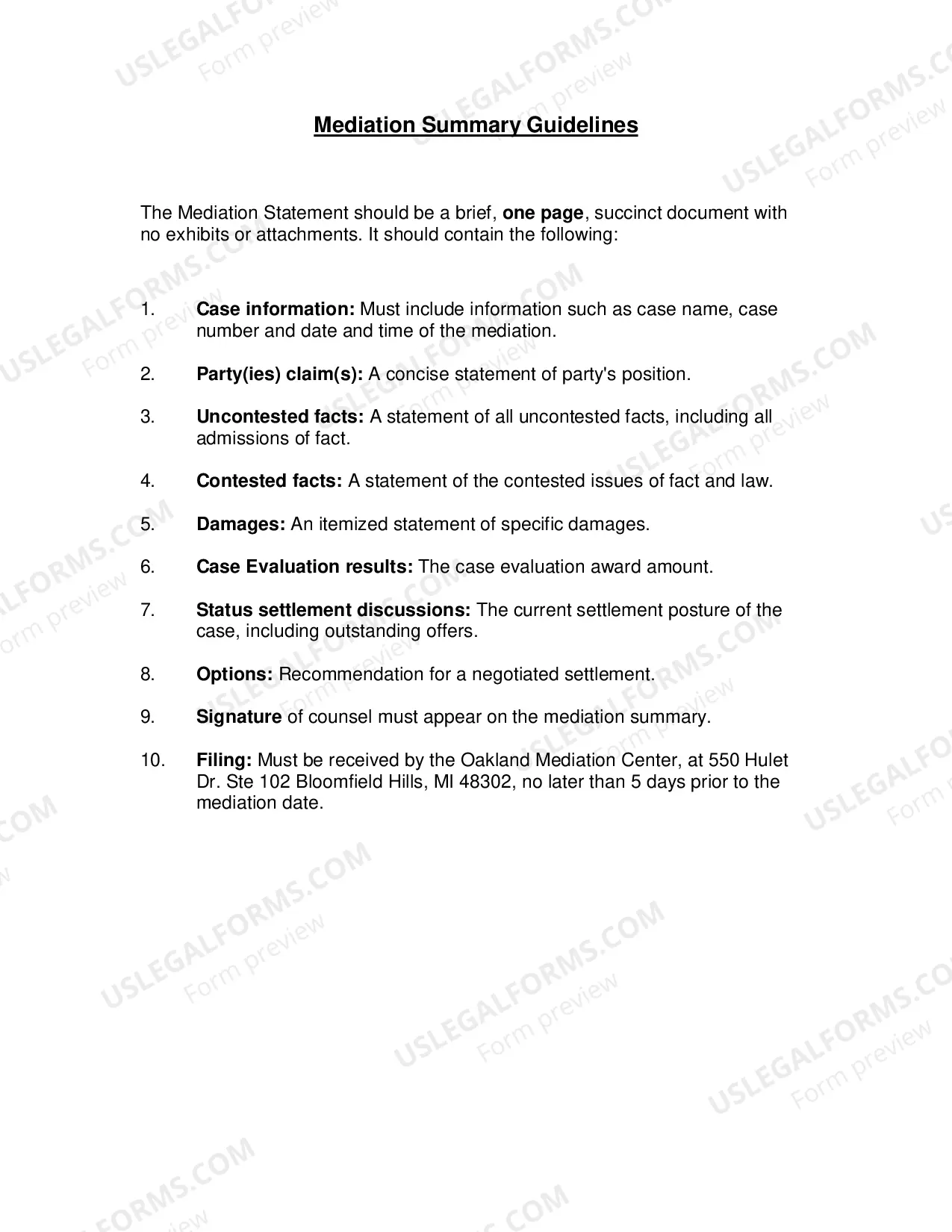
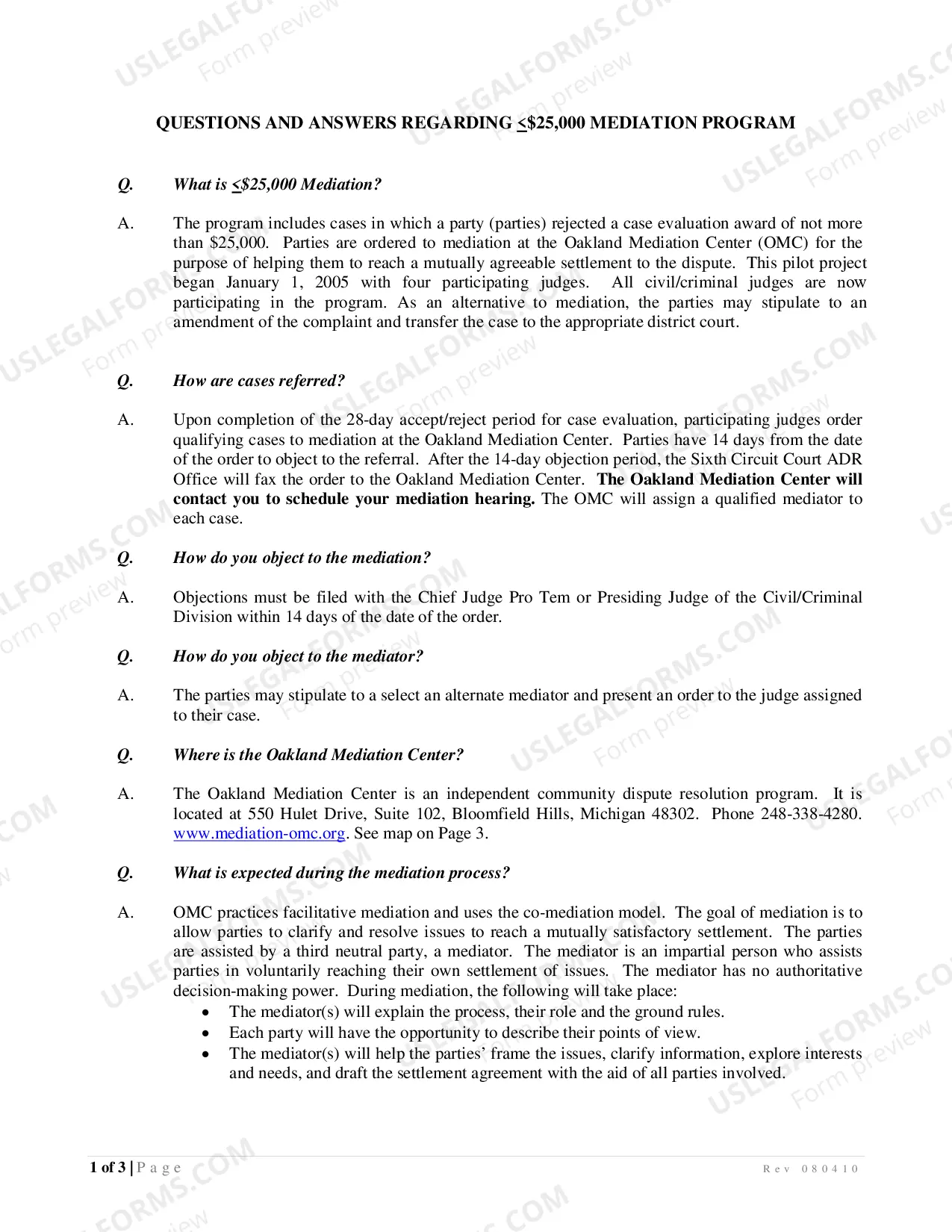
Michigan Interim Mediation Training Standards and Procedures is a set of guidelines created by the State of Michigan that outline the requirements for mediators to become certified and practice in the state. It also outlines the training standards, procedures, and qualifications for mediators to become certified. The standards and procedures are intended to ensure that mediation is conducted in a professional and consistent manner that meets the needs of the parties and the state. The Michigan Interim Mediation Training Standards and Procedures apply to all mediators who are seeking certification or recertification. The standards include a minimum of 40 hours of mediation training that must be completed in order to be certified. The training requirements include instruction in conflict management, dispute resolution, communication, and mediation ethics and practice. The Michigan Interim Mediation Training Standards and Procedures also include specific qualifications that must be met in order to become a certified mediator. The qualifications include at least two years of professional experience in the field of mediation, including at least one year of experience in the field of family mediation. Mediators must also pass a written examination and participate in a skills' assessment in order to be certified. There are two types of Michigan Interim Mediation Training Standards and Procedures: family mediation and general mediation. Family mediation is a type of mediation that is used to resolve disputes between family members. General mediation is a type of mediation that is used to resolve disputes between any two or more parties, regardless of their relationship.
Michigan Interim Mediation Training Standards and Procedures
Description

Get your form ready online
Our built-in tools help you complete, sign, share, and store your documents in one place.
Make edits, fill in missing information, and update formatting in US Legal Forms—just like you would in MS Word.
Download a copy, print it, send it by email, or mail it via USPS—whatever works best for your next step.
Sign and collect signatures with our SignNow integration. Send to multiple recipients, set reminders, and more. Go Premium to unlock E-Sign.
If this form requires notarization, complete it online through a secure video call—no need to meet a notary in person or wait for an appointment.
We protect your documents and personal data by following strict security and privacy standards.

Make edits, fill in missing information, and update formatting in US Legal Forms—just like you would in MS Word.

Download a copy, print it, send it by email, or mail it via USPS—whatever works best for your next step.

Sign and collect signatures with our SignNow integration. Send to multiple recipients, set reminders, and more. Go Premium to unlock E-Sign.

If this form requires notarization, complete it online through a secure video call—no need to meet a notary in person or wait for an appointment.

We protect your documents and personal data by following strict security and privacy standards.
Looking for another form?

How to fill out Michigan Interim Mediation Training Standards And Procedures?
US Legal Forms is the simplest and most affordable method to discover suitable legal templates.
It’s the largest online collection of business and personal legal documents created and verified by legal experts.
Here, you can locate printable and fillable templates that adhere to national and local regulations - just like your Michigan Interim Mediation Training Standards and Procedures.
Review the form description or preview the document to verify you’ve identified the one that meets your needs, or find another using the search tab above.
Click Buy now when you’re confident of its suitability with all the standards, and select the subscription plan that suits you best.
- Acquiring your template involves just a few straightforward steps.
- Users who already possess an account with an active subscription only need to Log In to the web service and download the form to their device.
- Subsequently, they can find it in their profile under the My documents section.
- And here’s how you can secure a correctly drafted Michigan Interim Mediation Training Standards and Procedures if you are utilizing US Legal Forms for the first time.
Form popularity
FAQ
To become an IMI qualified mediator, candidates must fulfill specific training and assessment requirements set by the International Mediation Institute. This includes completing mediation courses that comply with the Michigan Interim Mediation Training Standards and Procedures. Demonstrating competence through assessments further solidifies your qualifications and enhances professional credibility in mediation.
To become a mediator, you typically need a background in dispute resolution or a related field. While formal qualifications may vary, completing a training program that adheres to the Michigan Interim Mediation Training Standards and Procedures is essential. Additionally, strong communication and interpersonal skills are vital for mediators to effectively guide parties towards resolution.
The 40-hour mediation training program is a comprehensive educational course designed to equip participants with essential mediation skills and knowledge. It covers various techniques and strategies, all aligned with the Michigan Interim Mediation Training Standards and Procedures. Completing this training not only prepares you for certification but also enhances your ability to facilitate effective dispute resolution.
Becoming an IMI certified mediator requires participants to undergo specific training and meet established competencies. Individuals must complete a mediation training program that aligns with the Michigan Interim Mediation Training Standards and Procedures, followed by an assessment to demonstrate their skills. This certification enhances credibility and signals a commitment to quality mediation practices.
To become a certified mediator in Michigan, individuals must complete an accredited mediation training program that meets the Michigan Interim Mediation Training Standards and Procedures. After completing the training, candidates must apply for certification through a recognized organization and demonstrate their mediation skills. This process ensures that all certified mediators possess the necessary knowledge and experience to facilitate effective resolutions.
The four main types of mediators include family mediators, civil mediators, workplace mediators, and organizational mediators. Each type specializes in different areas and requires distinct skills and knowledge. These mediators play crucial roles in resolving conflicts and disputes effectively. Understanding these categories can help you determine which mediation type aligns with the Michigan Interim Mediation Training Standards and Procedures.
Model Standards of Conduct for Mediators These standards are designed to serve as fundamental ethical guidelines for persons mediating in all practice contexts. They serve three goals: to guide the conduct of mediators, to inform the mediating parties, and to promote public confidence in mediation.
A mediator should not render a decision on the issues in dispute. The primary responsibility for the resolution of a dispute rests with the parties. mediator should not coerce a party in anyway. A mediator may make suggestions, but all settlement decisions are to be made voluntarily by the parties themselves.
The Six Stages Of Mediation Stage One: Opening Statement.Stage Two: Opening Remarks From The Disputants.Stage Three: Joint Discussion.Stage Four: Private Caucus.Stage Five: Joint Negotiation.Stage Six: Written Settlement Agreement.
THE MAIN STEPS IN A MEDIATION agreeing the ground rules of the process. gathering information and identifying issues. exploring the interests of the parties. developing options for settlement. evaluating options.