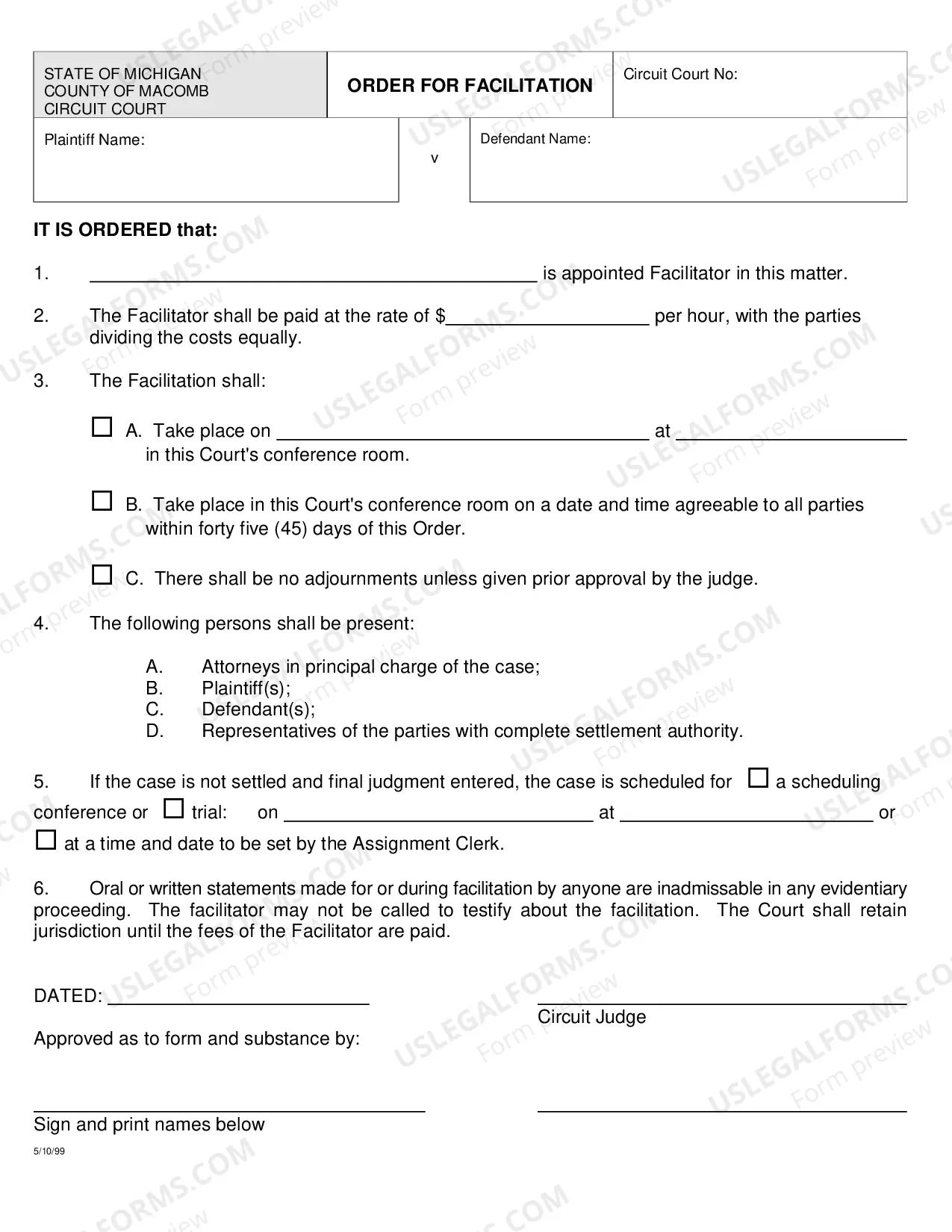
Michigan Order For Facilitation (MOF) is a court-ordered dispute resolution process in Michigan designed to facilitate settlement of family disputes, such as divorce, child custody, support, and property division. It is an alternative to traditional litigation and is used when parties are having difficulty reaching an agreement. The process is voluntary, confidential and non-binding. The MOF process is typically initiated by one or both parties filing a motion in court. The court then appoints a facilitator to help the parties reach a negotiated settlement. The facilitator is a neutral third party who assists the parties in understanding their options and the legal implications of their decisions. The facilitator is not a judge and does not have the authority to make decisions on behalf of the parties. There are two types of Michigan Order for Facilitation: Traditional MOF and Expedited MOF. Traditional MOF is designed for cases where parties have a high likelihood of reaching a settlement. It generally involves multiple meetings and can take several months to complete. Expedited MOF is designed for cases where parties are close to reaching a settlement. It is a more streamlined process that usually takes place over the course of one or two meetings. Overall, Michigan Order for Facilitation is designed to help parties resolve disputes more quickly and efficiently than traditional litigation.
Michigan Order For Facilitation
Description
Get your form ready online
Our built-in tools help you complete, sign, share, and store your documents in one place.
Make edits, fill in missing information, and update formatting in US Legal Forms—just like you would in MS Word.
Download a copy, print it, send it by email, or mail it via USPS—whatever works best for your next step.
Sign and collect signatures with our SignNow integration. Send to multiple recipients, set reminders, and more. Go Premium to unlock E-Sign.
If this form requires notarization, complete it online through a secure video call—no need to meet a notary in person or wait for an appointment.
We protect your documents and personal data by following strict security and privacy standards.

Make edits, fill in missing information, and update formatting in US Legal Forms—just like you would in MS Word.

Download a copy, print it, send it by email, or mail it via USPS—whatever works best for your next step.

Sign and collect signatures with our SignNow integration. Send to multiple recipients, set reminders, and more. Go Premium to unlock E-Sign.

If this form requires notarization, complete it online through a secure video call—no need to meet a notary in person or wait for an appointment.

We protect your documents and personal data by following strict security and privacy standards.
Looking for another form?


How to fill out Michigan Order For Facilitation?
How much time and resources do you frequently spend on creating formal documentation? There’s a better alternative to obtaining such forms than employing legal professionals or squandering hours searching the internet for a suitable template. US Legal Forms is the leading online repository that offers professionally designed and validated state-specific legal documents for any purpose, such as the Michigan Order For Facilitation.
To obtain and complete an appropriate Michigan Order For Facilitation template, follow these straightforward steps: Look through the form content to ensure it complies with your state regulations. To do this, read the form description or utilize the Preview option. In case your legal template doesn’t satisfy your needs, find another one using the search bar at the top of the page.
Download your Michigan Order For Facilitation onto your device and fill it out on a printed hard copy or electronically.
Another advantage of our library is that you can access previously downloaded documents that you securely store in your profile in the My documents tab. Retrieve them at any time and re-complete your paperwork as often as you need. Save time and effort preparing legal documentation with US Legal Forms, one of the most dependable web solutions. Sign up with us today!
- If you are already signed up with our service, Log In and download the Michigan Order For Facilitation.
- If not, proceed to the next steps.
- Click Buy now once you find the correct template.
- Choose the subscription plan that fits you best to access our library’s full service.
- Register for an account and pay for your subscription.
- You can transact with your credit card or via PayPal - our service is completely trustworthy for that.
Form popularity
FAQ
The 7 day order rule in Michigan refers to the requirement for a Michigan Order For Facilitation to be served to the opposing party within seven days of its issuance. This rule ensures that both parties have sufficient time to prepare for the facilitation process. If you don't follow this timeline, it may affect your case negatively. To navigate this process smoothly, consider using USLegalForms, which provides templates and guidance tailored to Michigan's legal framework.
Yes, in Michigan, you can file motions online through the Michigan Supreme Court's e-filing system. This digital platform allows you to submit documents conveniently, saving time and effort. By referencing your situation within the context of the Michigan Order For Facilitation, you can ensure that your filings align with the facilitation process, leading to a smoother resolution of your case.
The 77 day rule in Michigan is a guideline that mandates a timeline for resolving certain family law issues, particularly for disputes entering the court system. Under this rule, the court aims to encourage the timely resolution of cases, ideally within 77 days after the initial filing. Adhering to the Michigan Order For Facilitation can significantly aid in meeting this timeline by providing a clear path toward agreement and resolution, thereby improving the overall experience.
Facilitation in Michigan refers to a process where a neutral third party helps resolve disputes, often related to family law matters such as custody and parenting time. The goal is to encourage communication and help both parties reach an agreement. Utilizing a Michigan Order For Facilitation can streamline this process, making it more efficient and effective for involved parties. This structured approach fosters collaboration, enabling a smoother resolution.
Facilitation consists of each party submitting written briefs to a single attorney who attempts to settle the lawsuit by discussing it with each side. Typically, each party sits in a separate room with their attorney and the facilitator visits with each party and tries to bring them together to a settlement.
Facilitation refers to the use of a neutral third party to enhance cooperation processes and provide guidance to help multi-party groups take informed decisions. More focused on the dispute process, mediation rather refers to use a third party to reach a satisfying resolution of a conflict over a particular issue.
How do I file a Motion? You file a motion by completing the form and filing it with the same court that signed the default entry or default judgment. There is a $20 motion fee for filing a motion to set aside default.
Included under MCR 2.116(C)(7) are motions based on the ground that the claim is barred because of release, payment, prior judgment, immunity granted by law, statute of limitations, statute of frauds, an agreement to arbitrate or litigate in a different forum, infancy or other disability of the moving party, or
Facilitator means ?a person who impartially aids in the discussions and negotiations among the members of a negotiated rulemaking committee to develop a proposed rule.? 5 USCS § 562.