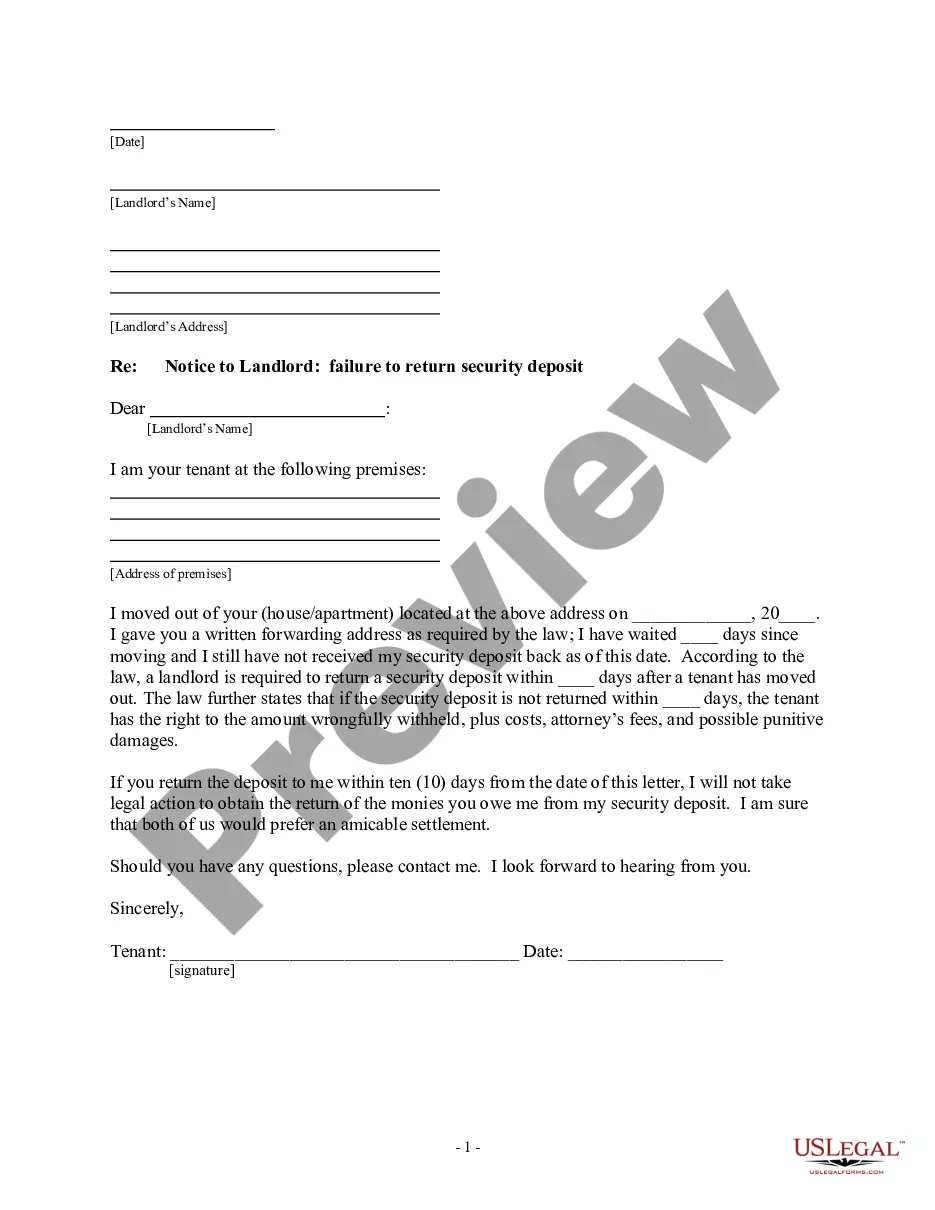
Michigan Complaint for Divorce with Minor Children
Overview of this form
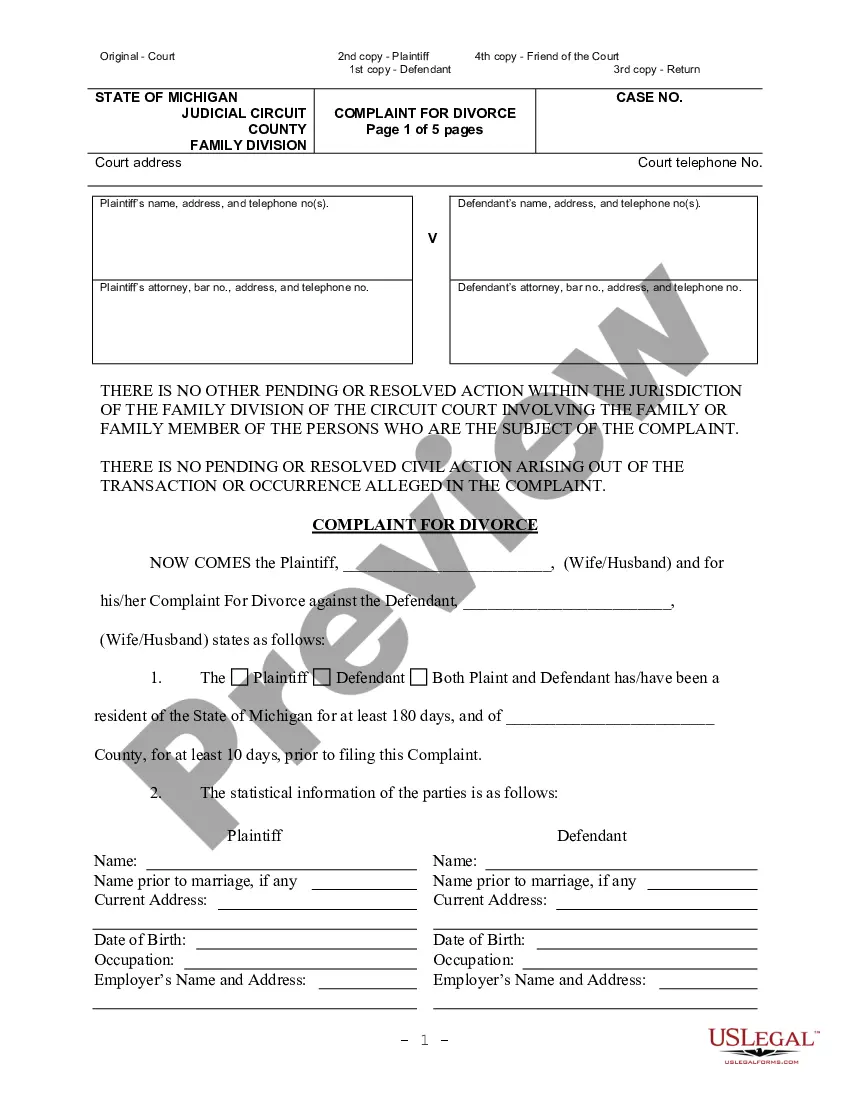
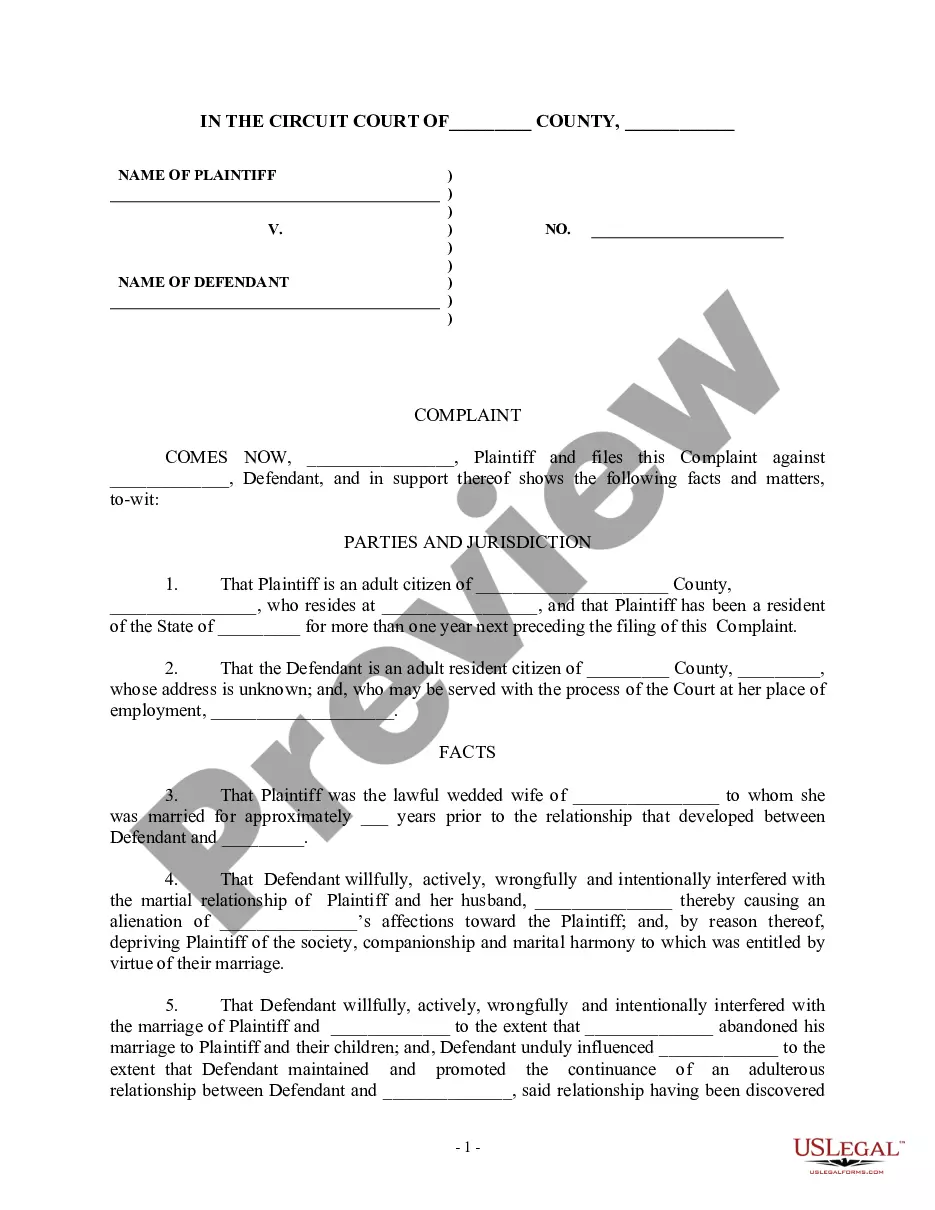
The Complaint for Divorce with Minor Children is a legal document used to initiate divorce proceedings when the couple has minor children from the marriage. This form requests the court to grant a divorce and address related matters, such as child custody and support. Unlike a standard divorce complaint, this form specifically takes into account the welfare of children involved, requiring additional considerations regarding their care and support.
What’s included in this form
- Information about the plaintiff and defendant, including names and relationships.
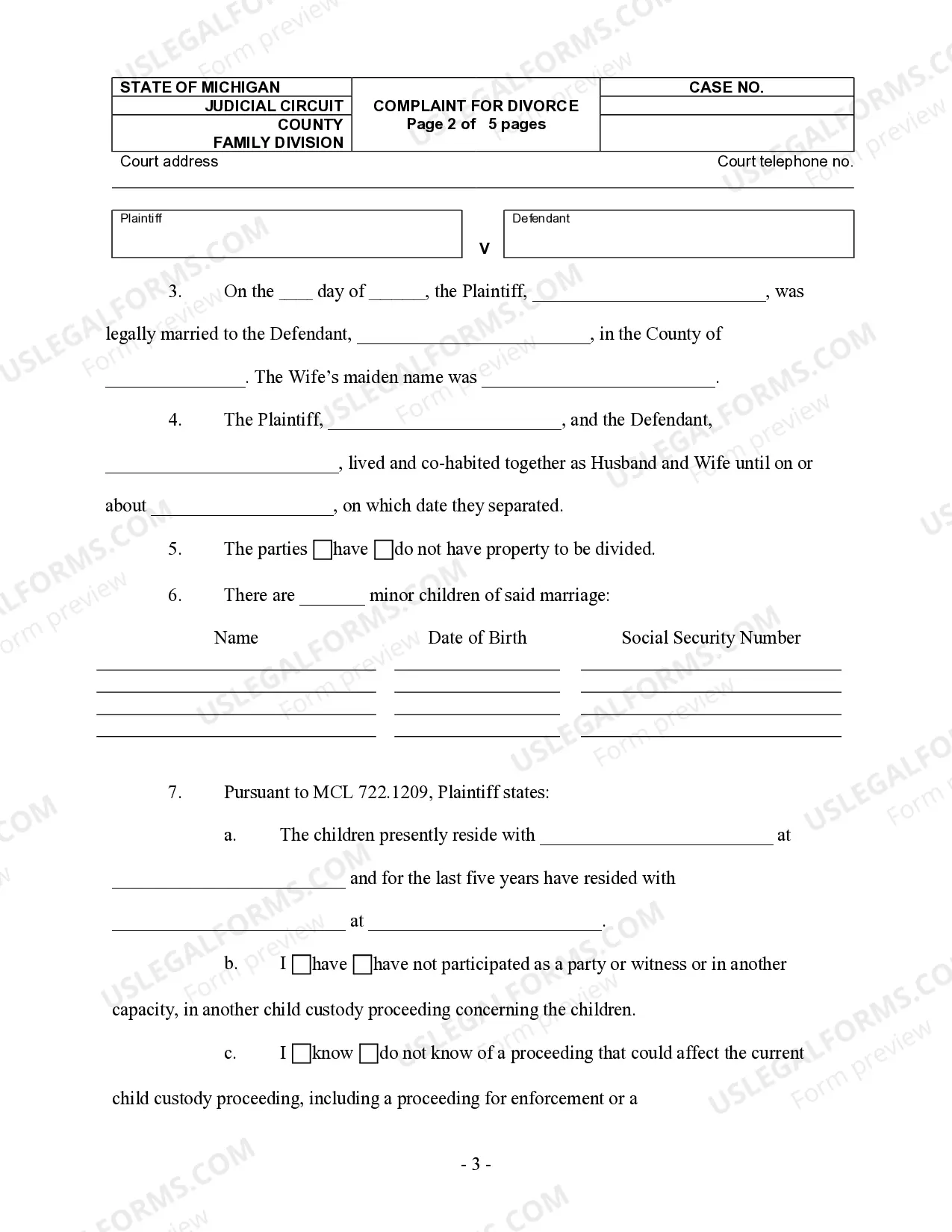
- Details on the date of separation and living arrangements.
- Number of minor children and related custody considerations.
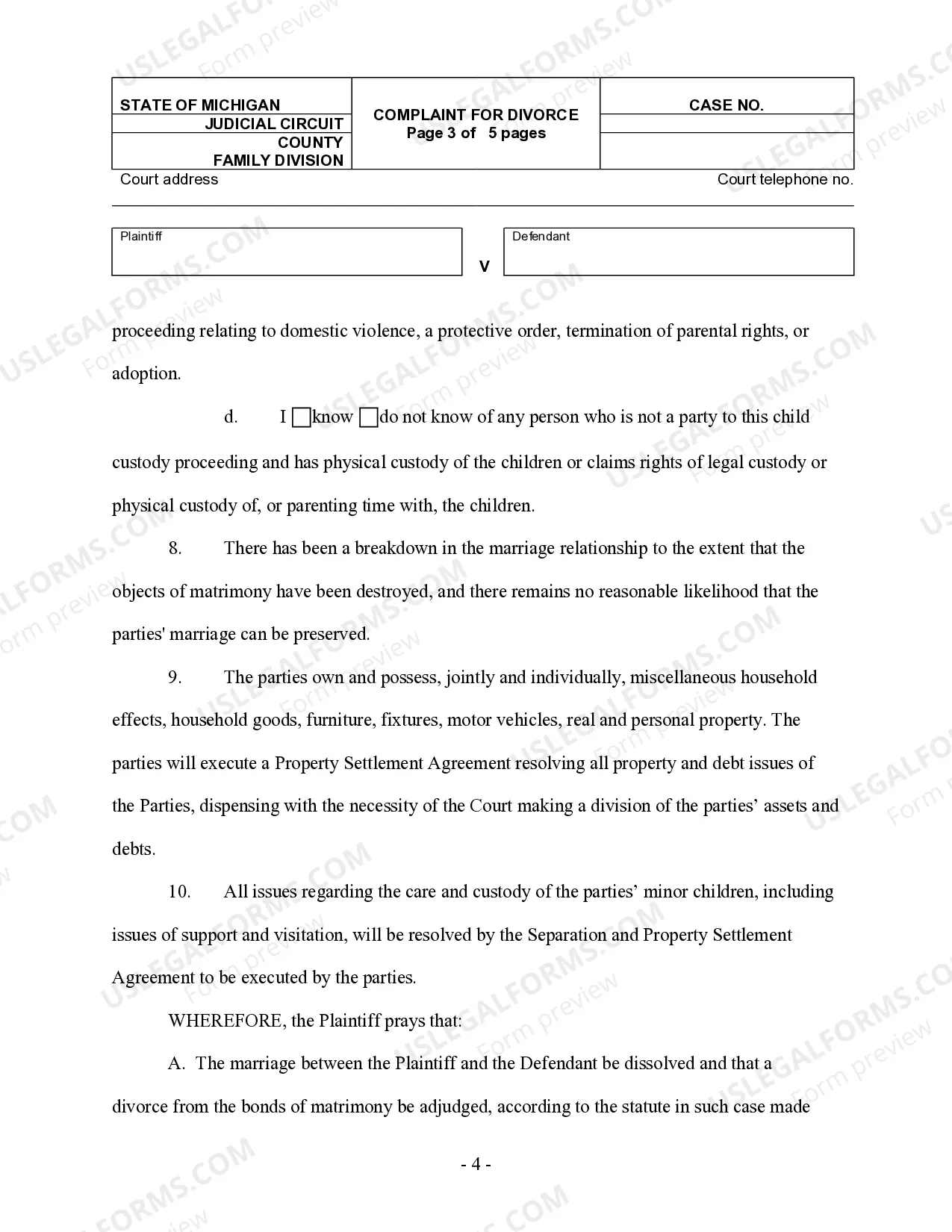
- Statements regarding the breakdown of the marriage and asset division.
- Requests for child support and visitation terms.
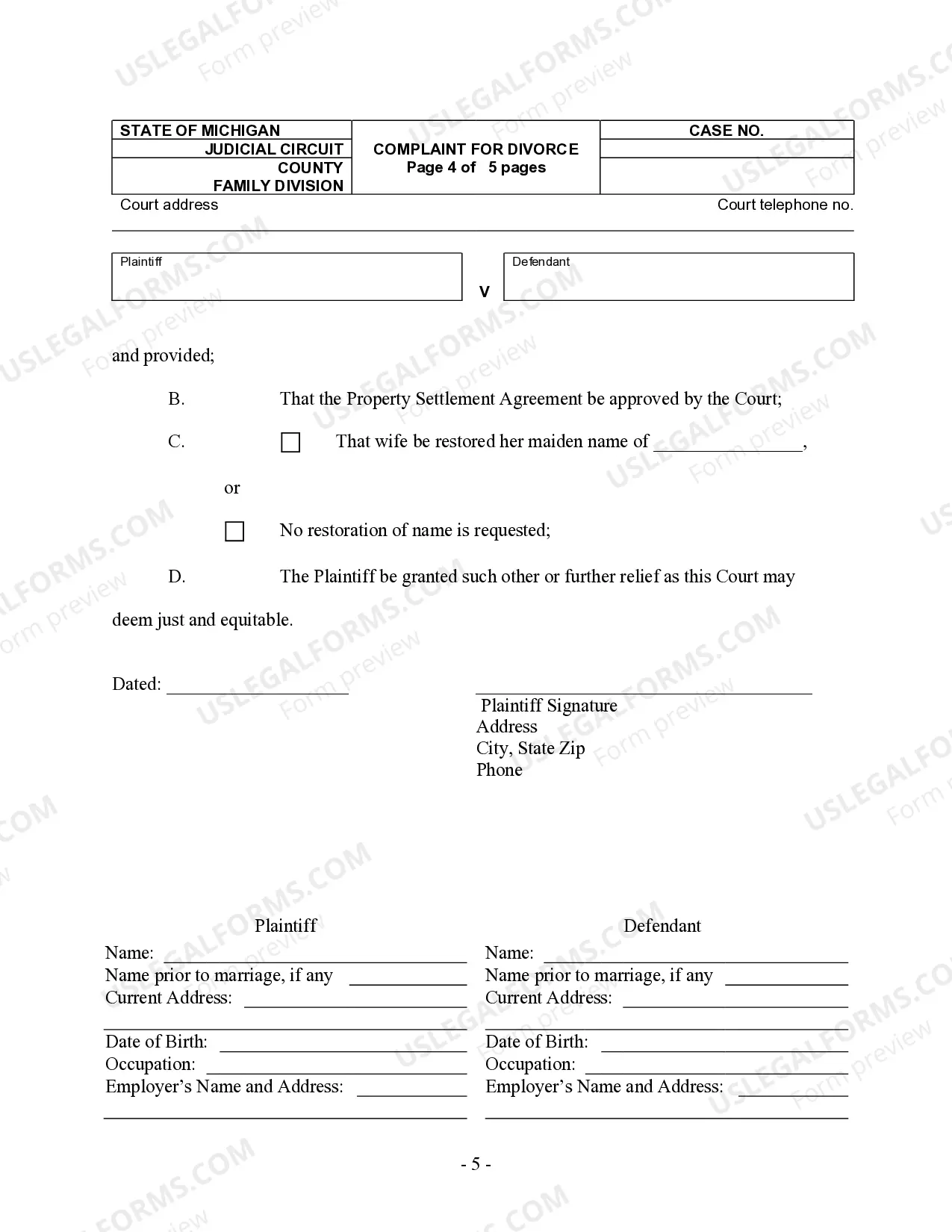
- Information about restoring a maiden name, if applicable.


When to use this form
You should use the Complaint for Divorce with Minor Children when you are legally seeking a divorce from your spouse and you have minor children together. This form is essential when you need to establish custody arrangements, child support obligations, and any other relevant parental rights as part of the divorce process. It is appropriate in situations where the marriage has irretrievably broken down, and both parties are interested in dissolving the marriage while ensuring the best interests of their children are addressed.
Who needs this form
- Individuals seeking a divorce who have minor children from their marriage.
- Parents who wish to formalize child custody and support arrangements during the divorce.
- People who have already separated and wish to initiate legal proceedings for divorce.
How to prepare this document
- Identify and enter the names of the plaintiff (you) and the defendant (your spouse).
- Fill in the date when you and your spouse separated.
- Specify the number of minor children involved and detail any custody or support arrangements.
- Include statements regarding the breakdown of the marriage and any property matters.
- Sign the form in the presence of a notary if required, and ensure all necessary copies are made for the court and other involved parties.
Does this document require notarization?
Notarization is required for this form to take effect. Our online notarization service, powered by Notarize, lets you verify and sign documents remotely through an encrypted video session, available 24/7.
Get your form ready online
Our built-in tools help you complete, sign, share, and store your documents in one place.
Make edits, fill in missing information, and update formatting in US Legal Forms—just like you would in MS Word.
Download a copy, print it, send it by email, or mail it via USPS—whatever works best for your next step.
Sign and collect signatures with our SignNow integration. Send to multiple recipients, set reminders, and more. Go Premium to unlock E-Sign.
If this form requires notarization, complete it online through a secure video call—no need to meet a notary in person or wait for an appointment.
We protect your documents and personal data by following strict security and privacy standards.

Make edits, fill in missing information, and update formatting in US Legal Forms—just like you would in MS Word.

Download a copy, print it, send it by email, or mail it via USPS—whatever works best for your next step.

Sign and collect signatures with our SignNow integration. Send to multiple recipients, set reminders, and more. Go Premium to unlock E-Sign.

If this form requires notarization, complete it online through a secure video call—no need to meet a notary in person or wait for an appointment.

We protect your documents and personal data by following strict security and privacy standards.
Mistakes to watch out for
- Failing to properly fill out the names of the parties involved.
- Neglecting to specify custody arrangements for minor children.
- Omitting the date of separation or providing inaccurate information.
- Not signing the document in front of a notary when required.
Benefits of using this form online
- Convenient access to legally compliant templates anytime.
- Easy to download and customize to suit individual circumstances.
- Assurance that forms are drafted by licensed attorneys, enhancing their reliability.
Looking for another form?

Form popularity
FAQ
Michigan is an equitable distribution state. This means courts will attempt to divide property and assets in a divorce in a fair and equal way but it doesn't mean that the assets will always be divided on a 50/50 basis.Separate property can become marital property if it is commingled with marital property.
From a legal perspective, it generally does not matter who files for divorce first.Filing first creates an opportunity to present the court with various orders before your spouse is notified of the Michigan divorce proceedings. The orders are called Ex Parte, which means literally, on one side only.
In Michigan, you may be relieved to know, the short answer is no. If one spouse wants a divorce, the other spouse cannot prevent it. If your spouse refuses to participate in the process, your divorce can be finalized within a matter of months.
Michigan has no-fault divorce.Although you don't have to prove fault to get a divorce, a spouse's behavior during the marriage can impact the outcomes of your divorce. The judge can consider fault in making decisions about spousal support (alimony) and dividing property.
Find the Default Request and Entry form that was prepared when you used the Do-It-Yourself Divorce tool. Enter your case number and the name of the assigned judge in the top right corner of the form. Take the Default Request and Entry form to the court clerk's office. The clerk will sign the form, entering the default.
California is a no-fault state when it comes to divorce or legal separation. It does not matter if you are filing for divorce because your spouse cheated on you, or because you just don't get along anymore.
One of the main legal advantages that a person gains by filing the divorce petition before his or her spouse does is that the filer can request a Standing Order from the court when filing the petition.If the matter should go to a hearing, the person who files the petition usually presents his or her case first.
You or Your Spouse Must Be a Resident Either you or your spouse must have lived in Michigan for at least the last six months before filing. You must file your divorce in circuit court in the county where either you or your spouse has lived for at least ten days before filing.
Find the Default Request and Entry form that was prepared when you used the Do-It-Yourself Divorce tool. Enter your case number and the name of the assigned judge in the top right corner of the form. Take the Default Request and Entry form to the court clerk's office. The clerk will sign the form, entering the default.