Michigan Proof of Mailing - Judgment of Divorce
Understanding this form
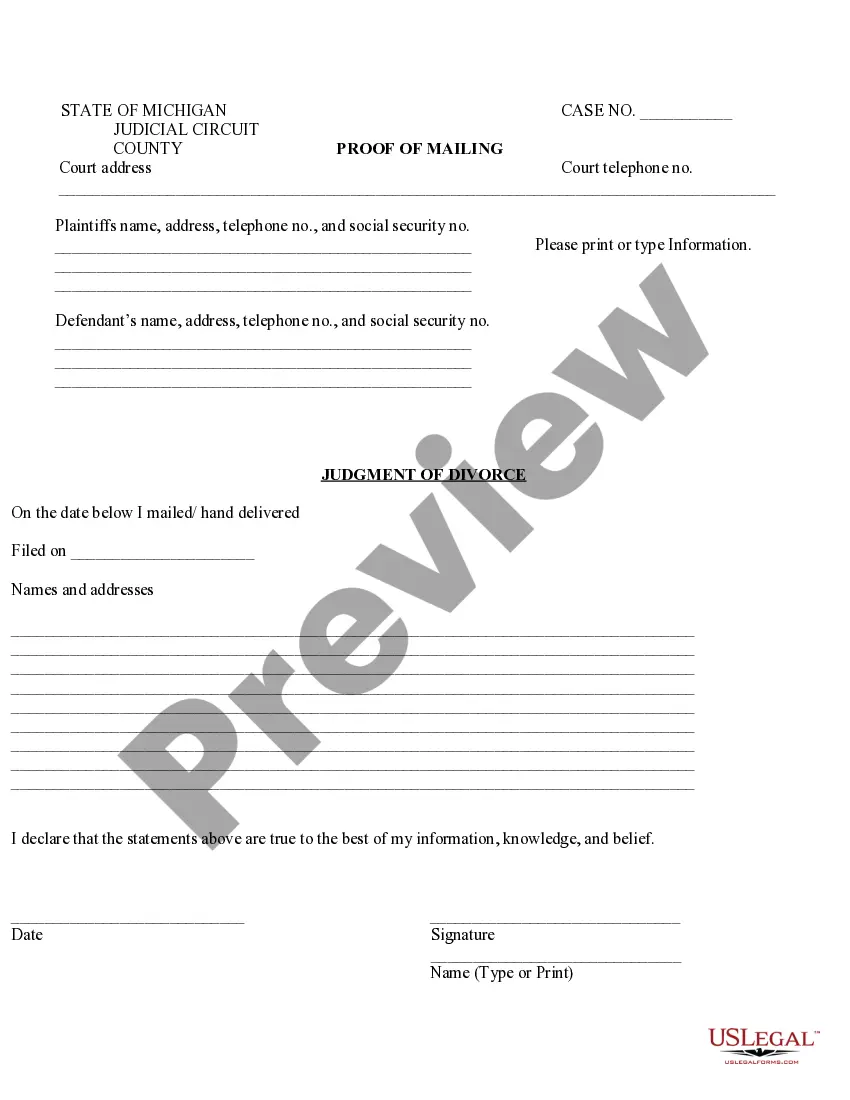
The Proof of Mailing - Judgment of Divorce is a legal document that serves as evidence that a divorce judgment has been properly sent to the involved parties. This form is vital in confirming that all parties have received necessary legal notices during the divorce process, making it distinct from other types of mailing proofs that may not pertain specifically to divorce judgments.
Main sections of this form
- Judicial circuit and county information to identify the court jurisdiction.
- Plaintiff's details, including name, address, telephone number, and social security number.
- Defendant's details, including name, address, telephone number, and social security number.
- Date of mailing or hand delivery of the divorce judgment.
- Signature and printed name of the person completing the form, along with the date of completion.
- Sections for listing names and addresses of the individuals served with the judgment.
Situations where this form applies
This form should be used when you have obtained a judgment of divorce and need to provide proof that it has been officially mailed or delivered to all relevant parties. It is essential for fulfilling legal obligations in the divorce process and may be required by the court to demonstrate compliance with notification requirements.
Who can use this document
- Individuals who have received a judgment of divorce.
- Plaintiffs in a divorce case who need to provide proof of mailing.
- Defendants in a divorce case seeking verification that they were notified of the judgment.
How to complete this form
- Identify the judicial circuit and county where the divorce was filed.
- Fill in the plaintiff's name, address, telephone number, and social security number.
- Provide the defendant's name, address, telephone number, and social security number.
- Enter the date the judgment was mailed or hand delivered.
- Sign and date the form, and print your name for clarity.
- List the names and addresses of all individuals who received the judgment.
Is notarization required?
This form does not typically require notarization unless specified by local law. Users should consult local regulations to confirm any notarization requirements.
Get your form ready online
Our built-in tools help you complete, sign, share, and store your documents in one place.
Make edits, fill in missing information, and update formatting in US Legal Forms—just like you would in MS Word.
Download a copy, print it, send it by email, or mail it via USPS—whatever works best for your next step.
Sign and collect signatures with our SignNow integration. Send to multiple recipients, set reminders, and more. Go Premium to unlock E-Sign.
If this form requires notarization, complete it online through a secure video call—no need to meet a notary in person or wait for an appointment.
We protect your documents and personal data by following strict security and privacy standards.

Make edits, fill in missing information, and update formatting in US Legal Forms—just like you would in MS Word.

Download a copy, print it, send it by email, or mail it via USPS—whatever works best for your next step.

Sign and collect signatures with our SignNow integration. Send to multiple recipients, set reminders, and more. Go Premium to unlock E-Sign.

If this form requires notarization, complete it online through a secure video call—no need to meet a notary in person or wait for an appointment.

We protect your documents and personal data by following strict security and privacy standards.
Common mistakes to avoid
- Not including all necessary recipients in the mailing list.
- Failing to sign and date the form.
- Providing incorrect contact details for the plaintiff or defendant.
Benefits of completing this form online
- Convenience of completing the form from home at any time.
- Editability allows users to tailor the information to their specific case.
- Reliable format ensures compliance with legal requirements.
Looking for another form?


Form popularity
FAQ
A judge will typically only deny an uncontested divorce if there are procedural matters that haven't been done properly, something is unclear or confusing, or something is not in the best interests of the child.
Find the Default Request and Entry form that was prepared when you used the Do-It-Yourself Divorce tool. Enter your case number and the name of the assigned judge in the top right corner of the form. Take the Default Request and Entry form to the court clerk's office. The clerk will sign the form, entering the default.
Find the Default Request and Entry form that was prepared when you used the Do-It-Yourself Divorce tool. Enter your case number and the name of the assigned judge in the top right corner of the form. Take the Default Request and Entry form to the court clerk's office. The clerk will sign the form, entering the default.
Judgment of divorce is a formal written document. This document states that a man and a woman are divorced. A judgment of divorce is prepared by an attorney and presented to the court for the Judge to affix his/her sign. This is recognized in some states and provinces as a Divorce Decree or Decree of Dissolution.
A divorce decree is just another term for a Judgment for Dissolution of Marriage.
The judge makes the decision in the divorce case on the issue of spousal support by going through the Family Code 4320 factors. Once again, testimony is taken and evidence is presented on each of the factors. The focus is on the marital standard of living.
It is important to note that certified copies of divorce decrees can only be obtained in the county where the divorce was finalized. Accessing this record via the Office of Vital Records is the only way to obtain full and certified copies of these records.
The court will give you a proof of written judgement that lets you know that your divorce is final. You can request a copy of this judgement from the court in your jurisdiction contact the courthouse or visit its website to see what its specific procedures are.
You can mail the divorce documents by certified mail. You can also have a sheriff serve the papers for a fee. If you have an adult that you trust and that is not involved in the divorce, you can also have him or her serve the papers. Your spouse must then complete and return a Proof of Service to the county clerk.