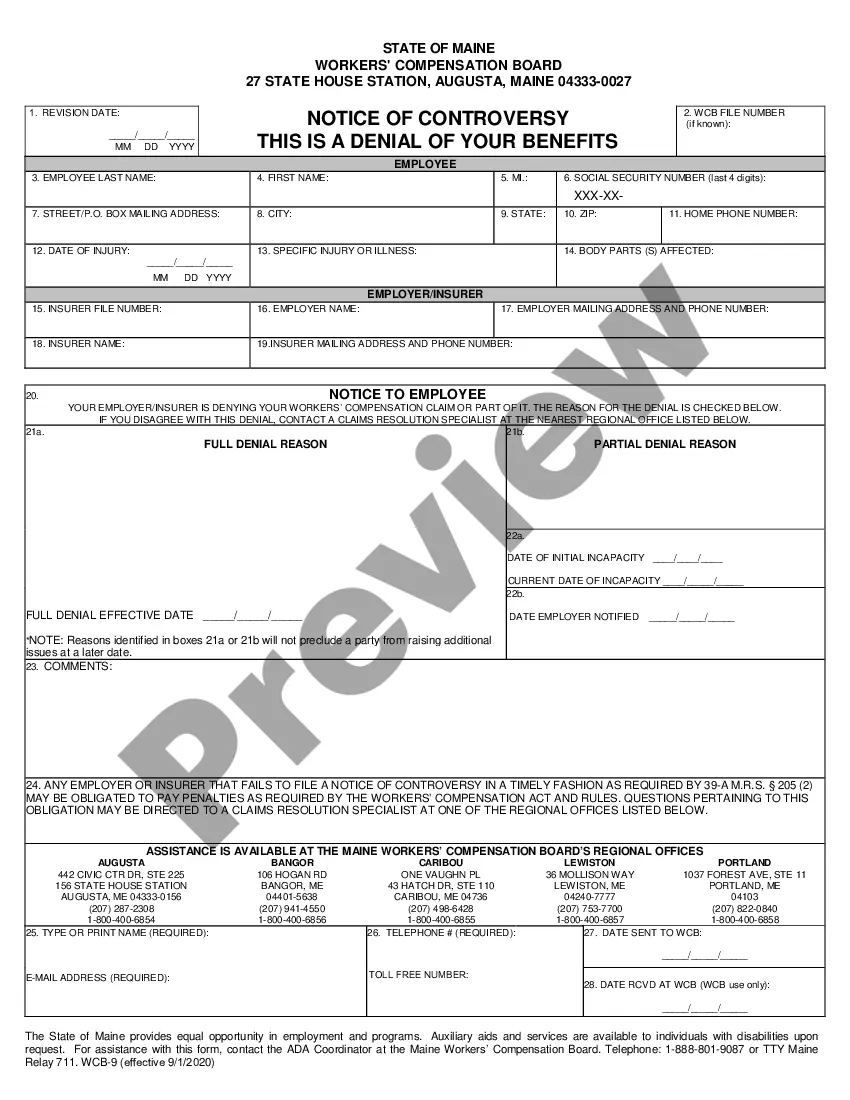
This is one of the official Workers' Compensation forms for the state of Maine.
Maine Notice of Controversy for Workers' Compensation
State:
Maine
Control #:
ME-WCB-9-WC
Format:
PDF
Instant download
This website is not affiliated with any governmental entity
Public form
Description
Get your form ready online
Our built-in tools help you complete, sign, share, and store your documents in one place.
Built-in online Word editor
Make edits, fill in missing information, and update formatting in US Legal Forms—just like you would in MS Word.
Export easily
Download a copy, print it, send it by email, or mail it via USPS—whatever works best for your next step.
E-sign your document
Sign and collect signatures with our SignNow integration. Send to multiple recipients, set reminders, and more. Go Premium to unlock E-Sign.
Notarize online 24/7
If this form requires notarization, complete it online through a secure video call—no need to meet a notary in person or wait for an appointment.
Store your document securely
We protect your documents and personal data by following strict security and privacy standards.

Make edits, fill in missing information, and update formatting in US Legal Forms—just like you would in MS Word.

Download a copy, print it, send it by email, or mail it via USPS—whatever works best for your next step.

Sign and collect signatures with our SignNow integration. Send to multiple recipients, set reminders, and more. Go Premium to unlock E-Sign.

If this form requires notarization, complete it online through a secure video call—no need to meet a notary in person or wait for an appointment.

We protect your documents and personal data by following strict security and privacy standards.
Looking for another form?

How to fill out Maine Notice Of Controversy For Workers' Compensation?
Obtain any document from 85,000 legal records including Maine Notice of Dispute for Workers' Compensation online with US Legal Forms. Each template is crafted and refreshed by state-accredited lawyers.
If you have a membership, sign in. Once you reach the document’s page, click on the Download button and navigate to My documents to gain access to it.
If you haven’t subscribed yet, follow the procedures below.
With US Legal Forms, you will consistently have instant access to the appropriate downloadable document. The service offers access to forms and categorizes them to simplify your search. Utilize US Legal Forms to acquire your Maine Notice of Dispute for Workers' Compensation quickly and effortlessly.
- Review the state-specific criteria for the Maine Notice of Dispute for Workers' Compensation you need to utilize.
- Browse through the description and preview the document.
- Once you are certain the template meets your requirements, click on Buy Now.
- Select a subscription plan that truly fits your financial plan.
- Establish a personal account.
- Make the payment in either of two suitable methods: by credit card or via PayPal.
- Choose a format to download the document in; two formats are available (PDF or Word).
- Download the document to the My documents section.
- After your reusable document is downloaded, print it or save it to your device.
Form popularity
FAQ
A wrongful termination is any firing that is done in violation of federal, state, or local laws; the terms of an employment agreement; or for reasons that go against public policy.
The short answer is, no, your employer cannot fire you merely because of your workers' compensation claim.But your employer must be able to show there were reasons for firing you or laying you off that didn't have to do with your filing a workers' compensation claim.
What RTW / workers' comp information IS confidential? While relevant, recent, work-related medical information is usually not confidential, other medical informationsuch as the individual's medical historyis confidential.
Some of the common reasons workers compensation insurance companies stop paying benefits are:Your employer offers you suitable light duty work. A doctor says you have reached maximum medical improvement. The insurance company determines you were injured somewhere other than work, and.
A prospective employer has no right to ask whether you have had a previous workers' compensation claim. However, a prospective employer does have the right to know if you have an injury or medical condition that will impact on your ability to perform your work duties.
While the average settlement for wrongful termination cases in California is around $40,000, the average value of a court verdict in wrongful termination cases is slightly larger, around $45,000 (but do keep in mind that attorney fees for legal representation in a wrongful termination trial will skyrocket, too).
In most cases, the settlement you would receive is calculated based on your damages, the losses you incurred as a result of the wrongful termination. These damages need to be proven with documents for them to be taken seriously by a court or jury, and the employer.
Workers' compensation insurance doesn't cover unemployment expenses, injuries that occur outside of work or wrongful termination. It doesn't cover injuries resulting from fights at work, alcohol- or drug-related injuries on the job.
The short answer is, no, your employer cannot fire you merely because of your workers' compensation claim. However, your employer can fire you while you have an open workers' compensation claim.