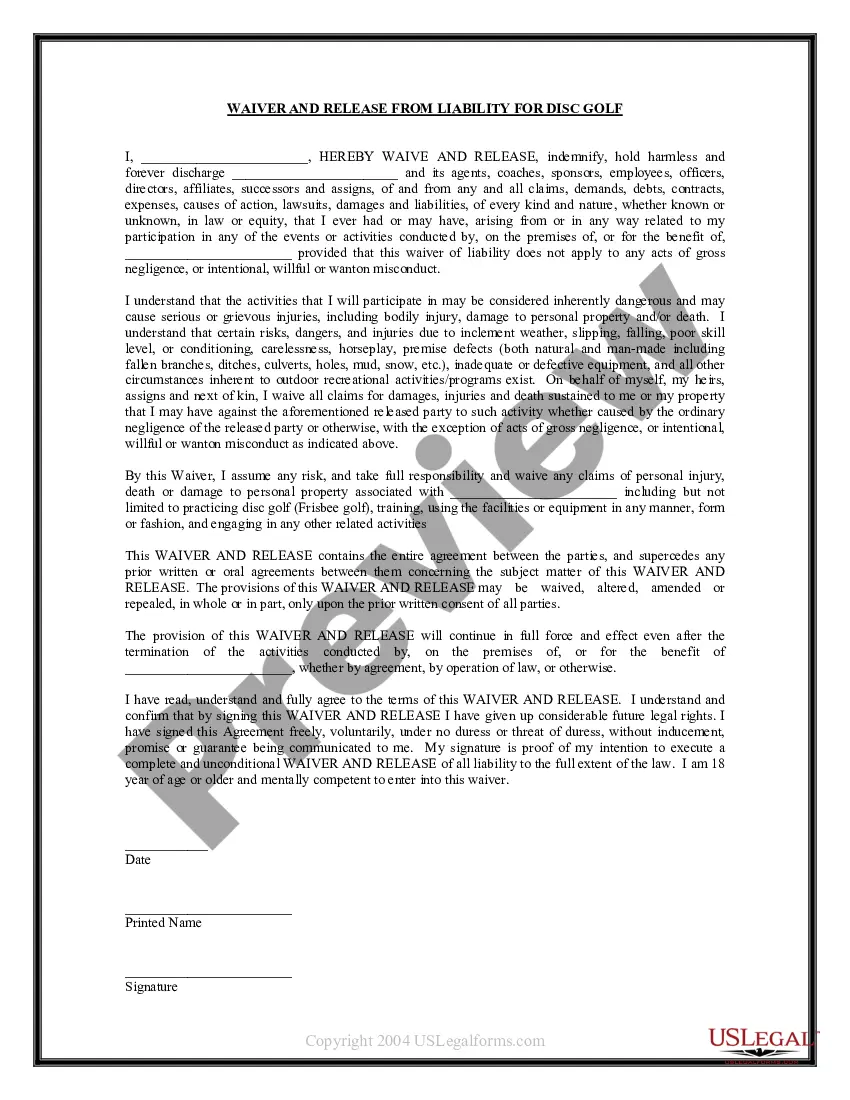
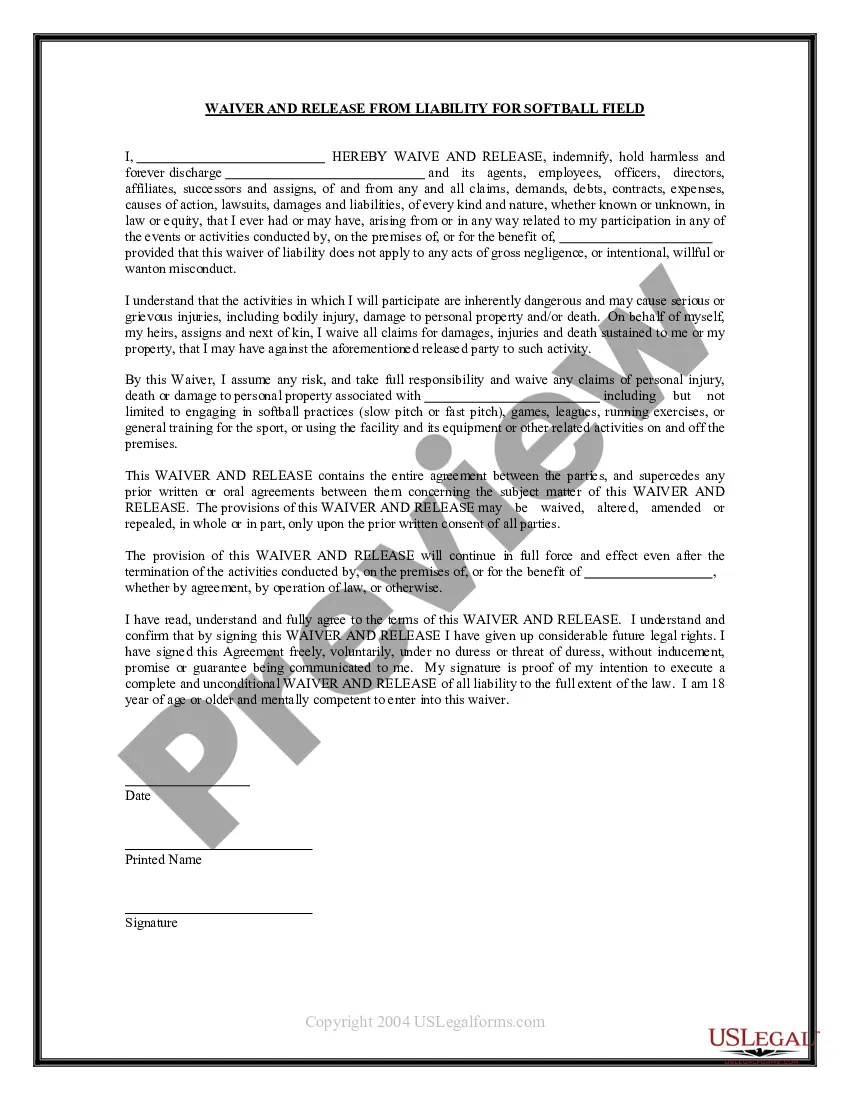
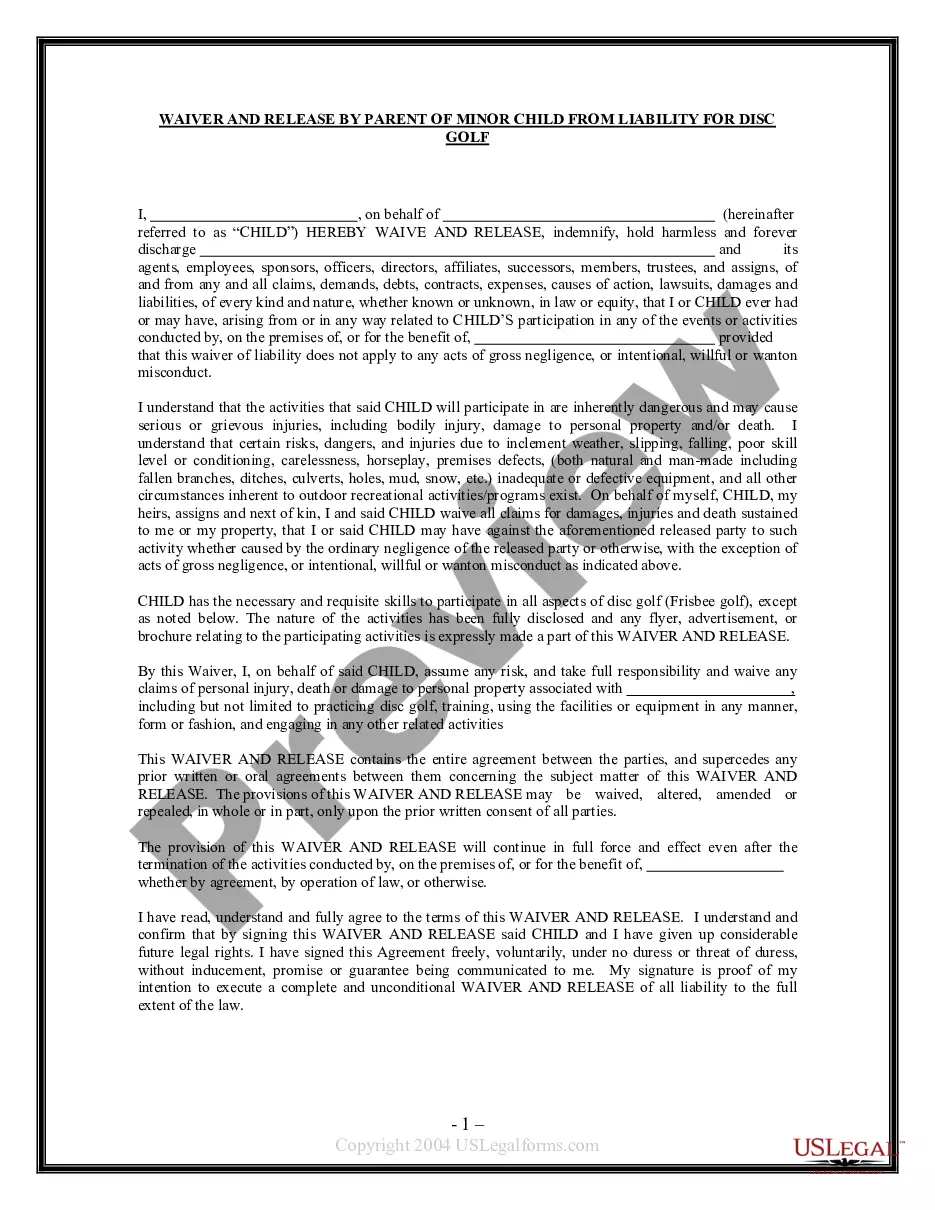
This form releases a property owner from liability for permitting an individual to participate in disc golf.
Maine Waiver and Release From Liability For Adult for Disc Golf
Category:
State:
Multi-State
Control #:
US-WAV-84A
Format:
Word;
Rich Text
Instant download
Description
How to fill out Waiver And Release From Liability For Adult For Disc Golf?
You can commit hrs on the Internet searching for the legal file design that fits the state and federal requirements you will need. US Legal Forms gives 1000s of legal types which can be examined by specialists. It is simple to acquire or print the Maine Waiver and Release From Liability For Adult for Disc Golf from my service.
If you already possess a US Legal Forms profile, it is possible to log in and then click the Down load switch. Afterward, it is possible to total, edit, print, or indication the Maine Waiver and Release From Liability For Adult for Disc Golf. Every single legal file design you buy is yours for a long time. To obtain one more version of the acquired kind, go to the My Forms tab and then click the related switch.
If you work with the US Legal Forms internet site the first time, stick to the simple instructions below:
- Initial, make certain you have selected the best file design to the area/town of your choosing. See the kind outline to make sure you have picked the right kind. If offered, make use of the Review switch to search from the file design as well.
- If you wish to discover one more variation from the kind, make use of the Lookup discipline to find the design that meets your needs and requirements.
- When you have identified the design you need, click on Buy now to move forward.
- Pick the pricing plan you need, enter your qualifications, and register for an account on US Legal Forms.
- Comprehensive the deal. You can use your credit card or PayPal profile to pay for the legal kind.
- Pick the formatting from the file and acquire it to the device.
- Make changes to the file if possible. You can total, edit and indication and print Maine Waiver and Release From Liability For Adult for Disc Golf.
Down load and print 1000s of file web templates making use of the US Legal Forms site, that provides the most important assortment of legal types. Use expert and express-distinct web templates to handle your company or person needs.
Form popularity
FAQ
The 30 second rule in disc golf states that players must make their throw within 30 seconds of reaching their lie. This rule helps maintain a steady pace of play and keeps the game enjoyable for everyone. Understanding this rule is crucial for all players, especially when participating in tournaments. By adhering to the 30 second rule, you can enhance your disc golf experience while also ensuring compliance with the standards set forth in your Maine Waiver and Release From Liability For Adult for Disc Golf.
Yes, you can write your own liability waiver, but it is essential to ensure that it meets legal standards. A well-crafted Maine Waiver and Release From Liability For Adult for Disc Golf should clearly state the risks involved in the activity and explicitly release liability for the organizer. However, to avoid potential legal issues, consider using a professionally designed template from a platform like US Legal Forms. This way, you can ensure your waiver is comprehensive and compliant with state laws.
Here is all that pertains writing an effective liability waiver:Get help. Writing a waiver should not be complicated.Use the correct structure.Proper formatting.Include a subject line.Include a caution!Talk about the activity risks.Do not forget an assumption of risk.Hold harmless.More items...?
A liability waiver is a legal document that a person who participates in an activity may sign to acknowledge the risks involved in their participation. By doing so, the company attempts to remove legal liability from the business or person responsible for the activity.
A release of liability, also known as a liability waiver or a hold harmless agreement, is a contract in which one party agrees not to hold another party liable for damages or injury. These contracts are common in fields that involve some risk to property, finances, or health.
How long do I keep signed waivers? The sponsoring unit is required to retain the waiver for six (6) years after the end of the event or activity for which the waiver was signed.
The main difference between releases and waivers is the transferring of ownership. When rights are released, they are transferred to another party. When rights are waived, they are gone altogether.
Liability waiver form protects your business against any lawsuit if someone is injured during a business-hosted event....Elements of a Liability waiverFormal structure.Risk involved section.Assumption of risk section.Choice of law provision section.Confirmation.Signature.
As tempting as it may be, you should never write your own liability waiver. Unless you're a fully qualified lawyer with experience in this area, it's likely that you'll omit critical language that puts your business at risk for lawsuits.
A liability waiver, or release waiver, is a legal document that a company or organization requires members of the public to sign in order to protect their organization from being sued if you sustain an injury.