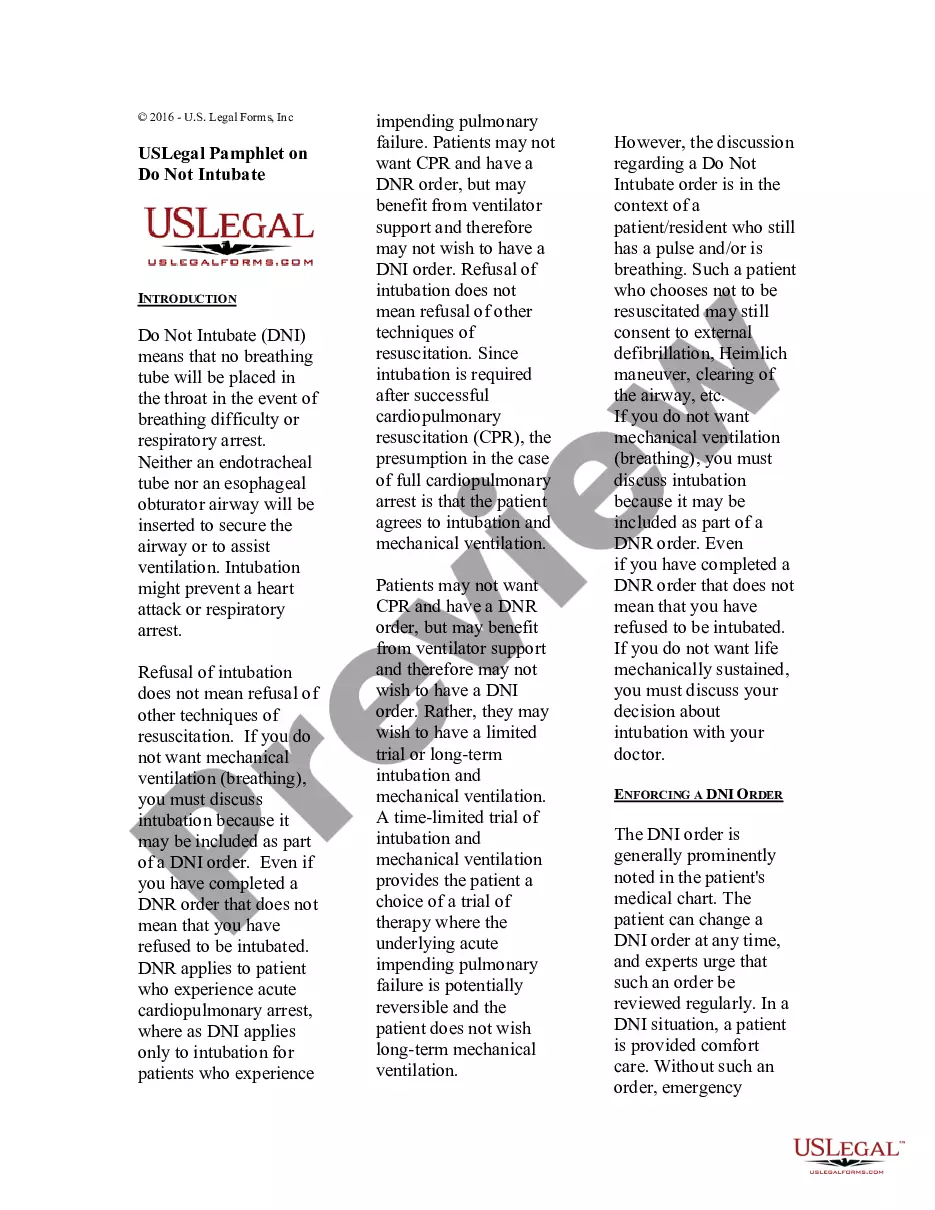
This pamphlet provides an overview on Do Not Resuscitate (DNI) orders. A comparison of DNI and DNR orders is included.
Maine USLegal Pamphlet on Do Not Intubate - DNI
State:
Multi-State
Category:
Control #:
US-PMPH-05
Format:
Word;
Rich Text
57 downloads
Description
Free preview
Get your form ready online
Our built-in tools help you complete, sign, share, and store your documents in one place.
Built-in online Word editor
Make edits, fill in missing information, and update formatting in US Legal Forms—just like you would in MS Word.
Export easily
Download a copy, print it, send it by email, or mail it via USPS—whatever works best for your next step.
E-sign your document
Sign and collect signatures with our SignNow integration. Send to multiple recipients, set reminders, and more. Go Premium to unlock E-Sign.
Notarize online 24/7
If this form requires notarization, complete it online through a secure video call—no need to meet a notary in person or wait for an appointment.
Store your document securely
We protect your documents and personal data by following strict security and privacy standards.

Make edits, fill in missing information, and update formatting in US Legal Forms—just like you would in MS Word.

Download a copy, print it, send it by email, or mail it via USPS—whatever works best for your next step.

Sign and collect signatures with our SignNow integration. Send to multiple recipients, set reminders, and more. Go Premium to unlock E-Sign.

If this form requires notarization, complete it online through a secure video call—no need to meet a notary in person or wait for an appointment.

We protect your documents and personal data by following strict security and privacy standards.
Looking for another form?
How to fill out USLegal Pamphlet On Do Not Intubate - DNI?
Selecting the optimal valid document template can be quite a challenge. Naturally, there are numerous templates accessible on the web, but how will you find the valid form you require? Utilize the US Legal Forms website. The service offers thousands of templates, such as the Maine USLegal Pamphlet on Do Not Intubate - DNI, which can be utilized for business and personal purposes. All of the forms are reviewed by experts and comply with federal and state regulations.
If you are already registered, Log In to your account and then click the Download button to obtain the Maine USLegal Pamphlet on Do Not Intubate - DNI. Use your account to browse the legal forms you may have purchased previously. Visit the My documents section of your account and retrieve another copy of the document you require.
If you are a new user of US Legal Forms, here are simple instructions for you to follow: First, ensure you have selected the correct form for your locality/county. You can preview the form using the Review option and examine the form summary to confirm it is the right one for you. If the form does not meet your needs, utilize the Search field to find the appropriate form. Once you are confident that the form is suitable, click on the Download now button to acquire the form. Choose the pricing plan you need and enter the required details. Create your account and complete an order using your PayPal account or credit card. Select the file format and download the legal document template to your device. Complete, modify, print, and sign the acquired Maine USLegal Pamphlet on Do Not Intubate - DNI. US Legal Forms is the largest collection of legal forms where you can find a variety of document templates. Use the service to obtain properly crafted papers that adhere to state requirements.
Form popularity
FAQ
A Do Not Resuscitate (DNR) order primarily prevents medical staff from performing resuscitation efforts in the event of cardiac arrest. However, if a patient has a DNR, it does not automatically mean they cannot be intubated for other medical reasons. The Maine USLegal Pamphlet on Do Not Intubate - DNI clarifies these distinctions, helping patients and families navigate complex healthcare decisions. Understanding both DNR and DNI orders is crucial for ensuring that medical care aligns with a patient’s desires.
Yes, DNI stands for 'do not intubate.' This directive indicates a patient's wish not to undergo intubation, a medical procedure where a tube is inserted into the airway to assist with breathing. The Maine USLegal Pamphlet on Do Not Intubate - DNI provides detailed information on this topic, helping individuals understand their rights and options regarding end-of-life care. It's essential to communicate these wishes clearly to healthcare providers.
For a Do Not Resuscitate (DNR) order to be valid, it typically needs to be signed by a licensed physician and should reflect your clear wishes about resuscitation. In Maine, specific documentation, like the Maine USLegal Pamphlet on Do Not Intubate - DNI, can help you understand the necessary steps and requirements. Having a valid DNR order ensures that your medical preferences are honored, giving you peace of mind in your healthcare decisions.
If you do not have a Do Not Resuscitate (DNR) order in place, medical professionals are generally required to perform resuscitation efforts in the event of a cardiac arrest. This could include intubation and other life-saving measures, which may not align with your wishes. To ensure your preferences are respected, consider using the Maine USLegal Pamphlet on Do Not Intubate - DNI. This resource can guide you through the process of establishing your wishes clearly.
Yes, you can have a Do Not Intubate (DNI) order without a Do Not Resuscitate (DNR) order. The Maine USLegal Pamphlet on Do Not Intubate - DNI clarifies that a DNI directive allows individuals to refuse intubation while still permitting other life-saving measures, including resuscitation efforts. This distinction is crucial for ensuring that your healthcare wishes are respected. It is always advisable to discuss your choices with your medical team and loved ones.
Yes, you can have a Do Not Resuscitate (DNR) order without a Do Not Intubate (DNI) order. A DNR allows you to decline CPR, while a DNI specifically prevents intubation if you cannot breathe on your own. Understanding these terms is crucial, especially when reviewing the Maine USLegal Pamphlet on Do Not Intubate - DNI. You can use this pamphlet to clarify your wishes and ensure they are respected in medical situations.
Conclusions: Conflation of DNR and DNI into DNR/DNI does not reliably distinguish patients who refuse or accept intubation for indications other than cardiac arrest, and thus may inappropriately deny desired intubation for those who would accept it, and inappropriately impose intubation on patients who would not.
A patient has the option to be Full Code, DNR (Do Not Resuscitate), DNI (Do Not Intubate) or both DNR and DNI.
When you request a Do Not Resuscitate (DNR) order, your doctor may ask you whether or not you also want a Do Not Intubate (DNI) order. The two are separate because you can have trouble breathing before your heartbeat or breathing stops. If your breathing problems continue, your heart or lungs may go into full arrest.