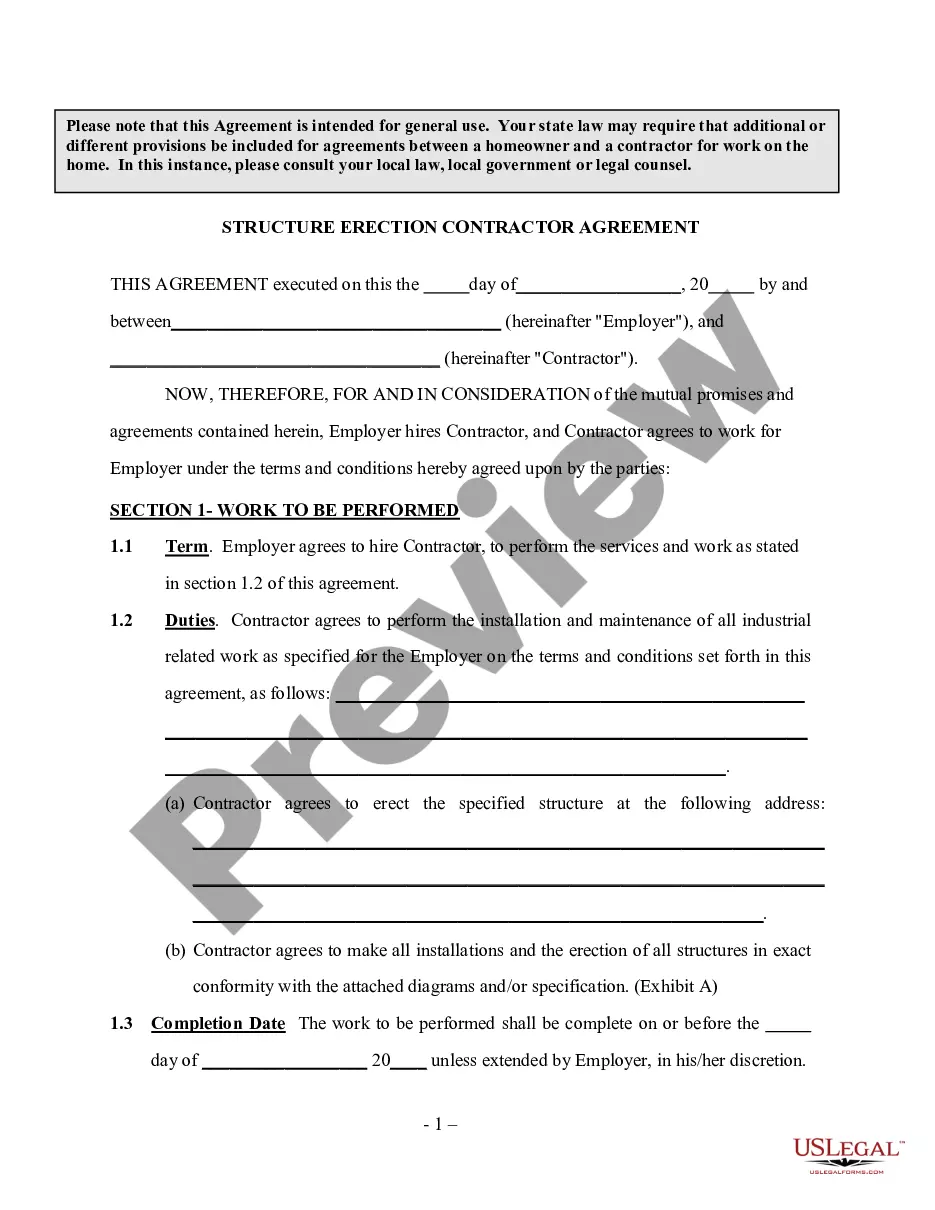
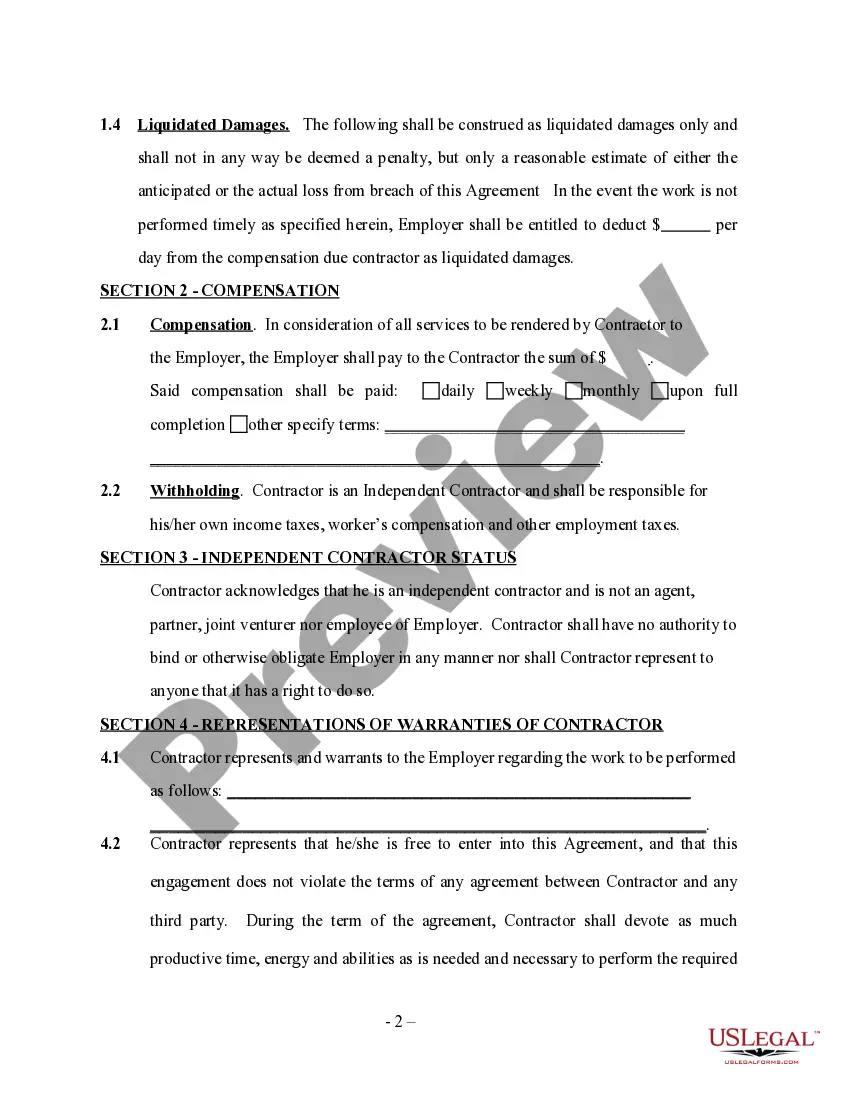
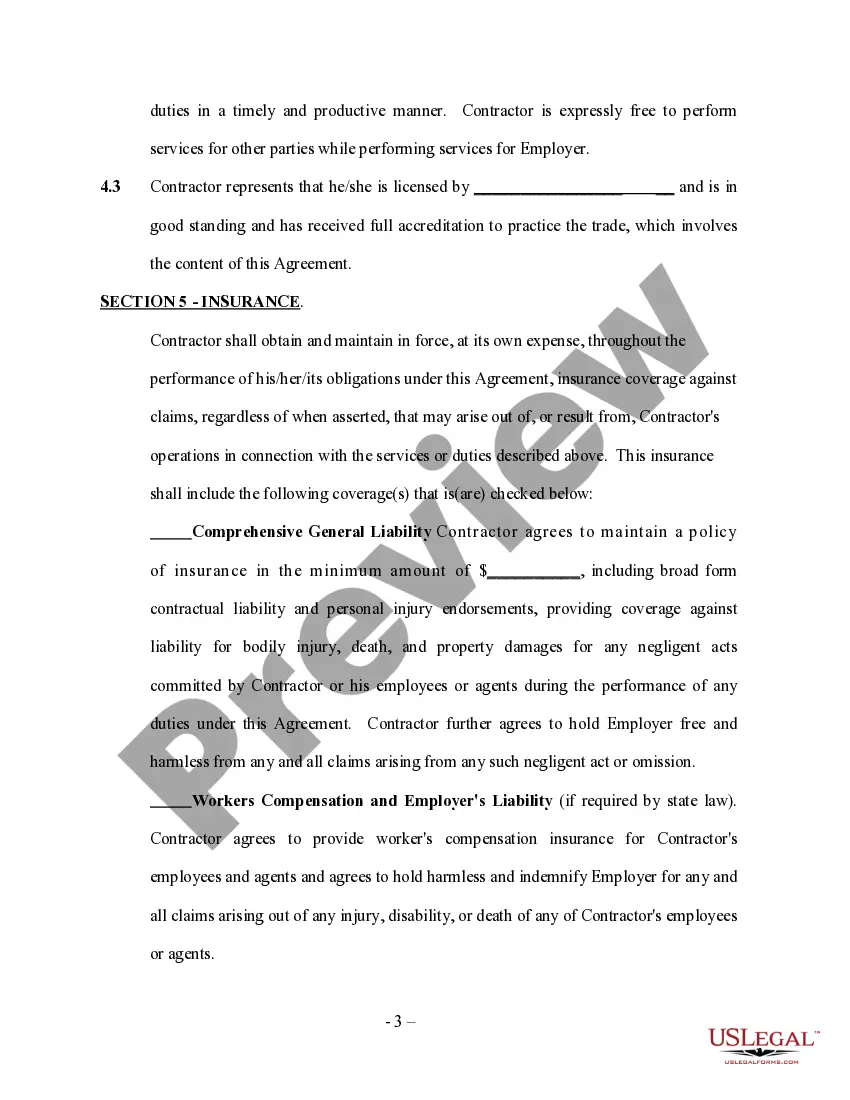
Employer contracts with an independent contractor to erect an edifice as specified and agreed upon in the contract. Please note that this Agreement is intended for general use. Your state law may require that additional or different provisions be included for agreements between a homeowner and a contractor for work on the home. In this instance, please consult your local law, local government or legal counsel.
Maine Structure Erection Contractor Agreement - Self-Employed
State:
Multi-State
Control #:
US-INDC-111
Format:
Word;
Rich Text
Instant download
Description
Free preview
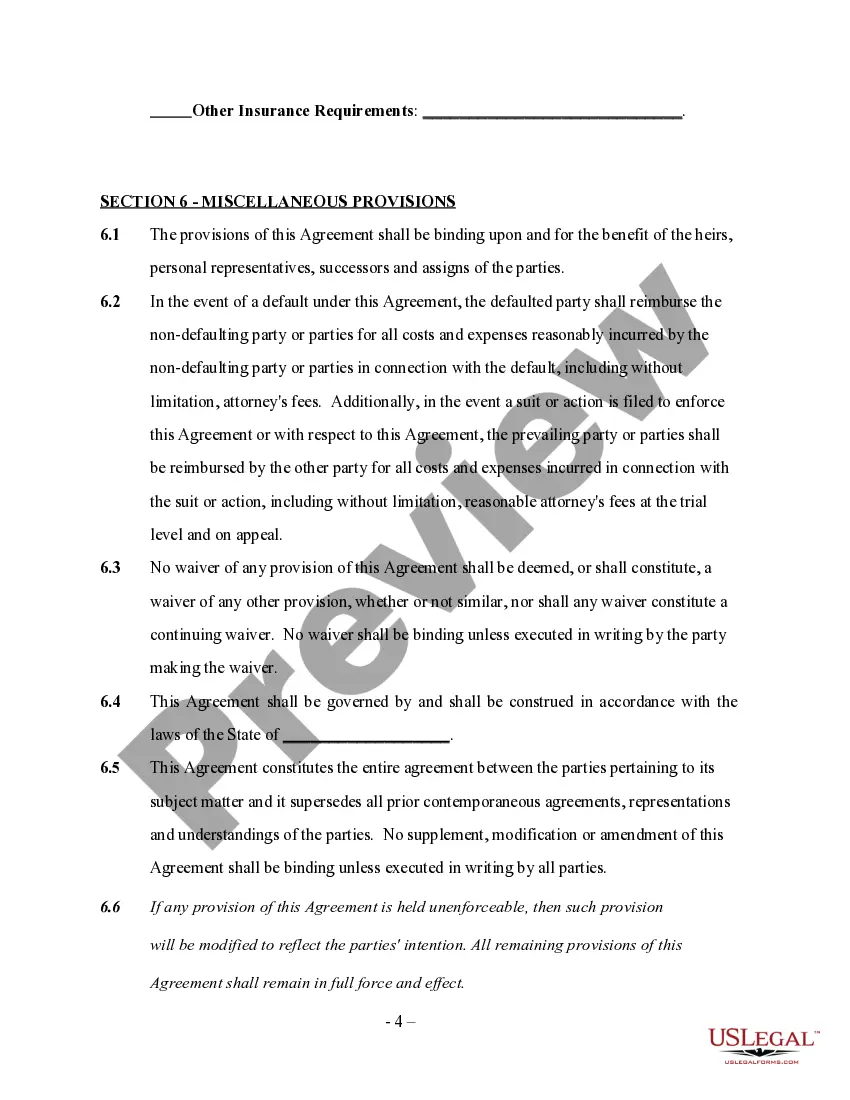
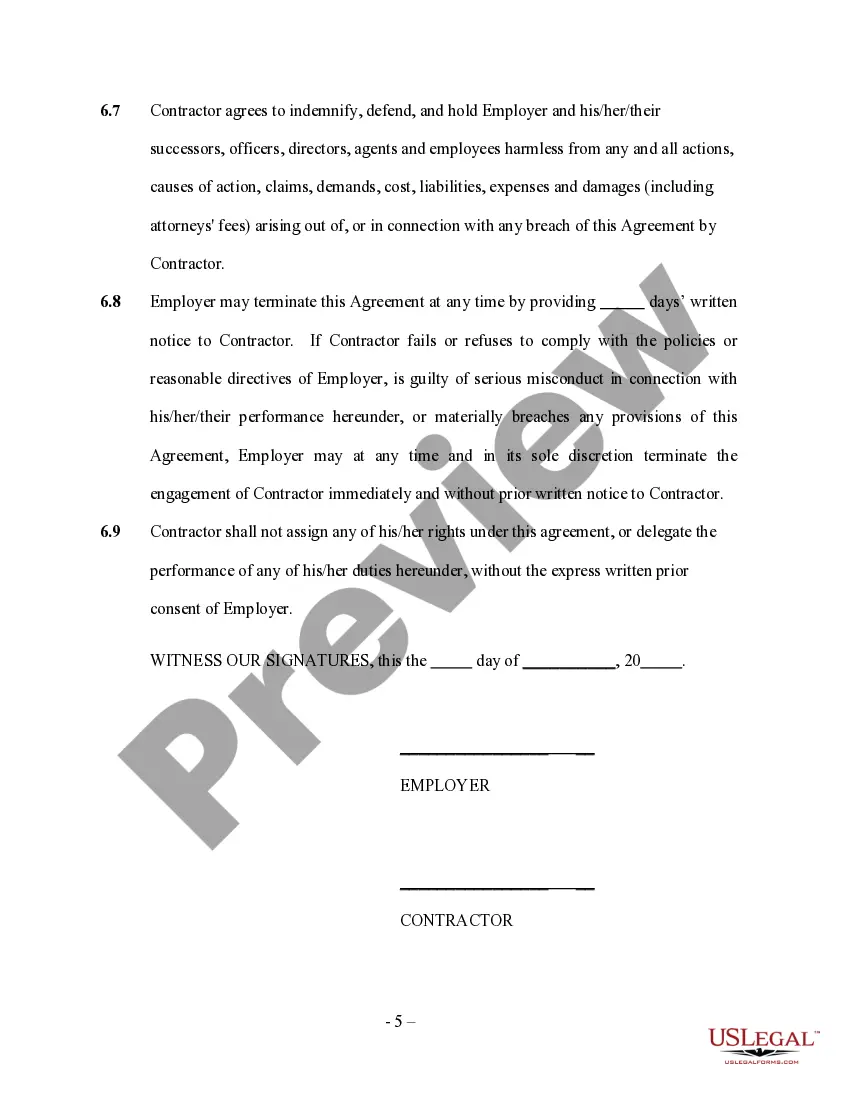
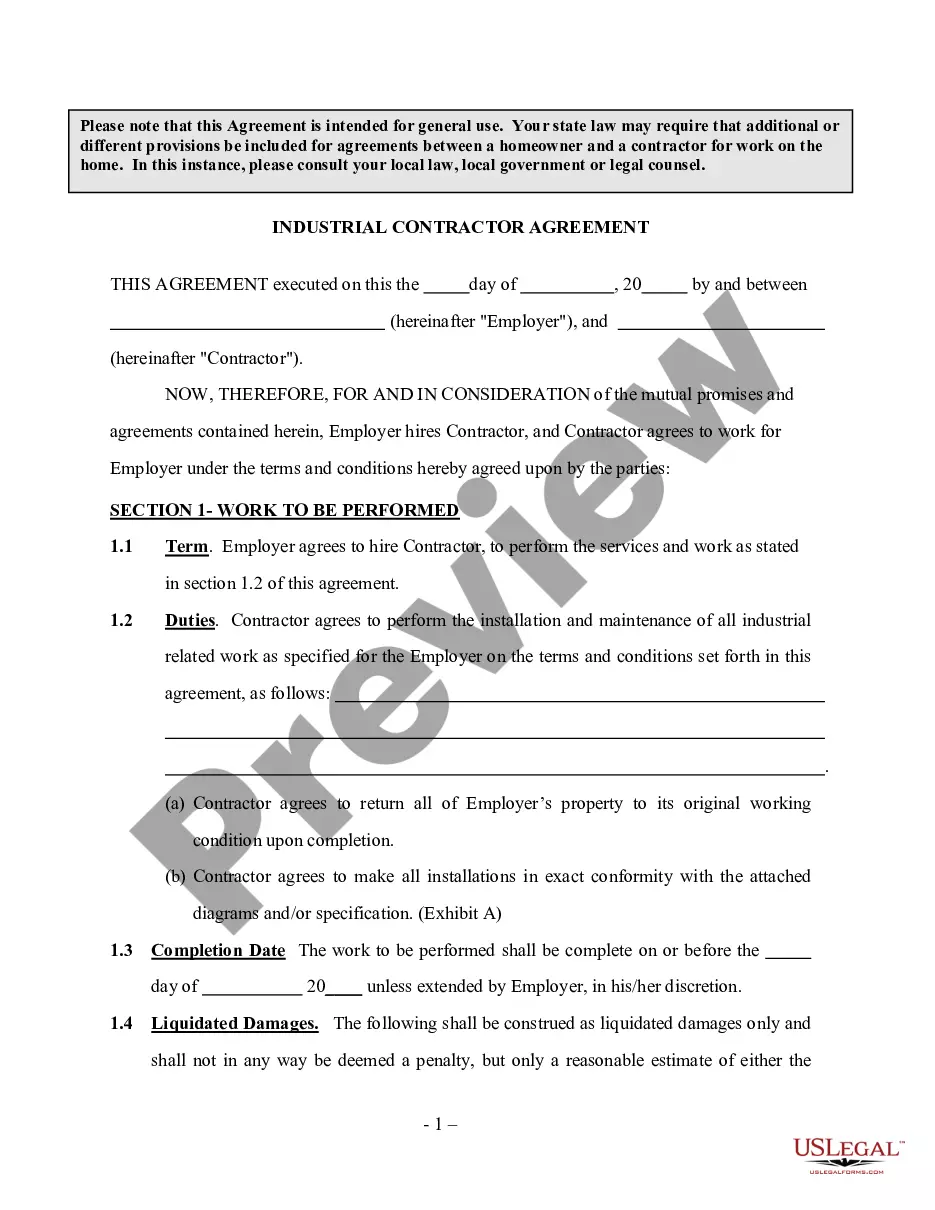
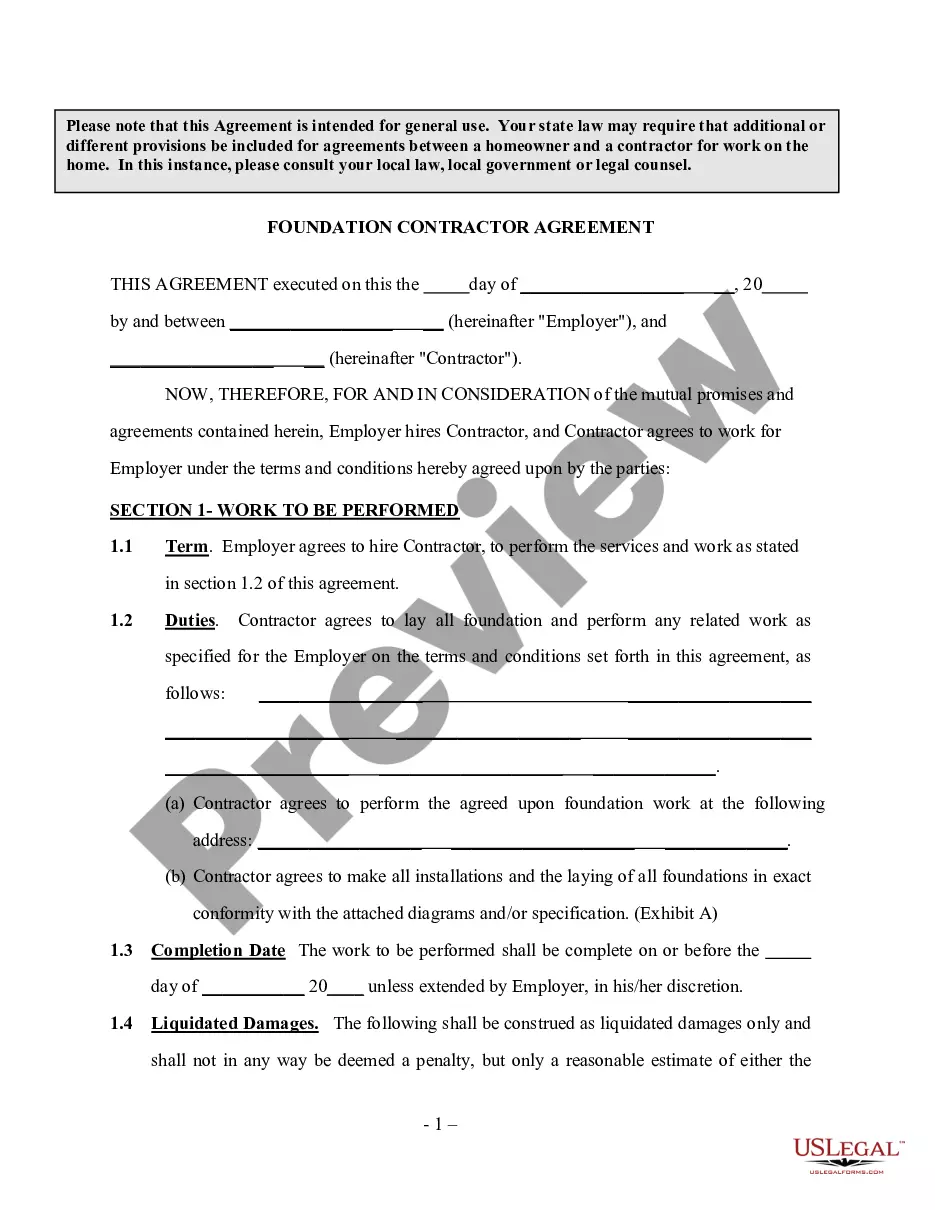
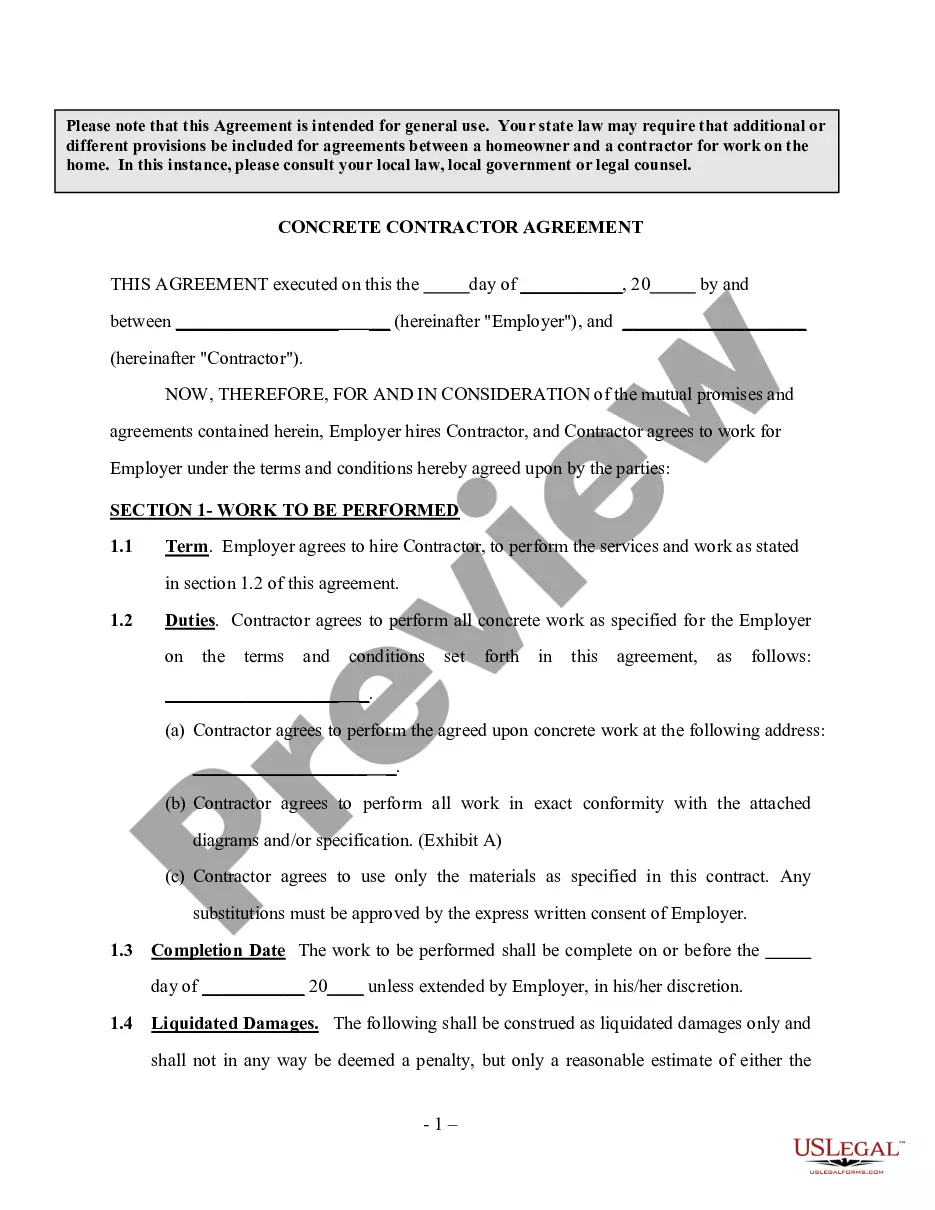
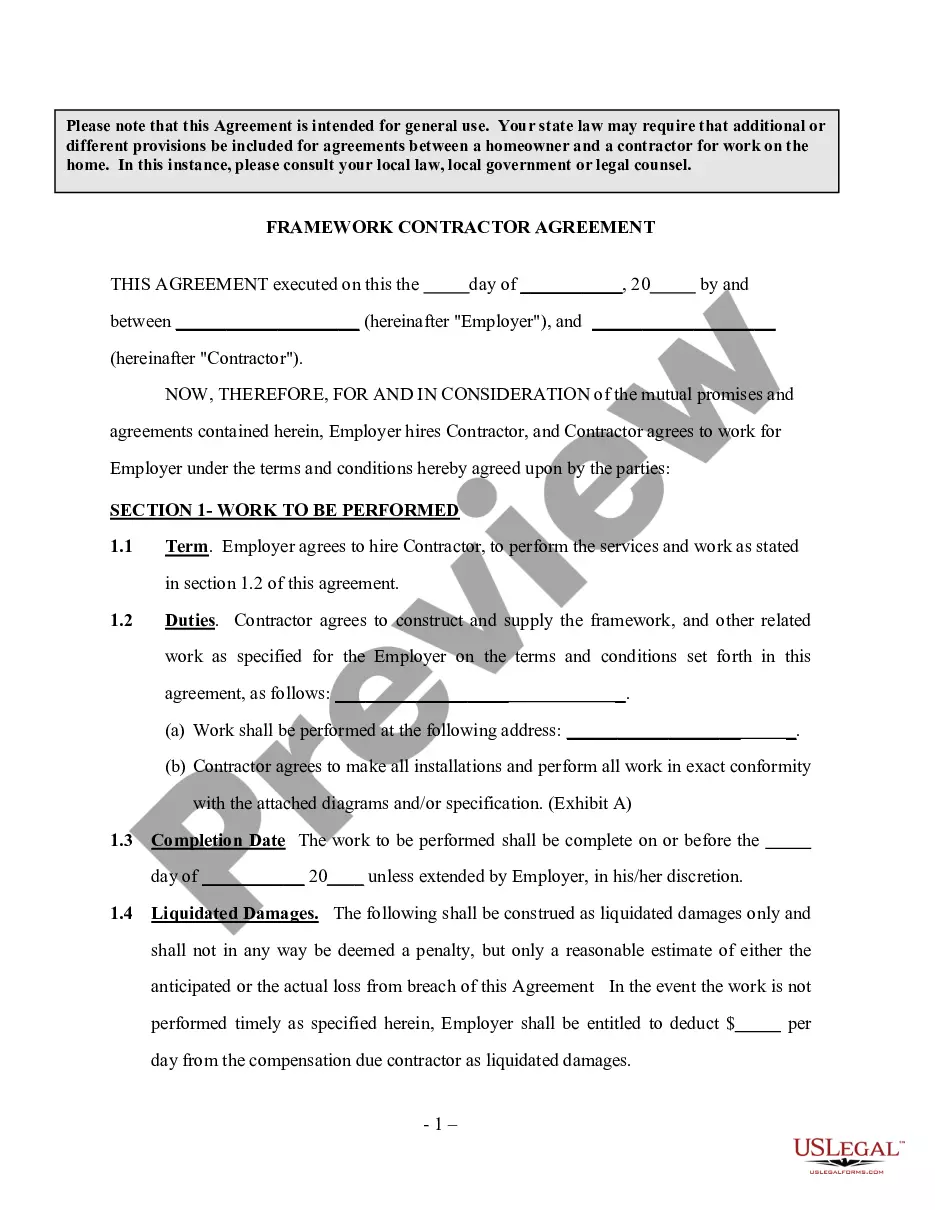

How to fill out Structure Erection Contractor Agreement - Self-Employed?
If you need to aggregate, obtain, or produce valid document templates, utilize US Legal Forms, the largest repository of official forms, accessible online. Leverage the website's straightforward and convenient search function to locate the documents you require. Numerous templates for corporate and personal applications are organized by categories and states, or keywords. Use US Legal Forms to find the Maine Structure Erection Contractor Agreement - Self-Employed with just a few clicks.
If you are already a US Legal Forms customer, Log In to your account and click on the Download option to retrieve the Maine Structure Erection Contractor Agreement - Self-Employed. You can also access forms you previously downloaded in the My documents tab of your account.
If you are using US Legal Forms for the first time, follow the steps below: Step 1. Ensure you have selected the form for the correct city/state. Step 2. Utilize the Review feature to browse through the form’s contents. Do not forget to read the details. Step 3. If you are dissatisfied with the form, take advantage of the Search area at the top of the screen to find alternative versions in the legal form category. Step 4. Once you have identified the form you need, click on the Purchase now button. Choose the payment plan you prefer and enter your credentials to register for an account. Step 5. Complete the transaction. You can use your Visa or Mastercard or PayPal account to finalize the payment. Step 6. Select the format of the legal document and download it onto your device. Step 7. Complete, modify, and print or sign the Maine Structure Erection Contractor Agreement - Self-Employed.
- Each legal document template you purchase is yours permanently.
- You will have access to every form you downloaded within your account.
- Click on the My documents section and select a form to print or download again.
- Compete and download, and print the Maine Structure Erection Contractor Agreement - Self-Employed with US Legal Forms.
- There are numerous professional and state-specific forms you can utilize for your business or personal requirements.
Form popularity
FAQ
The basic independent contractor agreement outlines the relationship between a contractor and a client, detailing the services provided and expectations. In the context of a Maine Structure Erection Contractor Agreement - Self-Employed, it specifies key terms such as compensation, deadlines, and responsibilities. This document serves to protect both parties while ensuring clarity and professionalism in the working relationship. Utilizing resources like US Legal Forms can help you create a compliant and effective agreement.
Filling out a Maine Structure Erection Contractor Agreement - Self-Employed begins with gathering essential information about both parties involved, such as names, addresses, and contact details. Next, clearly define the scope of work, payment terms, and timeline expectations. It is crucial to review the document for any legal requirements specific to Maine. For added convenience, consider using platforms like US Legal Forms to access templates that streamline the process.
In Maine, an operating agreement for an LLC is not legally required, but it is highly recommended. This document outlines the management structure and operational procedures of your business, which is particularly useful if you have multiple members. It can help prevent future disputes and clarify each member's responsibilities. To streamline your process, consider utilizing the Maine Structure Erection Contractor Agreement - Self-Employed available through uslegalforms, which can serve as a valuable resource in drafting an effective operating agreement.
A contractor agreement should include details such as the scope of work, payment terms, start and completion dates, and responsibilities of each party. Additionally, clauses addressing confidentiality, dispute resolution, and any warranties or guarantees add clarity. Ensuring these elements are included in a Maine Structure Erection Contractor Agreement - Self-Employed minimizes potential conflicts and provides a solid foundation for the working relationship.
A construction contract in Maine must clearly outline the scope of work, payment schedule, and timeline. Specific terms about permits, warranties, and liabilities are also essential. Both parties should sign and date the document to ensure mutual agreement. It is beneficial to use a Maine Structure Erection Contractor Agreement - Self-Employed to ensure compliance with local regulations.
To structure an independent contractor agreement effectively, start with an introduction that identifies both parties and states the project’s purpose. Follow this with sections detailing services to be provided, payment specifics, timelines, and rights regarding intellectual property. Include provisions for dispute resolution and termination to protect all involved. Remember, a clear structure in the Maine Structure Erection Contractor Agreement - Self-Employed leads to better project outcomes.
Writing an independent contractor agreement involves outlining the scope of work, payment terms, and deadlines. Ensure to include clauses on confidentiality, dispute resolution, and termination terms. Using a template, like those available on uslegalforms, can simplify the process and ensure you don’t miss important legal aspects. This effort ultimately protects both you and your client.
To set up as a self-employed contractor, start by determining your business structure and registering it if necessary. Next, obtain any required permits or licenses specific to your industry and location in Maine. Create a detailed business plan, focusing on your services and target market. Finally, consider using a Maine Structure Erection Contractor Agreement - Self-Employed to formalize contracts with your clients.
Typically, the hiring party writes the independent contractor agreement, but the contractor can also contribute in drafting it. A well-crafted Maine Structure Erection Contractor Agreement - Self-Employed should reflect the needs and expectations of both parties. When both parties participate, it fosters a collaborative approach and leads to a mutual understanding. Utilizing platforms like uslegalforms can streamline this process.
The best business structure for an independent contractor often depends on individual needs, but many choose a sole proprietorship or an LLC. These structures offer flexibility and simplicity in operations. With a sole proprietorship, you retain complete control, while an LLC provides personal liability protection. Consider your financial situation and tax implications when deciding which structure suits you best.