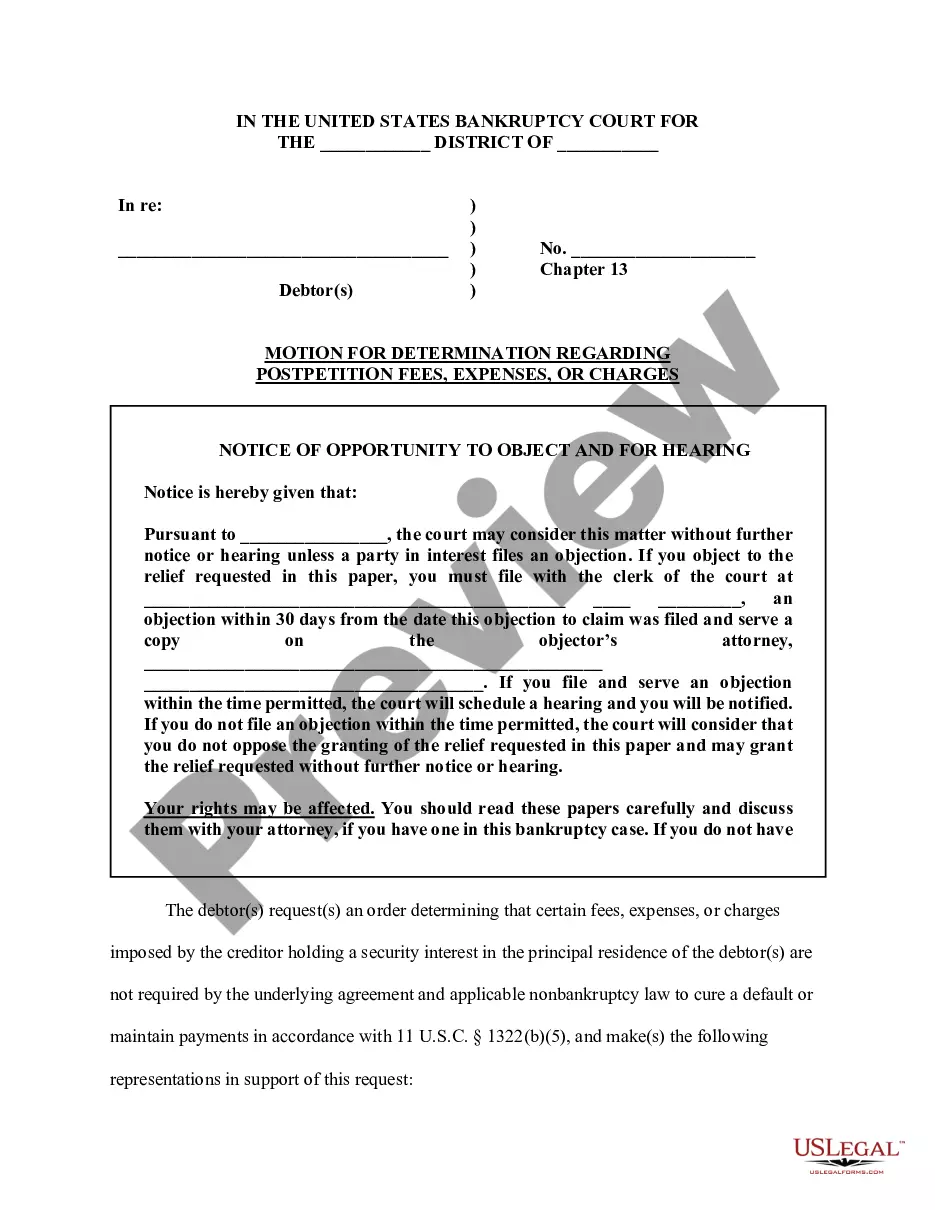
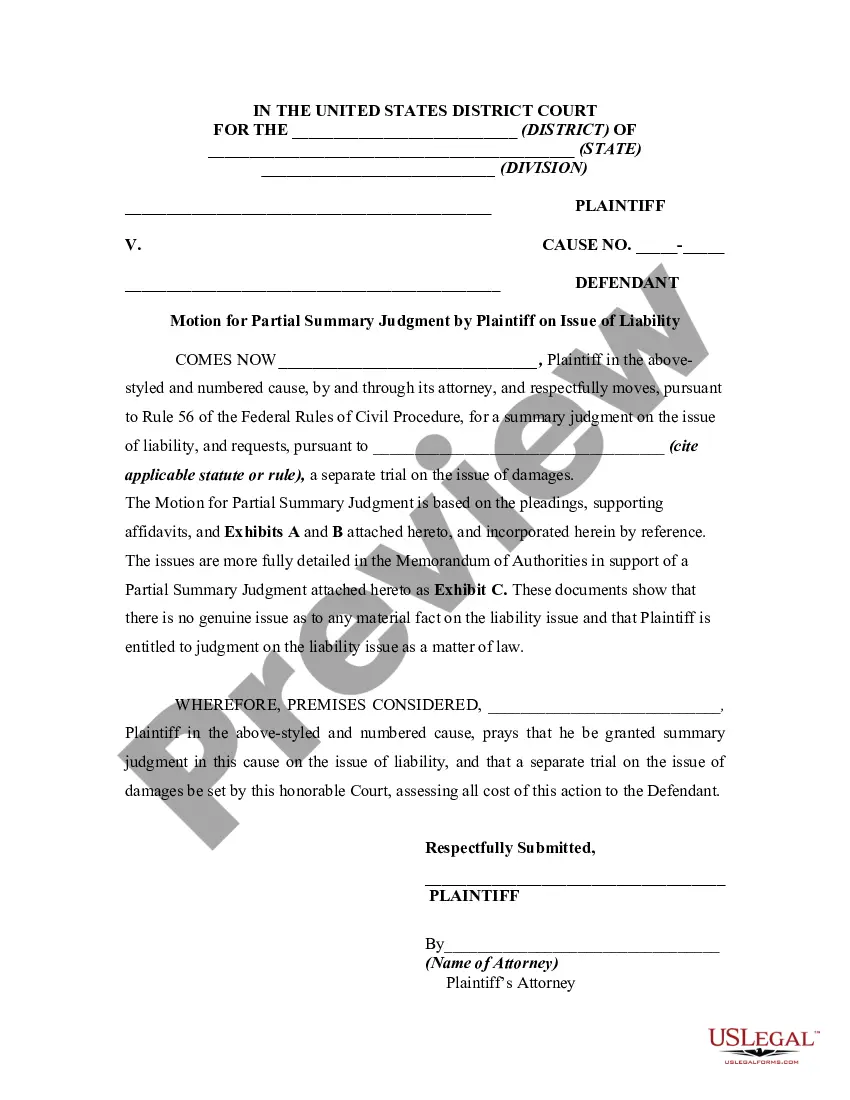
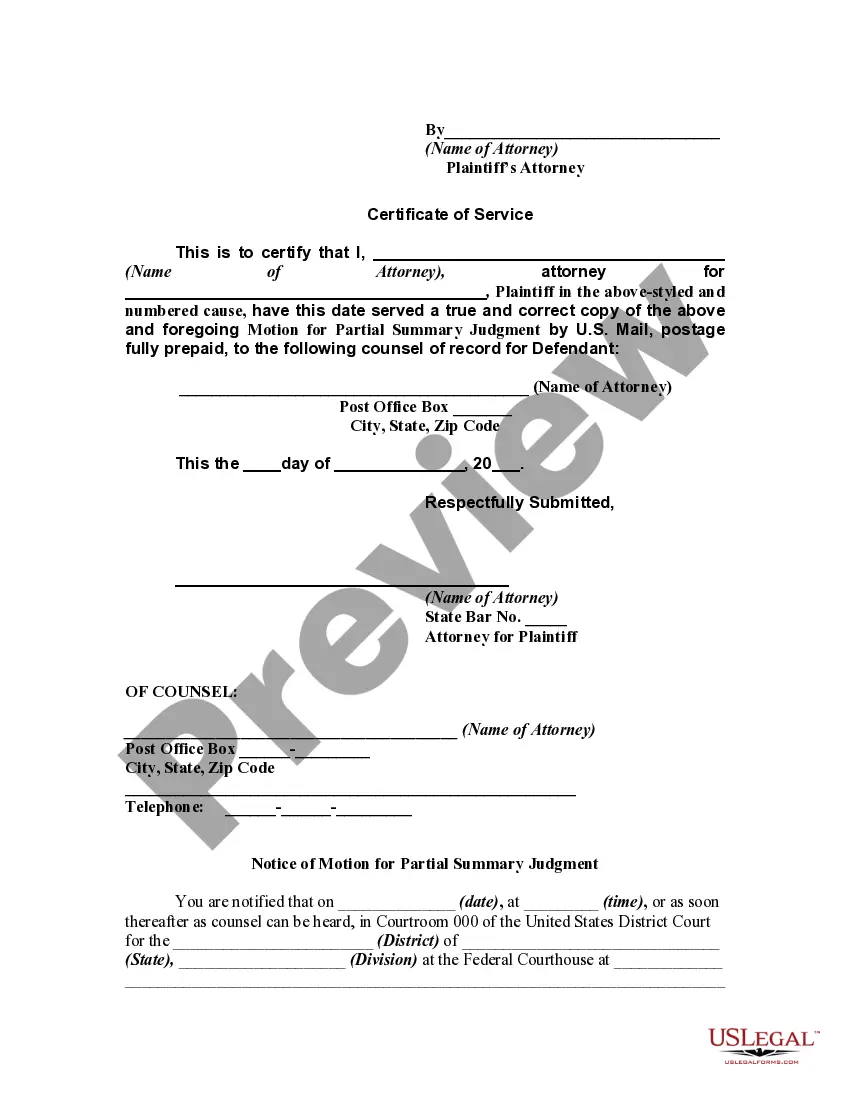
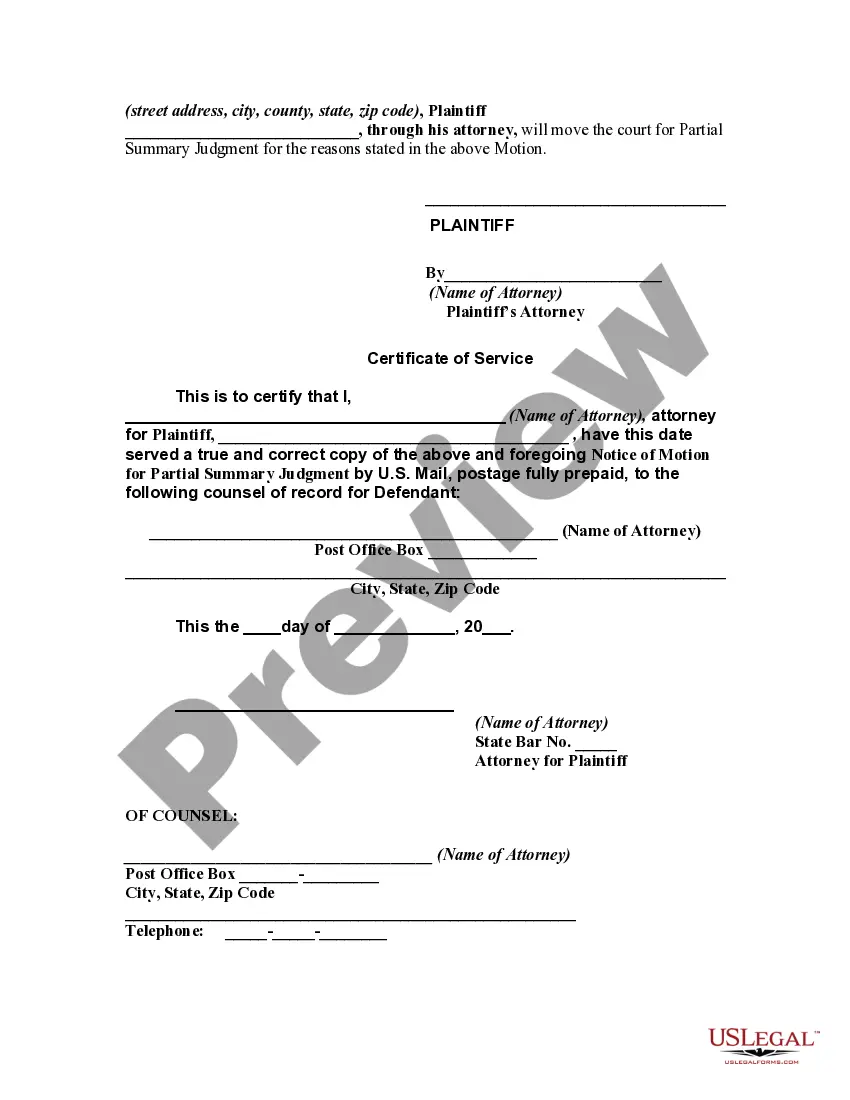
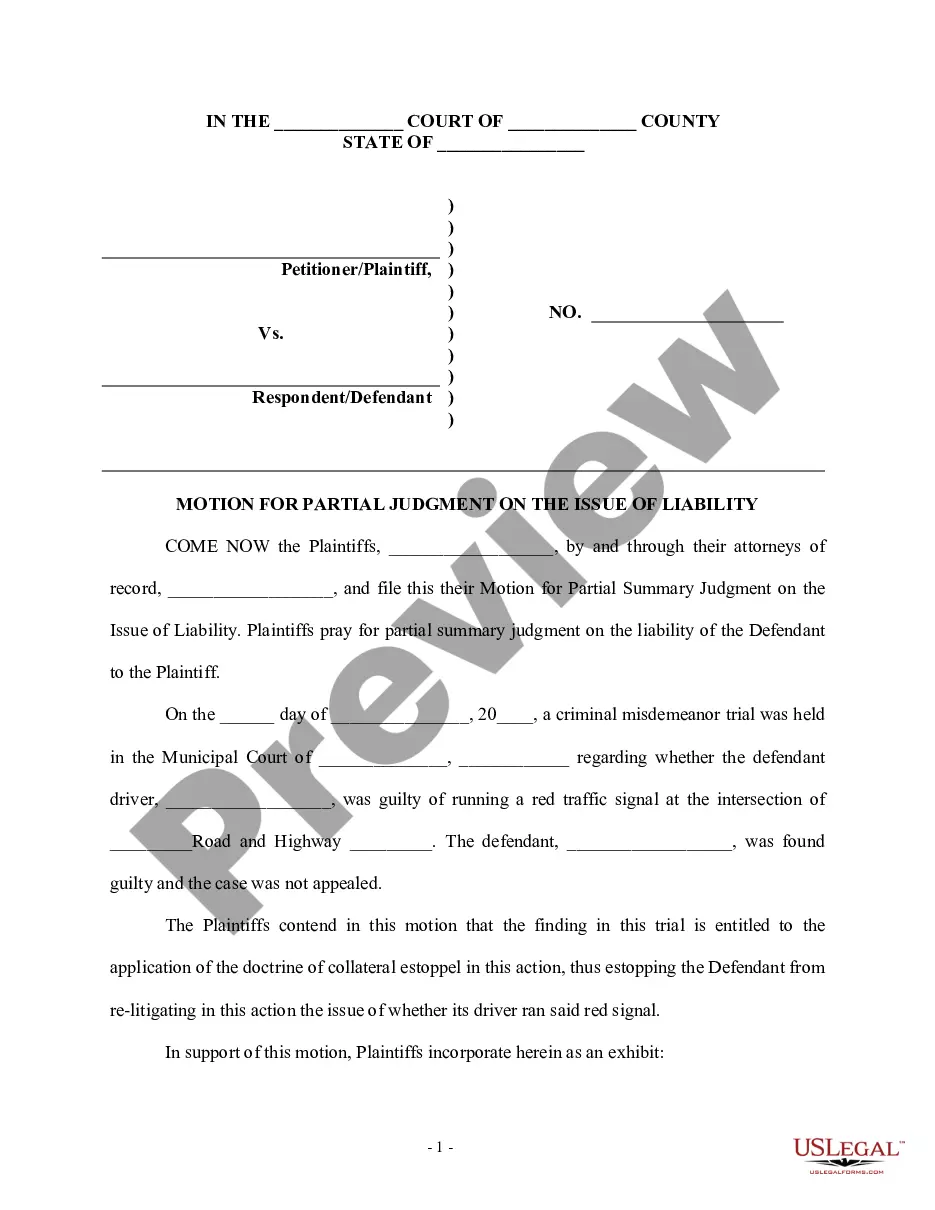
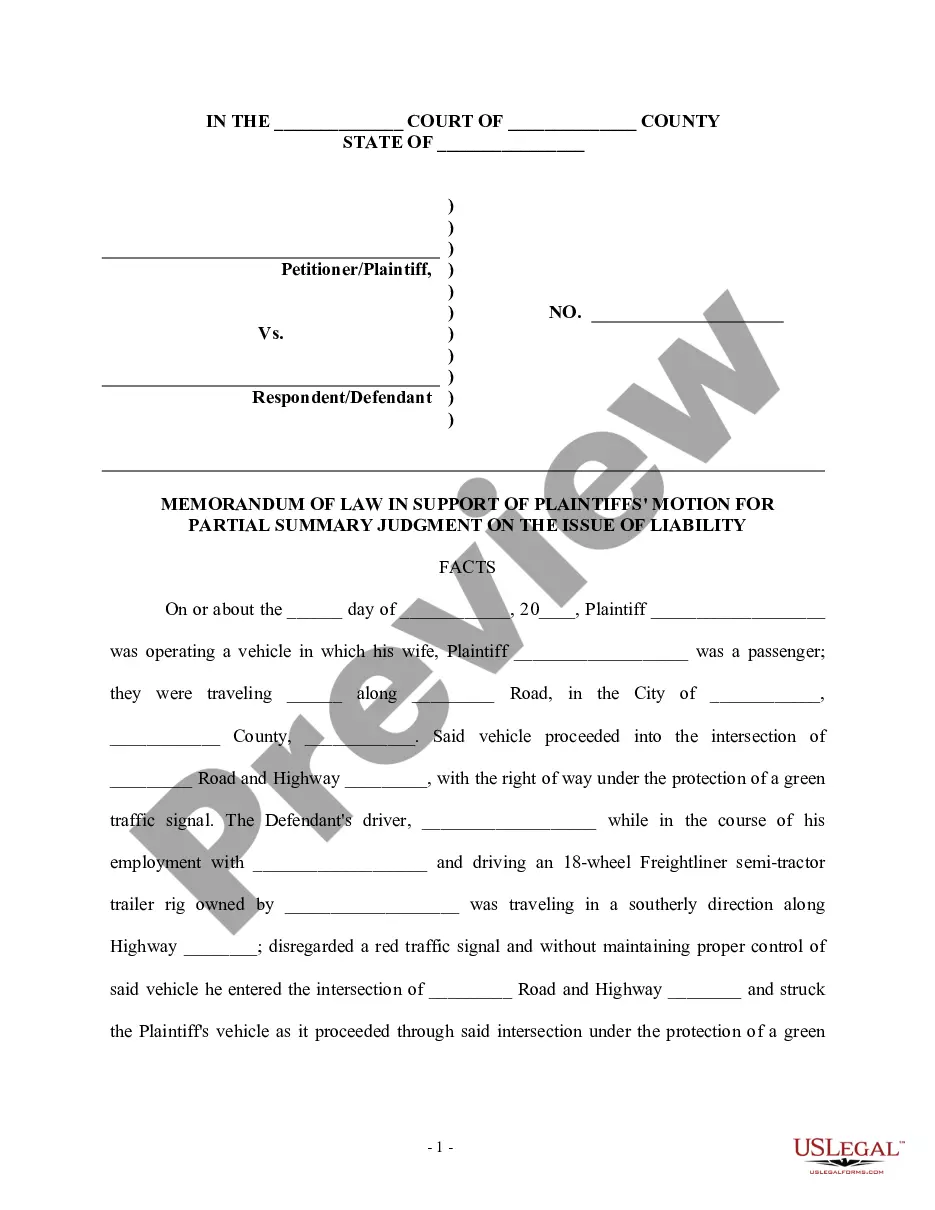
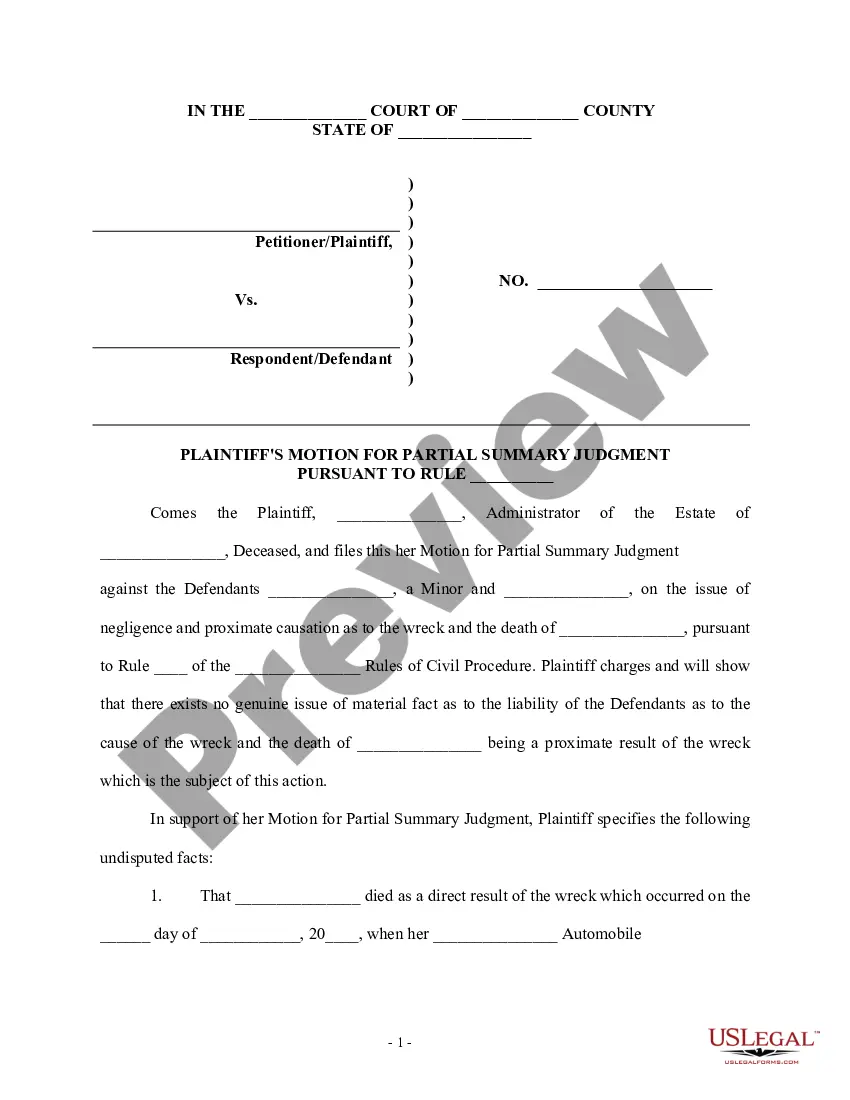
This form is a generic motion for partial summary judgment on the issue of liability. The motion adopts the "notice pleadings" format of the Federal Rules of Civil Procedure, which have been adopted by most states in one form or another.
Maine General Form of Partial Motion for Summary Judgment by Plaintiff on Issue of Liability with Notice of Motion and with Request for Separate Trial on Issue of Damages
Category:
State:
Multi-State
Control #:
US-00918BG
Format:
Word;
Rich Text
Instant download
Description
Free preview

How to fill out General Form Of Partial Motion For Summary Judgment By Plaintiff On Issue Of Liability With Notice Of Motion And With Request For Separate Trial On Issue Of Damages?
You can invest time online searching for the legal document template that meets the state and federal criteria you require.
US Legal Forms provides a vast collection of legal forms that are reviewed by professionals.
You can easily download or print the Maine General Form of Partial Motion for Summary Judgment by Plaintiff on Issue of Liability with Notice of Motion and with Request for Separate Trial on Issue of Damages from my service.
If available, use the Review button to browse through the document template as well. If you want to find another version of the form, utilize the Search field to locate the template that suits your needs and requirements. Once you have found the template you desire, click Acquire now to proceed. Select the pricing plan you prefer, enter your details, and register for an account on US Legal Forms. Complete the transaction. You can use your credit card or PayPal account to purchase the legal form. Choose the format of the document and download it to your device. Make modifications to your document if possible. You can complete, edit, sign, and print the Maine General Form of Partial Motion for Summary Judgment by Plaintiff on Issue of Liability with Notice of Motion and with Request for Separate Trial on Issue of Damages. Obtain and print a vast array of document templates using the US Legal Forms website, which offers the largest selection of legal forms. Utilize professional and state-specific templates to address your business or personal needs.
- If you possess a US Legal Forms account, you may Log In and click on the Obtain button.
- After that, you can complete, modify, print, or sign the Maine General Form of Partial Motion for Summary Judgment by Plaintiff on Issue of Liability with Notice of Motion and with Request for Separate Trial on Issue of Damages.
- Each legal document template you acquire is yours indefinitely.
- To obtain an extra copy of the acquired form, visit the My documents section and click the corresponding button.
- If you are using the US Legal Forms website for the first time, follow the simple instructions provided below.
- First, ensure that you have selected the correct document template for the state/city you choose.
- Check the form details to ensure you have chosen the accurate template.
Form popularity
FAQ
The chance of success in these cases is less than 10% [1]. Another study found that summary judgment is mostly granted in Title VII cases, for example, cases involving equal pay or employment discrimination [2]. When it comes to federal cases, summary judgments are filed in 17% of total cases.
Rule 80B(m) is amended to clarify that an order of remand from the Superior Court to the governmental agency is not a final judgment from which an appeal lies, absent special circumstances. The amendment is not intended to change the law governing final judgments, moot issues or the preservation of issues for appeal.
What Is a Partial Summary Judgement? In some cases, the court may grant a motion for partial summary judgment. The purpose of partial summary judgment is to simplify a trial by ruling on some claims, but not all. For example, the court might rule on some factual issues but leave others for trial.
No deposition shall be taken before a person who is a relative or employee or attorney or counsel of any of the parties, or is a relative or employee of such attorney or counsel, or is financially interested in the action.
A motion for summary judgment shall be supported by a separate, short, and concise statement of material facts, set forth in numbered paragraphs, as to which the moving party contends there is no genuine issue of material fact to be tried.
No judgment by default shall be entered upon a claim based on a negotiable instrument or other negotiable obligation unless an original or copy of the instrument or obligation is filed with the clerk or unless the court for cause shown shall otherwise direct on such terms as it may fix.
If an application is made to produce the information under Rule 26(g), the party resisting discovery bears the initial burden to show the court that the information is not, in fact, "reasonably accessible because of undue burden or expense." The requesting party must then show "good cause" why the information should be ...
What Is a Summary Judgment Motion? A motion for summary judgment is when a litigant in a case, either the plaintiff or the defendant, asks the court to end the case without holding a trial.