Maryland Codicil to Will Form for Amending Your Will - Will Changes or Amendments
What this document covers
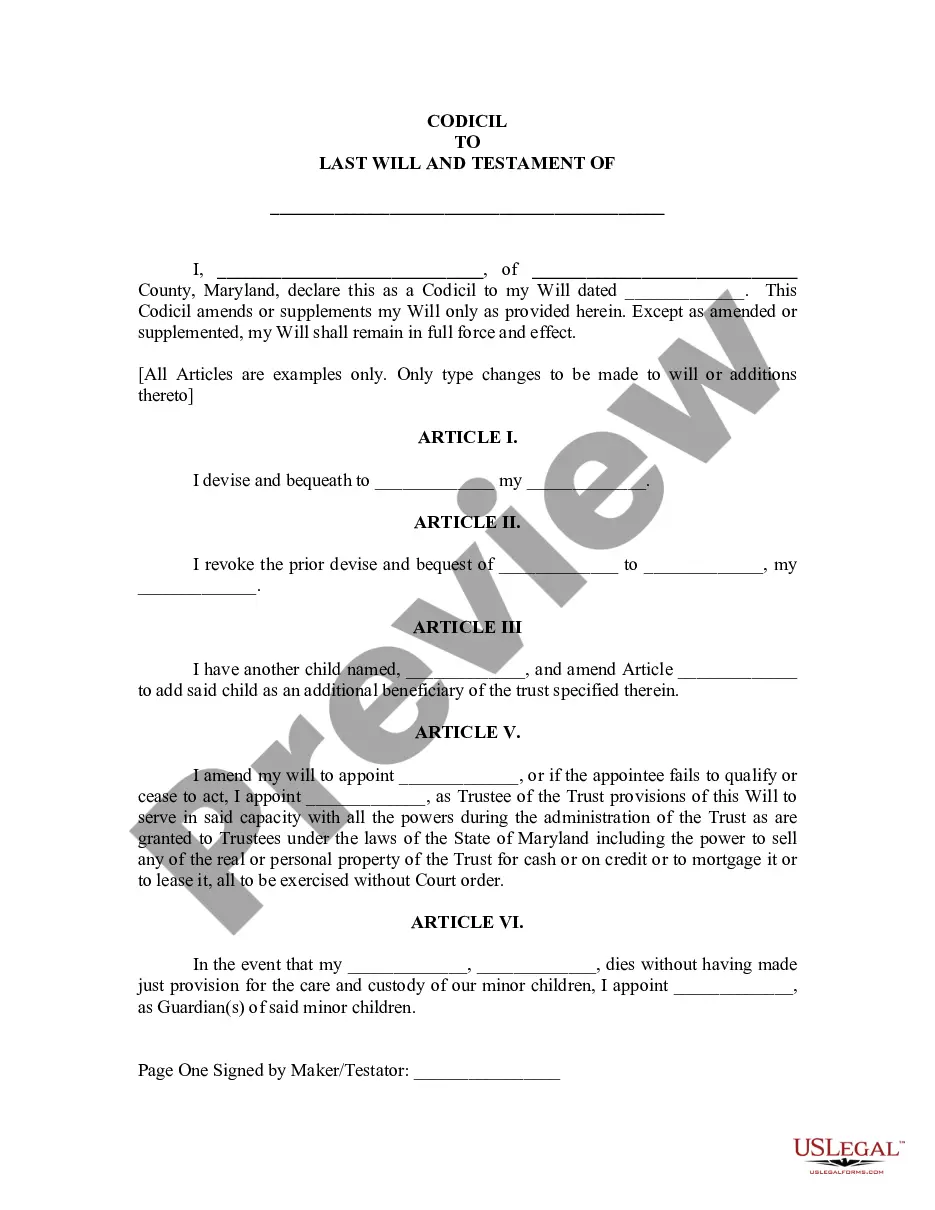
This Codicil to Will form allows you to amend your existing will without creating an entirely new document. By using this form, you can maintain the validity of your former will while making specific changes as needed. This codicil contains provisions that specify which parts of your original will remain intact and includes the necessary state requirements for execution and attestation. It acts as a streamlined approach for individuals who need to update their Last Will and Testament due to life changes or new decisions about their estate.
Key parts of this document
- Declaration of the codicil's relation to the original Will.
- Specific articles for adding or revoking beneficiaries.
- Appointment of guardians for minor children, if applicable.
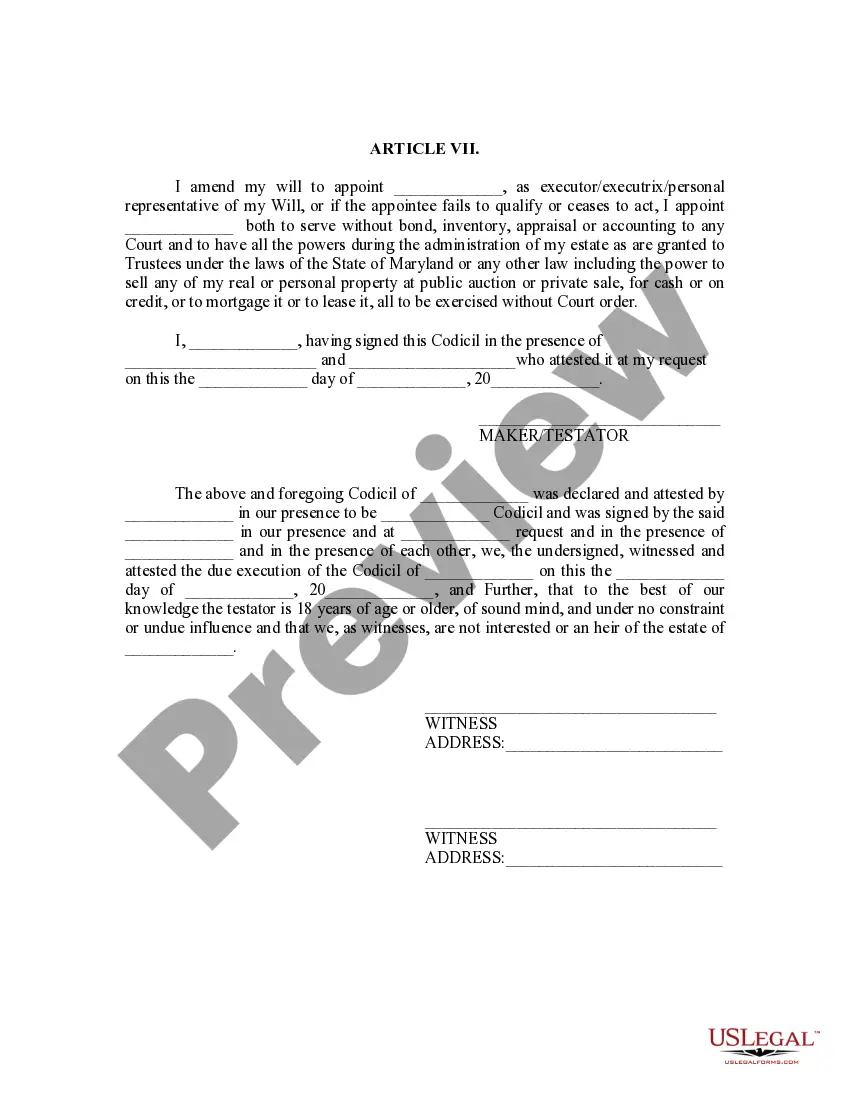
- Designation of an executor or personal representative of the estate.
- Execution and attestation clauses to meet legal requirements.

When to use this document
You may need a Codicil to Will form in various situations, including when you wish to:
- Add or remove beneficiaries from your will.
- Change your choice of executor or trustee for your estate.
- Update guardianship arrangements for minor children.
- Make changes in property distributions due to changing circumstances.
Intended users of this form
- Individuals who have an existing last will and testament.
- Those looking to make specific amendments without drafting a new will.
- People managing their estate planning and personal affairs.
- Residents of Maryland or applicable jurisdiction needing a codicil form.
Instructions for completing this form
- Start by filling in the original date of your Last Will and Testament.
- Clearly specify any changes to your beneficiaries or their bequests by using the provided articles.
- Designate any new executors, trustees, or guardians where necessary.
- Ensure that you sign the codicil in the presence of two witnesses, as required by Maryland law.
- Have the witnesses sign to attest to your signing of the codicil.
Notarization requirements for this form
This form does not typically require notarization unless specified by local law. However, having it notarized may provide additional legal assurance and is often recommended as a best practice in estate planning to avoid future disputes.
Get your form ready online
Our built-in tools help you complete, sign, share, and store your documents in one place.
Make edits, fill in missing information, and update formatting in US Legal Forms—just like you would in MS Word.
Download a copy, print it, send it by email, or mail it via USPS—whatever works best for your next step.
Sign and collect signatures with our SignNow integration. Send to multiple recipients, set reminders, and more. Go Premium to unlock E-Sign.
If this form requires notarization, complete it online through a secure video call—no need to meet a notary in person or wait for an appointment.
We protect your documents and personal data by following strict security and privacy standards.

Make edits, fill in missing information, and update formatting in US Legal Forms—just like you would in MS Word.

Download a copy, print it, send it by email, or mail it via USPS—whatever works best for your next step.

Sign and collect signatures with our SignNow integration. Send to multiple recipients, set reminders, and more. Go Premium to unlock E-Sign.

If this form requires notarization, complete it online through a secure video call—no need to meet a notary in person or wait for an appointment.

We protect your documents and personal data by following strict security and privacy standards.
Avoid these common issues
- Failing to properly sign the document in the presence of witnesses.
- Not clarifying which parts of the original will are being amended.
- Exceeding the legal boundaries set by state laws in your amendments.
- Using unclear language that may confuse the intent of the changes.
Why use this form online
- Convenience of completing and downloading the form from your own device.
- Editability to tailor the amendments to your specific needs before printing.
- Access to legally vetted documents drafted by licensed attorneys.
- Time-saving with instant availability and no need for appointments or consultations.
Looking for another form?
Form popularity
FAQ
Holographic wills are wills that have been written entirely in the hand of the testator. Although Maryland does recognize holographic wills, they must comply with Maryland law. Unless holographic wills are written properly, there is a chance the courts may not recognize the document as a valid last will and testament.
Maryland law requires that your will be in writing, signed by the testator (you) and witnessed by two individuals in the testator's presence. This is called "executing a will." When you are ready to execute your will, you should have at least two witnesses, although three is better.
No, in Maryland, you do not need to notarize your will to make it legal. Maryland does allow you to make your will "self-proving," which speeds up probate because the court can accept the will without contacting the witnesses who signed it.
It must be in writing. Generally, of course, wills are composed on a computer and printed out. The person who made it must have signed and dated it. A will must be signed and dated by the person who made it. Two adult witnesses must have signed it. Witnesses are crucial.
Is a holographic (handwritten) Will legal in Maryland ? Yes, if it complies with Maryland Law.
Is a holographic (handwritten) Will legal in Maryland ? Yes, if it complies with Maryland Law.