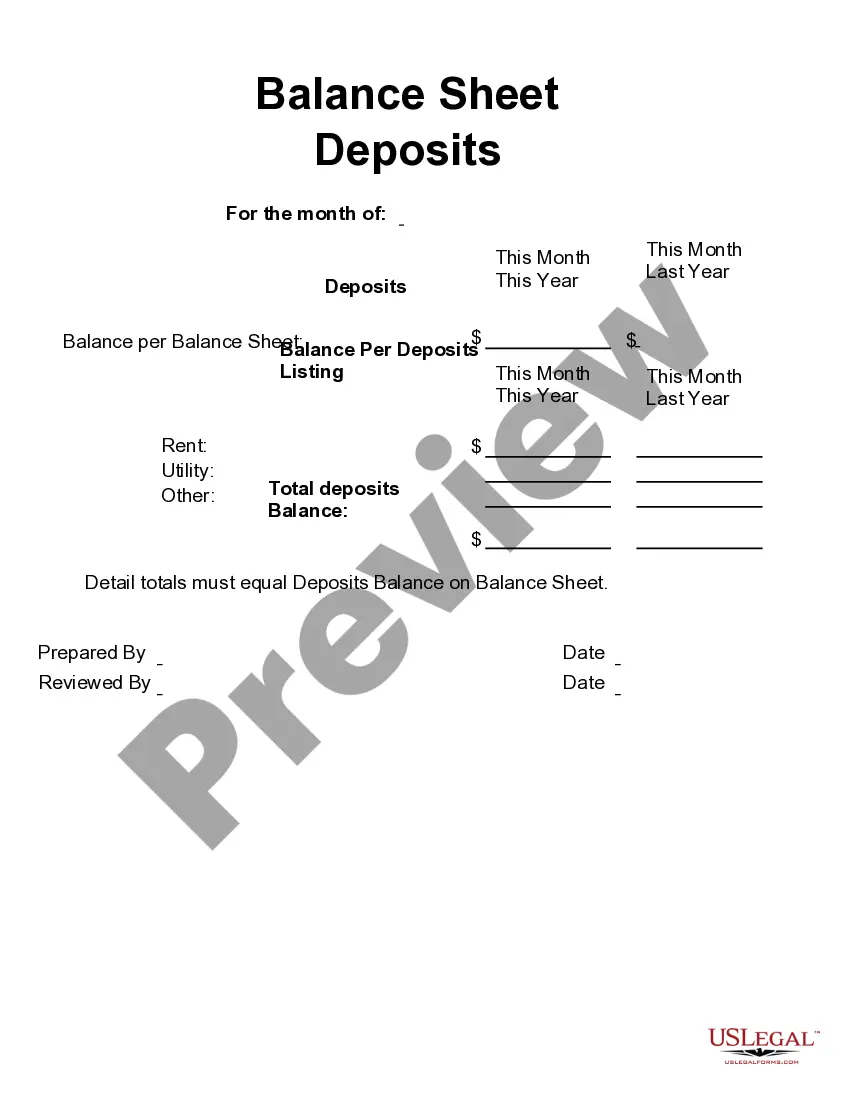
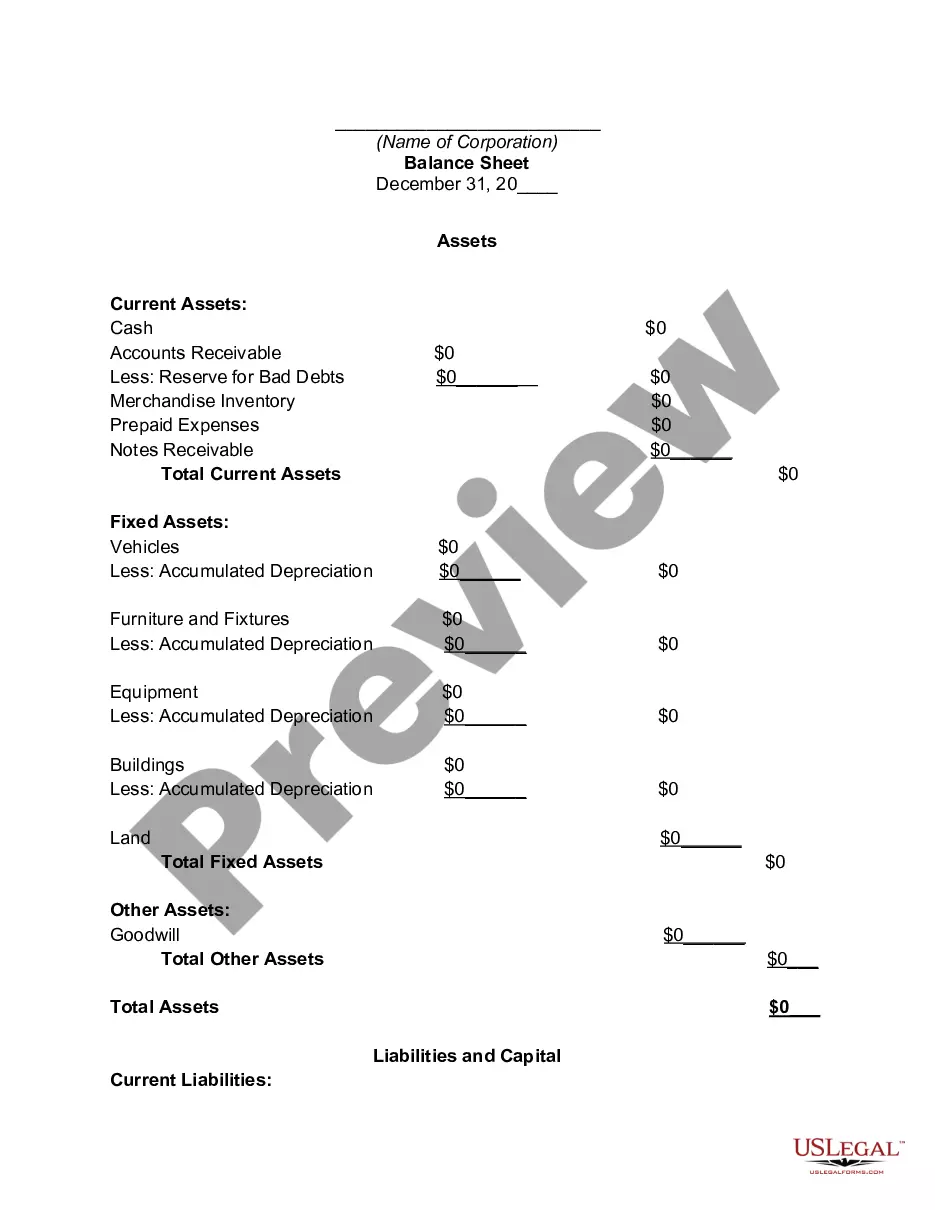
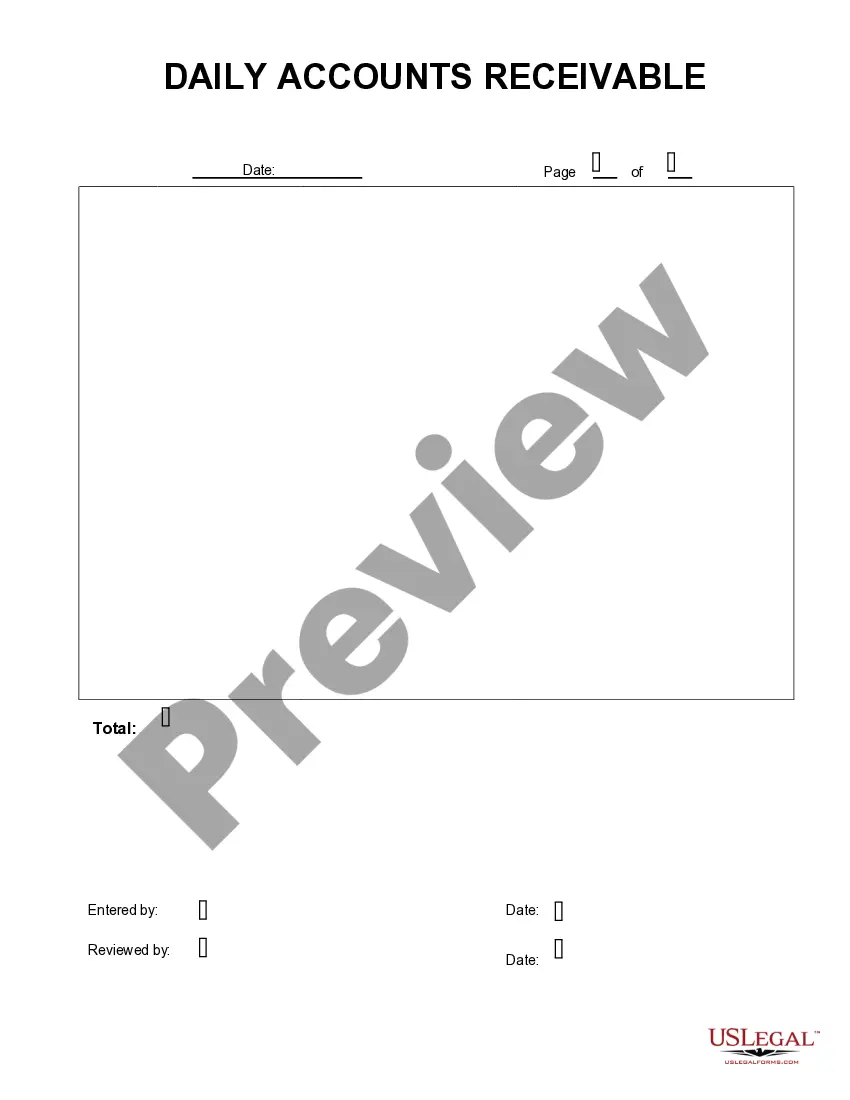
This form is a business type form that is formatted to allow you to complete the form using Adobe Acrobat or Word. The word files have been formatted to allow completion by entry into fields. Some of the forms under this category are rather simple while others are more complex. The formatting is worth the small cost.
Maryland Balance Sheet Deposits
Category:
State:
Multi-State
Control #:
US-122-AZ
Format:
Word;
PDF;
Rich Text
Instant download
Description
Get your form ready online
Our built-in tools help you complete, sign, share, and store your documents in one place.
Built-in online Word editor
Make edits, fill in missing information, and update formatting in US Legal Forms—just like you would in MS Word.
Export easily
Download a copy, print it, send it by email, or mail it via USPS—whatever works best for your next step.
E-sign your document
Sign and collect signatures with our SignNow integration. Send to multiple recipients, set reminders, and more. Go Premium to unlock E-Sign.
Notarize online 24/7
If this form requires notarization, complete it online through a secure video call—no need to meet a notary in person or wait for an appointment.
Store your document securely
We protect your documents and personal data by following strict security and privacy standards.

Make edits, fill in missing information, and update formatting in US Legal Forms—just like you would in MS Word.

Download a copy, print it, send it by email, or mail it via USPS—whatever works best for your next step.

Sign and collect signatures with our SignNow integration. Send to multiple recipients, set reminders, and more. Go Premium to unlock E-Sign.

If this form requires notarization, complete it online through a secure video call—no need to meet a notary in person or wait for an appointment.

We protect your documents and personal data by following strict security and privacy standards.
Looking for another form?





How to fill out Balance Sheet Deposits?
US Legal Forms - one of the largest collections of legal documents in the United States - offers a range of legal form templates that you can download or print.
By utilizing the website, you can discover thousands of forms for both business and personal use, organized by categories, states, or keywords.
You can find the latest versions of forms such as the Maryland Balance Sheet Deposits in mere seconds.
If the form does not meet your requirements, use the Search field at the top of the screen to find the one that does.
If you are satisfied with the form, confirm your selection by clicking the Get now button. Then, choose the pricing plan you prefer and provide your details to register for an account.
- If you already have an account, Log In to access the Maryland Balance Sheet Deposits from your US Legal Forms library.
- The Download button will be available on every form you view.
- You have access to all previously downloaded forms from the My documents section of your account.
- To use US Legal Forms for the first time, here are straightforward tips to help you get started.
- Ensure you have selected the correct form for your city/state.
- Select the
Form popularity
FAQ
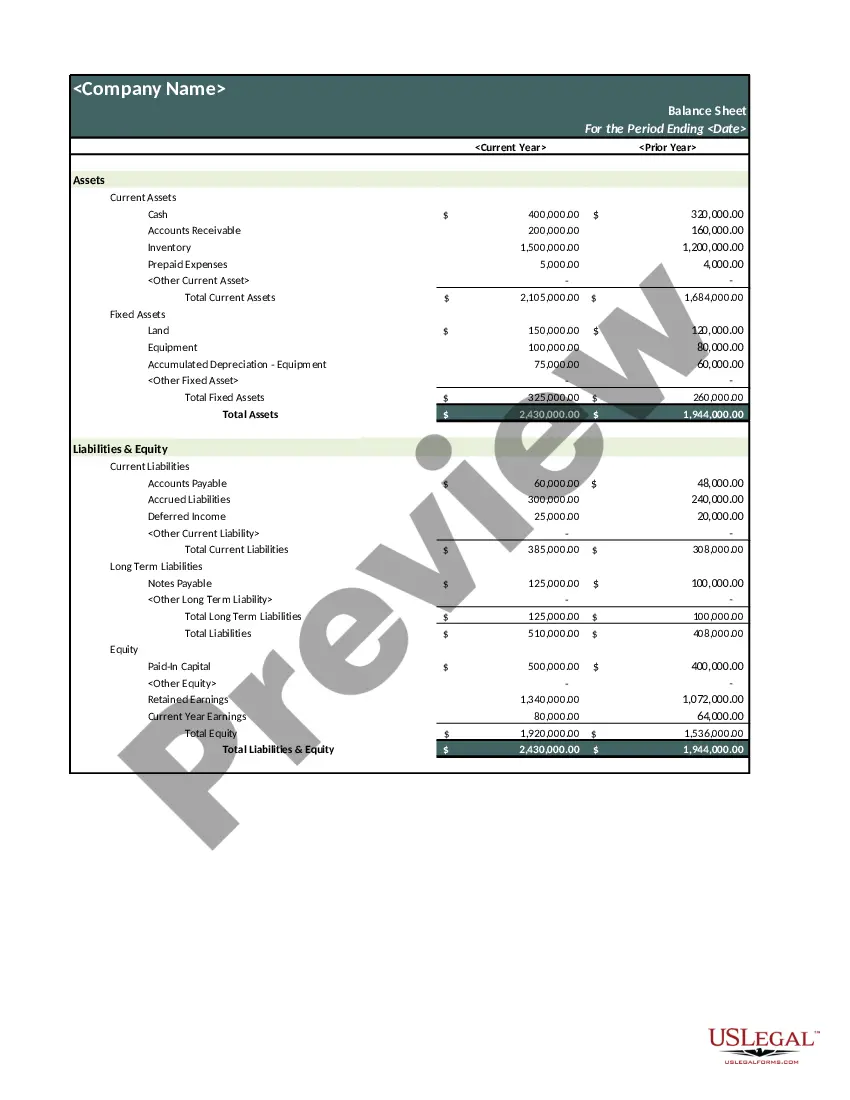
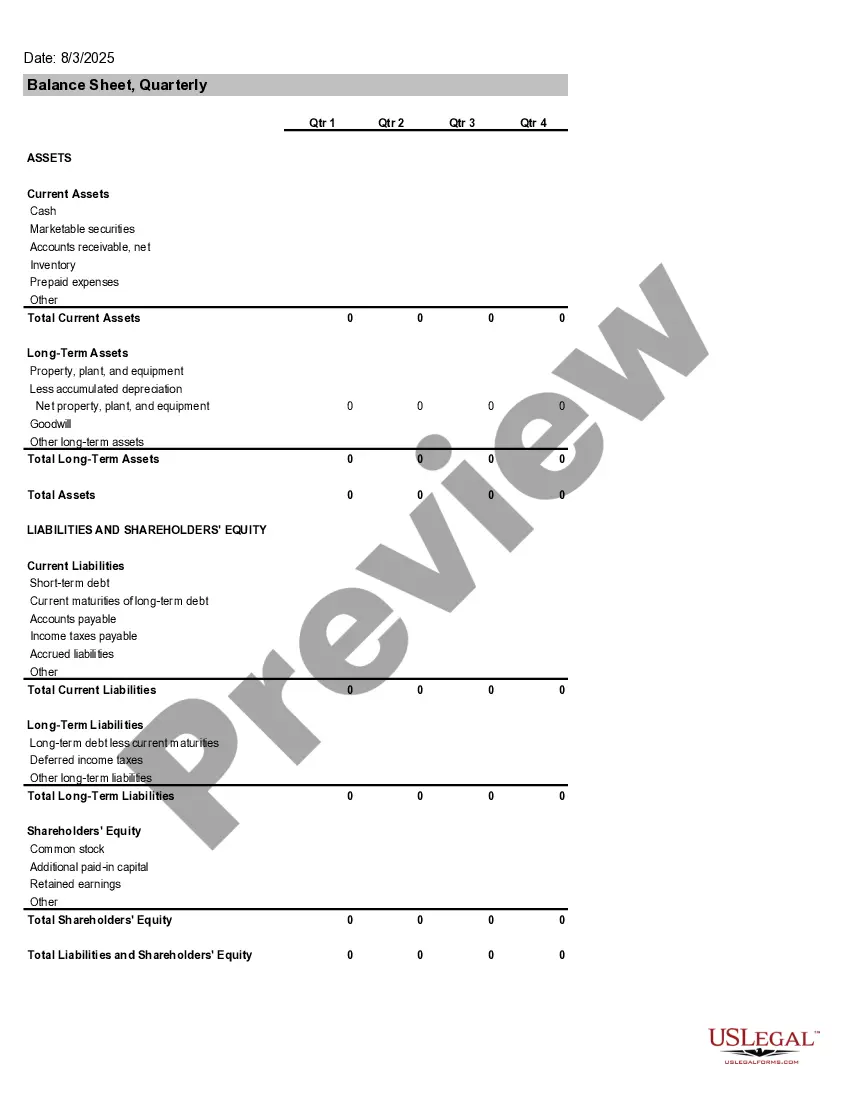
As an overview of the company's financial position, the balance sheet consists of three major sections: (1) the assets, which are probable future economic benefits owned or controlled by the entity; (2) the liabilities, which are probable future sacrifices of economic benefits; and (3) the owners' equity, calculated as
A typical balance sheet starts with a heading which consists of three lines. The first line presents the name of the company; the second describes the title of the report; and the third states the date of the report.
How to Prepare a Basic Balance SheetDetermine the Reporting Date and Period.Identify Your Assets.Identify Your Liabilities.Calculate Shareholders' Equity.Add Total Liabilities to Total Shareholders' Equity and Compare to Assets.10 Sept 2019
How to make a balance sheetStep 1: Pick the balance sheet date.Step 2: List all of your assets.Step 3: Add up all of your assets.Step 4: Determine current liabilities.Step 5: Calculate long-term liabilities.Step 6: Add up liabilities.Step 7: Calculate owner's equity.Step 8: Add up liabilities and owners' equity.
Cash and cash equivalents under the current assets section of a balance sheet represent the amount of money the company has in the bank, whether in the form of cash, savings bonds, certificates of deposit, or money invested in money market funds.
The balance sheet is based on the fundamental equation: Assets = Liabilities + Equity. As such, the balance sheet is divided into two sides (or sections).
Deposits is a current liability account in the general ledger, in which is stored the amount of funds paid by customers in advance of a product or service delivery. These funds are essentially down payments.
The balance sheet is prepared in order to report an organization's financial position at the end of an accounting period, such as midnight on December 31. A corporation's balance sheet reports its: Assets (resources that were acquired in past transactions) Liabilities (obligations and customer deposits)
Cash and cash equivalents under the current assets section of a balance sheet represent the amount of money the company has in the bank, whether in the form of cash, savings bonds, certificates of deposit, or money invested in money market funds. It tells you how much money is available to the business immediately.
Step 1: Analyze and record transactions.Step 2: Post transactions to the ledger.Step 3: Prepare an unadjusted trial balance.Step 4: Prepare adjusting entries at the end of the period.Step 5: Prepare an adjusted trial balance.Step 6: Prepare financial statements.