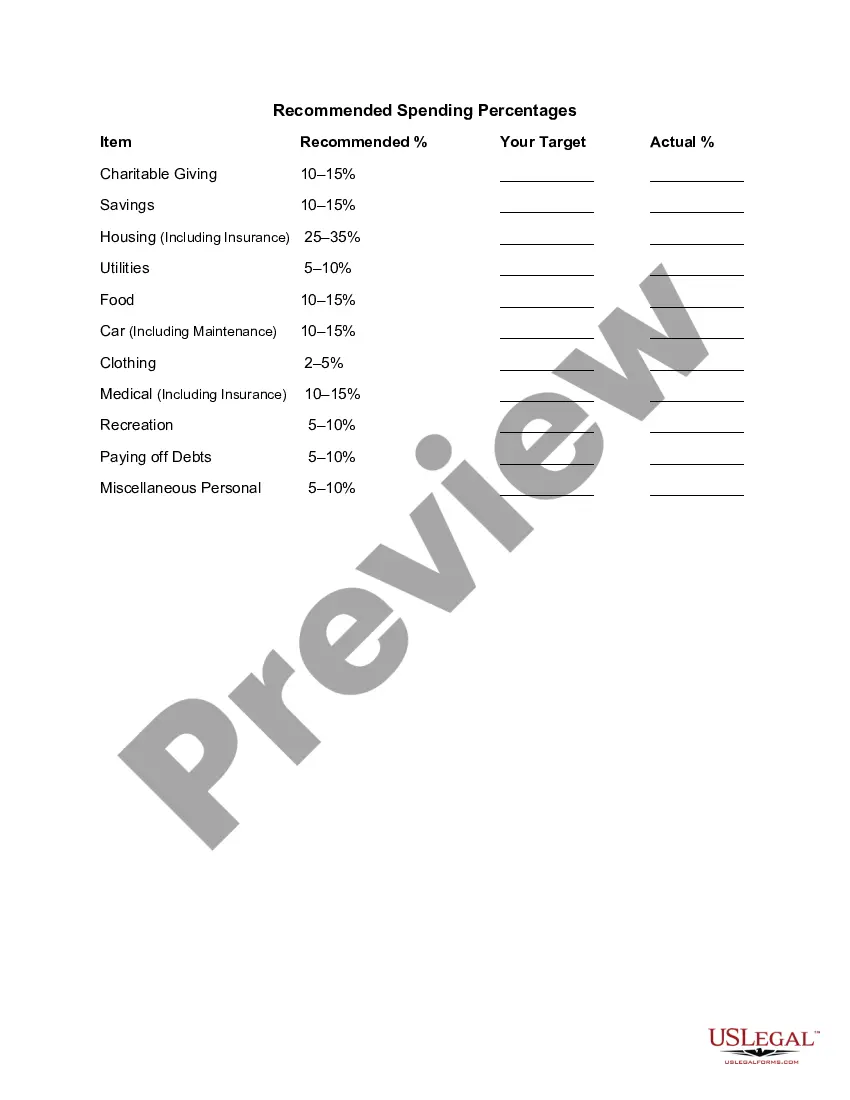
Maryland Recommended Spending Percentages
Description
Get your form ready online
Our built-in tools help you complete, sign, share, and store your documents in one place.
Make edits, fill in missing information, and update formatting in US Legal Forms—just like you would in MS Word.
Download a copy, print it, send it by email, or mail it via USPS—whatever works best for your next step.
Sign and collect signatures with our SignNow integration. Send to multiple recipients, set reminders, and more. Go Premium to unlock E-Sign.
If this form requires notarization, complete it online through a secure video call—no need to meet a notary in person or wait for an appointment.
We protect your documents and personal data by following strict security and privacy standards.

Make edits, fill in missing information, and update formatting in US Legal Forms—just like you would in MS Word.

Download a copy, print it, send it by email, or mail it via USPS—whatever works best for your next step.

Sign and collect signatures with our SignNow integration. Send to multiple recipients, set reminders, and more. Go Premium to unlock E-Sign.

If this form requires notarization, complete it online through a secure video call—no need to meet a notary in person or wait for an appointment.

We protect your documents and personal data by following strict security and privacy standards.
Looking for another form?


How to fill out Recommended Spending Percentages?
You might spend several hours online attempting to locate the legal document template that meets the state and federal requirements you require.
US Legal Forms offers a plethora of legal documents that are reviewed by specialists.
You can conveniently acquire or print the Maryland Suggested Spending Percentages from my assistance.
First, ensure that you have selected the correct document template for the area/city you choose. Review the form description to make sure you have selected the right form. If available, use the Review option to consult the document template as well.
- If you already possess a US Legal Forms account, you may sign in and then select the Download option.
- Subsequently, you can fill out, modify, print, or sign the Maryland Suggested Spending Percentages.
- Every legal document template you obtain will be yours for an extended period.
- To obtain another copy of the acquired form, navigate to the My documents tab and click on the corresponding option.
- If you are accessing the US Legal Forms website for the first time, follow the simple instructions provided below.
Form popularity
FAQ
In 2020, Maryland's Gross Domestic Product (GDP) was $410.7 billion, 15th in the nation, and down from $421.6 billion in 2019. The largest sector in 2020 was finance, insurance, and real estate, followed by government, and then professional and business services.
Expenditures generally include spending on government salaries, infrastructure, education, public pensions, public assistance, corrections, Medicaid, and transportation.
As Figure A suggests, Social Security is the single largest mandatory spending item, taking up 38% or nearly $1,050 billion of the $2,736 billion total. The next largest expenditures are Medicare and Income Security, with the remaining amount going to Medicaid, Veterans Benefits, and other programs.
In 2020, Congress budgeted $1.6 trillion in discretionary spending. By far, the biggest category of discretionary spending is spending on the Pentagon and military. In most years, this accounts for more than half of the discretionary budget.
In state fiscal year (SFY) 2018, state and local child welfare agencies spent $33 billion using a combination of federal, state, local, and other funds. State and local child welfare agencies rely on multiple funding streams to administer programs and services.
Maryland records show a gradual, but uneven, change in currency from "pounds" to "dollars." Montgomery County tax assessments in 1793, 1798, and 1804 were listed in pounds; in 1813, the currency changed to dollars.
Nearly 60 percent of mandatory spending in 2019 was for Social Security and other income support programs (figure 3). Most of the remainder paid for the two major government health programs, Medicare and Medicaid.
The four main areas of federal spending are national defense, Social Security, healthcare, and interest payments, which together account for about 70% of all federal spending. When a government spends more than it collects in taxes, it is said to have a budget deficit.
The individual income tax, retail sales tax, and State Lottery are the three largest sources of general fund revenue. Other sources include the corporate income tax and other business taxes, alcohol and tobacco taxes, and miscellaneous taxes and fees.
This category includes entitlement programs such as Social Security, Medicare, and unemployment compensation. It also includes welfare programs such as Medicaid. Social Security will be the biggest expense, budgeted at $1.196 trillion. It's followed by Medicare at $766 billion and Medicaid at $571 billion.