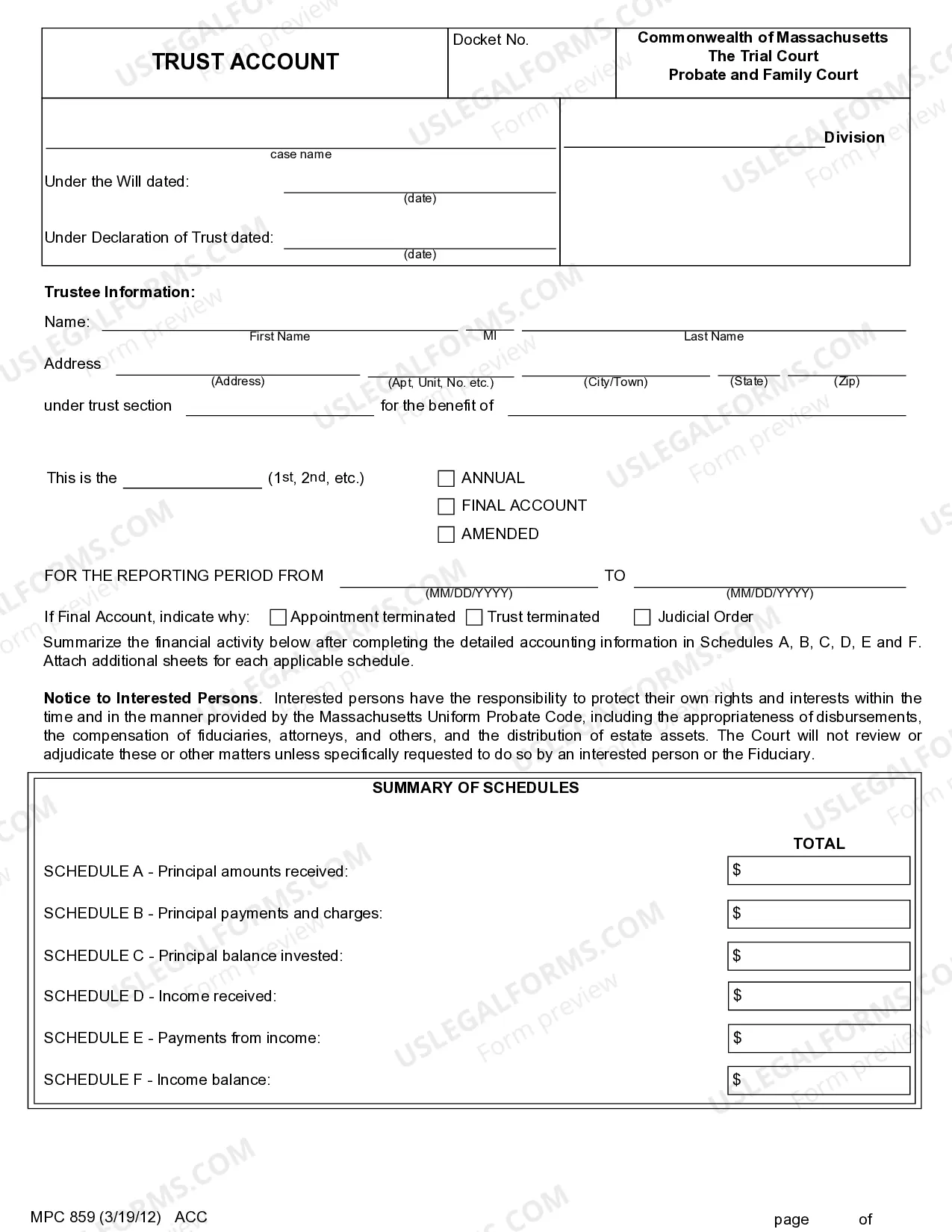
Massachusetts Trust Accounts are financial accounts that allow an individual or organization to hold and manage funds on behalf of another individual or organization. The funds held in these accounts are kept separate and distinct from the personal accounts of the trust or and the trustee, and the funds can only be used for the purpose specified in the trust agreement. These accounts are regulated by the Massachusetts Division of Banks and are governed by the Massachusetts General Laws. There are two main types of Massachusetts Trust Accounts: revocable and irrevocable. Revocable trust accounts are those in which the trust or can change the terms of the trust and the assets held within it at any time. Irrevocable trust accounts are those in which the terms of the trust and the assets held within it cannot be changed. Both types of accounts can be used to manage funds for the benefit of another person or entity.
Massachusetts Trust Account
Description
Get your form ready online
Our built-in tools help you complete, sign, share, and store your documents in one place.
Make edits, fill in missing information, and update formatting in US Legal Forms—just like you would in MS Word.
Download a copy, print it, send it by email, or mail it via USPS—whatever works best for your next step.
Sign and collect signatures with our SignNow integration. Send to multiple recipients, set reminders, and more. Go Premium to unlock E-Sign.
If this form requires notarization, complete it online through a secure video call—no need to meet a notary in person or wait for an appointment.
We protect your documents and personal data by following strict security and privacy standards.

Make edits, fill in missing information, and update formatting in US Legal Forms—just like you would in MS Word.

Download a copy, print it, send it by email, or mail it via USPS—whatever works best for your next step.

Sign and collect signatures with our SignNow integration. Send to multiple recipients, set reminders, and more. Go Premium to unlock E-Sign.

If this form requires notarization, complete it online through a secure video call—no need to meet a notary in person or wait for an appointment.

We protect your documents and personal data by following strict security and privacy standards.
Looking for another form?
How to fill out Massachusetts Trust Account?
Creating legal documents can be a significant hassle without available fill-in templates. With the US Legal Forms online collection of formal documents, you can trust the blanks you encounter, as they all adhere to federal and state rules and have been validated by our specialists.
Acquiring your Massachusetts Trust Account from our platform is as simple as one, two, three. Previously registered users with an active subscription simply need to Log In and hit the Download button after finding the right template. Afterward, if necessary, users can access the same document from the My documents section of their account. Nevertheless, even if you are new to our service, registering with a valid subscription will only take a few moments. Here’s a quick guide for you.
Haven’t explored US Legal Forms yet? Sign up for our service today to acquire any official document promptly and effortlessly whenever you require it, and maintain your paperwork in order!
- Form compliance evaluation. You should thoroughly review the content of the document you wish to ensure it meets your requirements and adheres to your state law stipulations. Previewing your file and reviewing its general overview will assist you in doing just that.
- Alternative search (optional). If you notice any discrepancies, explore the collection using the Search tab at the top of the page until you spot an appropriate blank, and click Buy Now when you identify the one you need.
- Account setup and document purchase. Register for an account with US Legal Forms. After account confirmation, Log In and select your desired subscription plan. Proceed with payment to continue (both PayPal and credit card methods are available).
- Template acquisition and further usage. Select the file format for your Massachusetts Trust Account and click Download to save it on your device. Print it out for manual completion, or utilize a multifunctional online editor to create an electronic version more swiftly and effectively.
Form popularity
FAQ
To help you get started on understanding the options available, here's an overview the three primary classes of trusts. Revocable Trusts. Irrevocable Trusts. Testamentary Trusts.
Massachusetts laws Describes the instrument that must be recorded in the Registry of Deeds when real estate is transferred by a trustee. Requires trustees to notify beneficiaries of accounting and much more.
In Massachusetts, there are filing fees that will depend on the exact type of petition you wish to make. In order to create a general petition for the creation of a trust, the filing fee is $375 with a surcharge of $15.
An irrevocable trust offers your assets the most protection from creditors and lawsuits. Assets in an irrevocable trust aren't considered personal property. This means they're not included when the IRS values your estate to determine if taxes are owed.
Between the two main types of trusts, revocable trusts are the most common. This is primarily due to the level of flexibility they provide. In a revocable trust, the trustor (or the person who created the trust) has the option to modify or cancel the trust at any time during their lifetime.
A living trust in Massachusetts is created by the grantor, the person putting things into trust. As the grantor you must choose a trustee who is charged with managing the trust for your benefit while you are alive and distributing your assets to your beneficiaries after your death.
What assets cannot be placed in a trust? Retirement assets. While you can transfer ownership of your retirement accounts into your trust, estate planning experts usually don't recommend it.Health savings accounts (HSAs)Assets held in other countries.Vehicles.Cash.
With that said, revocable trusts, irrevocable trusts, and asset protection trusts are among some of the most common types to consider. Not only that, but these trusts offer long-term benefits that can strengthen your estate plan and successfully protect your assets.