Massachusetts Forest Land Tax Lien
Understanding this form
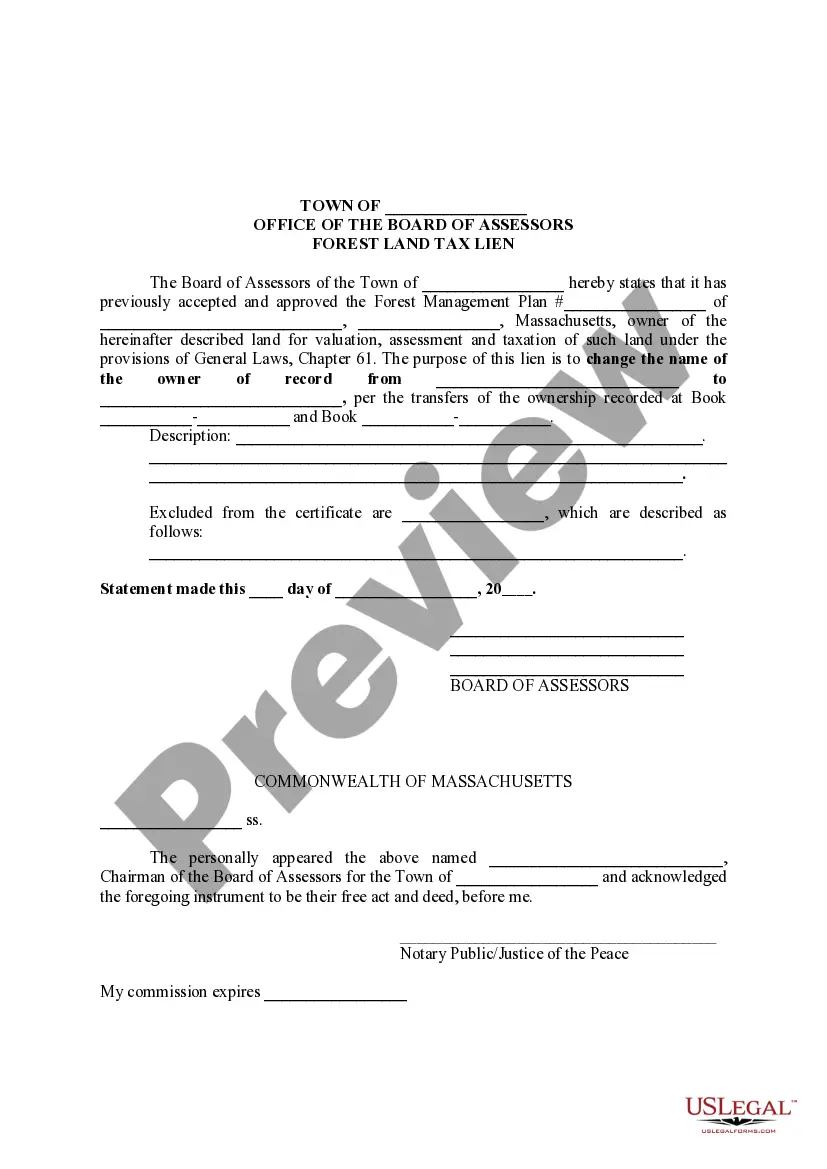
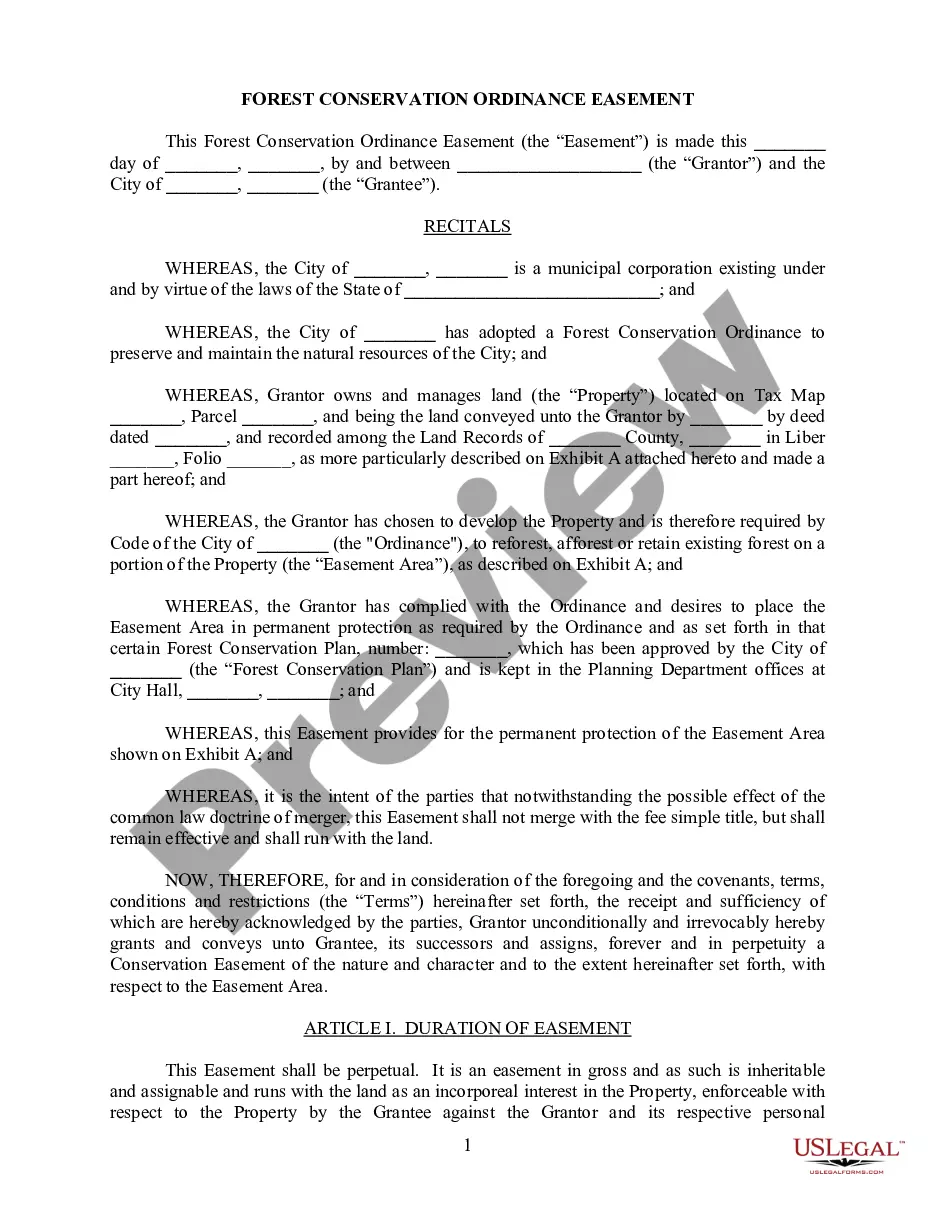
The Forest Land Tax Lien form is an official document that the Board of Assessors uses to acknowledge the approval of a Forest Management Plan and to note changes in property ownership. This form serves to update the name of the owner of record for a property assessed under the provisions of General Laws, Chapter 61. Unlike other tax lien forms, this specific lien is tailored for forest land, ensuring compliance with state regulations while protecting the interests of the new owner.
Key parts of this document
- Identification of the Town and Board of Assessors.
- Details of the approved Forest Management Plan and its owner.
- Statement of ownership change, including book and page references.
- Description of the land affected by the lien.
- Signature of the Board of Assessors and acknowledgment by a notary.
When this form is needed
This form is used when there is a change in the owner of a forest property that has an approved Forest Management Plan. It is essential for ensuring that the new property owner's name is correctly recorded for taxation purposes. If you have transferred ownership of a forested area in Massachusetts, this form is necessary to officially update the records and acknowledge the existing management plan.
Who needs this form
- New owners of forest land in Massachusetts who want to ensure their ownership is recorded.
- Real estate professionals facilitating the transfer of forest properties.
- Landowners looking to benefit from assessed tax programs related to forest management.
Instructions for completing this form
- Enter the name of the Town and Board of Assessors at the top of the form.
- Fill in details of the Forest Management Plan, including its number and current owner's name.
- Specify the new owner's name to whom the property is being transferred.
- Provide the book and page numbers that document the ownership transfer.
- Include a detailed description of the land in question.
- Sign the form and have it notarized by a Notary Public or Justice of the Peace.
Notarization guidance
Yes, this form must be notarized to be legally valid. Notarization helps confirm the identity of the signatories and ensures the authenticity of the document. US Legal Forms offers an integrated online notarization service available 24/7 via secure video call, making the process smooth and efficient without the need for travel.
Get your form ready online
Our built-in tools help you complete, sign, share, and store your documents in one place.
Make edits, fill in missing information, and update formatting in US Legal Forms—just like you would in MS Word.
Download a copy, print it, send it by email, or mail it via USPS—whatever works best for your next step.
Sign and collect signatures with our SignNow integration. Send to multiple recipients, set reminders, and more. Go Premium to unlock E-Sign.
If this form requires notarization, complete it online through a secure video call—no need to meet a notary in person or wait for an appointment.
We protect your documents and personal data by following strict security and privacy standards.

Make edits, fill in missing information, and update formatting in US Legal Forms—just like you would in MS Word.

Download a copy, print it, send it by email, or mail it via USPS—whatever works best for your next step.

Sign and collect signatures with our SignNow integration. Send to multiple recipients, set reminders, and more. Go Premium to unlock E-Sign.

If this form requires notarization, complete it online through a secure video call—no need to meet a notary in person or wait for an appointment.

We protect your documents and personal data by following strict security and privacy standards.
Mistakes to watch out for
- Failing to complete all fields, especially the property description.
- Not providing accurate book and page numbers for ownership records.
- Omitting the signature or notarization, which can invalidate the document.
Why complete this form online
- Convenience of downloading and completing the form at your own pace.
- Editability allows for quick adjustments before finalizing the document.
- Reliable access to attorney-drafted forms that comply with state laws.
Looking for another form?



Form popularity
FAQ
The agricultural and horticultural land classification program under Massachusetts General Laws Chapter 61A is designed to encourage the preservation of the Commonwealth's valuable farmland and promote active agricultural and horticultural land use.
The term farm includes stock, dairy, poultry, fruit, furbearing animal, and truck farms, plantations, ranches, nurseries, ranges, greenhouses or other similar structures used primarily for the raising of agricultural or horticultural commodities, and orchards and woodlands.A vineyard selling grapes is a farm.
A farm is defined as any place from which $1,000 or more of agricultural products were produced and sold, or normally would have been sold, during the year.
There is no hard-and-fast land requirement. However, the farmers I spoke with said that someone would need at least 500 owned acres and 1,000 leased acres to make a living. The quality of the land certainly affects those numbers.
Ch. 61B is the recreational land tax law. The purpose of Ch. 61B is to reduce the assessed value of land based on its use for open space or recreation. Assessed values under this law are reduced by 75%.
"'Farming' or 'agriculture' shall include farming in all of its branches and the cultivation and tillage of the soil, dairying, the production, cultivation, growing and harvesting of any agricultural, aquacultural, floricultural or horticultural commodities, the growing and harvesting of forest products upon forest
USDA defines a small farm as an operation with gross cash farm income under $250,000.While most U.S. farms are small 91 percent according to the Census of Agriculture large farms ($250,000 and above) account for 85 percent of the market value of agricultural production.