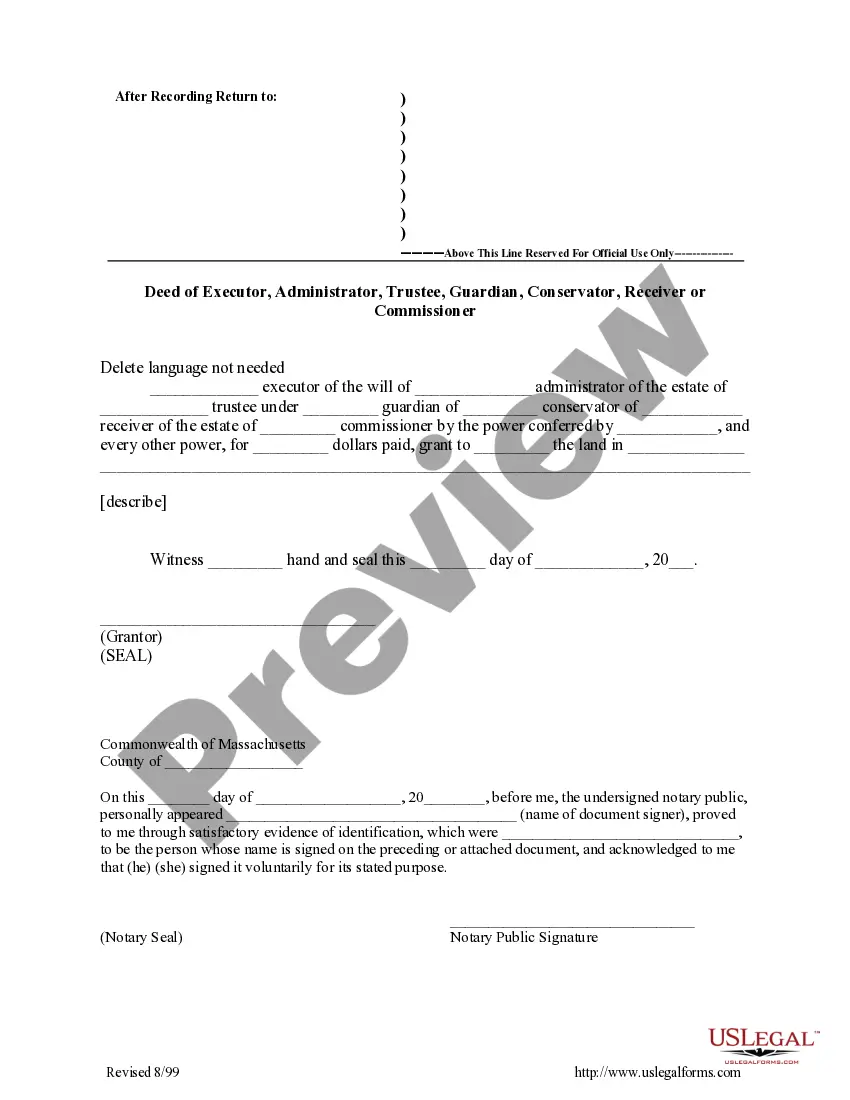
Massachusetts Deed of Executor, Administrator, Trustee, Guardian, Conservator, Receiver or Commissioner
What is this form?
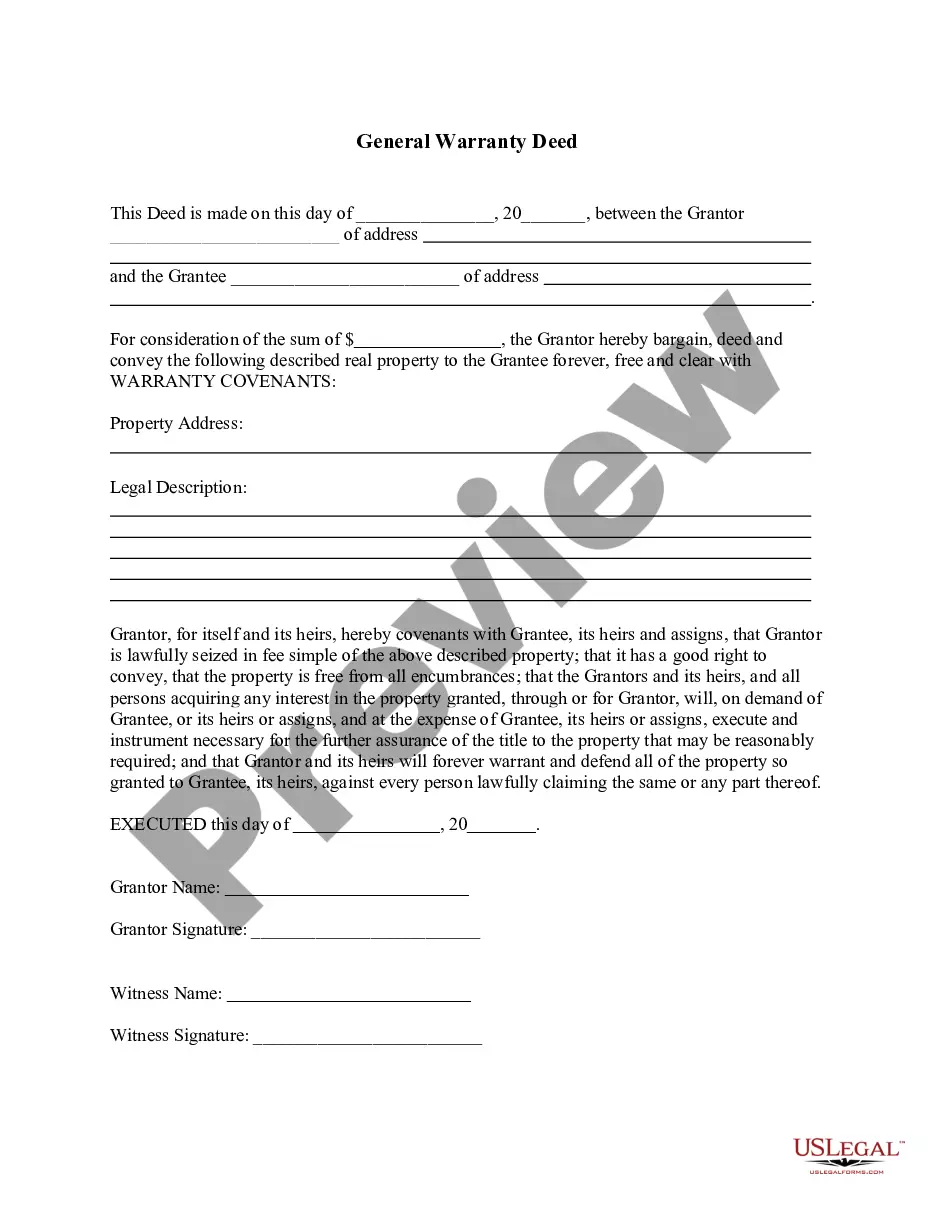
The Deed of Executor, Administrator, Trustee, Guardian, Conservator, Receiver, or Commissioner is a legal document utilized in property transactions. This form facilitates the transfer of property rights between parties, specifically when dealing with estates and trusts. Unlike standard deeds, this form is tailored for use by individuals in specific fiduciary roles, allowing them to convey property as part of their responsibilities in managing estates or trusts.
Form components explained
- Identification of the grantor's role (executor, administrator, trustee, etc.).
- Details of the property being transferred.
- Consideration amount (the payment made in exchange for the property).
- Signature and seal of the grantor.
- Notary acknowledgment to validate the execution of the deed.


Situations where this form applies
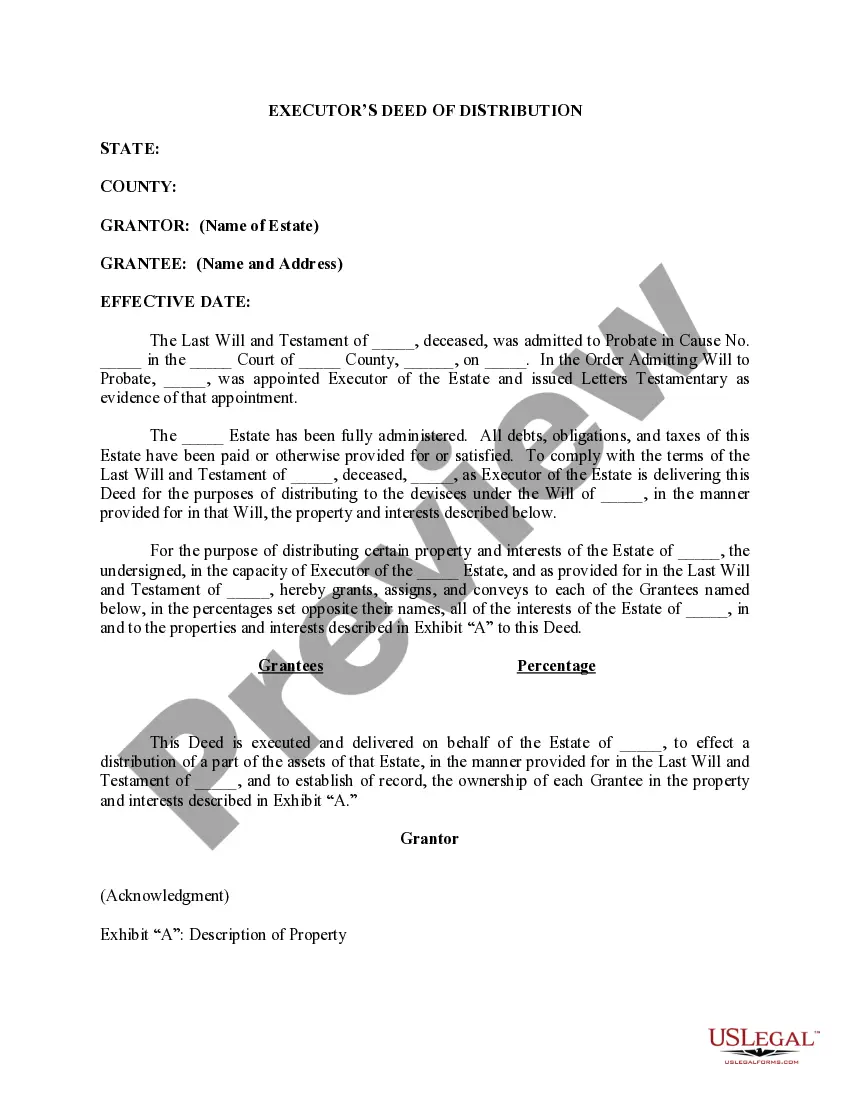
This form should be used when an executor, administrator, trustee, guardian, conservator, receiver, or commissioner needs to transfer property from an estate or trust to another party. Typical scenarios include conveying real estate to heirs after probate, transferring property in a trust, or managing assets on behalf of someone unable to do so themselves.
Who this form is for
- Executors of wills managing the distribution of an estate.
- Administrators of estates where a will does not exist.
- Trustees handling property held in a trust.
- Guardians managing assets for minors.
- Conservators overseeing property of individuals with legal disabilities.
- Receivers or commissioners appointed by courts to manage property.
Instructions for completing this form
- Identify the parties involved, including the grantor and grantee.
- Specify the type of fiduciary role (executor, administrator, etc.) of the grantor.
- Enter the accurate description of the property being conveyed.
- Fill in the consideration amount being exchanged.
- Have the grantor sign the deed and affix their seal.
- Obtain a notaryâs acknowledgment to formalize the document.
Is notarization required?
Yes, this form must be notarized to be legally valid. Notarization is essential for ensuring the authenticity of signatures and the integrity of the document. US Legal Forms offers convenient online notarization services, allowing you to complete this process via secure video call, ensuring no need to travel.
Get your form ready online
Our built-in tools help you complete, sign, share, and store your documents in one place.
Make edits, fill in missing information, and update formatting in US Legal Forms—just like you would in MS Word.
Download a copy, print it, send it by email, or mail it via USPS—whatever works best for your next step.
Sign and collect signatures with our SignNow integration. Send to multiple recipients, set reminders, and more. Go Premium to unlock E-Sign.
If this form requires notarization, complete it online through a secure video call—no need to meet a notary in person or wait for an appointment.
We protect your documents and personal data by following strict security and privacy standards.

Make edits, fill in missing information, and update formatting in US Legal Forms—just like you would in MS Word.

Download a copy, print it, send it by email, or mail it via USPS—whatever works best for your next step.

Sign and collect signatures with our SignNow integration. Send to multiple recipients, set reminders, and more. Go Premium to unlock E-Sign.

If this form requires notarization, complete it online through a secure video call—no need to meet a notary in person or wait for an appointment.

We protect your documents and personal data by following strict security and privacy standards.
Common mistakes
- Failing to correctly identify the grantor's role.
- Leaving out important property details.
- Not specifying the consideration amount.
- Omitting required signatures or the notary acknowledgment.
Why complete this form online
- Convenience of instant download and immediate access.
- Editability to customize the form to fit specific situations.
- Reliability, as templates are drafted by licensed attorneys to ensure legal compliance.
- 24/7 availability for completing legal paperwork.
Looking for another form?


Form popularity
FAQ
What Is Conservatorship Real Estate?A conservatorship is a legal arrangement where a court appoints an individual called a conservator to manage personal affairs, finances, or property for someone unable to care for their own financial affairs called the conservatee.
Conservator's deeds are used to convey an interest in real property that is held by a Protected Person.While this deed is in a form to transfer the property interest from one Grantor to one Grantee, it may be used to transfer a property interest from multiple Grantors to multiple Grantees.
Guardianship Versus Conservatorship What Is the Difference?A guardian of the person is responsible for decisions about care provisions and living arrangements of the ward. A guardian of the estate, also known as a conservator, is charged with the ward's property and financial affairs.
A conservator of the estate handles the conservatee's financial matters like paying bills and collecting a person's income if the judge decides the conservatee cannot do it.
Conservators have court-ordered authority and responsibility to manage the affairs of those who can no longer make their own decisions about finances or health care.
The conservator has the power to collect all the conservatee's assets, pay bills, make investments, etc. The conservator must seek court supervision for major transactions, such as purchase or sale of property, borrowing money, or gifting of assets.