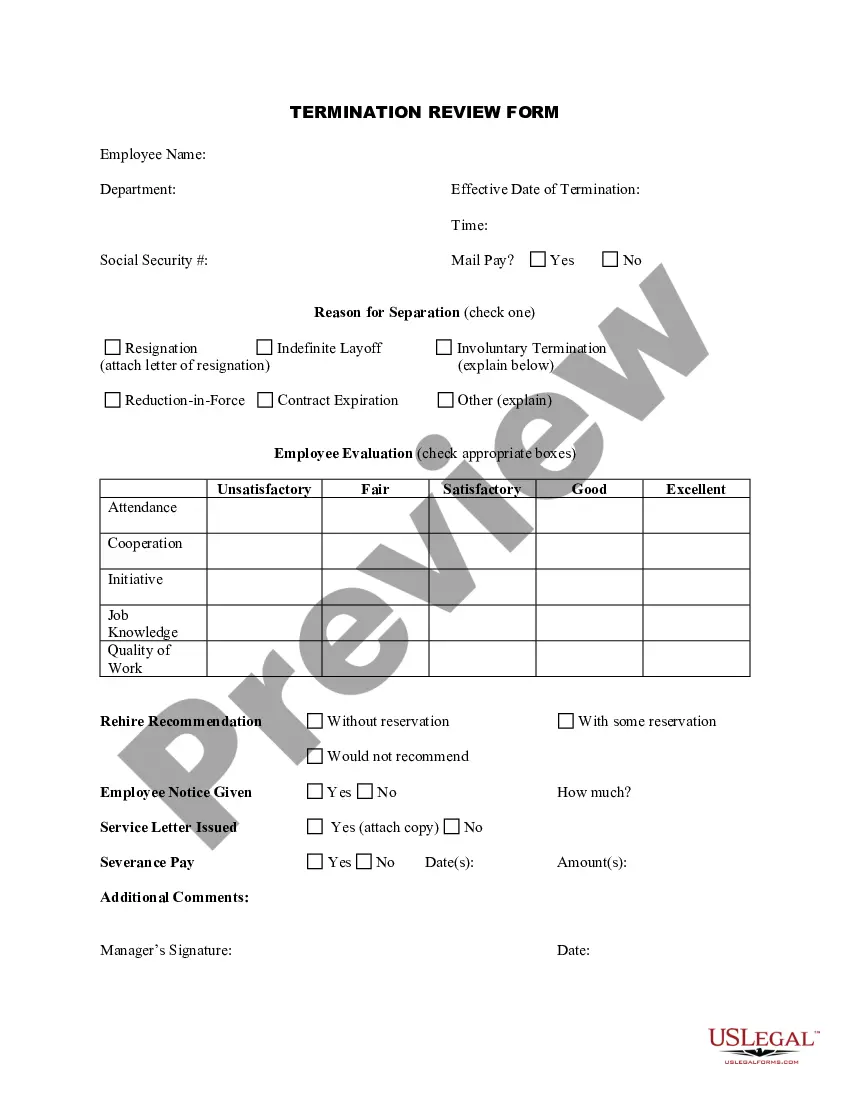
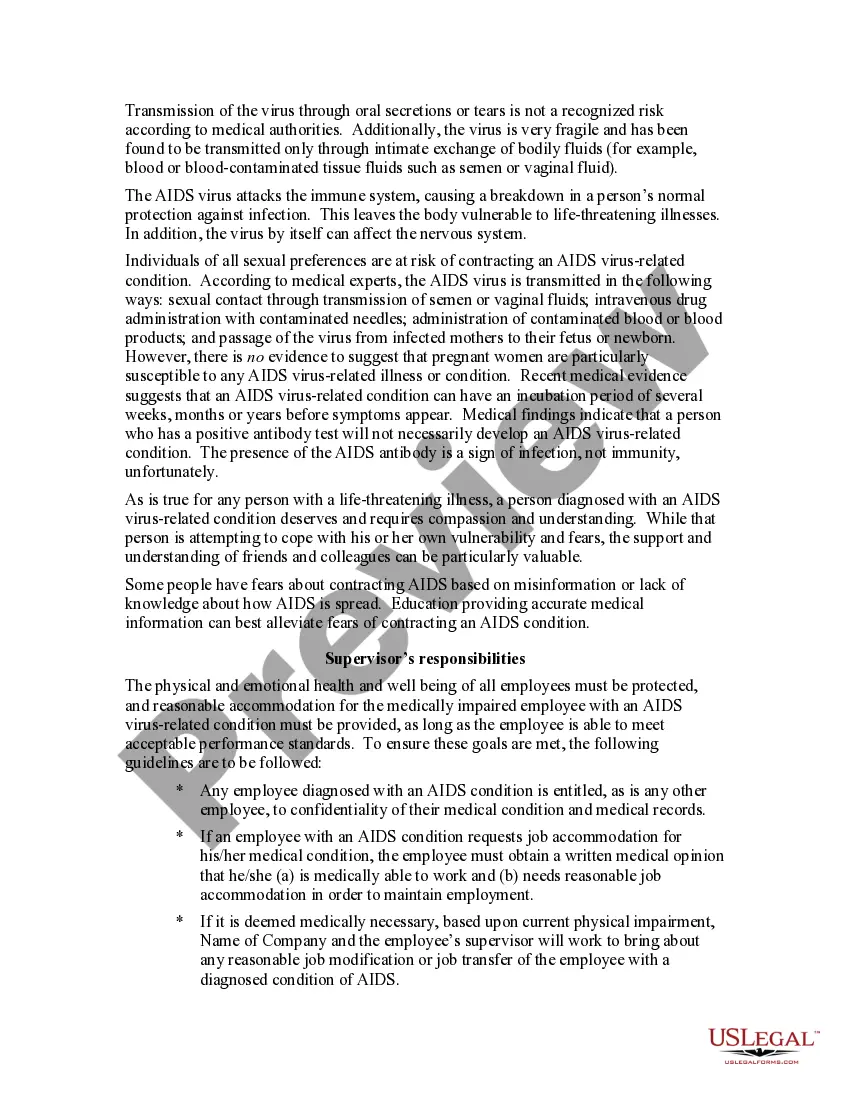
Louisiana Company Policy on AIDS
Description



Get your form ready online
Our built-in tools help you complete, sign, share, and store your documents in one place.
Make edits, fill in missing information, and update formatting in US Legal Forms—just like you would in MS Word.
Download a copy, print it, send it by email, or mail it via USPS—whatever works best for your next step.
Sign and collect signatures with our SignNow integration. Send to multiple recipients, set reminders, and more. Go Premium to unlock E-Sign.
If this form requires notarization, complete it online through a secure video call—no need to meet a notary in person or wait for an appointment.
We protect your documents and personal data by following strict security and privacy standards.

Make edits, fill in missing information, and update formatting in US Legal Forms—just like you would in MS Word.

Download a copy, print it, send it by email, or mail it via USPS—whatever works best for your next step.

Sign and collect signatures with our SignNow integration. Send to multiple recipients, set reminders, and more. Go Premium to unlock E-Sign.

If this form requires notarization, complete it online through a secure video call—no need to meet a notary in person or wait for an appointment.

We protect your documents and personal data by following strict security and privacy standards.
Looking for another form?
How to fill out Company Policy On AIDS?
You can dedicate time online looking for the legal documents template that meets the federal and state requirements you need.
US Legal Forms provides thousands of legal documents that are reviewed by professionals.
You can effortlessly obtain or print the Louisiana Company Policy on AIDS from my assistance.
To locate another version of your document, use the Search field to find the template that meets your needs and requirements.
- If you already have a US Legal Forms account, you can sign in and then click the Download button.
- Following that, you can complete, modify, print, or sign the Louisiana Company Policy on AIDS.
- Every legal document template you acquire is yours permanently.
- To get an additional copy of any downloaded form, navigate to the My documents section and click the appropriate button.
- If you are using the US Legal Forms website for the first time, follow the simple instructions below.
- First, ensure that you have selected the correct document template for the region/area of your choice.
- Review the form description to confirm you have chosen the correct document.
Form popularity
FAQ
Yet despite the fact that HIV and AIDS, tuberculosis, and malaria still kill millions of people each year across multiple countries and regions, these diseases are no longer talked about as pandemics, but are generally called epidemics, or endemic diseases.
You have no legal obligation to tell your employer you have HIV or AIDS. If you do tell your employer, you may be discriminated against. Under the Americans with Disabilities Act and other laws, people with HIV or AIDS may be termed disabled and entitled to get reasonable accommodation at work.
During the first period, life expectancy for a 21-year-old with HIV was 38 years, compared to 60 for uninfected peers. By 2014, that gap narrowed dramatically: A 21-year-old with HIV could expect to live to 56, compared to age 65 for uninfected adults, according to the report.
People with HIV are protected under the Equality Act (2010). There's no legal obligation to tell your employer you have HIV, unless you have a frontline job in the armed forces or work in a healthcare role where you perform invasive procedures.
An unsuccessful attempt to infect, or acting with reckless disregard, would be a class D felony. That is punishable by a maximum of five years in prison. A person who simply failed to disclose their HIV status could be charged with a misdemeanor.
The reality is, people with HIV can be in relationships, have sex, and live normal lives by taking a few precautions. Although there's no cure for HIV, there are medicines that help people with HIV live longer, healthier lives.
HIV and STD Criminalization Laws 2021In 12 states, laws require people with HIV who are aware of their status to disclose their status to sex partners, and 4 states require disclosure to needle-sharing partners. The maximum sentence length for violating an HIV-specific statute is also a matter of state law.
People with HIV are protected under the Equality Act (2010). There's no legal obligation to tell your employer you have HIV, unless you have a frontline job in the armed forces or work in a healthcare role where you perform invasive procedures.
With proper care and treatment, many people living with HIV lead normal, healthy lives, including having a job. Most people living with HIV can continue working at their current jobs or look for a new job in their chosen field.