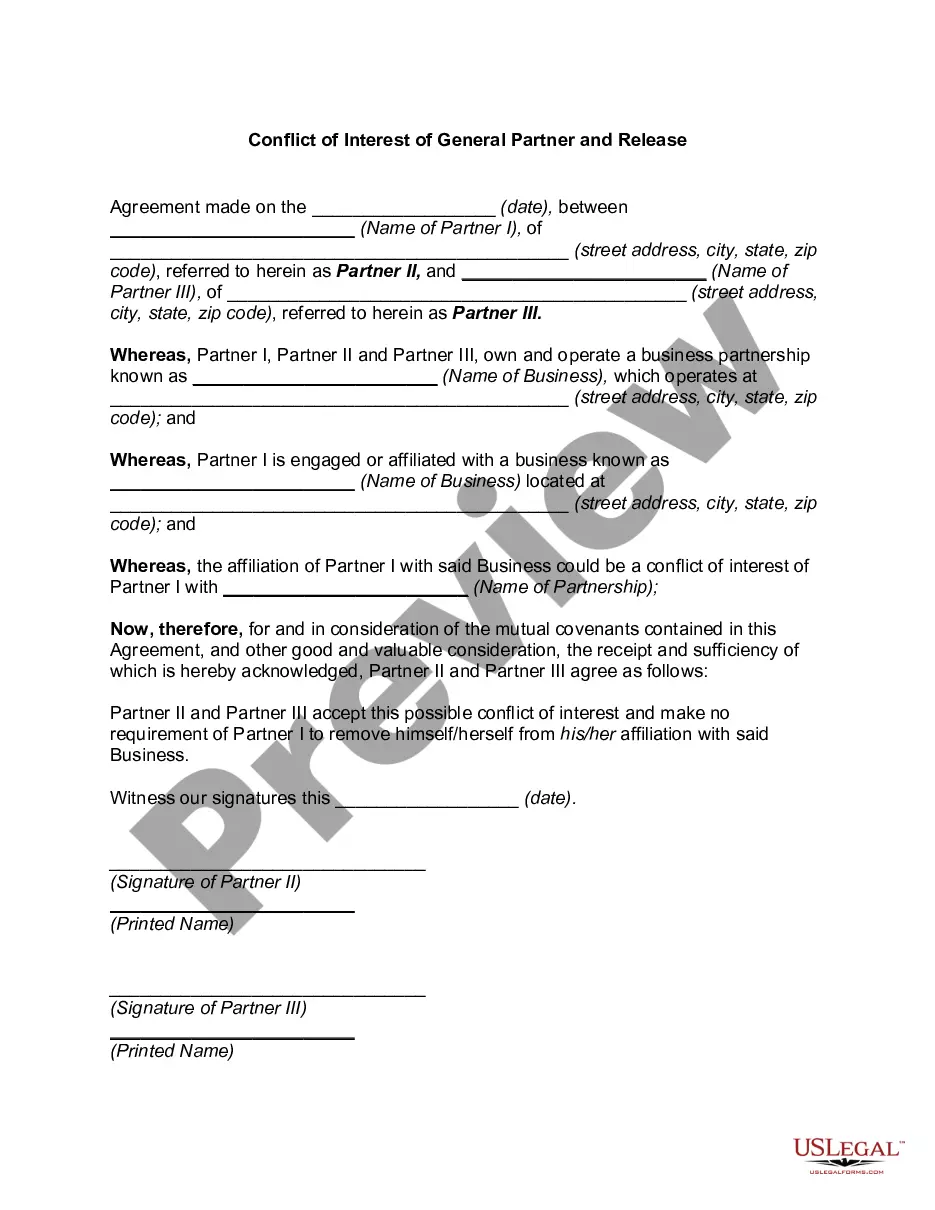
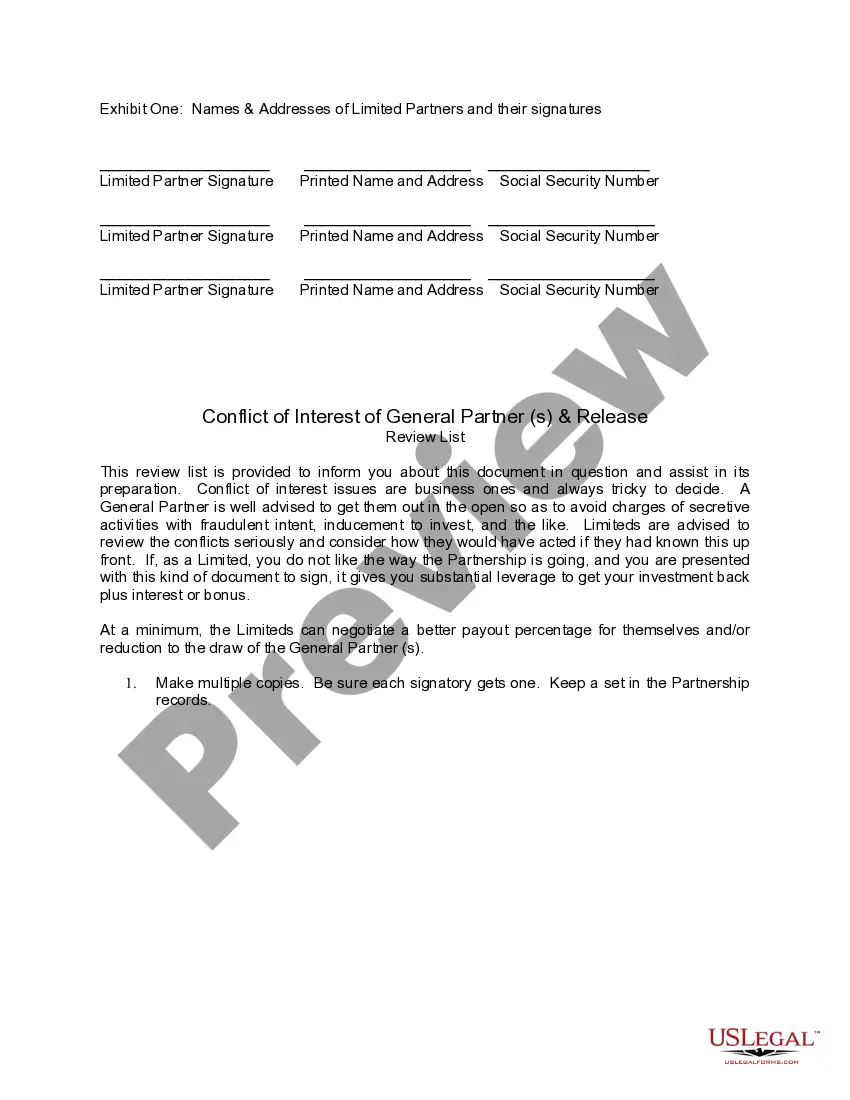
Louisiana Conflict of Interest of General Partner and Release
Description


How to fill out Conflict Of Interest Of General Partner And Release?
If you are looking for thorough, obtain, or print authorized document templates, utilize US Legal Forms, the largest collection of legal forms that are accessible online.
Take advantage of the site’s user-friendly and convenient search to find the documents you require.
A variety of templates for corporate and personal purposes are categorized by type and region, or by keywords.
Step 4. Once you have found the form you need, click the Get now button. Choose the payment plan you prefer and enter your information to register for an account.
Step 5. Complete the transaction. You can use your credit card or PayPal account to finalize the purchase.
- Employ US Legal Forms to acquire the Louisiana Conflict of Interest of General Partner and Release in just a few clicks.
- If you are already a US Legal Forms user, Log In to your account and click the Download button to access the Louisiana Conflict of Interest of General Partner and Release.
- You can also retrieve forms you previously downloaded within the My documents section of your account.
- If you are using US Legal Forms for the first time, follow these steps.
- Step 1. Make sure you have selected the form for the correct city/state.
- Step 2. Use the Review option to examine the content of the form. Don't forget to read the details.
- Step 3. If you are not satisfied with the form, use the Search area at the top of the screen to find alternate versions of the legal form template.
Form popularity
FAQ
A conflict of interest occurs when an individual's personal interests family, friendships, financial, or social factors could compromise his or her judgment, decisions, or actions in the workplace. Government agencies take conflicts of interest so seriously that they are regulated.
An example would be a minor who needs representation and whose fees are being paid for by their parents. If the parents feel that they are entitled to privileged communication, or that they have the right to direct the attorney in the proceedings, this would be a conflict of interest.
Concurrent representation means a situation in which a brokerage or an industry member represents two or more parties to a trade whose interests are seen to be in conflict; and (g) sale is complete when the purchase price is paid to the Seller or the Seller's lawyer and is releasable.
A conflict of interest is defined as a conflict between professional duties and private interests, or when there is a conflict between the duty to one client and another.
The California Rules generally permit a lawyer to represent multiple clients with conflicting interests so long as all the clients have provided their informed written consent.
Part 3: Different types of conflicts of interestfinancial conflict;non-financial conflict;conflict of roles; or.predetermination.
An attorney should represent the client without having their judgment affected by other parties. This type of conflict may arise when a client's fees are being paid for by a third party. An example would be a minor who needs representation and whose fees are being paid for by their parents.
A client can generally waive a conflict of interest that may arise in the future if that particular conflict of interest to be waived can ethically be waived and if the lawyer and client together have in their minds the conflict of interest that actually does later arise.
When a lawyer engages in a business transaction with a client, there is a risk that the lawyer's financial interests may conflict with the interests of the client, or otherwise limit the lawyer's ability to advocate for the client's interests.
Concurrent conflicts of interest can arise from the lawyer's responsibilities to another client, a former client or a third person or from the lawyer's own interests.