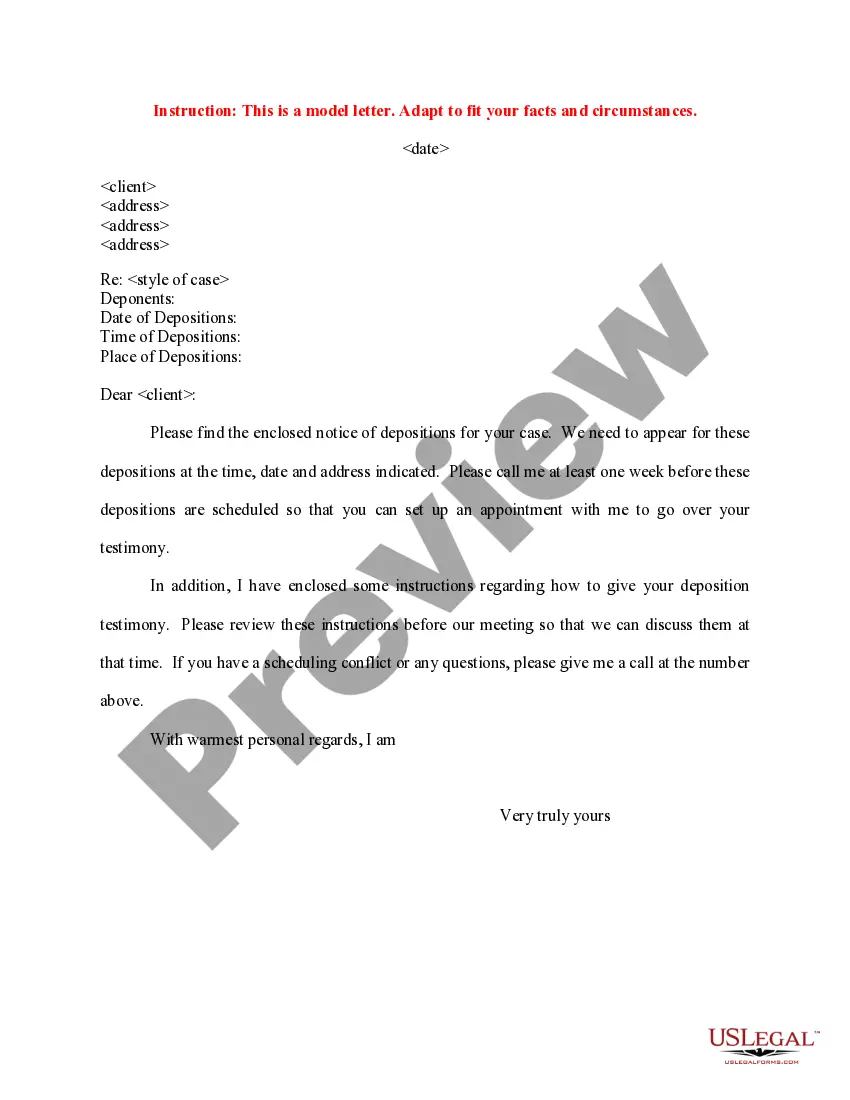
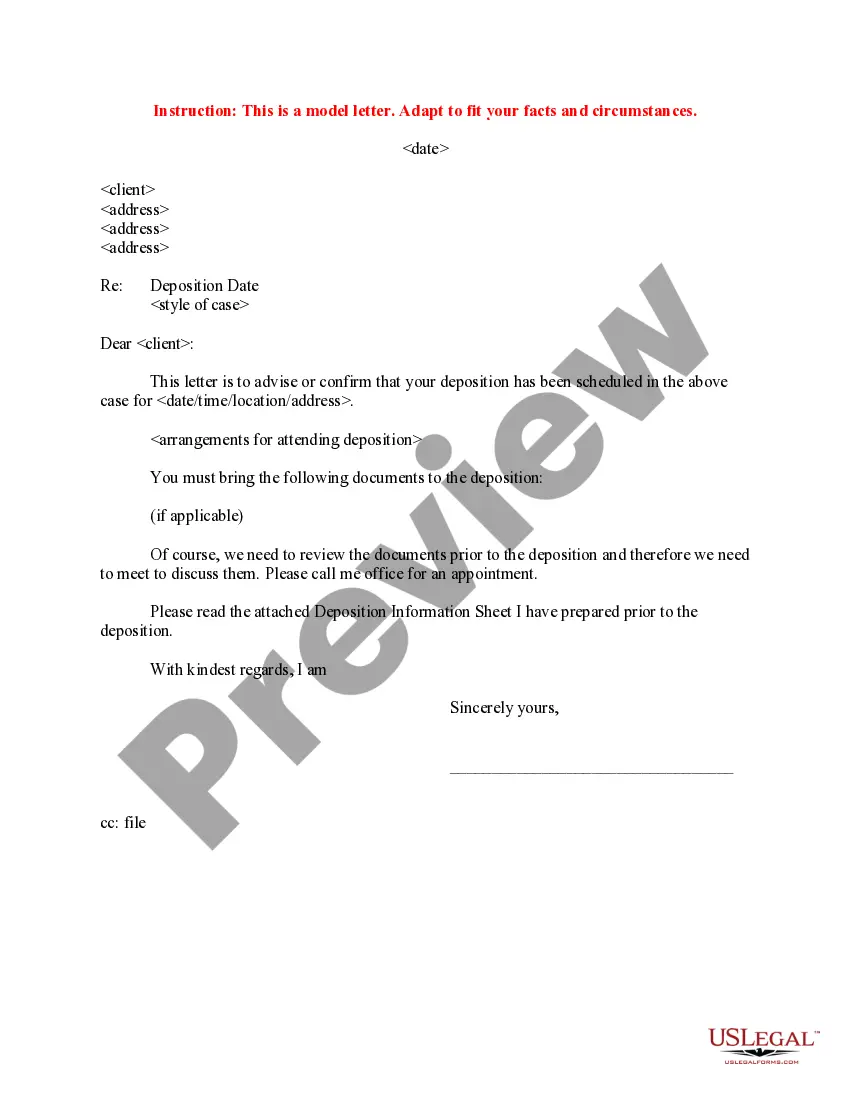
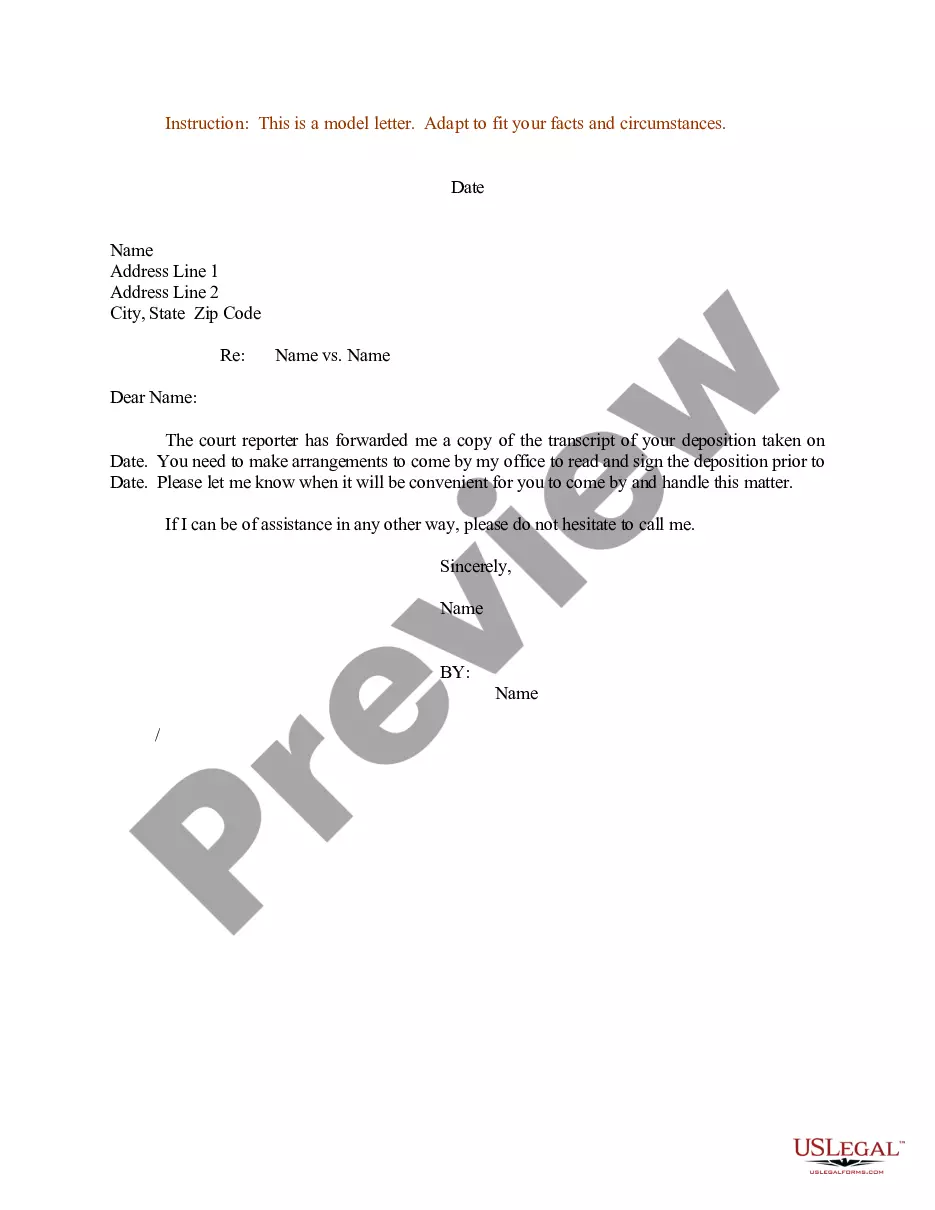
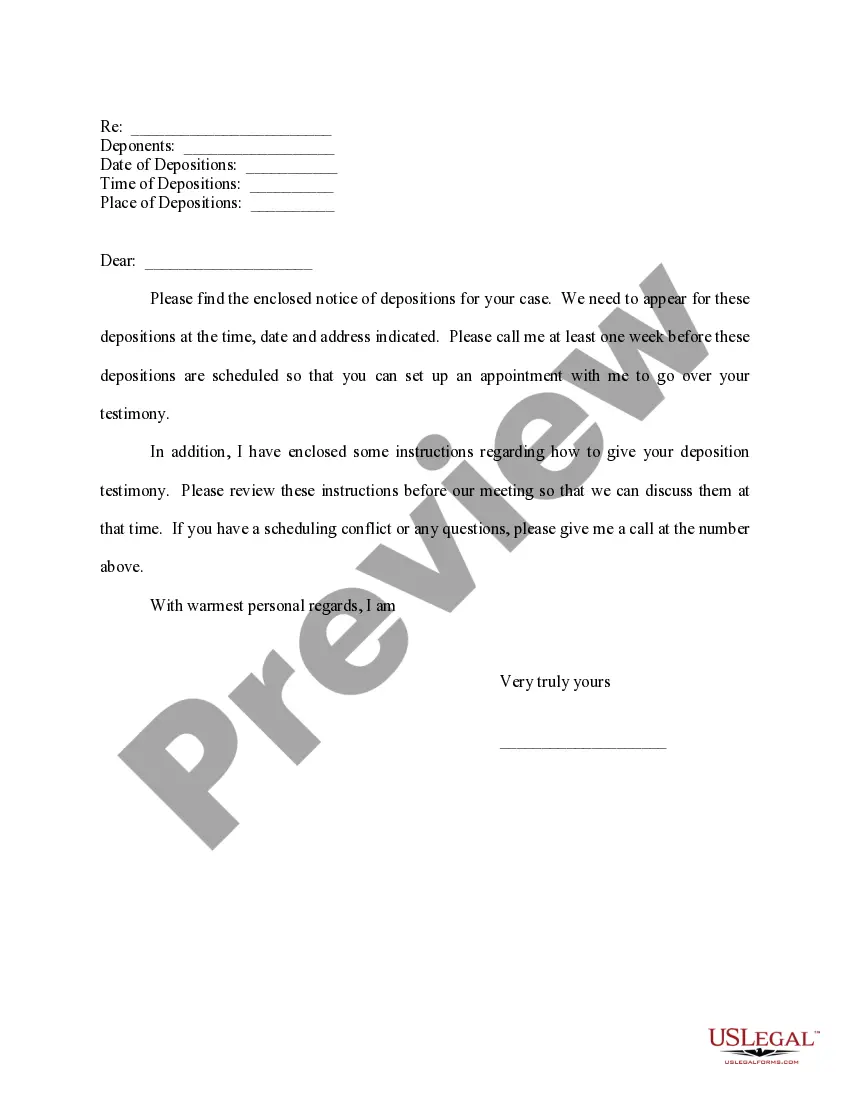
Louisiana Sample Letter to Client regarding Notice of Deposition - Discovery
Description
Get your form ready online
Our built-in tools help you complete, sign, share, and store your documents in one place.
Make edits, fill in missing information, and update formatting in US Legal Forms—just like you would in MS Word.
Download a copy, print it, send it by email, or mail it via USPS—whatever works best for your next step.
Sign and collect signatures with our SignNow integration. Send to multiple recipients, set reminders, and more. Go Premium to unlock E-Sign.
If this form requires notarization, complete it online through a secure video call—no need to meet a notary in person or wait for an appointment.
We protect your documents and personal data by following strict security and privacy standards.

Make edits, fill in missing information, and update formatting in US Legal Forms—just like you would in MS Word.

Download a copy, print it, send it by email, or mail it via USPS—whatever works best for your next step.

Sign and collect signatures with our SignNow integration. Send to multiple recipients, set reminders, and more. Go Premium to unlock E-Sign.

If this form requires notarization, complete it online through a secure video call—no need to meet a notary in person or wait for an appointment.

We protect your documents and personal data by following strict security and privacy standards.
Looking for another form?



How to fill out Sample Letter To Client Regarding Notice Of Deposition - Discovery?
You can commit several hours on-line looking for the legal papers web template that suits the state and federal requirements you want. US Legal Forms offers a large number of legal forms that are reviewed by experts. You can easily acquire or print out the Louisiana Sample Letter to Client regarding Notice of Deposition - Discovery from our support.
If you have a US Legal Forms bank account, you are able to log in and then click the Down load button. After that, you are able to complete, change, print out, or indicator the Louisiana Sample Letter to Client regarding Notice of Deposition - Discovery. Every single legal papers web template you buy is yours forever. To obtain yet another duplicate of any purchased kind, visit the My Forms tab and then click the corresponding button.
If you work with the US Legal Forms internet site the first time, stick to the simple directions beneath:
- First, make certain you have chosen the best papers web template to the state/area that you pick. Read the kind outline to ensure you have picked out the appropriate kind. If available, use the Preview button to appear throughout the papers web template as well.
- If you wish to discover yet another model in the kind, use the Search field to discover the web template that suits you and requirements.
- Once you have located the web template you desire, just click Purchase now to continue.
- Select the pricing program you desire, enter your qualifications, and register for a free account on US Legal Forms.
- Comprehensive the financial transaction. You can use your bank card or PayPal bank account to purchase the legal kind.
- Select the file format in the papers and acquire it to the product.
- Make modifications to the papers if needed. You can complete, change and indicator and print out Louisiana Sample Letter to Client regarding Notice of Deposition - Discovery.
Down load and print out a large number of papers templates using the US Legal Forms web site, that offers the most important collection of legal forms. Use specialist and condition-particular templates to take on your business or individual requirements.
Form popularity
FAQ
A deponent who, without justification, refuses a deposition when requested via subpoena may be ordered to pay expenses caused by the failure, including attorney's fees for the side that requested the deposition.
The sanctions may take one of two forms, either the witness may be held in contempt of court for not appearing, or the court may issue a Writ of Bodily Attachment. Basically, a writ of bodily attachment is a ?warrant? of sorts that permits law enforcement to arrest the witness.
The attorney for the defendant has requested your deposition as part of the discovery which you must provide in your lawsuit. A deposition is the defense attorneys' opportunity to ask you questions about your background, your accident, and your injuries, and to explore your claim in detail.
Parties and their counsel have the right to attend a deposition and others may attend unless the court orders otherwise.
The officer before whom the deposition is to be taken must put the witness under oath and must personally, or by someone acting under the officer's direction and in the officer's presence, record the testimony of the witness, except that when a deposition is being taken by communication technology under subdivision (b ...
The sanctions may take one of two forms, either the witness may be held in contempt of court for not appearing, or the court may issue a Writ of Bodily Attachment. Basically, a writ of bodily attachment is a ?warrant? of sorts that permits law enforcement to arrest the witness.
Ignoring a subpoena for a deposition can lead to a finding of contempt, which can lead to jail.
In federal and Florida state courts, lawyers can only instruct a witness not to answer a deposition question under the following limited circumstances: 1) when necessary to preserve a privilege; 2) to enforce a limitation on evidence directed by the court; or 3) to protect a witness from an examination being conducted ...