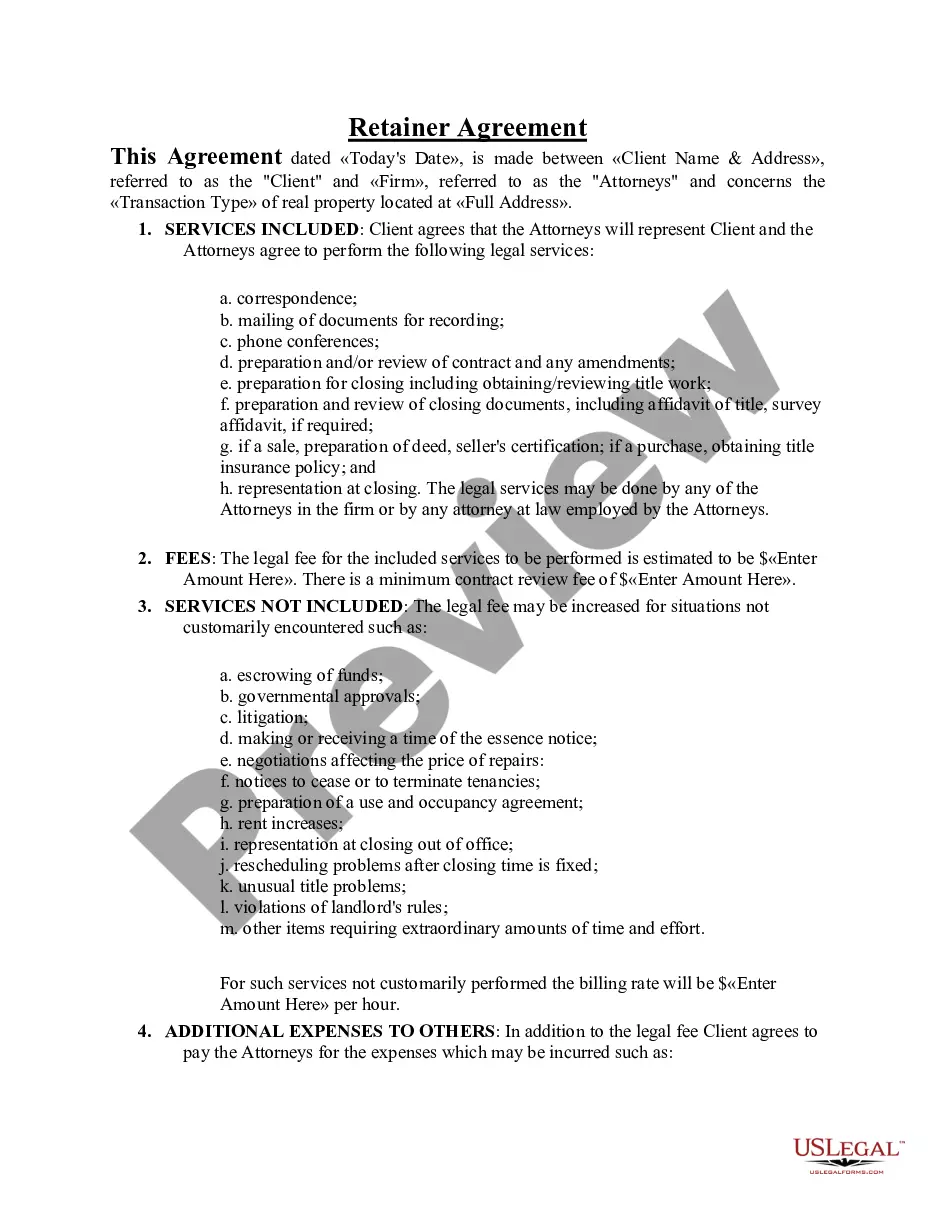
Louisiana Attorney Retainer Agreement
Description

Get your form ready online
Our built-in tools help you complete, sign, share, and store your documents in one place.
Make edits, fill in missing information, and update formatting in US Legal Forms—just like you would in MS Word.
Download a copy, print it, send it by email, or mail it via USPS—whatever works best for your next step.
Sign and collect signatures with our SignNow integration. Send to multiple recipients, set reminders, and more. Go Premium to unlock E-Sign.
If this form requires notarization, complete it online through a secure video call—no need to meet a notary in person or wait for an appointment.
We protect your documents and personal data by following strict security and privacy standards.

Make edits, fill in missing information, and update formatting in US Legal Forms—just like you would in MS Word.

Download a copy, print it, send it by email, or mail it via USPS—whatever works best for your next step.

Sign and collect signatures with our SignNow integration. Send to multiple recipients, set reminders, and more. Go Premium to unlock E-Sign.

If this form requires notarization, complete it online through a secure video call—no need to meet a notary in person or wait for an appointment.

We protect your documents and personal data by following strict security and privacy standards.
Looking for another form?


How to fill out Attorney Retainer Agreement?
It is possible to spend time online searching for the legitimate file format which fits the state and federal demands you need. US Legal Forms offers a large number of legitimate forms that happen to be analyzed by professionals. It is simple to obtain or printing the Louisiana Attorney Retainer Agreement from our services.
If you already possess a US Legal Forms account, you are able to log in and click the Download button. Next, you are able to total, edit, printing, or sign the Louisiana Attorney Retainer Agreement. Each legitimate file format you acquire is the one you have for a long time. To have an additional copy of the obtained form, check out the My Forms tab and click the related button.
If you are using the US Legal Forms web site the very first time, keep to the easy recommendations listed below:
- Very first, make certain you have chosen the right file format for your state/town of your choice. Read the form explanation to make sure you have selected the proper form. If readily available, use the Preview button to appear through the file format at the same time.
- If you want to discover an additional edition of your form, use the Look for discipline to find the format that meets your requirements and demands.
- When you have identified the format you need, click Buy now to carry on.
- Pick the pricing plan you need, enter your qualifications, and register for an account on US Legal Forms.
- Total the deal. You may use your bank card or PayPal account to cover the legitimate form.
- Pick the file format of your file and obtain it in your product.
- Make adjustments in your file if required. It is possible to total, edit and sign and printing Louisiana Attorney Retainer Agreement.
Download and printing a large number of file templates making use of the US Legal Forms website, which provides the biggest variety of legitimate forms. Use specialist and state-particular templates to tackle your small business or individual demands.
Form popularity
FAQ
Always terminate the relationship in writing. Even if you fire your attorney in a verbal exchange, you should follow up by sending a written termination letter. Be sure to send the letter by ?certified mail with return receipt requested? so there's proof your lawyer received the letter.
You may have signed a retainer agreement or a contract with an attorney, believing that he or she was the best choice, only to have communication break down or decide that you are simply not happy with your representation. Fortunately, California law permits you to terminate your contract for legal representation.
Retainers are a type of compensation agreement with lawyers either for reserving their employment or as compensation for future services. General retainers are the traditional type of retainers where a lawyer agrees to handle a case or future issues that arise for a client.
If you and your lawyer (or paralegal) are considering entering into a contingency fee arrangement, investigate whether it truly is the best deal. The typical contingency fee may be anywhere from 10% to as much as 45% of what you may be awarded. You must decide if this is a fair amount in your situation.
Pennsylvania's Rule 1.15 (a) states that complete records of client funds and other property, which includes client files, must be held for five years after termination of the representation.
Law firms must have an automated method to detect when documents and cases age out of the required retention timeline. Failure to destroy case documents puts the firm at greater risk of sanctions and prolongs unnecessary storage costs.
A: Depending on the type of case, client files should be kept for 5-10 years. For civil cases, important papers or property should be kept for a minimum of five years after closing the case, ing to the California Rule of Professional Conduct.
Every lawyer engaged in the practice of law in Louisiana shall maintain and preserve for a period of at least five years, after final disposition of the underlying matter, the records, check stubs, vouchers, ledgers, journals, closing statements, accounts or other statements of disbursements rendered to clients or ...