Louisiana Motion and Order to Release Defendant's Personal Belongings
About this form
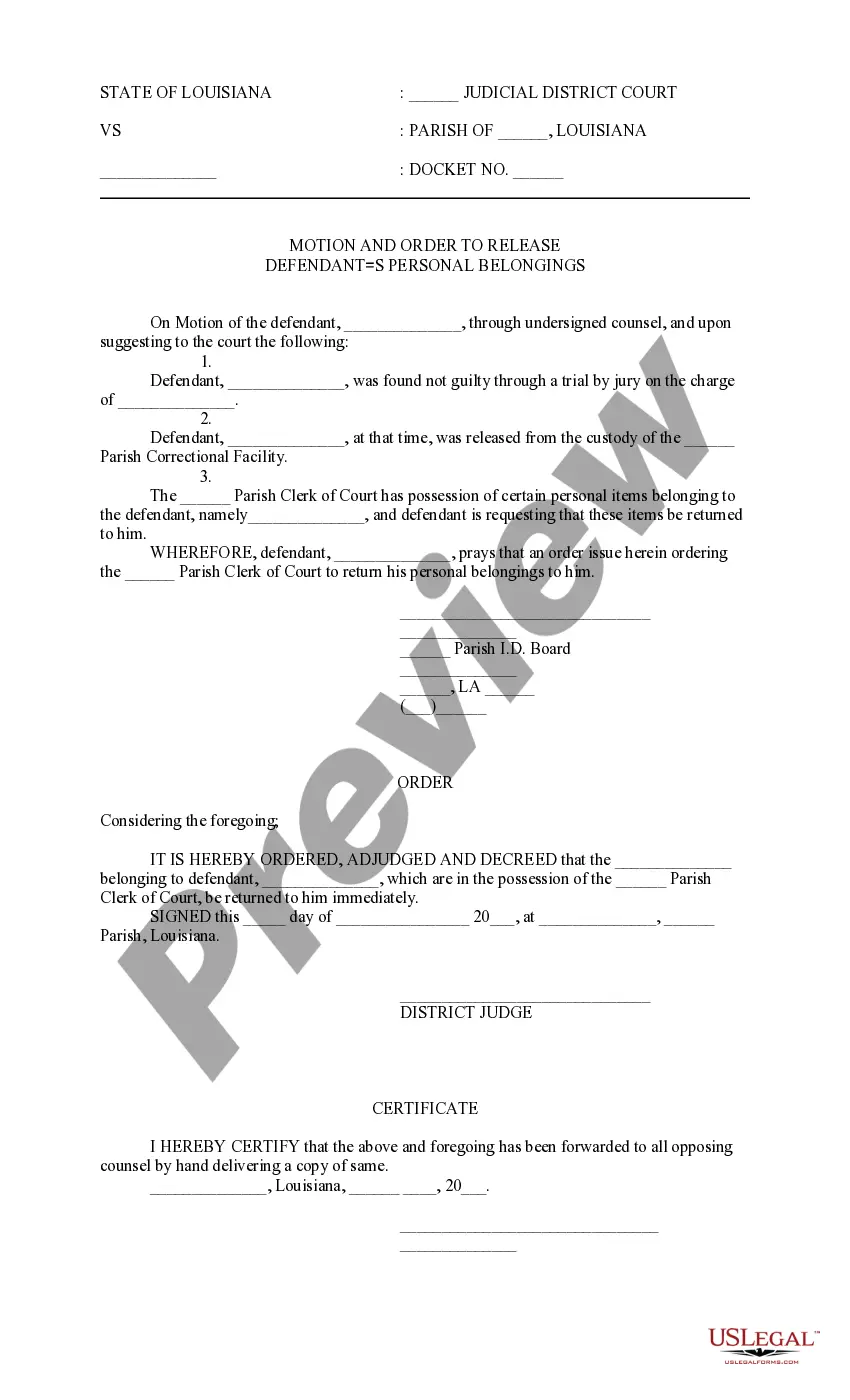
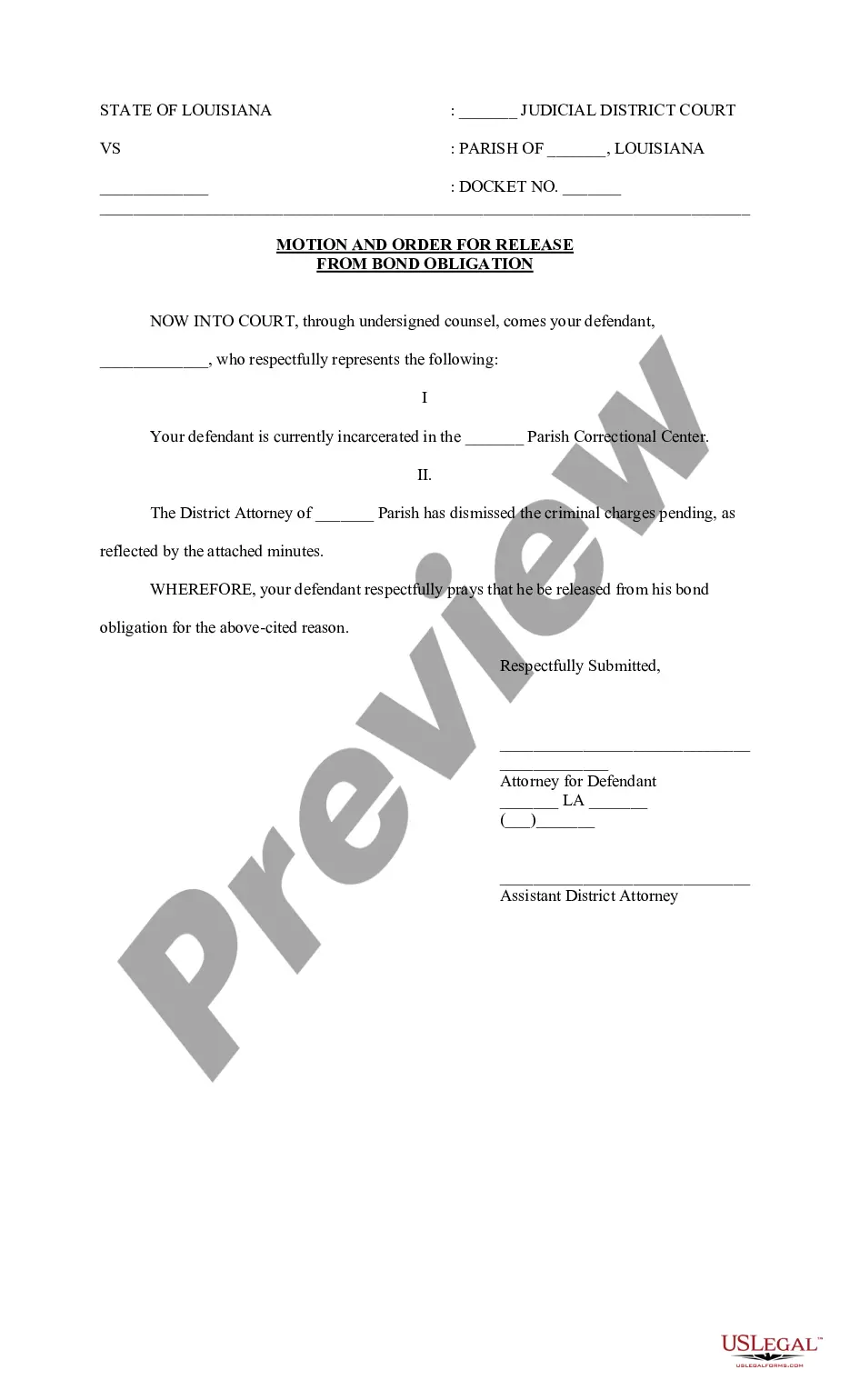
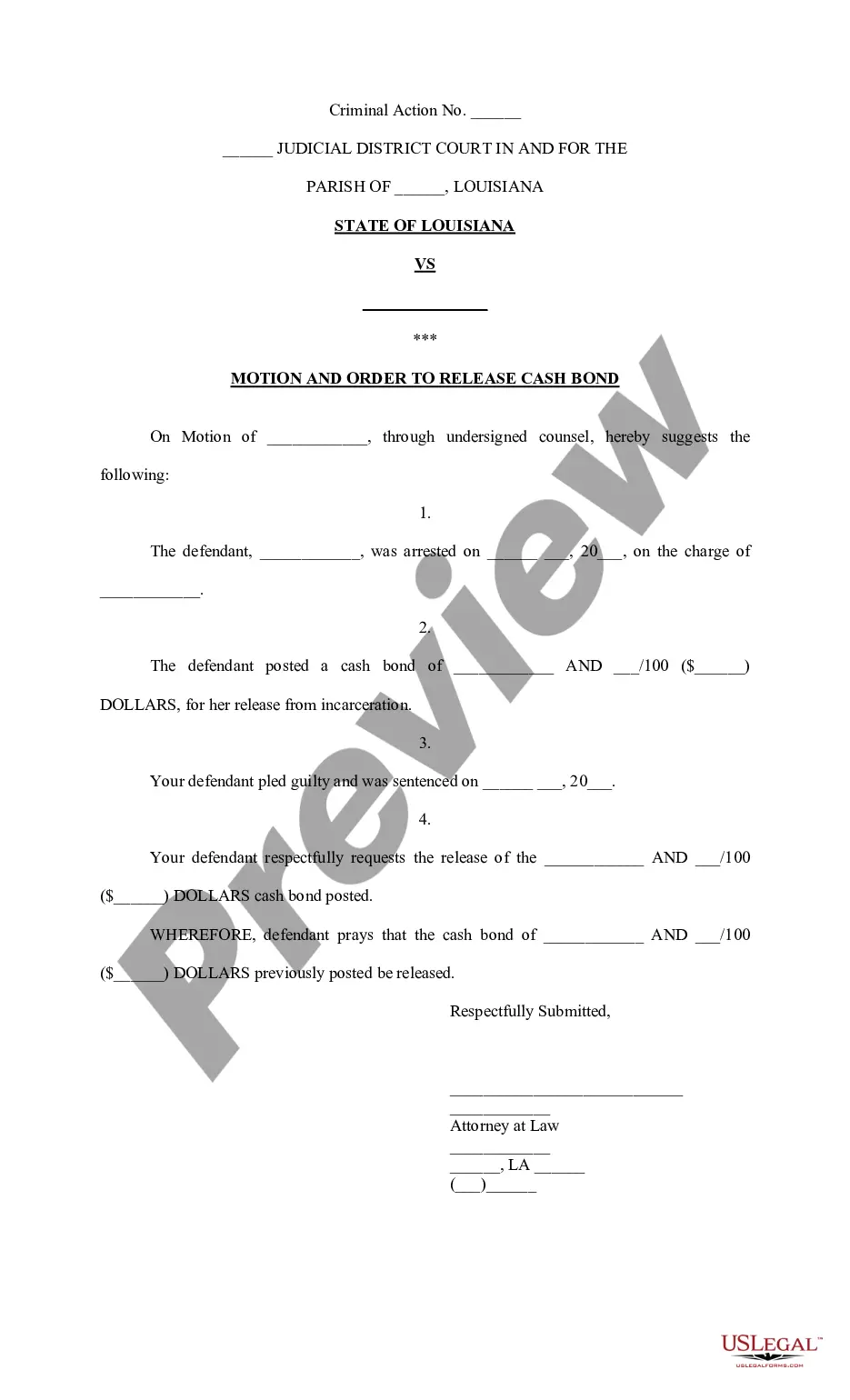
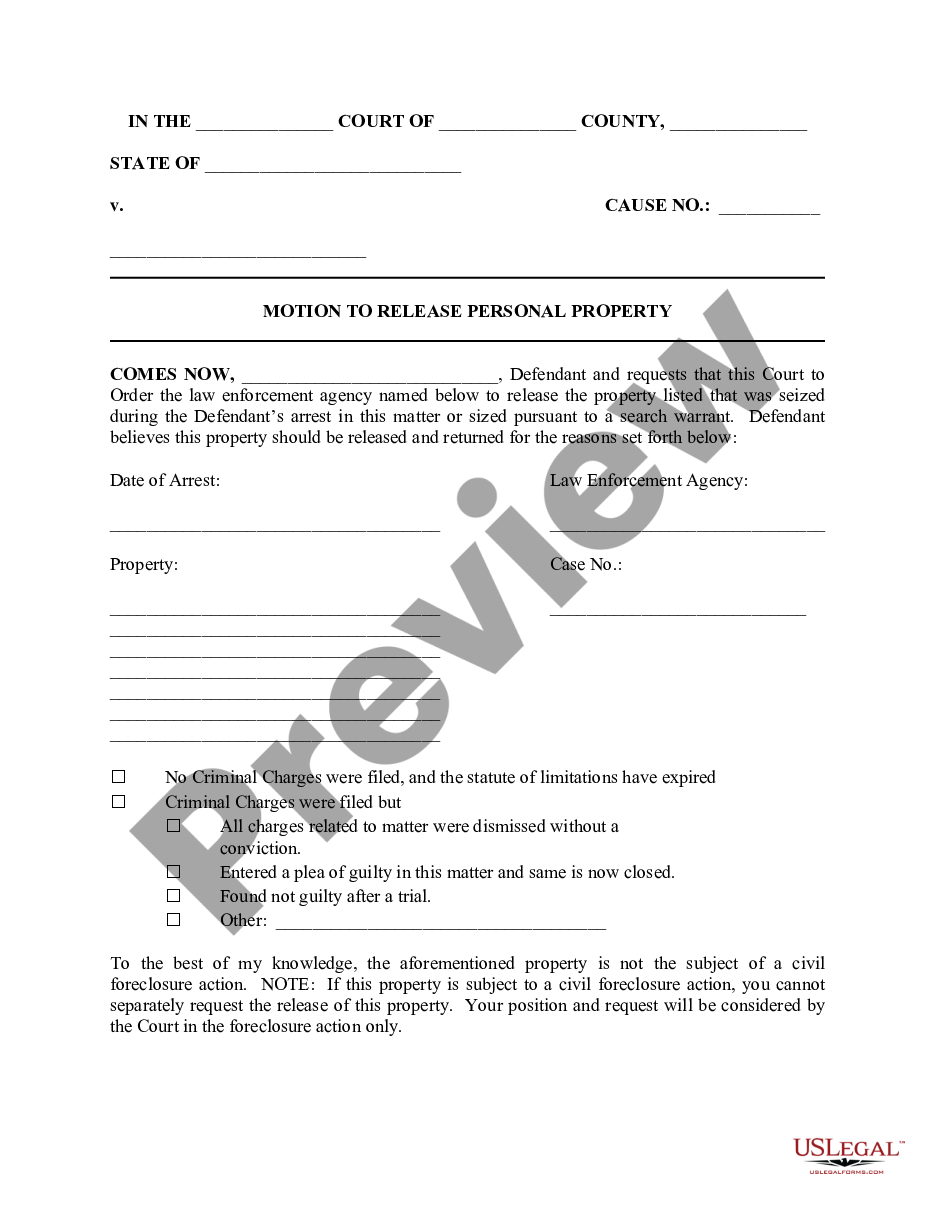
The Motion and Order to Release Defendant's Personal Belongings is a legal document that allows a defendant to request the return of personal items held by the court following an acquittal. This form is specifically designed for cases where the defendant was found not guilty after a jury trial and is no longer in custody. It streamlines the process of reclaiming belongings that may have been collected during legal proceedings, distinguishing it from general release forms or property claim forms.
Main sections of this form
- Defendant's name and the corresponding docket number.
- Statement of the not guilty verdict from the jury trial.
- Request for the return of specific personal items in the possession of the Clerk of Court.
- Prayer for relief, asking the court to issue an order for the return of belongings.
- Signature lines for the defendant and the district judge.
When this form is needed
This form should be used when a defendant has been acquitted of charges and wishes to retrieve personal belongings that were seized or retained by the court. It is particularly relevant in cases where the defendant has completed their legal obligations and requires their items for personal, financial, or residential reasons after their release.
Who this form is for
- Defendants who have received a not guilty verdict in a jury trial.
- Individuals seeking the return of personal property held by the court.
- Defense attorneys assisting clients in recovering personal belongings.
Completing this form step by step
- Enter the case details, including the defendant's name and docket number.
- Provide a clear statement affirming the verdict of not guilty.
- Specify the personal items you are requesting to be returned.
- Sign the motion as the defendant or have your attorney sign on your behalf.
- File the form with the appropriate court and ensure a copy is provided to all opposing counsel.
Notarization requirements for this form
This form usually doesn’t need to be notarized. However, local laws or specific transactions may require it. Our online notarization service, powered by Notarize, lets you complete it remotely through a secure video session, available 24/7.
Get your form ready online
Our built-in tools help you complete, sign, share, and store your documents in one place.
Make edits, fill in missing information, and update formatting in US Legal Forms—just like you would in MS Word.
Download a copy, print it, send it by email, or mail it via USPS—whatever works best for your next step.
Sign and collect signatures with our SignNow integration. Send to multiple recipients, set reminders, and more. Go Premium to unlock E-Sign.
If this form requires notarization, complete it online through a secure video call—no need to meet a notary in person or wait for an appointment.
We protect your documents and personal data by following strict security and privacy standards.

Make edits, fill in missing information, and update formatting in US Legal Forms—just like you would in MS Word.

Download a copy, print it, send it by email, or mail it via USPS—whatever works best for your next step.

Sign and collect signatures with our SignNow integration. Send to multiple recipients, set reminders, and more. Go Premium to unlock E-Sign.

If this form requires notarization, complete it online through a secure video call—no need to meet a notary in person or wait for an appointment.

We protect your documents and personal data by following strict security and privacy standards.
Avoid these common issues
- Failing to include the docket number, which can delay processing.
- Not specifying the exact personal items being requested.
- Omitting signatures or necessary dates before submission.
- Inaccuracies in personal information, such as name spelling or identification.
Benefits of using this form online
- Convenience of filling out the form from home without needing to visit a legal office.
- Editable fields allow for corrections before submission.
- Access to professionally drafted templates that adhere to legal standards.
- Quick download and easy printing options for physical filing.
Looking for another form?
Form popularity
FAQ
Read all of the paperwork that you receive from the court. Return the vehicle immediately to the rightful owner. Show proof of ownership if you want to dispute the claim. Speak with a licensed attorney in your area.
Generally, the petition is filed in a civil district court in the parish in which the interdict is domiciled (permanent home). If the defendant does not have a permanent home, the petition is filed where he resides or where he is physically present if he is not a resident of the state.
A "motion" is simply a formal request to a court that it do something or decide an issue in favor of the party that asks for it. "Granted" means the court agreed with the request, and did or decided in favor of the requester.
When you file your motion, the court clerk will insert the date, time, and place of the hearing on your motion. You must then serve (mail) a copy of your filed motion (including all exhibits and the date, time, and place of hearing) to all other parties in the case.
A motion is an application to the court made by the prosecutor or defense attorney, requesting that the court make a decision on a certain issue before the trial begins. The motion can affect the trial, courtroom, defendants, evidence, or testimony. Only judges decide the outcome of motions.
One option you have, aside from filing an answer and raising a valid defense to the request to replevin, is to file for bankruptcy. A bankruptcy action will stop a pending replevin request, and will also help you to get the rest of your finances in order.
A hearing for the purpose of asking a judge to issue a ruling or order. The motion is typically filed by one side and a notice is sent to the opposing attorney who responds in writing.
Generally speaking, a MOTION, is a request made to the Court to take some specified action or to compell a party to take some specified action, whereas an ORDER is the decree or decision of the Court.
A. A curator is the person appointed by the court to care for the interdicted person or his affairs, make decisions for the interdicted person, or to act in the place of the interdicted person.