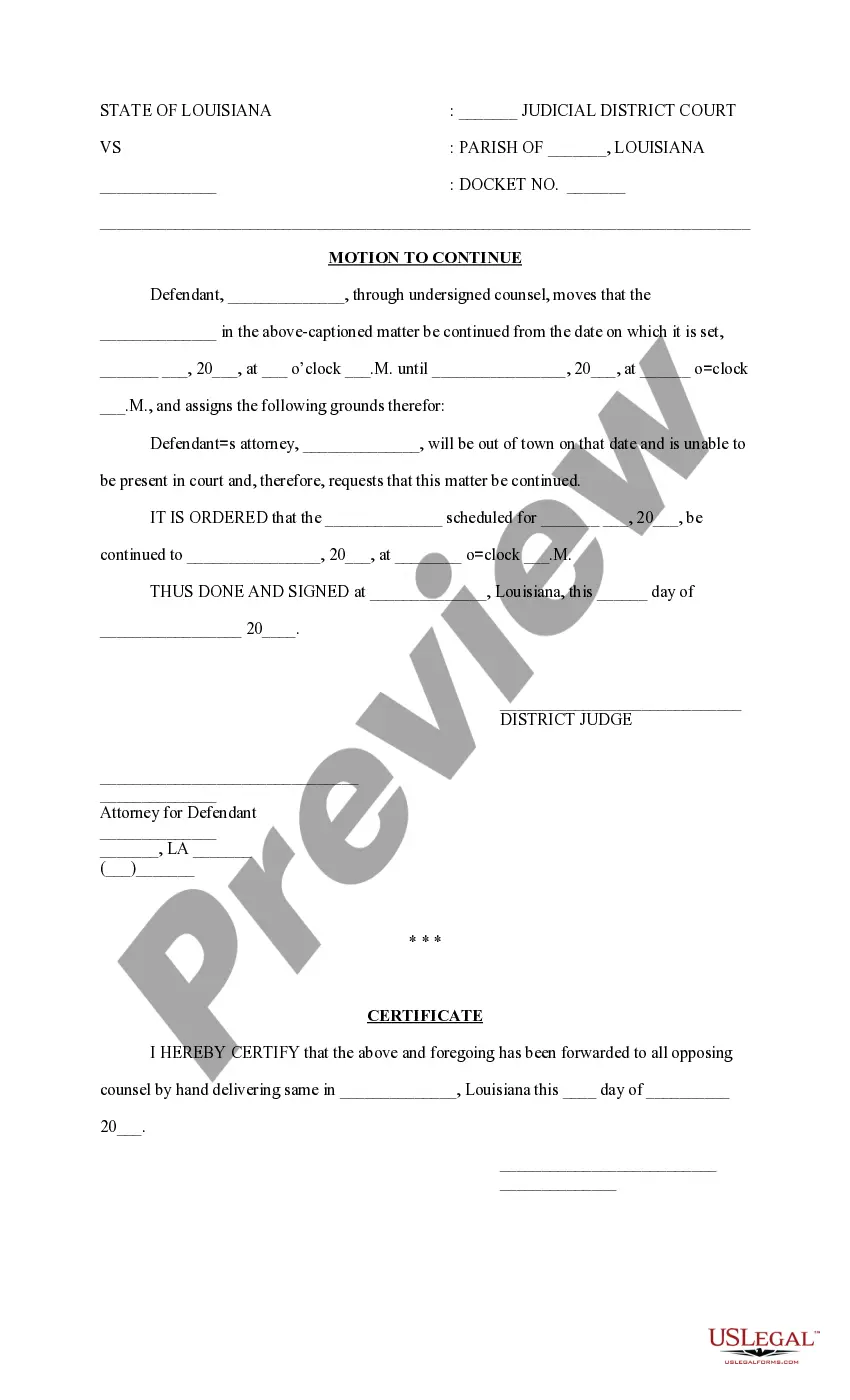
Louisiana Motion to Continue due to Attorney being out of town, and Order
About this form
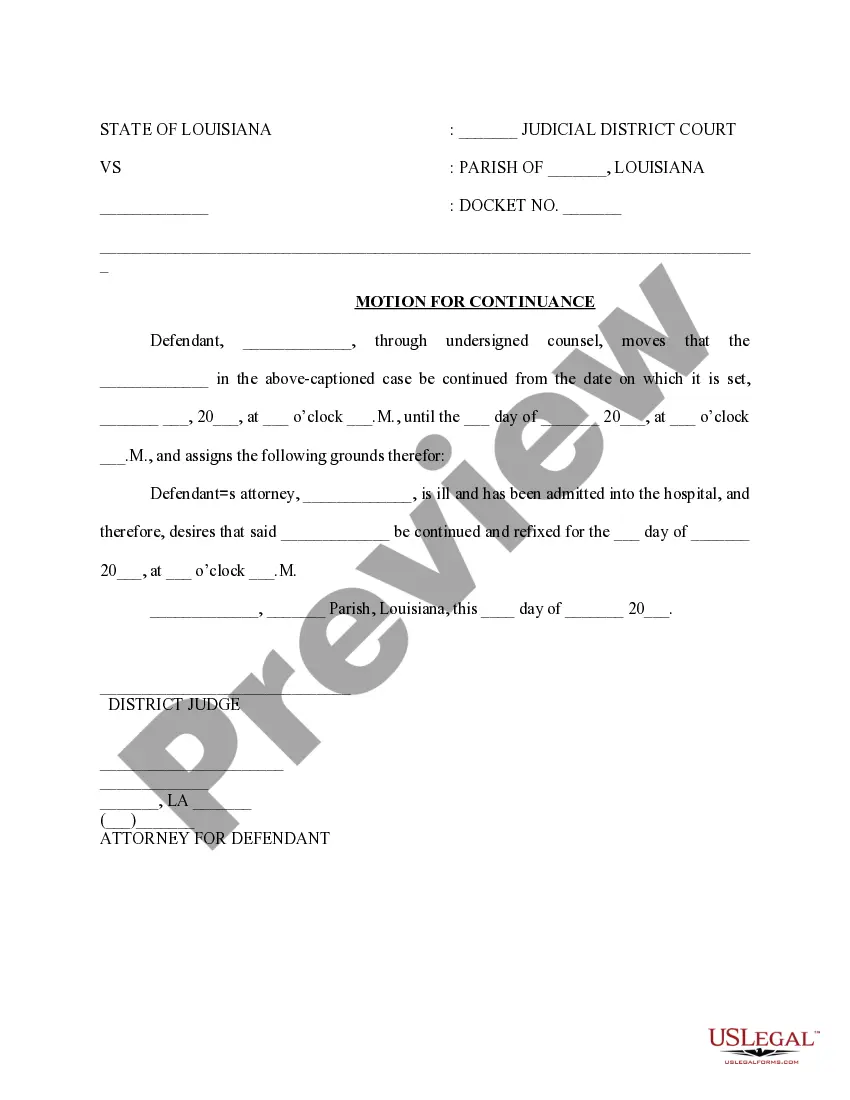
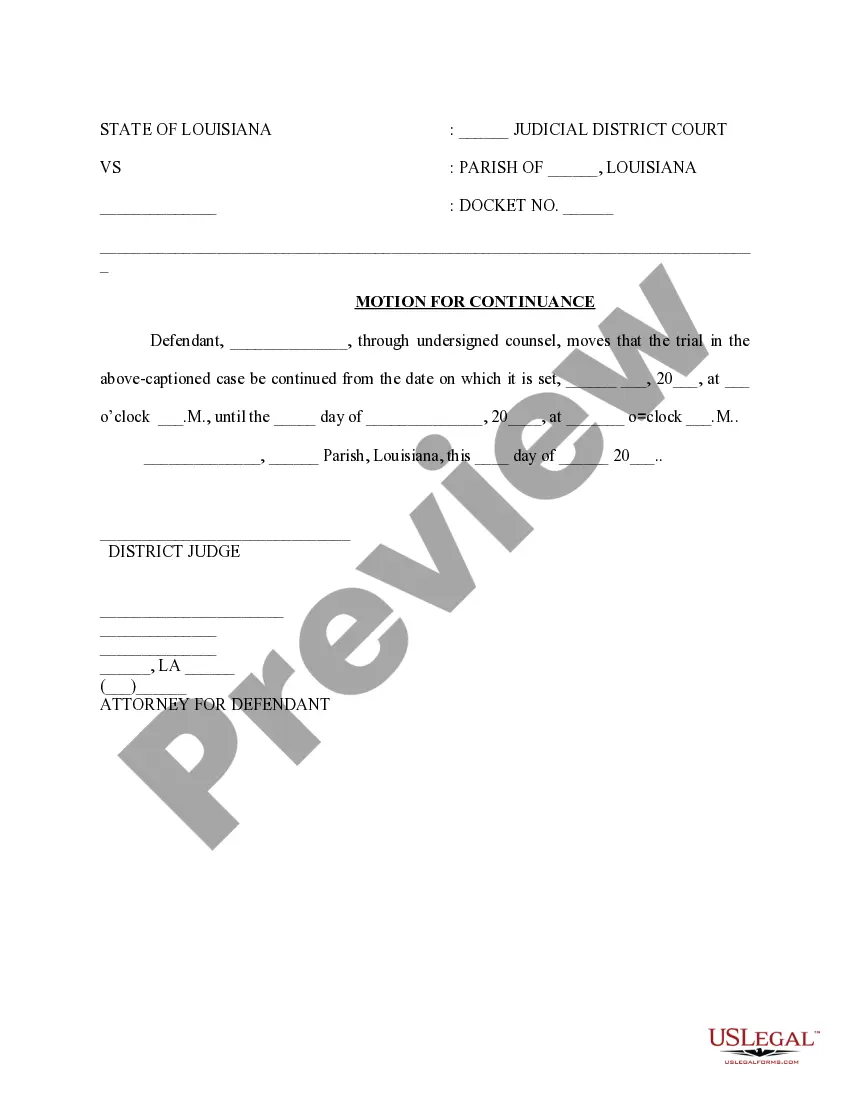
The Motion to Continue due to Attorney being out of town, and Order is a legal document used to request a rescheduling of a court proceeding. This form specifically addresses situations where the defense attorney cannot attend a scheduled hearing or trial due to being out of town. By submitting this motion, the attorney seeks to postpone the court date, ensuring that the defendant is adequately represented. It is crucial to differentiate this motion from other types of motions for continuance, which may be based on different grounds.
What’s included in this form
- Case details including the parish, docket number, and names of the parties involved.
- Date and time of the originally scheduled proceeding.
- New proposed date and time for the court proceeding.
- Statement of the grounds for the motion, specifically noting the attorney's absence.
- Signature block for the district judge granting the motion.
- Certificate of service to confirm that opposing counsel has been notified.
When to use this document
This form should be used when a court hearing or trial is scheduled, but the defense attorney cannot attend due to being out of town. It is applicable in instances where timely notice is provided, and a valid reason for the continuance is established. For example, if a crucial meeting or appointment conflicts with the court date, this motion can help prevent negative consequences for the defendant, such as losing the opportunity to adequately present their case.
Who needs this form
- Defense attorneys representing clients in court cases.
- Defendants seeking to delay a court proceeding due to their attorney's absence.
- Individuals involved in legal proceedings where a scheduled hearing or trial needs to be rescheduled.
Instructions for completing this form
- Identify the parties involved in the case and fill in the case details, including the parish and docket number.
- Specify the original date and time of the court proceeding that you wish to postpone.
- Provide a new proposed date and time for the hearing or trial.
- Clearly state the reason for the request, focusing on the absence of the defense attorney.
- Sign the form where indicated and ensure the district judge's signature section is left blank for the court's completion.
- Complete the certificate of service to confirm that all opposing counsels have been notified of the motion.
Does this form need to be notarized?
This form does not typically require notarization unless specified by local law. It is important to ensure that all signatures are properly executed to validate the motion prior to submission to the court.
Get your form ready online
Our built-in tools help you complete, sign, share, and store your documents in one place.
Make edits, fill in missing information, and update formatting in US Legal Forms—just like you would in MS Word.
Download a copy, print it, send it by email, or mail it via USPS—whatever works best for your next step.
Sign and collect signatures with our SignNow integration. Send to multiple recipients, set reminders, and more. Go Premium to unlock E-Sign.
If this form requires notarization, complete it online through a secure video call—no need to meet a notary in person or wait for an appointment.
We protect your documents and personal data by following strict security and privacy standards.

Make edits, fill in missing information, and update formatting in US Legal Forms—just like you would in MS Word.

Download a copy, print it, send it by email, or mail it via USPS—whatever works best for your next step.

Sign and collect signatures with our SignNow integration. Send to multiple recipients, set reminders, and more. Go Premium to unlock E-Sign.

If this form requires notarization, complete it online through a secure video call—no need to meet a notary in person or wait for an appointment.

We protect your documents and personal data by following strict security and privacy standards.
Mistakes to watch out for
- Failing to notify opposing counsel of the motion before filing.
- Not providing a valid reason for the continuance.
- Incorrectly completing the date and time fields.
- Omitting required signatures from the attorney or the judge.
Why complete this form online
- Convenience of completing the form from anywhere, at any time.
- Editable format allows for easy customization to fit your case.
- Access to templates drafted by licensed attorneys, ensuring reliability.
Legal use & context
- The Motion to Continue is a formal request recognized by courts to ensure fair legal representation.
- Granting of this motion is at the discretion of the judge and necessitates a valid reason.
- A properly filed motion can prevent potential legal consequences of failing to appear in court.
Summary of main points
- Use this form to request a delay in court proceedings due to an attorney's absence.
- Ensure all necessary parties are notified and required fields are completed correctly.
- Check state-specific rules for submitting motions to ensure compliance.
Looking for another form?
Form popularity
FAQ
To achieve a change of venue, defendants typically have to show a reasonable likelihood that they can't receive a fair trial.Other reasons for a change of venue include: a judge who is prejudiced against the defendant, and. in capital cases, a jury pool that's predisposed for or against the death penalty.
Take your completed Form SC-150 or letter to the clerk's office. Ask the clerk to attach it to your file. Or go to your trial and ask the judge for a postponement (or continuance). In your Form SC-150 or letter, give the judge a good reason why you are filing your request late.
A continuance in a criminal trial is a formal delay of the trial that can be requested by either side, before or during the trial.Requesting a continuance and receiving one are two very different things; it is important to have a good reason behind the request because it is a good reason the judge will expect.
The rule of reason applies to postponing a court date. If the justification is reasonable, related to trial preparation, your health or that of a family member, or a matter of some importance scheduled before the court date was set, the judge will likely have no problem with a request for postponement.
A continuance is a grant of additional preparation time before or during a trial. Either the prosecution or the defense can request a continuance, and sometimes even the court can order a continuance of its own accord.
When an attorney requests a change of venue, the attorney is asking: the Court of Appeals for the District of Columbia.
You can file a written response to the Motion to Continue, calling it something like an "Objection" or "Opposition." This MAY prevent the Court from entering a continuance without a hearing...
Continuances Based on Inadequate Time. Perhaps the most common reason for a continuance is when one side did not have enough time to investigate the case and analyze the evidence. Continuances Based on Changing the Indictment or Attorney. Continuances Based on Surprises.
A continuance can be asked for as many times as someone might wish. Whether the judge grants is going to be based on the type of case, the rationale for the request, and the particular judge's general stance on continuances.