Louisiana Motion and Order to Amend Sentence - Concurrent Federal Conviction
About this form
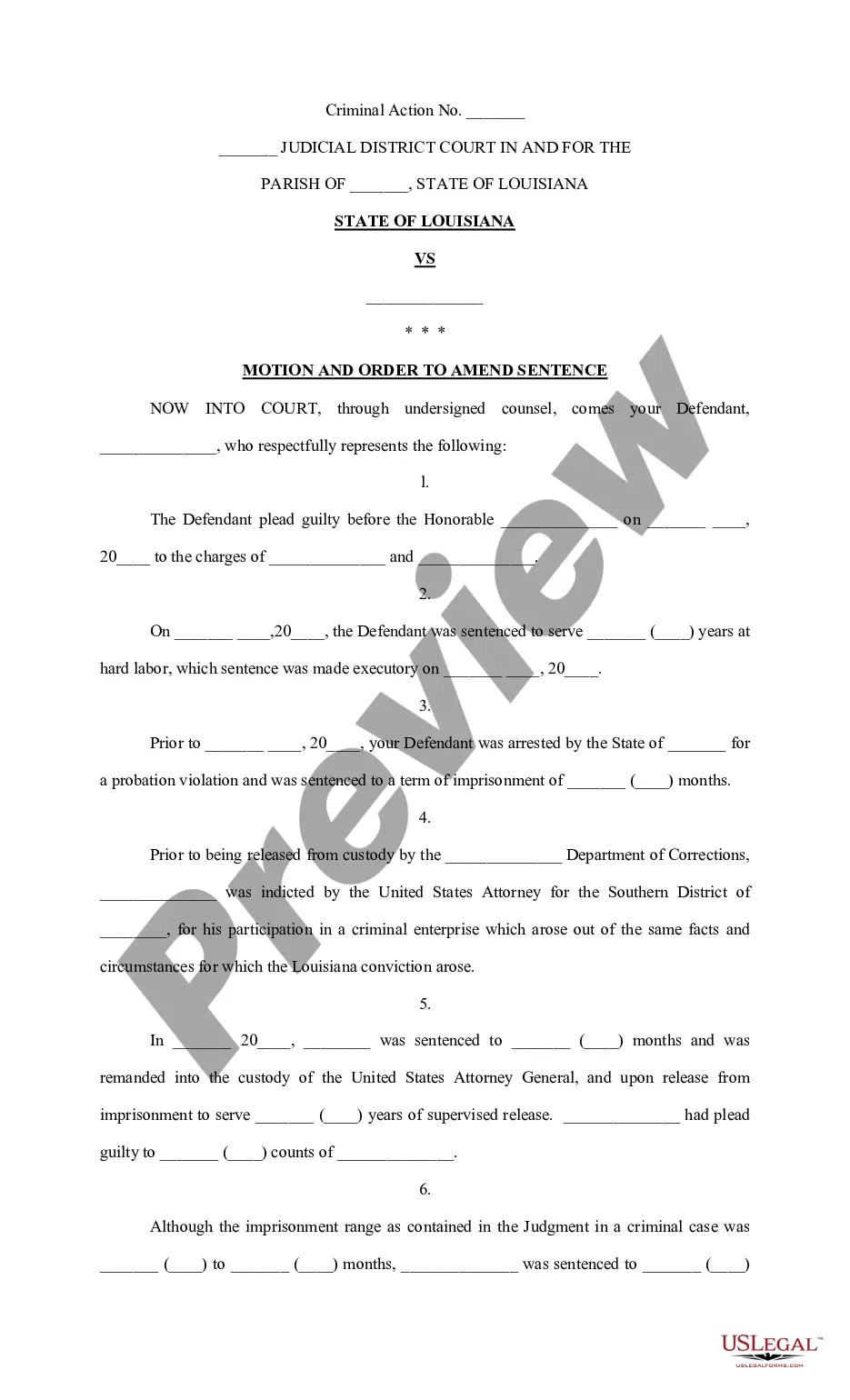
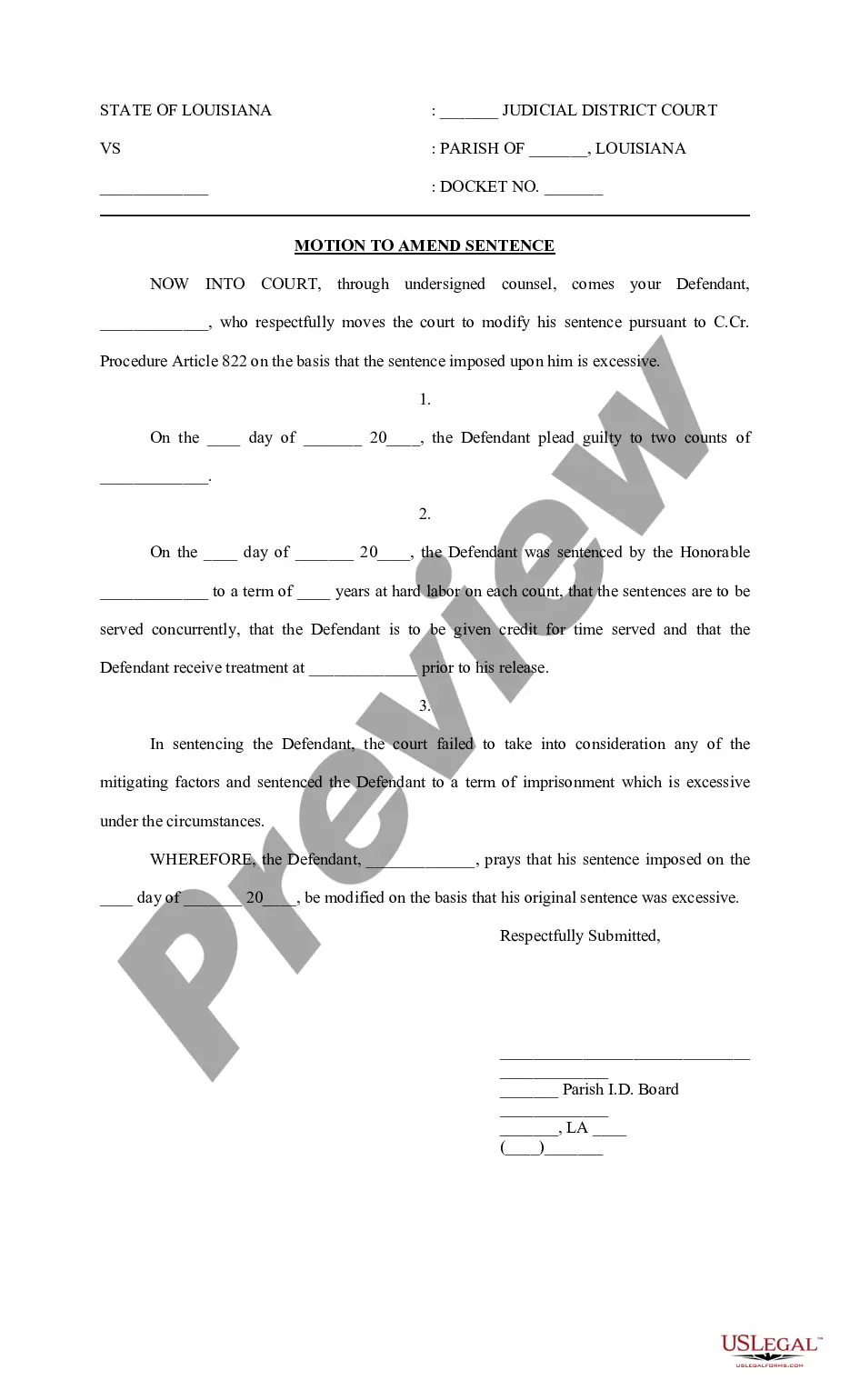
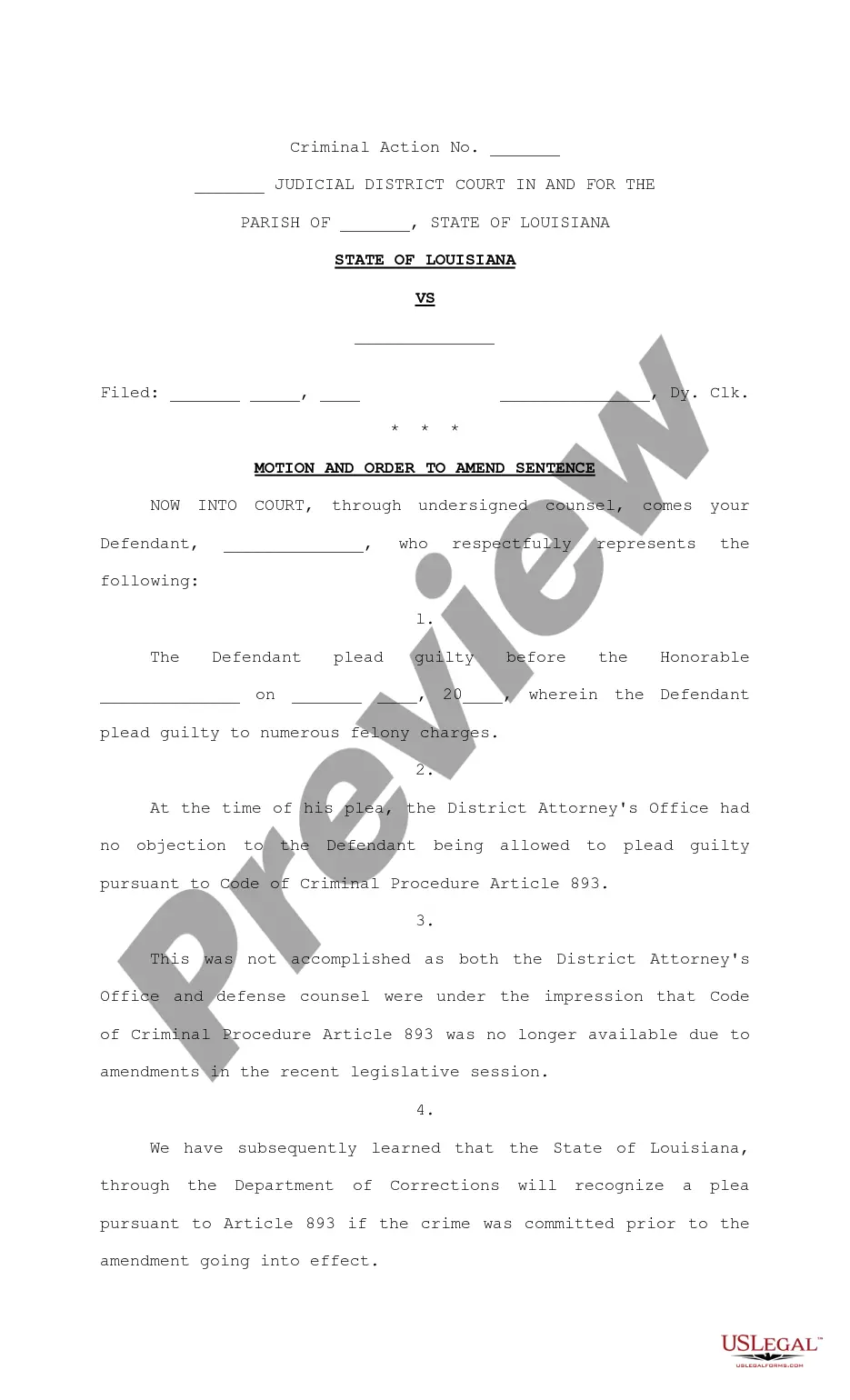
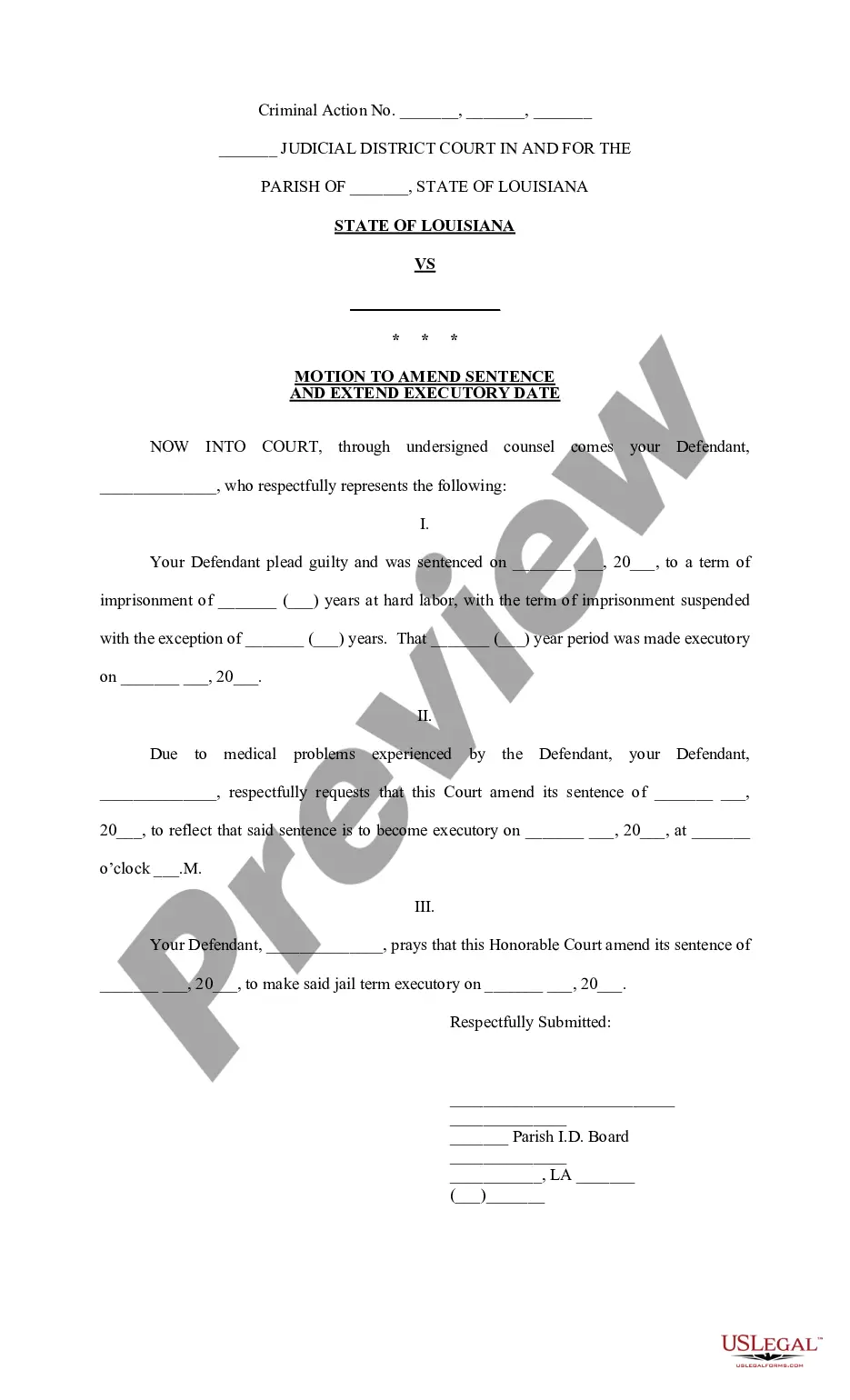
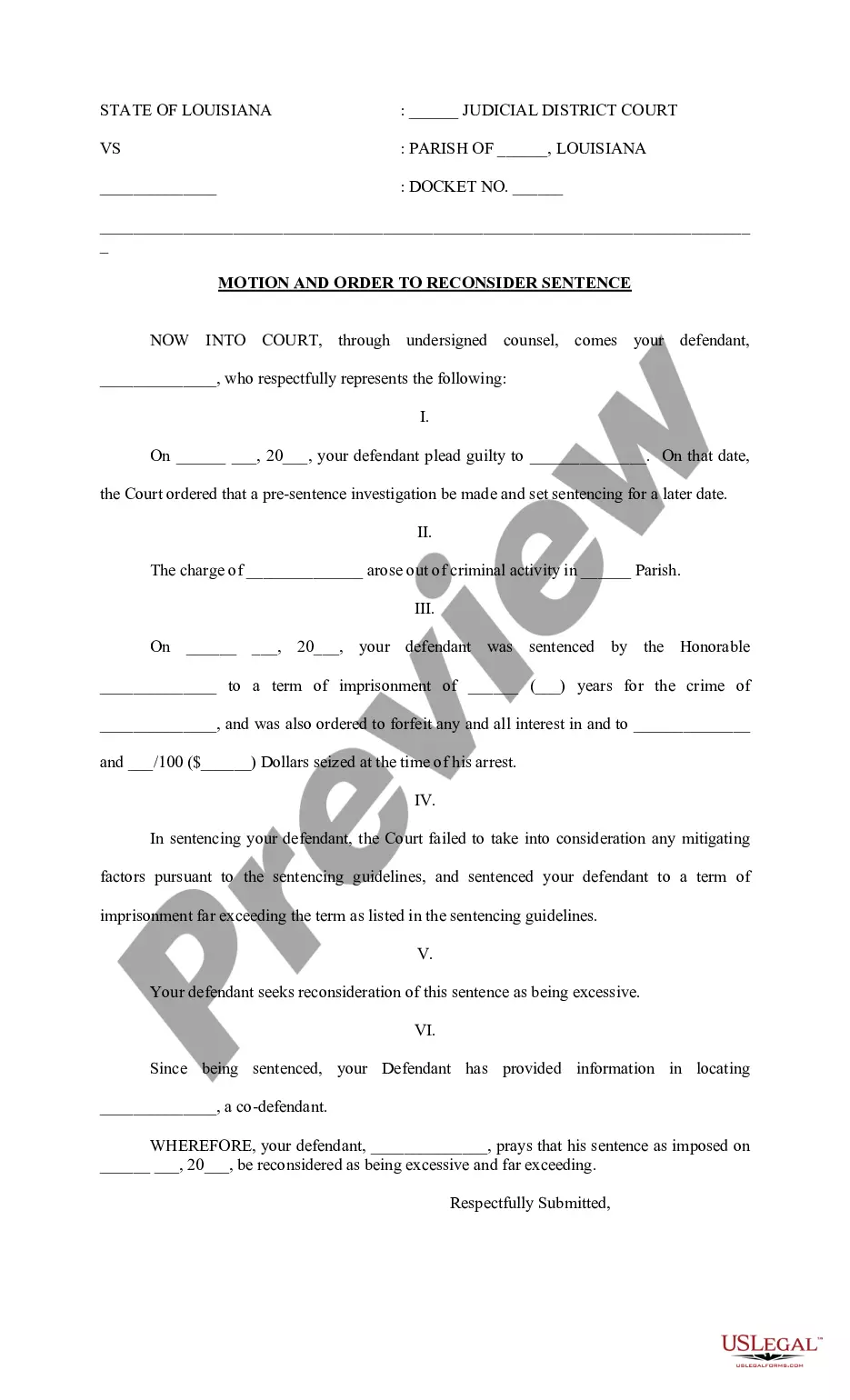
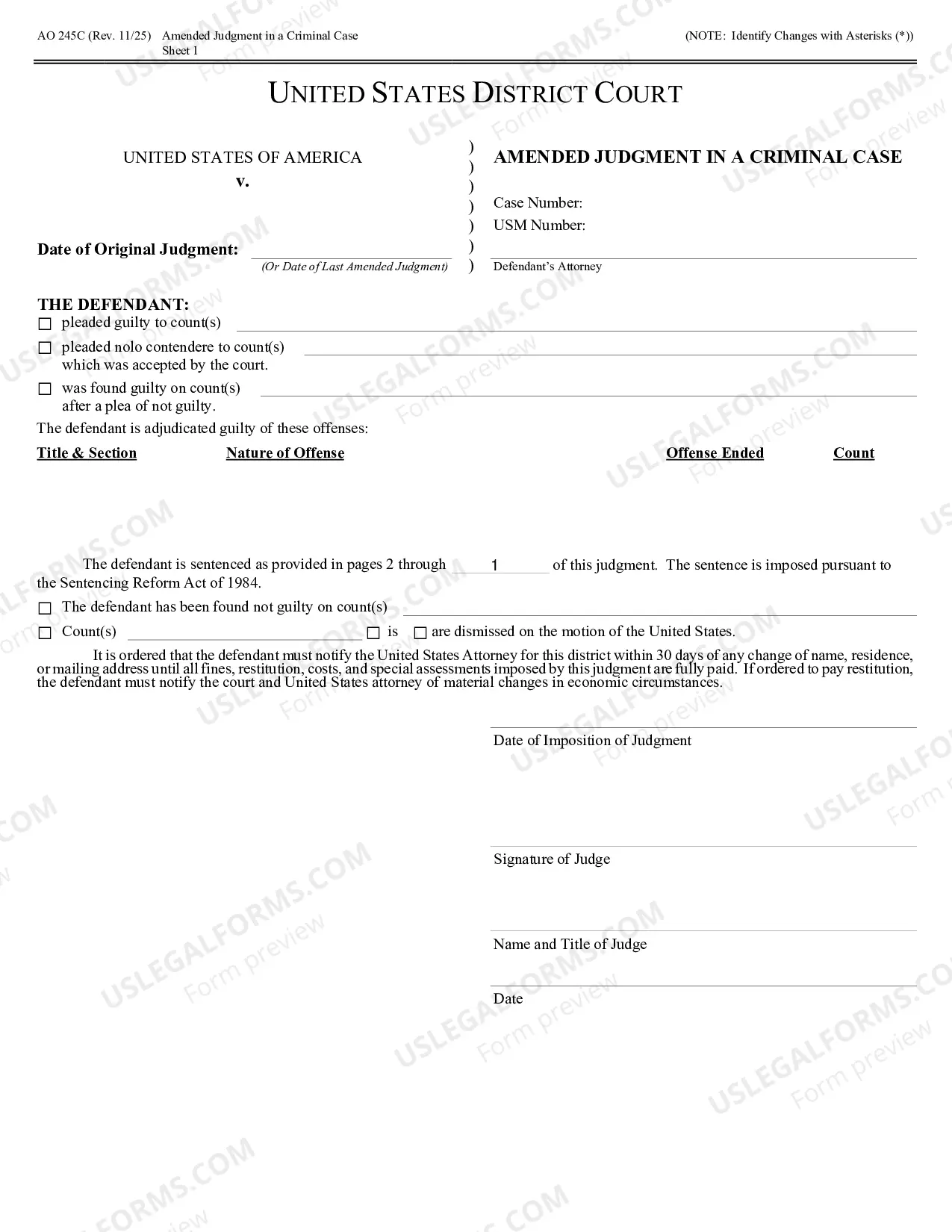
The Motion and Order to Amend Sentence - Concurrent Federal Conviction is a legal document used to request that a sentence imposed by a Louisiana court be amended. This motion specifically seeks to allow the defendant to serve their state sentence concurrently with an existing federal sentence. Additionally, it requests the court to grant credit for time served in federal custody. This form differs from other sentencing motions because it focuses on aligning state and federal sentences to streamline the defendant's incarceration period.
Key parts of this document
- Identification of the court and parties involved.
- Statement of the defendant's guilty plea and sentencing details.
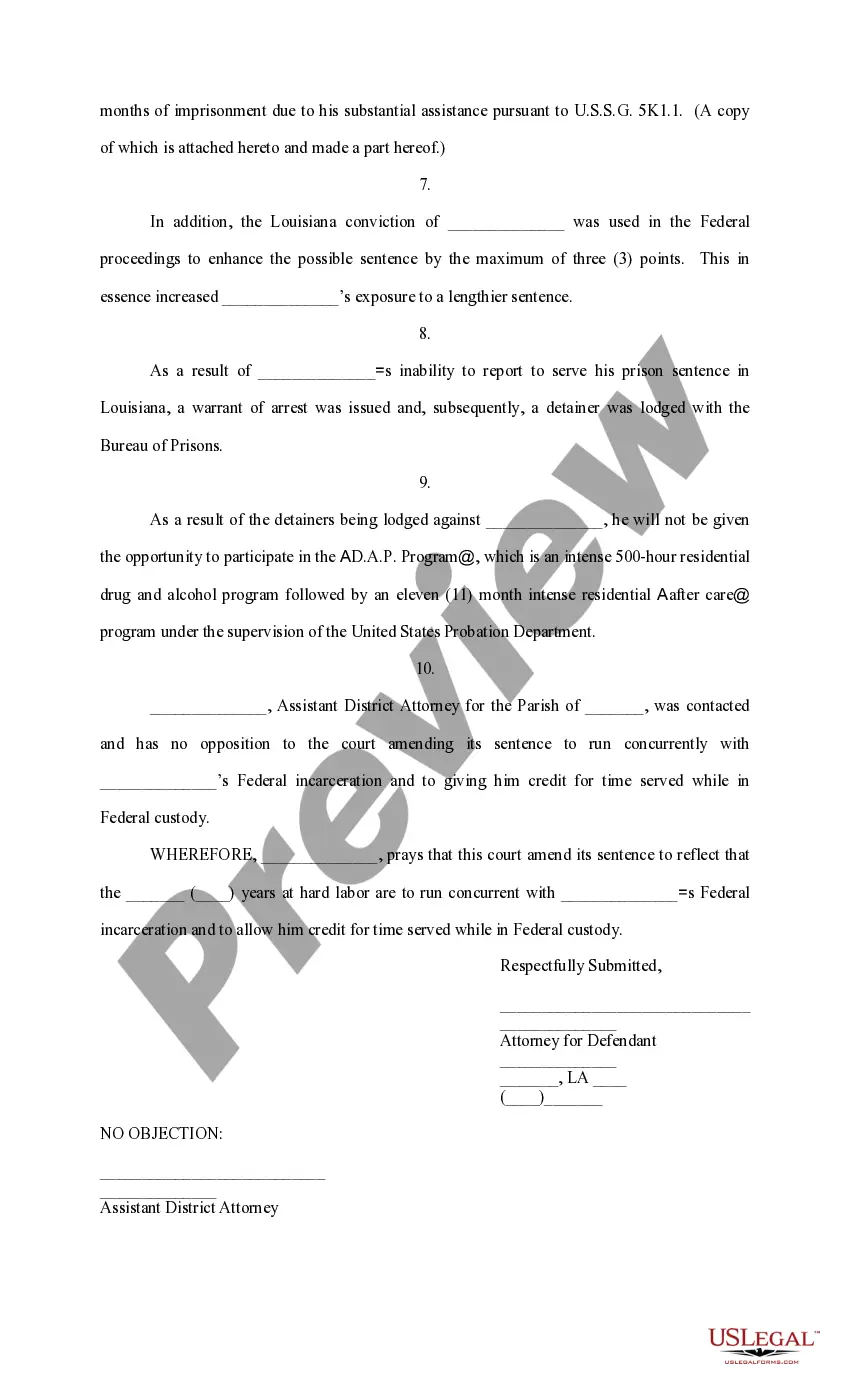
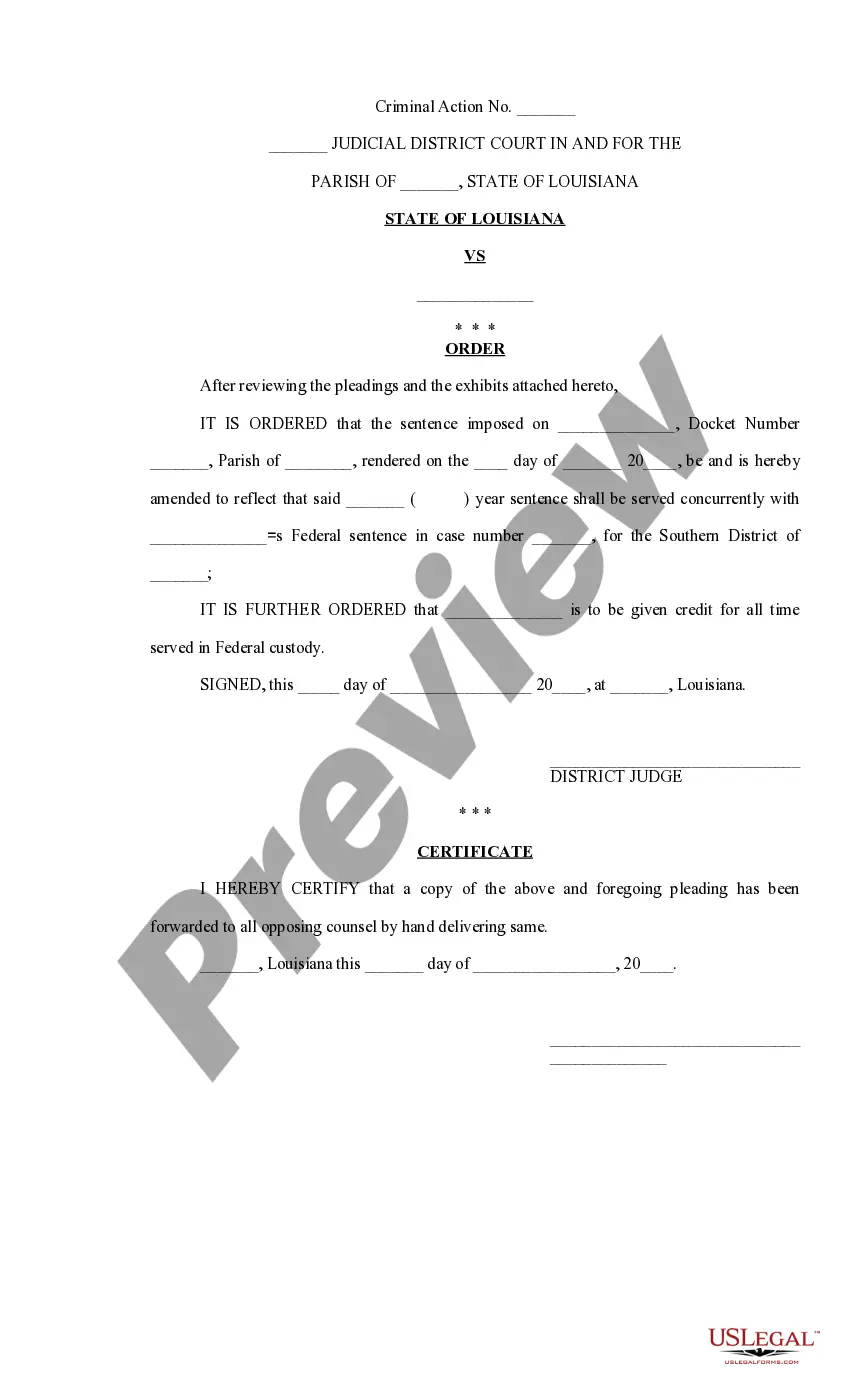
- Request to amend the state sentence to run concurrently with the federal sentence.
- Details on prior incarceration and charges related to federal convictions.
- Statement of agreement from the Assistant District Attorney regarding the amendment of the sentence.
- Order for the court's approval and signature line for the judge.
When to use this document
This form should be used when a defendant wishes to modify a state court sentence to run concurrently with a federal sentence. It is particularly relevant for those who have been sentenced in both jurisdictions and wish to avoid serving prolonged time in custody due to the overlap in sentences. Situations may include a defendant who has completed a federal sentence but still has outstanding state time to serve, or those seeking credit for time previously served in federal custody.
Who should use this form
- Defendants who have been convicted in a Louisiana state court and are also serving a federal sentence.
- Individuals who wish to amend their state sentence to reflect time served in federal custody.
- Defense attorneys representing clients in need of concurrent sentencing arrangements.
Completing this form step by step
- Fill in the names of the parties and the court where the motion is filed.
- Provide details of the guilty plea, including the date and charges.
- Specify the original state sentence and the federal sentence lengths.
- Include any relevant information regarding time served in both federal and state custody.
- Obtain the signature of the defense attorney and the Assistant District Attorney, if applicable.
- File the completed motion with the appropriate court and ensure copies are served to all opposing counsel.
Is notarization required?
Notarization is not commonly needed for this form. However, certain documents or local rules may make it necessary. Our notarization service, powered by Notarize, allows you to finalize it securely online anytime, day or night.
Get your form ready online
Our built-in tools help you complete, sign, share, and store your documents in one place.
Make edits, fill in missing information, and update formatting in US Legal Forms—just like you would in MS Word.
Download a copy, print it, send it by email, or mail it via USPS—whatever works best for your next step.
Sign and collect signatures with our SignNow integration. Send to multiple recipients, set reminders, and more. Go Premium to unlock E-Sign.
If this form requires notarization, complete it online through a secure video call—no need to meet a notary in person or wait for an appointment.
We protect your documents and personal data by following strict security and privacy standards.

Make edits, fill in missing information, and update formatting in US Legal Forms—just like you would in MS Word.

Download a copy, print it, send it by email, or mail it via USPS—whatever works best for your next step.

Sign and collect signatures with our SignNow integration. Send to multiple recipients, set reminders, and more. Go Premium to unlock E-Sign.

If this form requires notarization, complete it online through a secure video call—no need to meet a notary in person or wait for an appointment.

We protect your documents and personal data by following strict security and privacy standards.
Common mistakes to avoid
- Failing to include all necessary details about prior convictions and sentences.
- Not obtaining required signatures or approval from the Assistant District Attorney.
- Submitting the motion to the incorrect court or jurisdiction.
- Overlooking deadlines for filing the motion.
Benefits of completing this form online
- Convenience of downloading and completing the form at your own pace.
- Editability allows users to customize the form to their specific situation.
- Access to reliable legal templates drafted by licensed attorneys ensures compliance with legal standards.
- No need for in-person visits, simplifying the process for those in custody or with limited mobility.
Looking for another form?
Form popularity
FAQ
Rule 9.9 in Louisiana primarily deals with the conditions under which a defendant may be eligible for parole. This rule outlines the necessary steps and requirements that must be followed. For those looking to adjust their status or sentencing, understanding these rules is essential, especially when contemplating a Louisiana Motion and Order to Amend Sentence - Concurrent Federal Conviction.
'Sentence imposed' in Louisiana refers to the punishment assigned to a defendant by the court following a conviction. This encompasses various penalties, including jail time, fines, or other forms of punishment. If you believe that the sentence imposed should be reconsidered, exploring a Louisiana Motion and Order to Amend Sentence - Concurrent Federal Conviction could be an effective avenue.
A motion to amend a judgment in Louisiana is a formal request to change a criminal sentence or judgment entered by the court. This motion becomes vital when seeking to adjust or modify the original sentence based on new evidence or other compelling reasons. When dealing with a concurrent federal conviction, you may find this tool useful in your Louisiana Motion and Order to Amend Sentence. It's important to seek legal guidance to correctly navigate this process.
General Mitigation. A federal judge can reduce a sentence if there is an existence of mitigating circumstances. Fast Track. The reduction in sentencing here is based on expeditiously pleading guilty. Duress and Coercion. Criminal History. Diminished Capacity. Aberrant Behavior. Substantial Assistance to the Government.
Typically, sentencing will take place ninety days after a guilty plea or guilty verdict. Prior to sentencing, the judge must calculate the applicable guidelines range. The Sentencing Guidelines are a set of rules which apply in federal sentencing.A more serious prior conviction will receive more points.
An amended sentence typically means that the court may have missed something in the sentencing order that was originally not put on the record.
Unfortunately, yes, a sentence can be changed or modified so long as the court has jurisdiction over the matter. When a person is on probation the court continues to have jurisdiction.
Federal sentence may be consecutive or concurrent to state term. Usual rule No prior custody credit on federal sentence for time credited towards state sentence.If federal sentence not specific, default under 18 U.S.C. § 3584 if sentence is consecutive.
Sentences that may all be served at the same time, with the longest period controlling, are concurrent sentences. Judges may sentence concurrently out of compassion, plea bargaining, or the fact that the several crimes are interrelated. When the sentences run one after the other, they are consecutive sentences.
A sentence imposed in a federal criminal case may also be reduced pursuant to 28 U.S.C. § 2255 when the sentence needs to be vacated, set aside, or corrected due to constitutional violations.